Saylor Creek Horses Get Short End of Stick

Earlier this week the BLM said that some of the wild horses at Saylor Creek HMA would be removed because there are too many of them.  Let’s take a look at the numbers.

The HMA covers 101,858 acres in southern Idaho.  The AML is 50, yielding an aimed-at population density of 0.5 wild horses per thousand acres (50 ÷ 101,858 × 1,000).

Saylor Creek HMA Map-1

The 50 horses allowed by plan would consume 600 AUMs annually, given they graze 12 months per year (50 × 12).

The 137 horses currently on the HMA consume 1,644 AUMs per year (137 × 12).

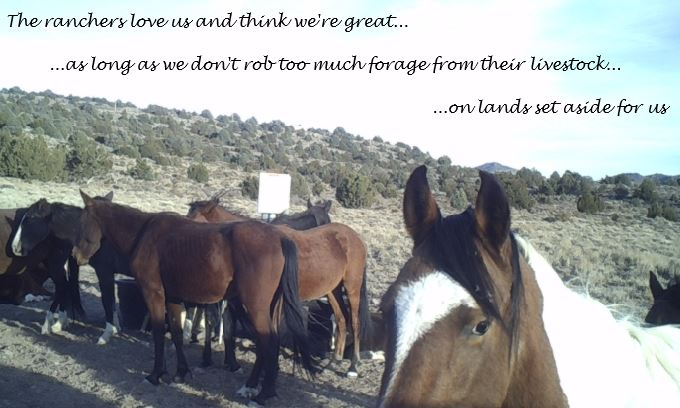
The HMA intersects eight grazing allotments, see Map 1 in the Final Environmental Assessment for the roundup (page 36)*.  Some allotments are 100% inside the HMA, others overlap partially.  None of the HMA is livestock-free.

Table 2 in Section 3.3 of the EA shows the grazing season and permitted AUMs for each allotment (page 17).

The allotments contribute forage to livestock according to their percentage in the HMA, assuming the resource is evenly distributed across the parcels.  For example, Black Mesa provides 785 AUMs per year because 78% of the land is inside the HMA (1,007 × .78).

The total forage allowed by plan for livestock inside the HMA is 11,193 AUMs per year, compared to 600 AUMs per year for wild horses.

The forage contributions can be converted to cow/calf pairs by dividing them by the number of months in their grazing seasons.  (Wild horses are said to be equivalent to cow/calf pairs in terms of their forage demand.)

The grazing season for Dove Springs is 8.5 months.  It is 100% inside the HMA, with 1,360 AUMs per year allowed by plan, yielding, 1,360 × 1 ÷ 8.5 = 160 cow/calf pairs in the HMA.

The total number of cow/calf pairs allowed in the HMA is 1,321, compared to 50 horses.

Saylor Creek Calcs-1

The average grazing season across the eight allotments is 8.5 months (11,193 ÷ 1,321).

The aimed-at population density for livestock inside the HMA is 1,321 ÷ 101,858 × 1,000 = 13 cow/calf pairs per thousand acres, compared to 0.5 wild horses per thousand acres.

These figures are displayed in the following charts.

Saylor Creek Charts-1

The roundup will come very close to achieving these goals.

Six of the allotments have been granted temporary increases in forage consumption, indicated as TNR AUMs in Table 2.  If those figures had been used in the calculations, the disparity between horses and cattle would be even greater.

Clearly, the land can support way more than 50 wild horses.  But the truth is masked by the deceit and greed of the public-lands ranchers and their allies in government.

*If you can’t view the map, click here.  BLM is aware of the problem.  If you can’t access the EA, click here.

Fifteenmile Roundup Begins Mid Month

BLM announced today that 600 wild horses will be removed from the Fifteenmile HMA in northern Wyoming beginning on or about October 17.

The operation, which will reduce the size of the herd by 85%, will be carried out with helicopters and will be open to public observation.

mccullough_peaks_hma_map-1

Captured animals will be taken to the BLM off-range corrals in Rock Springs.

Gather stats and daily reports will be posted to this page.

RELATED: Fifteenmile Roundup to Occur Later This Year.

Buffalo Hills / Granite Range Roundups Begin Next Week

BLM said yesterday that 100 wild horses and 175 wild burros would be removed from the HMAs starting on or about October 7.  The burros were found in the Buffalo Hills HMA, which is not managed for them (no AML).  The roundup will remove all of them.

The gather will be carried out with helicopters and will be open to public observation.

The Buffalo Hills HMA covers 131,861 acres in northwestern Nevada and has an AML of 314, for an aimed-at population density of 2.4 animals per thousand acres.

The Granite Range HMA, a few miles east of Buffalo Hills, covers 103,804 acres and has an AML of 258, for an aimed-at population density of 2.5 animals per thousand acres.

Buffalo Hills Granite Range HMA Map-1

The aimed-at population density across all HMAs is one animal per thousand acres.

Captured animals will be taken to the Litchfield Off-Range Corrals.

The Buffalo Hills HMA intersects one grazing allotment, according to Section 3.9 of the Final Environmental Assessment for the roundup (see page 48).

The same allotment intersects Granite Range but the full extent of livestock grazing on that HMA cannot be determined from the documents provided with the news release.

Livestock grazing in the area has been reduced slightly in recent years, with authorized AUMs running at approximately 90% of permitted AUMs.

Removal of wild horses and burros does not increase the permitted AUMs but can lead to relaxation of the curtailments.

Gather stats and daily reports will be posted to this page when the operation begins.

Senate Funding of ‘Path Forward’ in the News

Funding to carry out a sizeable chunk of the wild horse management plan, authorized last week by the Senate Committee on Appropriations, has ranchers celebrating and advocates fuming, according to an AP story posted today by KTLA News of Los Angeles.

The glorious ‘Path Forward,’ as it is known, will protect the animals from killing or sale to slaughter, according to the report, except that most of them will be removed from their home range (so they can be replaced with privately owned cattle and sheep).

Put them in sanctuaries or contracted pastures so they can live out their lives in segregated herds.  No families, no foals, no legacy.

RELATED: Who Added ‘Path Forward’ to Senate Spending Bill?

Who Added ‘Path Forward’ to Senate Spending Bill?

The legislation was drafted by the Subcommittee for Interior, Environment and Related Agencies and approved by the Senate Committee on Appropriations last week.  It still has to be put to a vote of the full Senate and be reconciled with the bill in the House.

The House authorized $6 million for a ‘Path Forward’ pilot program earlier this year.

The Senate authorized $35 million for the ‘Path Forward’ in FY 2020.

Almost all of the senators on the Subcommittee are liberals.  The two in the ‘minority’ are not paragons of conservatism (grades from Conservative Review).

  • Lisa Murkowski, Chair, R-AK, F
  • Tom Udall, Ranking Member, D-NM, F
  • Lamar Alexander, Member, R-TN, F
  • Roy Blunt, Member, R-MO, F
  • Mitch McConnell, Member, R-KY, F
  • Shelley Moore Capito, Member, R-WV, F
  • Cindy Hyde-Smith, Member, R-MS, F
  • Steve Daines, Member, R-MT, C
  • Marco Rubio, Member, R-FL, D
  • Dianne Feinstein, Member, D-CA, F
  • Patrick Leahy, Member, D-VT, F
  • Jack Reed, Member, D-RI, F
  • Jon Tester, Member, D-MT, F
  • Jeff Merkley, Member, D-OR, F
  • Chris Van Hollen, Member, D-MD, F

Look at the first page of the ‘Path Forward.’  There are no endorsements from oil companies, mining companies, timber companies.

So who on the Subcommittee is in bed with the public-lands ranchers?  Which senators would benefit from fewer wild horses in their state?

The BLM manages wild horses and burros in ten western states, while the Forest Service manages wild horses and burros in nine western states.

The demonic plan was not discussed in the Appropriations Committee meeting last week, even though the Bill for Interior contained a large expenditure for the new item.

You can listen to the audio here.  Remarks about the bill run from 30:37 to 43:30.

Apparently, the guilty parties don’t want to be identified.

Range Creek Gather in Progress

The roundup started yesterday, with 63 excess horses removed from their home range in eastern Utah.  No deaths were reported and body condition scores were 4’s, according to the daily report.  Public observation was not allowed because the operation was carried out on private land.  Observers were present at the temporary holding facility.

RELATED: Range Creek Gather This Month.

Cedar Island Herd to be Rebuilt

The remnant, following losses attributed to hurricane Dorian, includes thirteen mares and eight geldings—a non-starter for those unfamiliar with horses.

But one of the herd managers has a stallion in reserve, and he will be allowed to rejoin the herd in the spring, according to a story posted earlier today by the Carteret County News-Times of Morehead City, NC.

Although two other stallions are available in South Carolina, questions of inbreeding and genetic viability remain.

The Cedar Island herd was established about 25 years ago as a ‘backup’ for the herd at Shackleford Banks.

RELATED: Dorian Achieves Same Results as ‘Path Forward.’

IRRC Wins Stewardship Award

The Idaho Rangeland Resources Commission, the propaganda arm for public-lands ranching in the state, was recognized today by the BLM for involving students in rangeland education and policy formation.  The award was presented at the annual meeting of the Public Lands Council (another propaganda organ).

Also commended was their promotion of recreational activities involving livestock grazing, according to the news release.

RELATED: IRRC Expands Propaganda.