Short video from the Black Mountain HMA by John Hynek. Nice to see the youngster!
RELATED: PZP Zealots Target Black Mountain Burros.

Western Horse Watchers Association
Exposing the Hypocrisy, Lies and Incompetence of the Wild Horse Advocates
Short video from the Black Mountain HMA by John Hynek. Nice to see the youngster!
RELATED: PZP Zealots Target Black Mountain Burros.
What body condition scores would you assign to these Virginia Range mustangs?
The wild horse population density in this area is ten times higher than that set by the BLM for lands they manage.
Surely you’ll choose 1’s and 2’s, not because of what you see in the photos, but because of what you’ve been told by the PZP zealots and public-lands ranchers.
RELATED: Livestock Notably Absent.

The number of wild horses and burros in off-range corrals and long-term pastures can be explained by the misappropriation of forage on just a few dozen HMAs.
Half of those animals can be accounted for by the misuse of forage on 13 HMAs.
This 46-minute radio segment by KNPR of Las Vegas features J.J. Goicochea, Nevada state veterinarian and public-lands rancher, Greg Hendricks, director of field operations for American Wild Horse Campaign, and Celeste Carlisle, WHBAB member and science advisor for Return to Freedom. Listener comments included.
How can the ranchers fatten their cattle on lands where horses are starving?
RELATED: The ‘Path Forward’ is Wrong, Livestock Grazing in Nevada.
The population density on the Virginia Range is about ten wild horses per thousand acres, compared to an average of two or three wild horses per thousand acres on lands managed by the BLM. The aimed-at population density on those lands is one wild horse per thousand acres (to be achieved by the glorious ‘Path Forward’).
Why not ten on BLM lands? Because most of the forage has been assigned to privately owned livestock. That’s what drives the roundups and warehousing of wild horses.

The shooting occurred in the Lincoln National Forest so the case was turned over to the Forest Service, according to a report posted today by Ruidoso News.
The wild horses of Alto, NM were returned to their home range a year ago after a judge ruled that the state livestock board had taken them into custody illegally.
The incident follows the Clark Mountain wild burro shootings in California and Heber wild horse shootings in Arizona. No arrests have been made in those cases.
NPS said there were 22 males (29.3%) and 53 females (70.7%) on the Maryland side of the island in November, according to a story posted today by WMDT News of Salisbury.
The observed sex ratio of a wild horse herd will rarely be 50/50, but how far must it deviate from that value to indicate problems?
The answer must be found by calculation, using basic statistical formulas, where p-bar = .5 and n = 75. The range of variation between males and females attributable to natural causes is therefore .327 (32.7%) to .673 (67.3%).
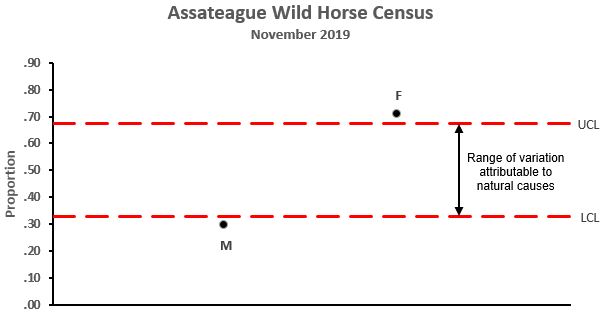
The observed proportions fall outside those limits, so an explanation should be sought.
If the observed proportions fell inside the limits, there would be no clear indication of trouble and an investigation would be a waste of time. The herd would be treated as if its sex ratio was 50/50, even though the observed value was, say, 38/62.
A teenager from Lexington Park has sponsored every one of the wild horses on the Maryland side of the island. Refer to this story, published today by Southern Living.
Now, can she find out why the sex ratio of the herd is skewed in favor of females?
At the end of the public comments in last week’s meeting of the WHBAB, the Chair admonished the Board about discussing the ill-conceived management plan for wild horses and burros:
“I want to make this perfectly clear that the BLM Wild Horse and Burro Advisory Board is not part of, has not and do not plan to discuss the Path Forward plan that had been mentioned so many times here. It was not presented to the board. It was not presented to BLM. It was presented to Congress. And it’s up to Congress to act on it, not this board. And we will not talk about it.”
Yet the Board’s recommendations to the BLM are nearly identical to those in the plan, according to a story by United Press International. The number of wild horses and burros on western rangelands must be drastically reduced, with more roundups, more adoptions and something new: Sterilization.
The population target stated in the report—26,715—does not represent the number of wild horses and burros the land can support—it’s not even close—but rather the forage loss the government and its ranching cronies are willing to tolerate.
Whenever you see references in an article to ‘humane management,’ ‘healthy horses’ and ‘healthy rangelands,’ you know you’re being lied to.
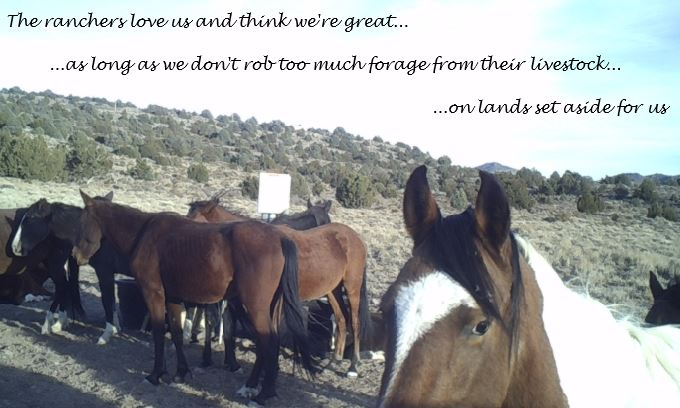
Refer to this story by the Daily Miner of Kingman, AZ. If that means they’ll stop having conversations about wild horses and burros without having conversations about public-lands ranching, then it’s definitely a step in the right direction.
The newly appointed member, who serves in the area of humane advocacy, said there are 50,000 wild horses in federal care and another 88,000 on ranches, according to the report.
Don’t quit your day job, dear.
RELATED: WHBAB Open Positions Filled.
The underlying premise of the ill-conceived WHB management plan is that public-lands ranching is a given, self-evident, unchanging.
It is not.
Who will prevail on western rangelands? Wild horses and burros or privately owned cattle and sheep?

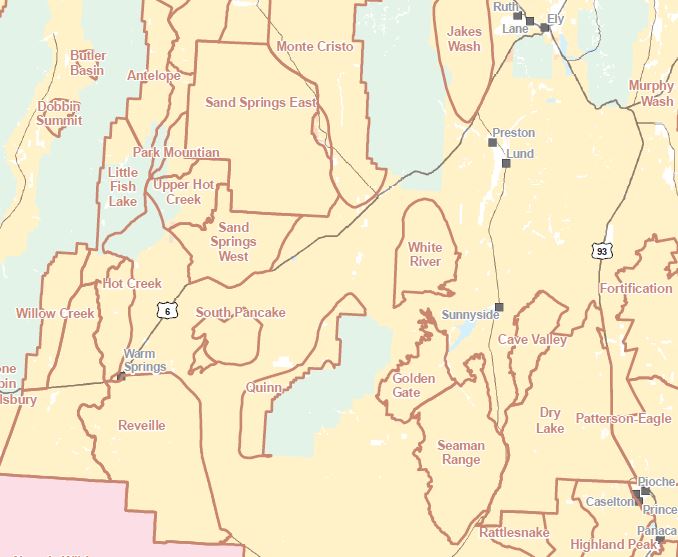
BLM said today that wild horses in and around the Seaman Range and White River Herd Areas—lands no longer designated for them—will be removed, starting next week.
The gathers will be carried out with helicopters and will be open to public observation, according to the news release.
The two former HMAs contain about 475,100 acres in eastern Nevada, south of Ely.
The Golden Gate and Seaman Range HAs were combined in the 1980s and are referred to as the Seaman Range HA in the Final Environmental Assessment for the roundups.
Captured animals will be taken to the off-range corrals in Ridgecrest, CA.
The two HAs have no AMLs and are not managed for wild horses, supposedly because they don’t have sufficient resources. But the horses are there.
So are thousands of privately owned cattle and sheep. Refer to Tables 2 and 3 in the EA.
The 31,000 AUMs per year offered to the public-lands ranchers would support 2,583 wild horses, but they are to be swept aside in favor of the crony capitalists.
Gather stats and daily reports will be posted to this page.
Mini-documentary by Delaney Tibbetts…as roundup season grinds across western rangelands and the ‘Path Forward‘ pushes through Congress.
These wheelbarrows contain the poop from three horses over two days. Their capacity is ten cubic feet. They are nearly full, holding around eight cubic feet each.
The individual contribution would be 16 ÷ 6 ÷ 2 = 1.33 cubic foot per horse per day.
That’s about ten gallons per horse per day!
How long did it take to scoop that poop? Around three hours. Photos taken 11-03-19.

On the Onaqui Mountain HMA (pre-gather) with Karen King.
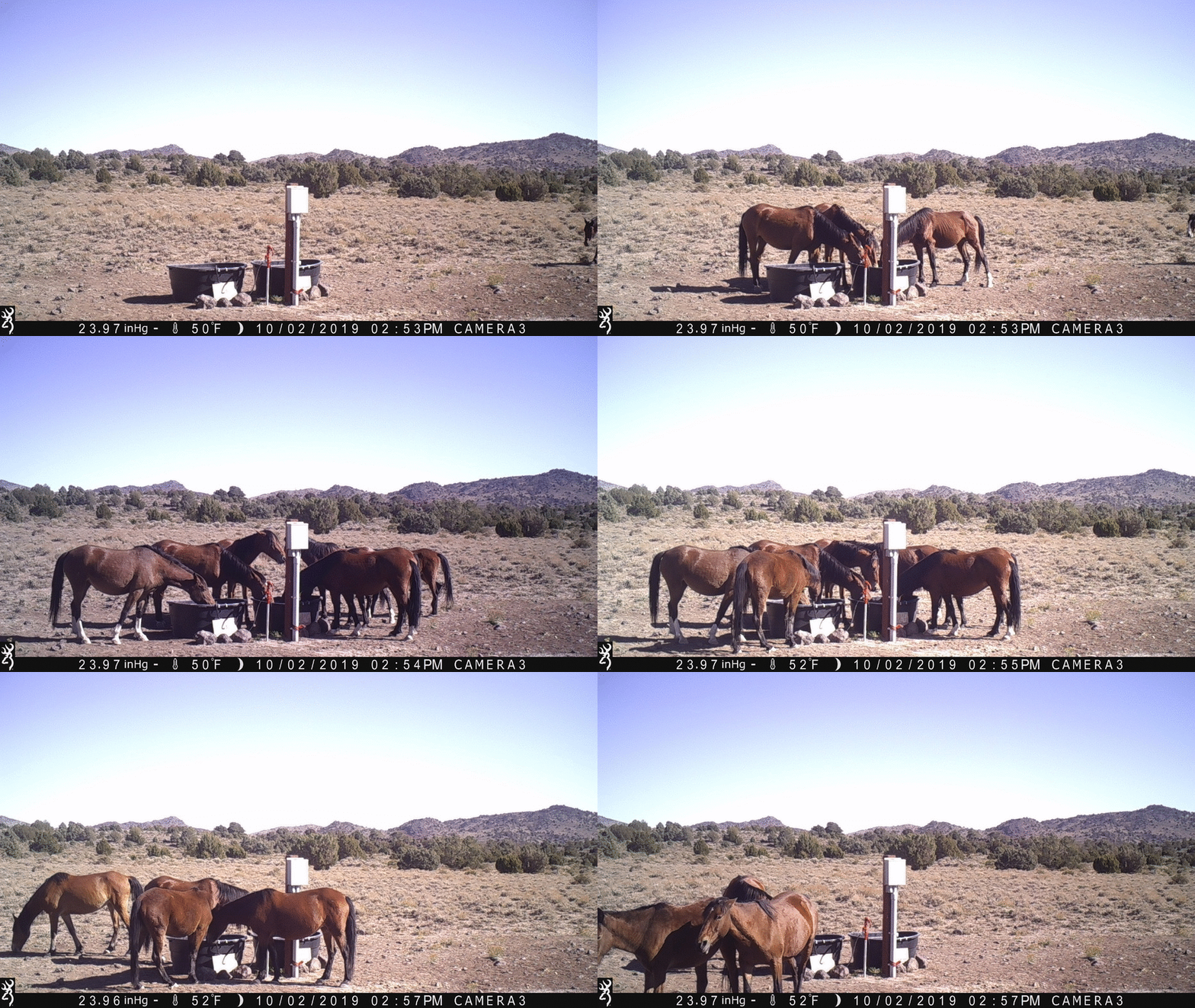
Trailcam photos of the water tanks on the Virginia Range. The one on the left had a thin layer of ice in it yesterday. Elevation 6,200 feet.

You can’t look at the numbers and then agree with the premise of this story, namely, that WHB populations are outpacing what the range can support—not when there are many more cow/calf pairs on the same land.
The Antelope Complex and Silver King HMA are just two examples (listed in the sidebar on the right under Short End of Stick).
What about policies and programs derived from a faulty premise?
Garbage in, garbage out.
Same band as in this post, different camera.
A fine example of what not to do. What are his prospects for adoption? How many times will he be handed off from owner to owner? How long before he’s put down or taken to auction because he’s ‘dangerous?’
Refer to this opinion piece in The Hill by a representative of the ASPCA, one of the signatories to the ill-conceived management plan for wild horses.
Forcing wild horses off their home range will ensure they’re not killed and sold for their meat—allowing ranchers to replace them with other animals that will be killed and sold for their meat. Brilliant.
RELATED: The ‘Path Forward’ is Wrong.

