Group Seeks Information on New Grazing Initiative

The Flathead Beacon of Kalispell, MT reported yesterday that the Western Watersheds Project filed a lawsuit earlier this week to obtain more information about a program announced in 2017 and launched in 2018.

BLM says the project will give land managers and permit holders greater flexibility in managing privately owned livestock on public lands.

WWP claims the program will put wildlife, including some endangered species, at risk.

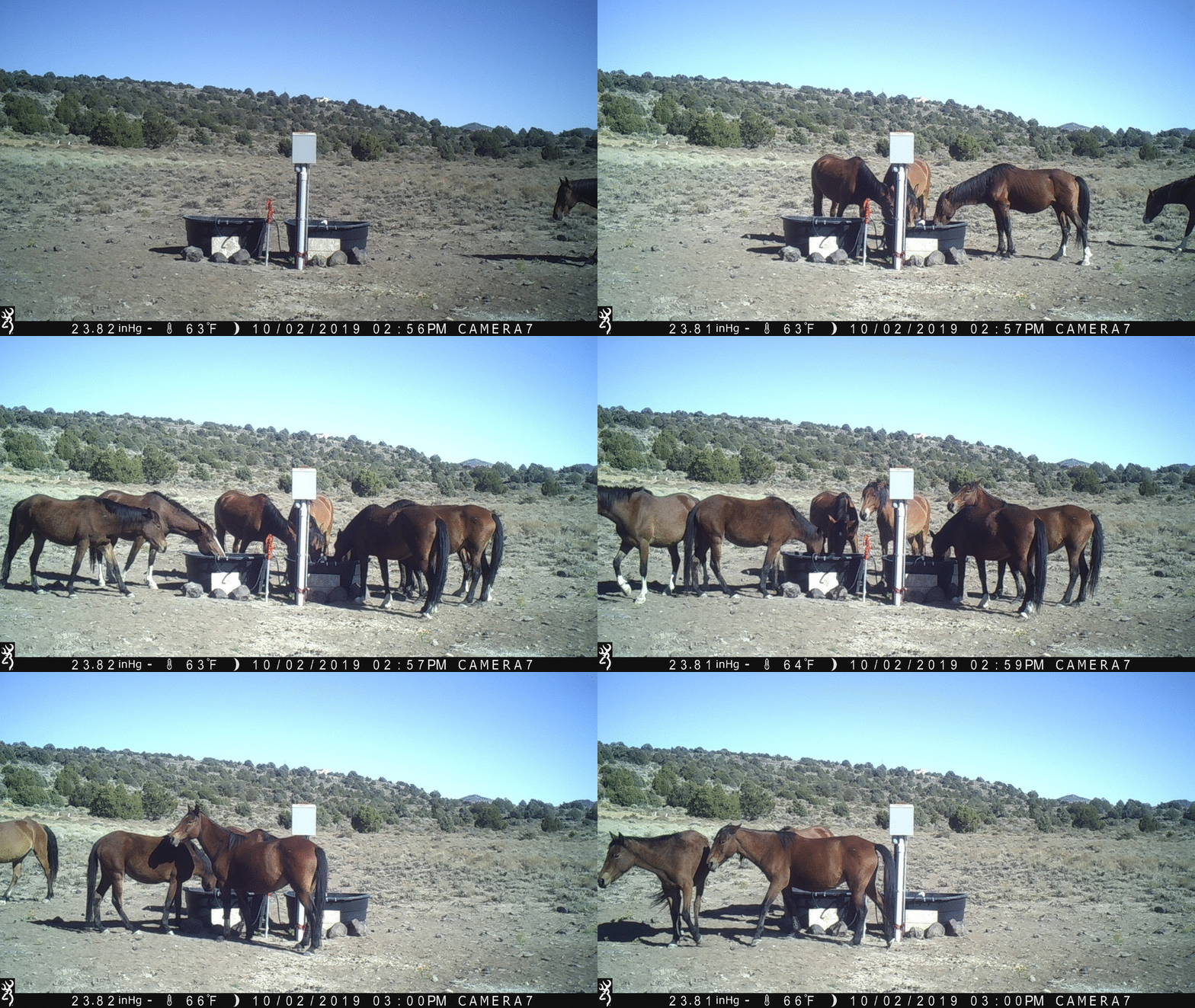
Although the link to the map is broken, the project may involve lands set aside for wild horses, given the list of operators in the 2018 news release.

Dorian Achieves Same Results as ‘Path Forward’

Sixty percent of the Cedar Island herd is gone.  You could argue that genetic diversity was lacking before the storm.  If not, it is now.  Can they recover?

The same thing could happen out west.  A fast moving wildfire, a harsh winter or a fatal disease could ruin one or more HMAs.

Even in the face of these threats, the PZP zealots will not rethink their position, because they, like the public-lands ranchers, believe there are too many wild horses on western rangelands.

The glorious Path Forward, with its plan for massive roundups and widespread use of contraceptives, will make those rangelands look like they were hit by a natural disaster, at least from a wild horse viewpoint.

The fences will still be there.  The forage will still be there.  And the livestock will still be there, as they were before that pesky Wild Horse Annie got involved.

RELATED: Cedar Island Horses Swept Away by Dorian.

Cedar Island Horses Swept Away by Dorian

The Charlotte Observer is reporting that 28 wild horses were lost on Cedar Island when hurricane Dorian hit on 09-06-19.  The horses roamed freely on 1,000 acres of privately owned land about 25 miles northeast of Shackleford Banks.  Only 21 remain.

Videos of a dead horse being eaten by a tiger shark in that area were posted two days ago by Reel Hooker Fishing & Outdoor Adventures.

The story did not indicate if the Cedar Island herd was subject to humane management practices (see Lexicon).

RELATED: New Pony on Shackleford Banks But Did They Survive Dorian?

Surprise Valley Horses Ignore HMA Boundaries

Filmed near Cedarville, CA, not far from the Nevada border, these wild horses roam in an area between Round Mountain HMA and Carter Reservoir HMA.

Cedarville CA Map-1

The Round Mountain HMA is the BLM-managed portion of the Devil’s Garden WHT, most of which lies to the west of Round Mountain (above Alturas).

Surprise Valley, which includes the town of Cedarville, is on the western side of the Great Basin, home to many of the nation’s wild horses and burros.

New Mexico Ranchers Pay $43 Per AUM for McGregor Range

Yesterday the BLM announced that local ranchers bid $35 to $43 per AUM to graze eight parcels on withdrawn lands in southern New Mexico.

The McGregor Range covers 606,000 acres on the west side of Otero Mesa, between Alamogordo, NM and El Paso, TX, according to the news release.  It was a part of Fort Bliss and supported live fire exercises with new missile systems.

McGregor Range Map-1

Pick the mid point.  If $40 per AUM is the going rate for livestock grazing on public lands, why are the ranchers who graze HMAs and WHTs allowed to pay just $1.35?

Title I of FLPMA says the U.S. [shall] receive fair market value of the use of the public lands and their resources unless otherwise provided for by statute (item 9, page 8).

How does $1.35 meet that requirement?  It doesn’t.  How do those endeavors return the maximum benefit to the American people?  They don’t.  (Refer to Title IV on page 31 for remarks about grazing fees.  Page 34 has the infamous helicopter roundup provision that was added to the WHB Act.)

Public-lands ranching is a gravy train.  That’s what groups like Protect the Harvest and the National Cattlemen’s Beef Association are trying to defend—and expand.

It’s the driver of the despicable ‘Path Forward.’

Raising the grazing fee to $60 per AUM—in line with the cost of warehousing excess wild horses and burros in off-range pastures—would be a nice down payment on the goal of erasing public-lands ranching from the American landscape.

The U.S. would receive an additional $528 million annually, at least for a while, until the ranchers throw in the towel, because paying market rates just plain spoils the party.

NEPA Workshop Next Month

The National Environmental Policy Act requires federal agencies (like the BLM) to assess the environmental effects of proposed actions, such as wild horse roundups, before making a decision.

Public participation is part of the process.

The four hour class in Burns, OR is open to anyone interested in NEPA and will focus on comment writing and review.

The news release did not indicate if the event would be live-streamed.

Example: Comments Invited on Range Creek Gather Plan.

‘Path Forward’ in the News

Refer to this report by the Washington Post, published yesterday.  Includes a link to the wild horse and burro management plan announced on 04-22-19.

The plan was negotiated by ranching interests and animal welfare groups.  Wild horse advocates were omitted from the process.

The story includes some photos and anecdotes from the Triple B roundup in July, and, as expected, gives the ranchers and their allies in government a pass.

RELATED: Liberals Will Never Condemn Public-Lands Ranching.

UPDATE: Added video.

How Wild Horses and Burros Should be Managed

The American Farm Bureau Federation issued this pronouncement today:

“Wild horses and burros are to be managed according to the Wild and Free-Roaming Horse & Burro Act of 1971, which not only specifies where wild horses and burros can occupy public lands but that they shall be managed in a manner that produces a thriving natural ecological balance.”

Couldn’t agree more.  Of course, the WHB Act of 1971 no longer exists—it was revamped by Congress at the behest of the public-lands ranchers.

So the first step would be to roll back the changes, restoring the Act to its original form.

Wild horses and burros are to occupy lands on which they were found when the bill was signed into law.  This will nearly double the amount of land they inhabit today.

As for the thriving ecological balance, Congress ordered the Secretaries of Interior and Agriculture to confer with state agencies to ensure that wildlife, especially endangered species, are not adversely affected by the horses and burros.

There was no provision for domestic livestock, which leads to the second step: Ending public-lands ranching and its 100-year reign of terror in the American west.

The third step is a thorough house cleaning of federal agencies involved with public lands: Anyone with a ranching background or ties to the ranching industry is gone.

RELATED: The Land Can Only Support 27,000 Wild Horses and Burros.

Bullfrog Gather in Progress

BLM said on 09-06-19 that approximately 600 excess wild burros would be removed from the Bullfrog HMA, starting the next day.  As of today, 302 animals have been captured, with no deaths reported.

The burros are a nuisance in the town of Beatty and a safety risk along U.S. highway 95, according to the news release.  The size of the herd had already been reduced by about 400 head in a roundup conducted in 2018.

The HMA covers 157,180 acres in southern Nevada and has an AML of 91, for an aimed-at population density of 0.6 animals per thousand acres.

Bullfrog-HMA-Map-1

The gather employs bait traps to remove the burros from their home range, so it is not open to public observation.  Captured animals are being taken to the off-range corrals in Axtell, UT.

The HMA intersects one grazing allotment, but only a portion of one pasture (about 12,000 acres) is currently active, according to Section 3.3 of the 2012 Environmental Assessment.  See Figure 3 on page 33 of the EA.

IMG_9729