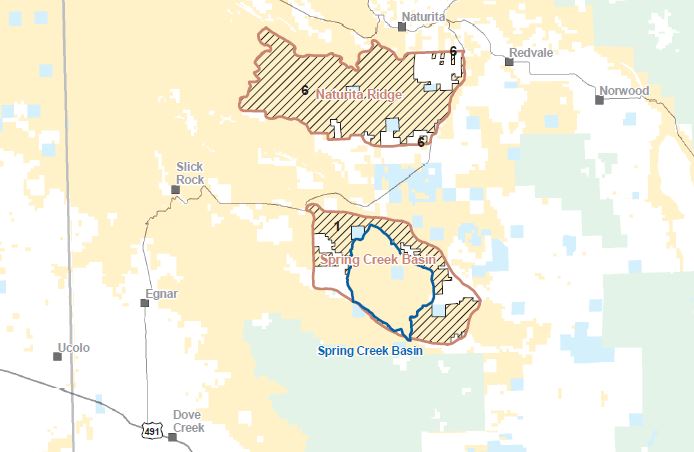
The proposed management actions announced earlier this week were prompted by resource impacts related to excessive horse population and a desire to achieve rangeland health standards in the area impacted by the overpopulated horses.
Does that mean the number of wild horses is too high or the AML is too low? What is the impact of other authorized users of those lands, not mentioned in the news release?
The forage requirement for the 721 wild horses currently on the HMA is 8,652 AUMs per year and their population density (stocking rate) is 5.3 animals per thousand acres.
The forage requirement for the 100 wild horses allowed by plan is 1.200 AUMs per year and their aimed-at stocking rate is 0.7 animals per thousand acres.
The HMA intersects four grazing allotments. The forage allocations and stocking rates for livestock inside the HMA must be computed from data in Table 2 of the draft EA.
Although cattle and sheep are authorized on the allotments, the calculations are based on cow/calf pairs only, for a direct comparison to the horses (the resource requirements of cow/calf pairs and wild horses are said to be equivalent).
Note that the cow/calf densities allowed by plan are in the same range as the pre-gather horse density. The Tatow density (5.7) is nearly identical to the current horse density.

The allotment acreage inside the HMA, computed from the portions inside the HMA (133,731), agrees fairly well with the acreage stated at the BLM page for the HMA (134,965) but differs from the acreage stated in Section 1.2 the EA (120,113). If you wanted to submit a substantive comment on the EA, that would be one.
The acreage from the BLM page was used in the density calculations. Accordingly, little if any of the land inside the HMA is not subject to permitted livestock grazing.
The forage contributed to livestock inside the HMA by the Antelope allotment would be .43 × 3,277 = 1,409 AUMs per year, assuming the resource is uniformly distributed across the parcel.
Likewise for the other three allotments. The total estimated forage available to livestock inside the HMA is the sum of the forage fractions (7,793 AUMs per year).
The number of cow/calf pairs that could be supported inside the HMA by the Antelope allotment is 1,409 ÷ 11 = 128. Ditto for the other allotments.
The total estimated number of cow/calf pairs inside the HMA is 887. The weighted average grazing season is 8.8 months (7,793 ÷ 887).
The estimated livestock density allowed by plan inside the HMA is 6.6 cow/calf pairs per thousand acres (887 ÷ 134,965 × 1,000).
These figures are compared in the following charts.

The forage allocated to horses and livestock inside the HMA would support the current wild horse population (1,200 + 7,793 > 8,652).
The forage available to livestock inside the HMA would support an additional 649 wild horses (7,793 ÷ 12) for an AML of 749 (100 + 649).
But the management plan assigns 13% of that resource to horses and 87% to livestock, on land set aside for the horses.
The wild horse management paradigm has been inverted. Privately owned livestock get the lion’s share of the resources and the horses are just a curiosity, if you can find them.
If your goal is to nullify the WHB Act without arousing suspicion, this is how you would do it—slowly, one HMA at a time.
The cattle allowed on the HMA are probably worth close to $1 million, assuming half of them ship to slaughter.
Another substantive comment on the EA involves the management paradigm: Why isn’t the HMA managed principally for the horses, in accordance with paragraph 1332(c) of the statute?
You don’t have a horse problem on western rangelands, you have a ranching problem, so why are roundups and contraceptives always tossed around as ‘solutions?’
RELATED: Comments Invited on Draft EA for Swasey Roundup.