More commentary by Rick Gore.
Author: Western Horse Watchers
Mustang Monday
On Paynes Prairie State Park with Rambling Tim.
Eagle Roundup Day 38
Cumulative totals through 02-22-20, per the BLM roundup page for the Eagle Complex:
- 1,716 animals gathered
- 23 deaths (1.3%)
- 766 studs (44.8%)
- 945 mares (55.2%)
- 5 new foals (2019 foals counted as adults)
The proportions of mares and studs are still outside of statistical limits corresponding to n = 1,711 and p-bar = .50. The number of mares removed from the area is assignably larger than the number of studs. Why?
The gather target of 1,700 horses has been achieved. Approximately 100 horses were to be returned but that hasn’t been reported yet.

The horses are not starving when their population exceeds AML, they’re robbing too much forage from the most noble and deserving inhabitants of public-lands: Privately owned livestock.
RELATED: Eagle Roundup Day 36, Eagle Wild Horses Get Short End of Stick.
Nothing to See Here
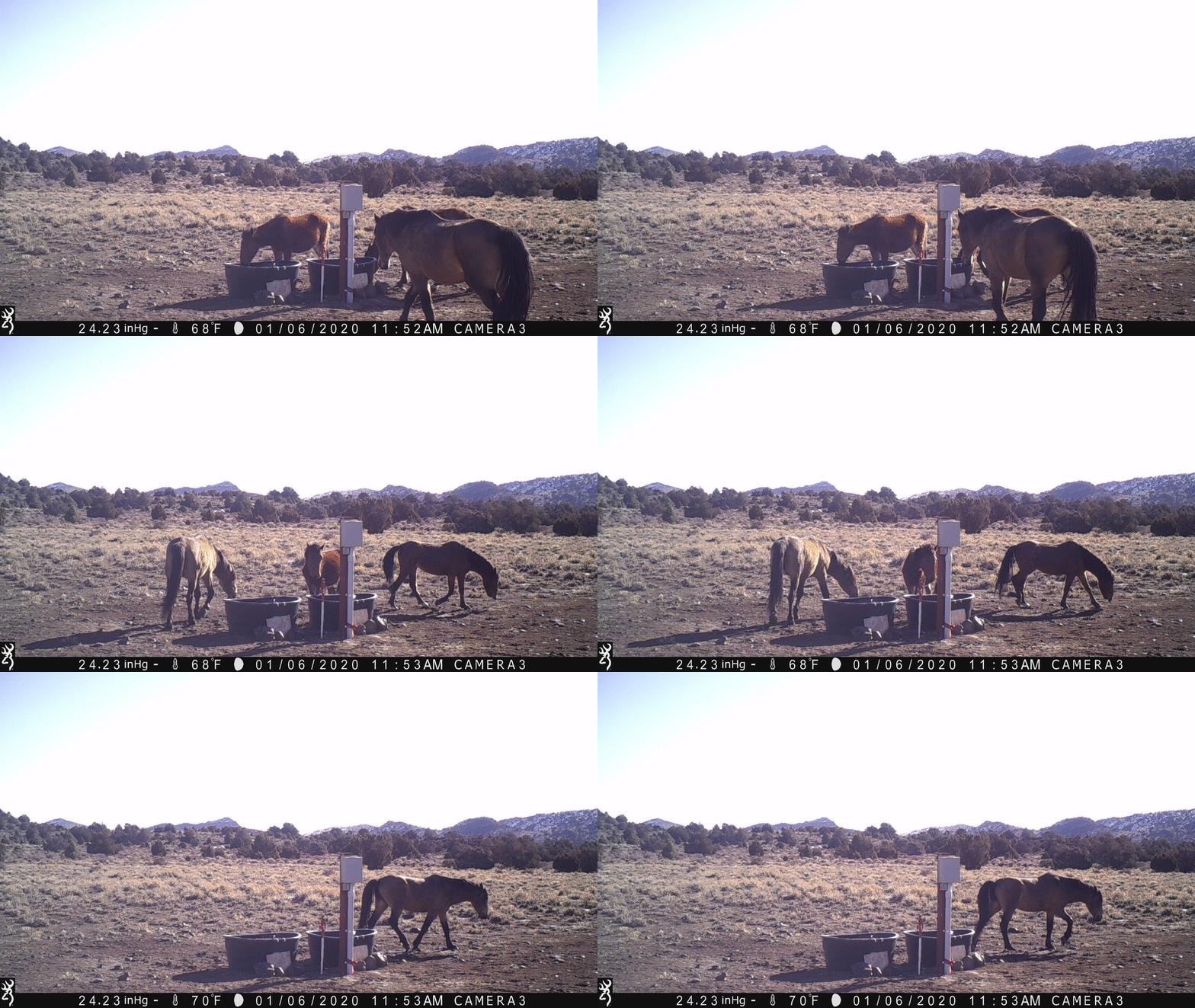
Virginia Range mustangs stop by for a drink but the system is still off for the season.

Laramie County Commissioners Looking for Cover?
The video posted yesterday about the grazing program overhaul highlights the conflicts of interest that permeate the management of public lands in the western U.S.
Residents near the proposed horse-feeding operation in Laramie County, WY rejected the idea and so did the planning commission.
The county board of commissioners must now decide if a rule change favoring the developers of the facility will be approved.
At their meeting earlier this month, commissioners tabled the amendment, in hopes of finding an odor propagation model that will corroborate public concerns.
They are probably under considerable pressure to give the right answer, meaning they must ignore the wishes of the people and do as the swamp requires.
Next meeting is March 3, with the final decision postponed until at least April 7.
RELATED: Laramie County BOC: Consent of Governed Notably Absent.

Grazing Program Overhaul
Panel discussion of issues facing the poor ranchers in Utah.
Concerns not addressed in the video:
- Water sources commandeered for personal gain
- Fences that impede the movement of other animals, limiting access to critical resources
- Grazing fees stuck in a time capsule since the 1960s
- Stocking rates that would destroy the land in a single season if it wasn’t for pasture rotation
- Rape and pillage sold as environmental stewardship
- Transmission of diseases to wildlife by domestic livestock (e.g., bighorn sheep)
- Wild horses forced off their home range so their food can be sold to the ranchers, courtesy of American taxpayers
- Consumers unable to tell if they’re buying range-fed beef
- Conflicts of interest by those who manage and monitor the programs
How can they defend any of this?
RELATED: BLM to Modernize Grazing Regulations on Public Lands.
Heber KMIs
What does the new plan look like in terms of key management indicators?
Data from the AML rationale document for the Heber WHT:
- 19,700 acres available
- 1,248 AUMs allocated to horses
- 506 AUMs assigned to privately owned livestock
Other values needed to compute the KMIs:
- 12 month grazing season for horses
- 5.6 month grazing season for livestock (determined elsewhere)
- 600 pounds dry weight per AUM (assumed)
Herd size
- 104 horses allowed by plan (1,248 ÷ 12)
- 90 cow/calf pairs allowed by plan (506 ÷ 5.6)
Stocking rate
- 5.3 horses per thousand acres (104 ÷ 19,700 × 1,000)
- 4.6 cow/calf pairs per thousand acres (90 ÷ 19,700 × 1,000)
Resource loading
- 3.2 pounds per acre per month for horses (1,248 × 600 ÷ 19,700 ÷ 12)
- 2.8 pounds per acre per month for livestock (506 × 600 ÷ 19,700 ÷ 5.6)
Would you say that the WHT is managed principally for wild horses?
During the grazing season, no. During the off season, when livestock values drop to zero, yes.
Many of the horses currently inhabiting the area will have to be removed to achieve these targets.
RELATED: Forest Service Invites Comments on Heber Management Plan.
Forest Service Invites Comments on Heber Management Plan
“What controls will be put in place to make sure the unallocated forage doesn’t go to public-lands ranchers?”
Project documents can be found here.
RELATED: Heber Forage Allocation?
Eagle Roundup Day 36
Cumulative totals through 02-20-20, per the BLM roundup page for the Eagle Complex:
- 1,656 animals gathered
- 19 deaths (1.1%)
- 741 studs (44.9%)
- 910 mares (55.1%)
- 5 new foals (2019 foals counted as adults)
A five year old stud was put down on day 36 due to injuries sustained while sorting.
The proportions of mares and studs are still outside of statistical limits corresponding to n = 1,651 and p-bar = .50. The operation has removed a large number of mares from the complex, relative to studs. The difference cannot be attributed to chance, but to one or more assignable causes.
The thriving ecological balance has been achieved, save for the removal of a few dozen more, followed by selective return.
Clearly, the WHB Act no longer affords the protections sought by Velma.

RELATED: Eagle Roundup Day 34, Eagle Wild Horses Get Short End of Stick.
Letter Hits Symptoms, Avoids Causes of Wild Horse ‘Problem’
Many people in the west understand the “ridiculous horse-feeding program,” but many in Congress and the rest of the nation do not, according to an opinion piece appearing yesterday in The Richfield Reaper of Richfield, UT.
Points discussed in the letter:
1. Almost 90,000 wild horses and burros inhabit ten western states but the government says the number should be about 27,000.
- The land, which was set aside for wild horses and burros, can support way more than 27,000 of them but the government has consigned most of their resources to public-lands ranchers.
- Which paragraph in the statute sets the limit at 27,000?
- The land is to be managed principally for WHB, according to the Act, but a federal regulation says ‘we’ll do that if we feel like it.’
2. Warehousing of wild horses and burros costs $81 million a year.
- Why are they in long-term holding? See Point #1.
- The government spends roughly $50 million per year to stockpile those animals so it can receive a few million dollars per year in grazing fees. If money and economic viability were the issues, the ranchers would have been shown the door years ago.
3. Distributors in the United States spent nearly $2.1 million in 2017 importing horse meat from Canada to feed carnivores in U.S. zoos.
- Shameful. The ranchers could be donating a small percentage of their output to help the poor zookeepers. What do you do for a living, madam?
4. Last year, the BLM began paying individuals a $500 incentive at the time of adoption and another $500 after the adopter takes title of the animal.
- The goal is to cashier as many animals through the program as possible, so more can be removed from the range and their food sold to the ranchers. See Point #1.
5. With so many horses in long-term holding, roundups will only exacerbate the problem and cost millions for taxpayers.
- Correct, because roundups treat the symptoms, not the causes. See Point #1.
Solutions are always aimed at causes. They stop unwanted events. We must have solutions to polio and smallpox because you don’t see them any more.
The answer, according to the writer, is to reopen the slaughter pipeline by overturning laws that prevent it.
How do you know it’s not a solution?
Because it guarantees that more and more horses will be coming off the range, bringing the ranchers closer and closer to the promised land.

Corolla Wild Horses Visiting Town Again
Fencing damaged by hurricane Dorian still hasn’t been repaired, so the ponies have been migrating from the 4WD area north of town into the village. But they are escorted back to their home territory on a daily basis, according to a report posted today by The Virginian-Pilot of Norfolk, VA.
Lies in Kerrville
Same woman, different venue.
They’re not overpopulated, not even close. The government has diverted most of their food to privately owned livestock, on territory set aside for them. That’s why you’re seeing so many roundups and adoption events.
If you don’t think that’s true, read any of the posts on the right in the section titled ‘Short End of Stick.’
RELATED: Lies at Pauls Valley, BLM News Release.
Eagle Roundup Day 34
Cumulative totals through 02-18-20, per the BLM roundup page for the Eagle Complex:
- 1,536 animals gathered
- 17 deaths (1.1%)
- 687 studs (44.9%)
- 844 mares (55.1%)
- 5 new foals (2019 foals counted as adults)
A 20 year old mare was put down on day 34 due to injuries sustained during sorting.
The proportions of mares and studs are still outside of statistical limits corresponding to n = 1,531 and p-bar = .50. If the herd is growing at a rate of 20% per year, where are the little ones? Coming soon to Palomino Valley?
The thriving ecological balance is now only 64 wild horses away.
RELATED: Eagle Roundup Day 32, Eagle Wild Horses Get Short End of Stick.
Heber Forage Allocation?
The rationale document for setting the AML on the Heber WHT says 50.0% of the forage will be allocated to horses, 25.6% to privately owned livestock and 24.4% for wildlife or “for future adjustments in the livestock grazing level.” See page 36.
Does that sound like a pledge to manage the WHT primarily for wild horses, as required by the statute?
Or are those weasel words that allow the forest supervisor to change the management strategy in favor the public-lands ranchers, without going through the customary reviews and approvals?
See page 19 in the draft management plan for the proposed granting of that authority.
RELATED: New Heber Management Plan Puts Supervisor in Charge?
Reveille Roundup Complete, No News Release
The daily reports ended on February 12, with 113 horses gathered, 74 shipped and no deaths. Thirty nine horses were returned to their home range, including 22 mares that were treated with contraceptives.
Of the horses shipped, 43 were studs and 31 were mares. Do those results look like they came from a process that produces 50% males and 50% females?
Hint: The gather was classified as selective removal.
Captured animals were taken to the Indian Lakes Off-Range Corrals in Fallon, NV.
RELATED: Reveille Roundup Approved.

Nature’s Hoof Cleaning
Found this piece of dried mud in one of the corrals today. It probably came out of a hoof as the horses were playing. The debris included rocks and poop. Having a muddy spot in the corral or pasture is not necessarily a bad thing. Photo taken outside of corral.

Eagle Roundup Day 32
Cumulative totals through 02-16-20, per the BLM roundup page for the Eagle Complex:
- 1,385 animals gathered
- 16 deaths (1.1%)
- 623 studs (45.1%)
- 757 mares (54.9%)
- 5 new foals (2019 foals counted as adults)
The range between males and females is still outside of statistical limits corresponding to n = 1,380 and p-bar = .50. The proportions of mares and studs don’t look like they came from a process that produces 50% of each.
The thriving ecological balance is now only 215 wild horses away (1,700 horses to be gathered − 100 to be returned − 1,385).
The forage allocated to livestock on the Eagle HMA, which represents about 88% of the Complex, would support over 2,000 wild horses, making the roundup unnecessary.
The government is probably spending around $1.5 million on the operation, which won’t increase the permitted AUMs, but it can lead to relaxation of AUM restrictions that were put in place because of the horses.
The incremental revenue will be no more than $26,000 per year (1,600 horses removed × 12 months per year × $1.35 per AUM).
Most of the horses won’t be adopted and will end up in long-term pastures at a cost of $1.2 million per year.
It’s absolutely nuts—the trouble and expense incurred by the government to prop up the public-lands ranchers. There is no economic benefit, no payout and no rate of return.
“Hey WHW, why do you say no economic benefit? These roundups create jobs for helicopter pilots, mechanics, wranglers, truck drivers and office personnel.”
Well, that may be true, but economic activity generated by government programs is always offset by a reduction in activity of those from whom the money is confiscated.
That would be you.
The wild horse ‘problem’ arises from government policy—its insistence on giving more and more resources to the public-lands ranchers, on territory set aside for the horses.

Photo: Studs from the Eagle Complex at Palomino Valley off-range corrals, 02-08-20.
RELATED: Eagle Roundup Day 29, Eagle Wild Horses Get Short End of Stick.
Mustang Monday
On the Salt River with MyKeyBee Photography.
WHW Mail 02-16-20
Q.
Trap Town NCS
Good video! Keep it up! Would you like to be YouTube friends? 🙂
A.
Dear Trap Town NCS,
If you’ve got four hooves and eat hay then yeah.
Regards,
Western Horse Watchers
You Know What They Say, Eat Hay While the Sun Shines
Some Virginia Range mustangs enjoy a brief respite from the snow. Water system off for the season. Elevation 6,200 feet.