Eagle Roundup Day 32

Cumulative totals through 02-16-20, per the BLM roundup page for the Eagle Complex:

  • 1,385 animals gathered
  • 16 deaths (1.1%)
  • 623 studs (45.1%)
  • 757 mares (54.9%)
  • 5 new foals (2019 foals counted as adults)

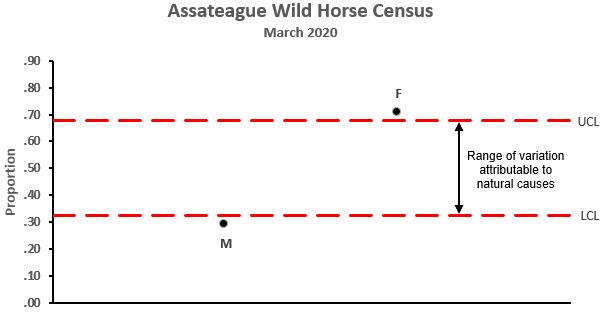
The range between males and females is still outside of statistical limits corresponding to n = 1,380 and p-bar = .50.  The proportions of mares and studs don’t look like they came from a process that produces 50% of each.

The thriving ecological balance is now only 215 wild horses away (1,700 horses to be gathered − 100 to be returned − 1,385).

The forage allocated to livestock on the Eagle HMA, which represents about 88% of the Complex, would support over 2,000 wild horses, making the roundup unnecessary.

The government is probably spending around $1.5 million on the operation, which won’t increase the permitted AUMs, but it can lead to relaxation of AUM restrictions that were put in place because of the horses.

The incremental revenue will be no more than $26,000 per year (1,600 horses removed × 12 months per year × $1.35 per AUM).

Most of the horses won’t be adopted and will end up in long-term pastures at a cost of $1.2 million per year.

It’s absolutely nuts—the trouble and expense incurred by the government to prop up the public-lands ranchers.  There is no economic benefit, no payout and no rate of return.

“Hey WHW, why do you say no economic benefit?  These roundups create jobs for helicopter pilots, mechanics, wranglers, truck drivers and office personnel.”

Well, that may be true, but economic activity generated by government programs is always offset by a reduction in activity of those from whom the money is confiscated.

That would be you.

The wild horse ‘problem’ arises from government policy—its insistence on giving more and more resources to the public-lands ranchers, on territory set aside for the horses.

IMG_0608

Photo: Studs from the Eagle Complex at Palomino Valley off-range corrals, 02-08-20.

RELATED: Eagle Roundup Day 29, Eagle Wild Horses Get Short End of Stick.

Rock Springs AML Amendments

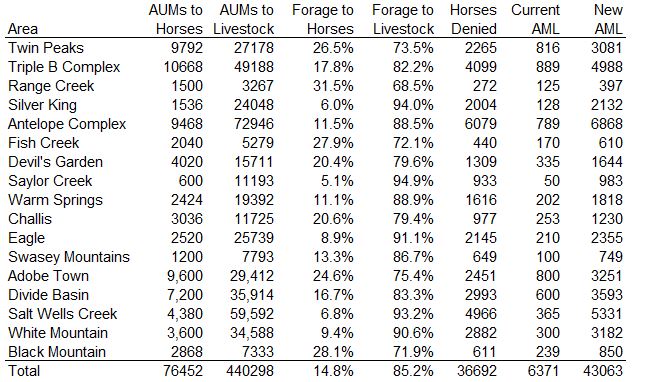
The post about the four HMAs affected by the Rock Springs RMP amendment indicated that over 13,000 wild horses had been denied a place on their home range because of privately owned livestock.  How would that number be apportioned if the livestock were removed and the forage reassigned to the horses?

On the Adobe Town HMA, 29,412 AUMs per year consigned to livestock, which would support 2,451 horses (29,412 ÷ 12), for a new AML of 3,251 (800 + 2,451).

On the Divide Basin HMA, 35,914 AUMs per year consigned to livestock, which would support 2,993 horses (35,914 ÷ 12), for a new AML of 3,593 (600 + 2,993).

On the Salt Wells Creek HMA, 59,592 AUMs per year consigned to livestock, which would support 4,966 horses (59,592 ÷ 12), for a new AML of 5,331 (365 + 4,966).

On the White Mountain HMA, 34,588 AUMs per year consigned to livestock, which would support 2,882 horses (34,588 ÷ 12), for a new AML of 3,182 (300 + 2,882).

Are you surprised that AMLs could be this large?  Now do you understand why the government is warehousing so many wild horses, ramping up its outplacement programs, and shifting its messaging to ‘Off the Range?’

Draft Management Plan for Heber WHT Released

Today the Forest Service released a draft management plan for the Heber WHT, marking the beginning of a 30-day comment period, according to a story posted this morning by the White Mountain Independent of Show Low, AZ.

The WHT covers approximately 19,700 acres and the proposed AML is 50 to 104, for an aimed-at stocking rate of 5.3 horses per thousand acres.  The rationale for setting the AML is presented in this document.

The WHT intersects two grazing allotments.  Data in Table 11 of the rationale document suggest that the horses will receive twice as much forage as livestock and that the WHT might be managed primarily for horses.

Substantive comments can be submitted at this page.

An initial comment might involve document quality.  The files appear to be scanned images of the originals and are not searchable.

Group Wants Salt River Herd Cut

The size of the Salt River herd should be reduced by 80%, according to the writer of an opinion piece appearing today in Phoenix-based AZCentral.

The ‘collaborative’ pushing for the change includes members from a stock grower’s association and a sportsmen’s group.

The writer describes the current situation as 100 guests at a party with just two large pizzas but it’s really two wolves and a lamb voting on what to have for lunch.

It’s not about healthy horses on healthy rangelands and it’s not about public safety.

It’s about forage consumed by the horses, and managing it to an ‘acceptable’ level.

Eagle Roundup Day 29, ‘Feel the Love’ Edition

Cumulative totals through 02-13-20, per the BLM roundup page for the Eagle Complex:

  • 1,288 animals gathered
  • 16 deaths (1.2%)
  • 574 studs (44.7%)
  • 709 mares (55.3%)
  • 5 new foals (2019 foals counted as adults)

The range between males and females is still outside of statistical limits corresponding to n = 1,283 and p-bar = .50.  Why are there more mares in the traps than studs?

The thriving ecological balance is now only 312 wild horses away (1,700 horses to be gathered − 100 to be returned − 1,288).

IMG_0538

Photo: Youngsters from the Eagle Complex, Palomino Valley corrals, 02-08-20.

RELATED: Eagle Roundup Day 26, Eagle Wild Horses Get Short End of Stick.

Rock Springs RMP Recap

Totals for the four HMAs affected by the proposed RMP amendment:

  • 2,810,951 acres available
  • 24,780 AUMs per year allocated to horses
  • 159,506 AUMs per year allocated to livestock

Other values needed to compute key management indicators for the complex:

  • 12 month grazing season for horses
  • 4 month grazing season for livestock (assumed)
  • 600 pounds dry weight per AUM (assumed)

Herd size

  • 2,065 horses allowed by plan (24,780 ÷ 12)
  • 39,876 cow/calf pairs allowed by plan (159,506 ÷ 4)

Stocking rate

  • 0.7 horses per thousand acres (2,065 ÷ 2,810,951 × 1,000)
  • 14.2 cow/calf pairs per thousand acres (39,876 ÷ 2,810,951 × 1,000)

Resource loading

  • 0.4 pounds per acre per month for horses (24,780 × 600 ÷ 2,810,951 ÷ 12)
  • 8.5 pounds per acre per month for livestock (159,506 × 600 ÷ 2,810,951 ÷ 4)

Livestock receive over six times as much forage than the horses—on lands set aside for the horses.  The stocking rate for livestock is 20 times higher.

Over 13,000 wild horses have been cheated out of a place on their home range because of the livestock, about 25% of the horses now in long-term holding (159,506 ÷ 12).

How many more HMAs would you have to evaluate to account for all of the wild horses in long-term holding?

How many wild horses have been displaced from all of the HMAs because of livestock?

How many mares will have to be darted (with contraceptives) before the government starts managing HMAs and WHTs principally for wild horses, per the statute?

“Hey WHW, that doesn’t make any sense.  You’d be darting mares if you wanted to manage the land primarily for livestock.”

Exactly.

RELATED: BLM FY 2021 Budget Request Targets Wild Horses, PZP Zealots Go Home.

IMG_0562

PZP Zealots Go Home

The government removes wild horses from HMAs not because there are too many of them, but because they’re robbing too much forage from the most noble and deserving inhabitants of western rangelands.

The PZP zealots, who try to pass themselves off as friends of the horses, also want to see their numbers reduced, by widespread application of contraceptives, a process that will turn them into non-reproducing herds.  They are allies of the public-lands ranchers.

RELATED: Contraceptives Are a Back-Door Channel to Sterilization.

PZP Zealots - Allies of the Public-Lands Ranchers

Eagle Roundup Day 26

Cumulative totals through 02-10-20, per the BLM roundup page for the Eagle Complex:

  • 1,263 animals gathered
  • 16 deaths (1.3%)
  • 563 studs (44.8%)
  • 695 mares (55.2%)
  • 5 new foals (2019 foals counted as adults)

The variation between males and females is outside of statistical limits corresponding to n = 1,258 and p-bar = .50.  The difference cannot be attributed to chance.

The thriving ecological balance is now only 337 wild horses away (1,700 horses to be gathered − 100 to be returned − 1,263).

IMG_0638

Photo: Studs from the Eagle Complex at Palomino Valley off-range corrals, 02-08-20.

RELATED: Eagle Roundup Day 23, Eagle Wild Horses Get Short End of Stick.

BLM FY 2021 Budget Request Targets Wild Horses

The President’s budget proposal for FY 2021 will take meaningful steps to address the untenable state of the WHB program and the unsustainable proliferation of wild horse herds on public lands, which far exceed what is healthy for the land and has impeded resource availability for other wildlife species, according to a news release issued today.

Not so fast, Chester.

What can’t be defended are the lies of omission about privately owned cattle and sheep on public lands designated for the horses and the amount of forage consigned thereto.

Consider the four HMAs affected by the Rock Springs RMP amendment, discussed at length on these pages over the last few days.

The total is 159,506 AUMs per year, enough to support 13,292 wild horses.  On just four HMAs!  Can you imagine the loss if the pattern is true for the other 173 HMAs?

There is no wild horse population crisis.  There is more than enough for them to eat on western rangelands.

The problem is the public-lands ranchers, their overlords, cheerleaders and political allies—not to mention their fences, which impede the movement of the horses, and the water holes they’ve stolen from them.

Thriving Ecological Balance on Western Rangelands

White Mountain Horses Get Short End of Stick

The Tier 1 analysis in Appendix A of the draft EIS for the Rock Springs RMP amendment provides data for current conditions at White Mountain HMA.

The HMA is to be managed principally for wild horses per paragraph 1332(c) of the statute, but do the numbers reflect that?

The EIS did not provide allotment sizes, grazing seasons and the type of animals allowed on the HMA.  The grazing season on some of the allotments is three months, according to Section 3.10 of the EIS, and on others it’s four to six months, so an average grazing season of four months was assumed.

White Mountain HMA Calcs-1

Forage requirements and stocking rates for livestock were computed for cow/calf pairs, whose resource requirements are said to be equivalent to those of wild horses, allowing a side-by-side comparison.  The grazing permits may allow other animals.

The results are presented in the following charts.

White Mountain HMA Charts-1

The horses have a much smaller footprint and environmental impact than livestock, but under the RMP amendment, the HMA will be eliminated and the land will be managed exclusively for livestock.

The government will pay between $500 and $1,000 to remove and process each horse from the area, plus another $730 per year to hold him in an off-range pasture, so it can collect $16 per year from the public-lands rancher to whom his food is sold.

It’s crazy.  Nobody in the private sector would do that.

RELATED: Salt Wells Horses Get Short End of Stick, Rock Springs EIS PostedSo Long, Pilot Butte Wild Horse Scenic Loop?

White Mountain Thriving Ecological Balance

Salt Wells Horses Get Short End of Stick

The Tier 1 analysis in Appendix A of the draft EIS for the Rock Springs RMP amendment provides data for current conditions on the Salt Wells Creek HMA.

The numbers were copied into a spreadsheet to see if the current management plan favors privately owned livestock over wild horses and if so by how much.

The EIS did not provide allotment sizes, grazing seasons, and livestock types within the HMA.  The grazing season on some of the allotments is three months, according to Section 3.10 of the EIS, and on others it’s four to six months, so an average grazing season of four months was assumed.

Salt Wells Creek HMA Calcs-1

Forage requirements and stocking rates for livestock were computed for cow/calf pairs, whose resource requirements are said to be equivalent to those of wild horses, allowing a side-by-side comparison.  The grazing permits may allow other animals.

Key indicators are presented in the following charts.

Salt Wells Creek HMA Charts-1

The HMA is already managed primarily for livestock—the horses are just a blip on the radar screen.  It will be zeroed out in the revised RMP, but who will notice?

The big-name ‘advocacy’ groups, unfazed by these results, will demand more contraceptives for wild horses, because they are allies of the public-lands ranchers.

Don’t give them a penny.

RELATED: Divide Basin Horses Get Short End of Stick.

Salt Wells Creek Thriving Ecological Balance-1

Notes from Palomino Valley

The off-range corrals are now filling up with horses from the Eagle Complex.

When you get out of your car, their heads go up.  If you approach the fence, they bolt.

Yes, Virginia, they really are wild.

Critics argue that they’re escaped ranch stock, nothing special, and while that’s true in some cases, it was generations ago.  There’s no domestication in these guys.

They don’t want anything to do with humans.  As you can see below, safety is more important than food.

What happens when they’re placed into training programs with 100-day timeframes?

Their spirits are literally broken.  The goal is to cashier as many horses as possible through the programs, so more can be removed from the range and their food sold to public-lands ranchers.

Palomino Valley can hold up to 1,850 horses on 98 acres, according to personnel in the office.

Can you imagine the conditions for the horses if the CAFO proposed by Equine Elite is built near Burns, WY, with a capacity of 5,000 horses on a bit more than 80 acres?

RELATED: Laramie County BOC Postpones Decision on Rule Change.

IMG_0484