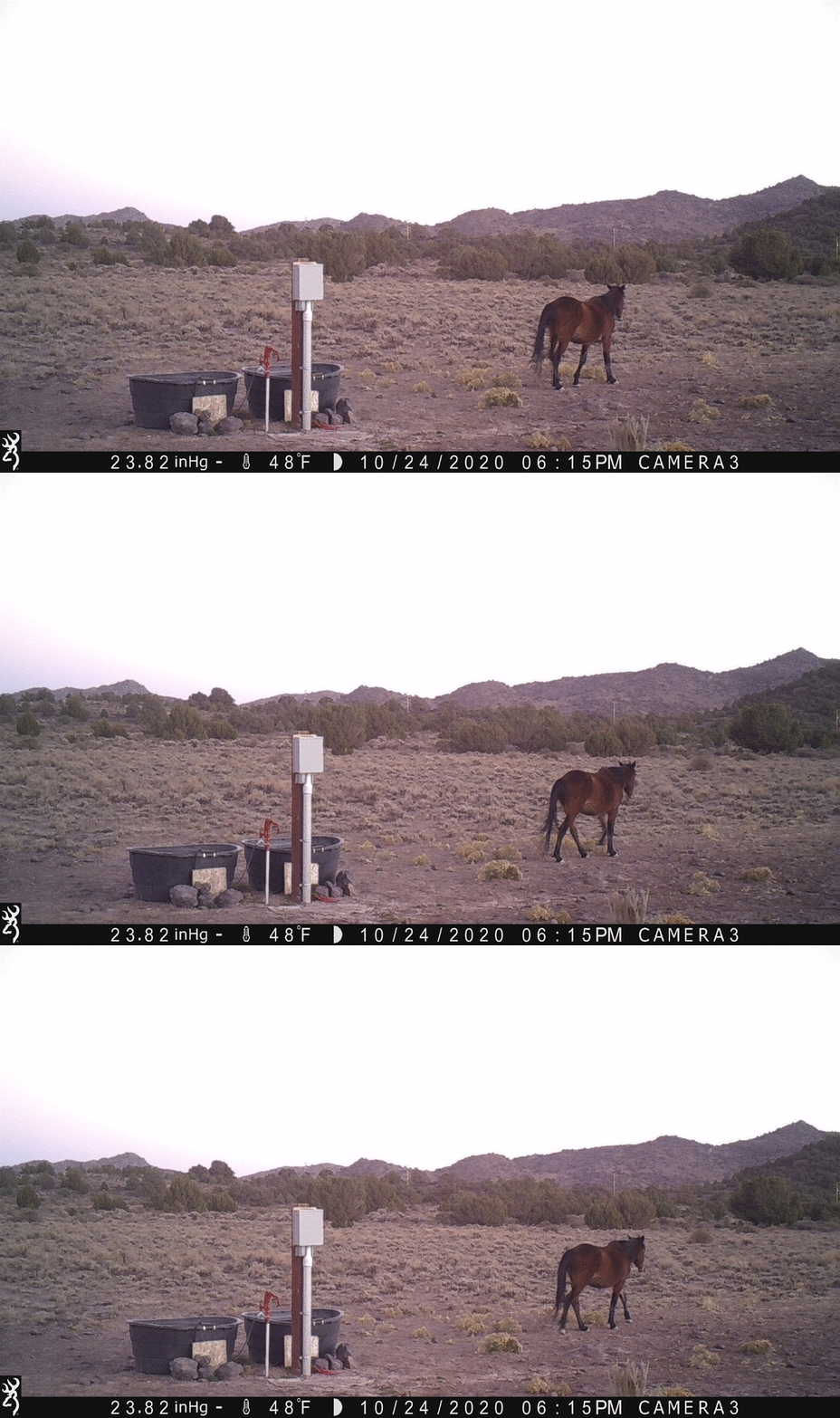
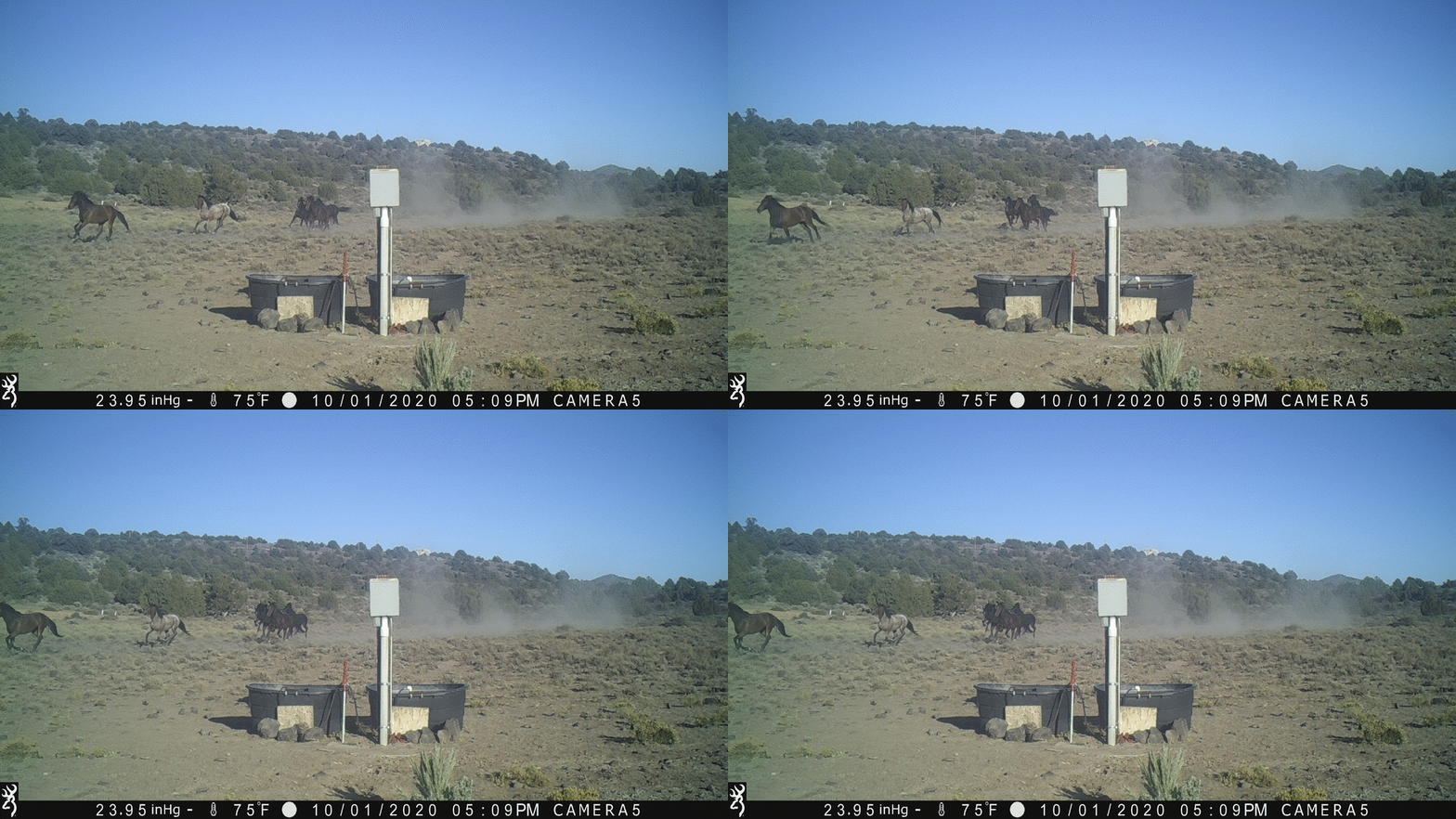
Last horse seen before turning water system off for the winter. Forecast says 20 °F Sunday morning. Hoses disconnected, yard hydrant shut, inside valve closed.

Western Horse Watchers Association
Exposing the Hypocrisy, Lies and Incompetence of the Wild Horse Advocates
Last horse seen before turning water system off for the winter. Forecast says 20 °F Sunday morning. Hoses disconnected, yard hydrant shut, inside valve closed.
The event started October 10. Gather stats through November 6:
No gather activity on Day 28.
One death occurred on Day 27, related to the roundup.
Foals accounted for 22.2% of the horses gathered since October 10. Of the captured adults, approximately 46% are males and 54% are females. Body condition scores are not known.
No horses were returned to their home range since the last update.
The number of unaccounted-for horses is 428.
Five HMAs are involved in the roundup.
RELATED: Red Desert Roundup Day 25.
Drone footage of a band stallion fending off a challenger in New Mexico. Might be a bachelor trying to steal mares. Thanks to Mindronebusiness for the video.
The stocking rate allowed by plan in the Paisley Desert HMA is 0.5 horses per thousand acres. Given a forage requirement 12 AUMs per year per horse, land designated for them must be able to produce 6 AUMs per year per thousand acres (AUMTA).
The HMA is also designated for permitted livestock grazing. Allotment numbers are shown in the following map. The HMA boundary appears in red.

Appendix E1, of the 2018 Lakeview RMP Amendment, provides data for the allotments.
At Squaw Lake, #0418, 834 AUMs per year have been assigned to livestock on 41,354 acres, for a production rate of 20 AUMTA.
Saint Patricks, #0419, offers 750 AUMs per year on 25,674 acres, for a production rate of 29 AUMTA.
Sheeprock, #0428, provides 3,967 AUMs per year on 146,278 acres, for a production rate of 27 AUMTA.
These parcels can only produce 6 AUMTA if you’re talking about wild horses.
What about the neighboring pastures?
Allotment #0426, on the southwest side of the HMA, offers 1,021 AUMs per year on 47,850 acres, for a production rate of 21 AUMTA.
Allotment #0420, on the northwest side of the HMA, provides 1,056 AUMs per year on 21,882 acres, for a production rate of 48 AUMTA.
Allotment #0430, on the east side of the HMA, has 4,202 AUMs per year on 43,654 acres, for a production rate of 96 AUMTA.
What can you conclude about these numbers? Land is much more productive when it’s designated for livestock. Productivity drops sharply when it’s earmarked for horses.
That’s why AMLs are small and true AMLs are much larger.
The event started October 10. Gather stats through November 3:
No gather activity on Day 23.
Two deaths occurred on Day 23 and three on Day 25, all due to pre-existing conditions.
Foals accounted for 22.2% of the horses gathered since October 10. Of the captured adults, approximately 46% were males and 54% were females. Body condition scores are not known.
Thirty two horses were returned to their home range since the last update. The number treated with fertility control is now 75.
The number of unaccounted-for horses is 446. The contractor may be holding them on site.
The release of captured horses may indicate the operation has concluded in one area and has resumed in another.
The reports don’t say where the helicopters are flying. Five HMAs are involved in the roundup.
RELATED: Red Desert Roundup Day 22.
BLM announced today the signing of a categorical exclusion and decision record authorizing the removal of approximately 75 wild horses from private lands in the Piceance-East Douglas HMA, subject to a 30-day appeal period.
The documents were approved last week but the news release appeared today. It’s not an announcement of a roundup but the intent to round up wild horses.
The operation would be carried out in a grazing allotment at the north end of the HMA and probably wouldn’t be open to public observation due to the method of capture.
The HMA covers 190,130 acres in western Colorado and has an AML of 235, for an aimed-at stocking rate of 1.2 horses per thousand acres.

The number of allotments intersecting the HMA and the amount of forage allocated to livestock are not known.
The current wild horse population in and around the HMA is approximately 1,200.
About three dozen animals have died over the last two weeks and the number is expected to rise, according to a report posted yesterday by AP News.
The burros live in an area between Moreno Valley and Colton, CA and are managed at the county level.
RELATED: Reche Canyon Burro Rescued from Sinkhole.
You don’t have time to be reading wild horse blogs. Go vote.

The Paisley Desert HMA covers 297,802 acres in central Oregon and has an AML of 150, according to a 2009 Environmental Assessment for wild horse management actions over a ten year period.
Western Horse Watchers was unable to find a current assessment and record of decision in the NEPA register, which may explain why the roundup last month was carried out on an emergency basis. The appendices and maps were not provided with the old EA and ROD.
The horses allowed by plan require 1,800 AUMs per. The stocking rate allowed by plan is 0.5 horses per thousand acres.
The HMA intersects four allotments. The map packet in the 2003 Lakeview RMP shows them, along with many others, but does not show the HMA boundary. A rough outline has been added by Western Horse Watchers, suggesting that all of the land inside the HMA is subject to permitted livestock grazing.

Table 1 in the EA provides grazing seasons and forage allocations inside the HMA.
The management plan assigns 10,151 AUMs per year to livestock, 1,800 AUMs per year to horses and 624 AUMs per year to wildlife.

The Christmas Lake grazing season is 9.5 months per year. The CL permittee would have to place 484 cow/calf pairs inside the HMA to graze off 4,598 AUMs in that time frame. The estimated herd sizes for the other three allotments are 882, 300 and 238 cow/calf pairs, respectively, for a total of 1,904 cow/calf pairs inside the HMA.
The estimated stocking rate is 1,904 ÷ 297,802 × 1,000 = 6.4 cow/calf pairs per thousand acres and the weighted average grazing season is 5.3 months per year.
These figures are compared in the following charts.
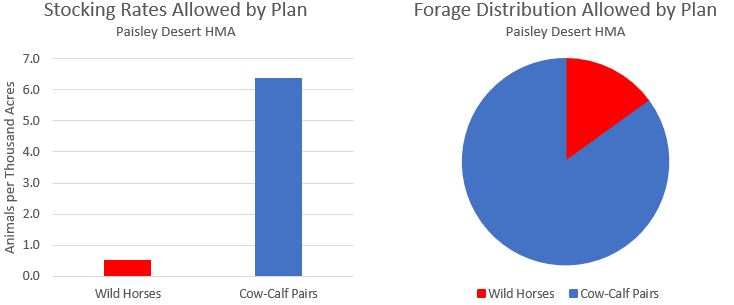 The HMA is managed primarily for livestock. Wild horses receive just 15% of the total authorized forage, excluding wildlife, providing more evidence that fractional stocking rates correlate with large amounts of forage diverted to privately owned livestock.
The forage assigned to livestock would support an additional 846 horses, for a true AML of 996.
The 350 horses remaining after the roundup put the HMA at 0.4X AML, not 2.3X AML.
The pre-gather population of 1,050 contained 54 excess horses, not 900.
If livestock aren’t free to move from one allotment to another, how are the horses supposed to do that? The map above only shows the allotment boundaries, it does not show the pastures within the allotments. The place must be crawling with fences.
RELATED: Paisley Desert Preview.
On the Virginia Range with SKYNNET PRO LLC.
Most of the AUMs in the HMA are assigned to the ZX Ranch.
A 1994 report by AP News says it’s owned by the J.R. Simplot Company. A 2017 story by American Cowboy provides details.
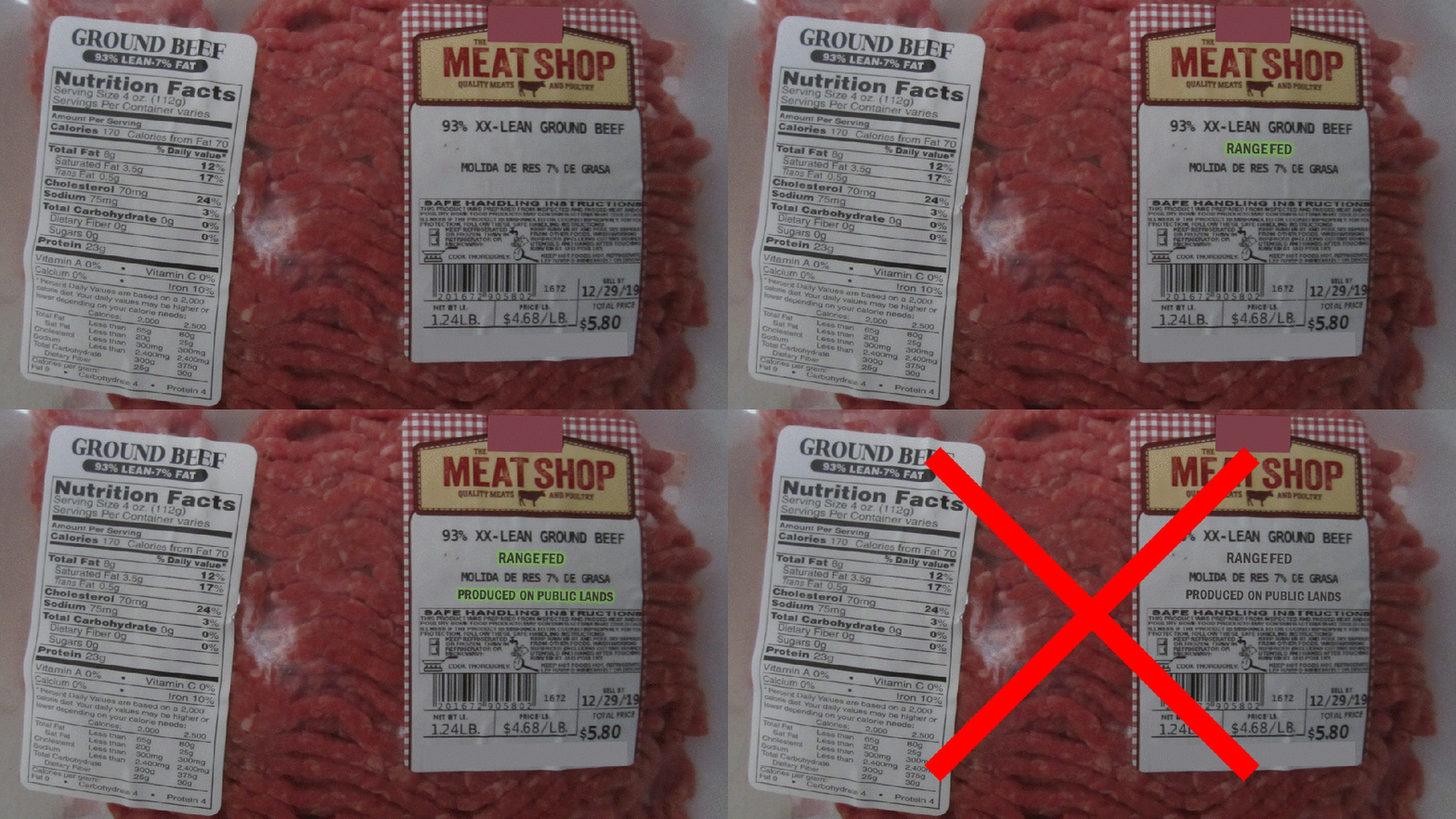
If you knew it would you buy it?
Volunteers with Wild Horse Connection are using unnatural methods “to make sure the horses stay in their natural habitat,” according to a story posted today by KOLO News of Reno. If feeding wild horses is a good idea, why is it illegal?
RELATED: Volunteers Needed for Virginia Range Feeding Program.
Here are the forage allocations for the Paisley Desert HMA, as presented in Table 1 of the Final EA for wild horse management actions therein.
The HMA intersects four allotments and has a Herd Area Management Plan (HMAP).
Would you say it’s managed principally for wild horses?
The Saint Patricks allotment is 100% inside the HMA but livestock receive over 20 times more forage than horses on that parcel.
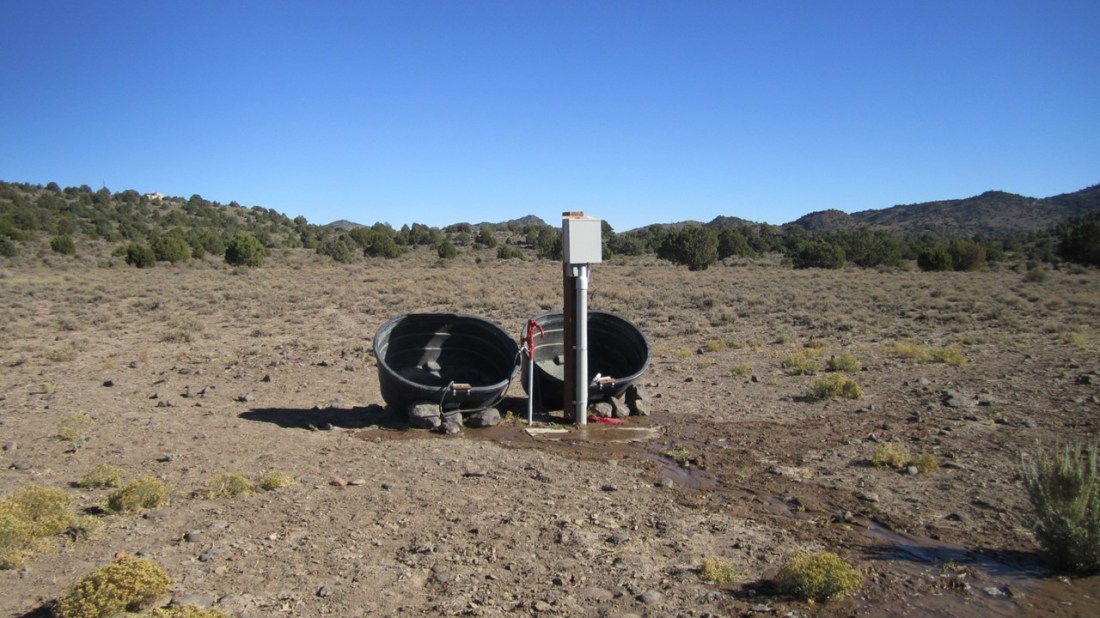
The EA said on page 27 that solar-powered wells were proposed for the HMA to provide water for the horses but over 700 of them were removed last month due to lack of water.
The event started October 10. Gather stats through October 31:
No deaths were reported over the last three days.
Foals accounted for 22.4% of the horses gathered since October 10. Of the captured adults, approximately 46% were males and 54% were females. Body condition scores are not known.
Three more horses were returned to their home since the last update. The number treated with fertility control is now 59.
The number of unaccounted-for horses is 1,672 – 4 – 118 – 1,055 = 495. The contractor may be holding them on site.
The reports don’t say where the horses were captured or returned. Five HMAs are involved in the roundup.
RELATED: Red Desert Roundup Day 19, Roundup Checks and Balances.
Yeah, it’s a tarantula, photographed September 20.
Happy Halloween from Western Horse Watchers!

These people are helping the government manage wild horse areas principally for livestock, by enforcing RMPs that are biased in favor of the public-lands ranchers.
Many of the so-called advocacy groups are involved. Don’t give them a penny!
RELATED: Future of Wild Horses in Hands of U.S. Senate?
Animals like these are the “not necessarily exclusively” part of the “managed principally but not necessarily exclusively” clause of the original WHB Act. There was no provision for livestock.

The roundup may be over but the investigation continues, according to staff at the BLM Ridgecrest Field Office. Forty six burros were found dead on their home range in 2019.
BLM said today that it has requested bids for new short-term holding facilities in Idaho, Nevada and Utah. Capacities of 500 to 10,000 wild horses and burros are desired, according to the news release.
Animals delivered to the corrals will be held temporarily before transfer to off-range pastures or adoption/sale locations across the country.
Proposals will be accepted through November 30.
The construction of a high-capacity animal feeding operation was the subject of a heated debate earlier this year in Laramie County, WY.
RELATED: BLM Seeks Off-Range Corrals.

It’s when the poor ranchers can enjoy the full benefit of their permitted AUMs.
Consider this example from Appendix VII of the Final EA for wild horse management actions in the Caliente Complex:
To reestablish the health to the rangeland in the Areas we currently run Cattle the population of Wild Horses must be managed properly. Current numbers indicate a gross overpopulation of Wild Horses on our allotments as well as many others. We currently have an allotment that is supposed to allow us up to 327 Cattle (1312 AUMS) on our Sheep Flat permit. The damage because of overpopulation of Wild Horses has made it to where we can barely run 100 head on this Allotment and not for the full grazing season. We have to gather cattle and move them to rented pasture in Barclay to finish out the summer season.
Can you imagine that? Having to pay market rates to feed your cattle? You wouldn’t wish that on your worst enemy.


