Fully Contracepted Herds Were Good Before They Were Bad

A year ago it’s what the advocates wanted for all wild horses, but now that the Park Service has proposed it for the horses at TRNP, they oppose it.

Actually, they still like the idea, but if you knew that they’d lose your financial support.

Kinda like the one-horse pony telling his voters they didn’t have to pay back their student loans.

The idea fizzled after the election.

Clan Alpine Roundup, Day 3

The incident began on November 8.  Results through November 10:

  • Scope: Clan Alpine HMA
  • Purpose: Pest control, resource enforcement, rancher protection
  • Target: Horses
  • Type: Planned
  • Method: Helicopter
  • Category: Cruel and costly*
  • Better way: Poison mares with ovary-killing pesticides*
  • Captured: 295, up from 130 on Day 1
  • Average daily take: 98.3
  • Capture goal: 1,594
  • Removal goal: 1,381
  • Returned: None
  • Deaths: 3, up from zero on Day 1
  • Shipped: 170, up from zero on Day 1

A mare was dispatched on Day 2 because of a missing eye.

On Day 3, a mare was put down due to a ruptured tendon along with a stallion that had cancer polyps on its head.

The death rate is 1.0%.

The capture total includes 125 stallions, 124 mares and 46 foals.

Youngsters represented 15.6% of the animals gathered.

Of the adults, 50.2% were male and 49.8% were female.

Body condition scores were not given.

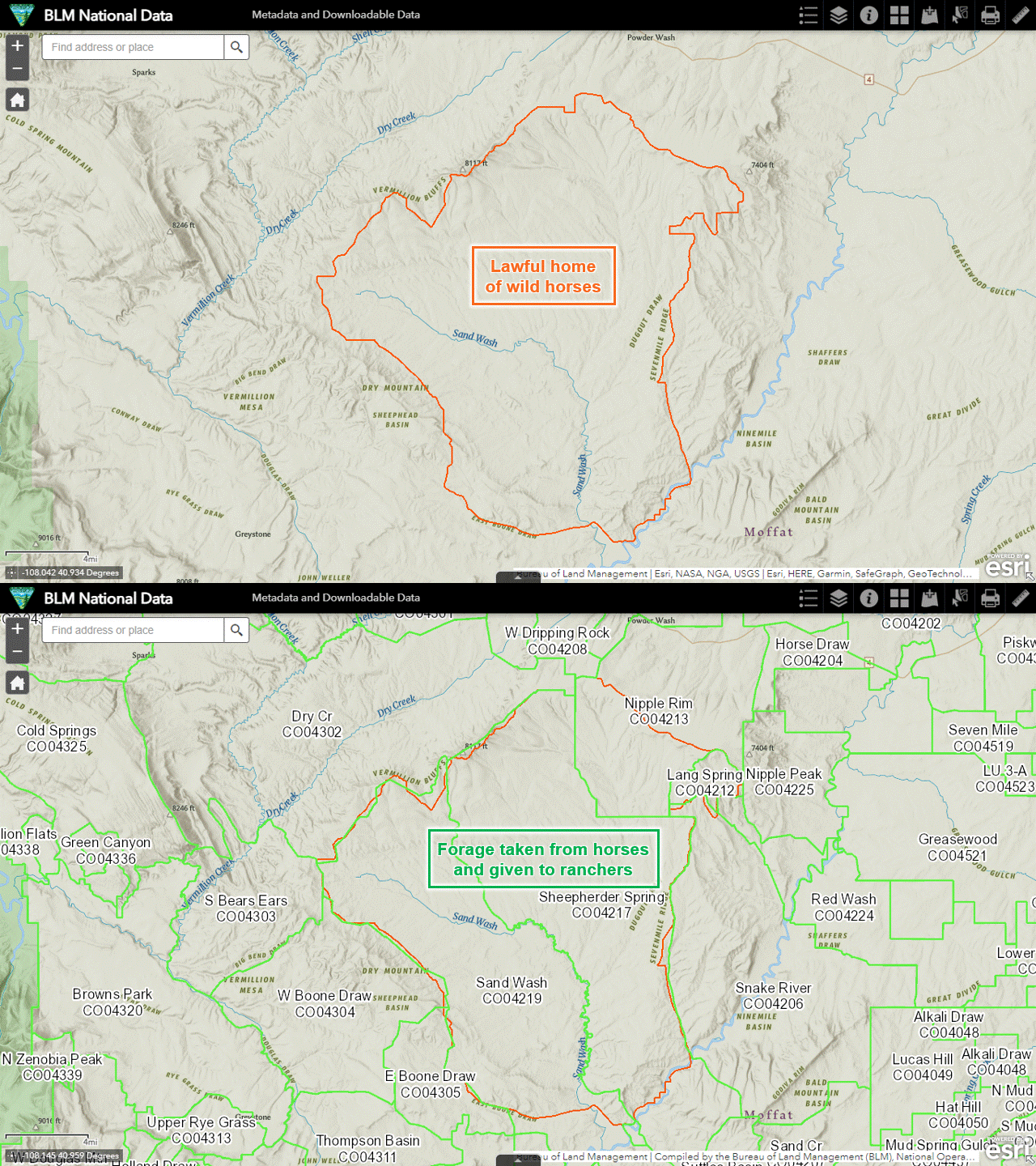
The HMA and surrounding lands are subject to permitted grazing.

*According to advocates.

Clan Alpine HMA with Allotments 06-17-23

Day 3 ended with 122 unaccounted-for animals.

Up to 81 mares will be treated with GonaCon Equine, a fertility control pesticide, before being returned the range with up to 121 stallions.

Other statistics:

  • Forage liberated to date: 3,540 AUMs per year
  • Water liberated to date: 2,950 gallons per day
  • Horses allowed by plan: 979
  • Forage assigned to horses: 11,748 AUMs per year
  • Forage assigned to livestock: 6,796 AUMs per year
  • Horses displaced from HMA by permitted grazing: 566
  • True AML: 1,545
  • Stocking rate at new AML: 5.2 wild horses per thousand public acres
  • Horses displaced by drilling and mining: Ask the advocates

RELATED: Clan Alpine Roundup in Progress.

Helicopters Don’t Force Wild Horses to Do Anything?

They simply guide them in a safe direction, a BLM public affairs officer told the Elko Daily Free Press in a story dated November 9.

“We typically will never use helicopters unless it is an extreme emergency, or we are in a wilderness study area where we cannot put vehicles in there.”

The article looks at resource management on public lands, a topic the advocates generally avoid.

If they told you that most HMAs are managed primarily for livestock, while they’re poisoning the mares with their favorite pesticide, you’d realize they’re protecting the ranchers, not the horses.

Thriving Ecological Balance-3

Foal-Free Friday, Snubbing the Wild Horse Advocates Edition

For the second time in a row, the Wild Horse and Burro Advisory Board has passed up an opportunity to meet with the advocates and admire their handiwork.

At the June meeting in Reno, they could have toured Herd Treatment Areas known as the Virginia Range and Pine Nut Mountains, but they deferred in favor of the Blue Wing Complex.

In December they could have visited the Lower Salt River to see a fully contracepted herd that’s dying off, but they opted for the Lake Pleasant HMA.

Simone Neterlands with Darting Rifle 09-02-23

What do these areas have in common?  The Campaign Against America’s Wild Horses.

It’s not fair to ignore their important work!

Let Us Fix Your Wild Horse Problem 02-18-23

If the next meeting is held in Salt Lake City, the Board would have a chance to learn about the Cedar Mountain darting program, also instigated by CAAWH, a leader in nonmotorized removal.

RELATED: Foal-Free Friday, Channeling Alternative C Edition.

Vegetation Study to Determine Sand Wash Carrying Capacity?

The project will provide accurate production data to ensure the BLM has determined the appropriate population range for the HMA, the appropriate level of livestock grazing therein, and to inform Colorado Parks and Wildlife’s big game management, according to a blog post dated November 6.

If forage production is less than expected, what activity will be reduced?

If it’s greater than expected, what activity will be increased?

The installation of a permanent trap site and application of Zonastat-H suggest the horses are not a priority in their lawful home.

RELATED: Sand Wash Horses Get Short End of Stick.

Sand Wash Basin HMA with Allotments 11-09-23

Next WHBAB Meeting Set for December 14

An unpublished notice in the Federal Register indicates a venue in Phoenix, with field trips to the Lake Pleasant HMA and Florence off-range corrals.

Apparently, they passed up a chance to visit the Salt River and see a fully contracepted herd that’s dying off, as NPS envisions for Theodore Roosevelt National Park.

RELATED: More Conflicts of Interest at WHBAB?

UPDATE: The meeting will be livestreamed according to the BLM news release.

BLM Publishes Gibellini Final Planning Documents

The DR and Final EIS were copied to the project folder on October 23.

BLM Director Tracy Stone-Manning said in the October 26 news release that responsible development of critical minerals is central to the clean energy transition, adding that the BLM is leading the way with efficient and collaborative permitting processes as it builds a sustainable supply chain to power a clean energy future.

When did they put that up for a vote?

They didn’t.  They’re cramming it down our throats while sabotaging traditional energy sources that are clean, dependable and affordable.

Iron-Fisted Government 11-08-23

They don’t believe in consent of the governed.  Rather, they believe in big, bloated, overreaching, iron-fisted, authoritarian government.

A twist in the story, since the Draft EA was put out for review, is that Nevada Vanadium purchased Fish Creek Ranch, the source of water for the mine, for $4.2 million.

Livestock and hay were sold.

Fish Creek Ranch was a base property with grazing preference on the Fish Creek Ranch Allotment.

The permittee was Bench Creek Ranch.

A Rangeland Management Specialist with the Battle Mountain District indicated last week that that they had not been notified of the sale and that the permit was on hold until they could get further information.

The Allotment Master Report puts Fish Creek Ranch in the Improve category, with 4,815 active AUMs on 289,292 public acres.

The allotment overlaps the Fish Creek HMA.

RELATED: Water for Vanadium Mine to Be Supplied by Fish Creek Ranch.

Fish Creek Ranch with Allotments 11-08-23

Scoping Begins for Montgomery Pass Wild Horse Removal

The BLM and Forest Service seek public input on proposed gathers outside the Montgomery Pass Wild Horse Territory in Mono County, CA.

The horses have migrated west to Mono Lake and are a safety concern for motorists traveling on Highways 6 and 120.

They may also be consuming forage intended for livestock, but this was not stated in today’s news release.

The scoping letter has been copied to the project folder in ePlanning.

The WHT has an AML of 138 to 230.  It’s not listed on the WHT home page.

An aerial survey in 2020 counted 654 horses, with most of them outside the WHT.

The BLM is the lead agency preparing the environmental assessment and the Inyo National Forest would be the lead agency for an initial gather.

The Forest Service announcement directs traffic to ePlanning.

Comments will be accepted through December 7.

RELATED: Montgomery Pass Wild Horses Migrating Westward?

Montgomery Pass HMA with Allotments 11-07-23

Roberts Mountain Roundup Marked Complete

The incident concluded yesterday, with 858 horses captured, 847 shipped, one released and ten dead.

There were no unaccounted-for animals.

The capture and removal goals were 1,106 and 1,068, respectively.

The death rate was 1.0%.  Horses lost in the Day 9 truck rollover were not included in the total.

The capture total included 338 stallions, 397 mares and 123 foals.

Youngsters represented 14.3% of the animals gathered, suggesting the herd was growing at a rate of 9% per year.

Of the adults, 46.0% were male and 54.0% were female.

The number of horses removed cannot be determined at this time.

Up to 19 mares were to be treated with GonaCon Equine, a fertility control pesticide, before being returned to the range with up to 19 stallions.

The number of horses shipped on Day 11 was changed from 50 to 52.

A stallion was released, perhaps by accident, on Day 14.  No details were given.

The operation supported three tenets of rangeland management:

  • Pest control
  • Resource enforcement
  • Rancher protection.

Three HMAs were affected.

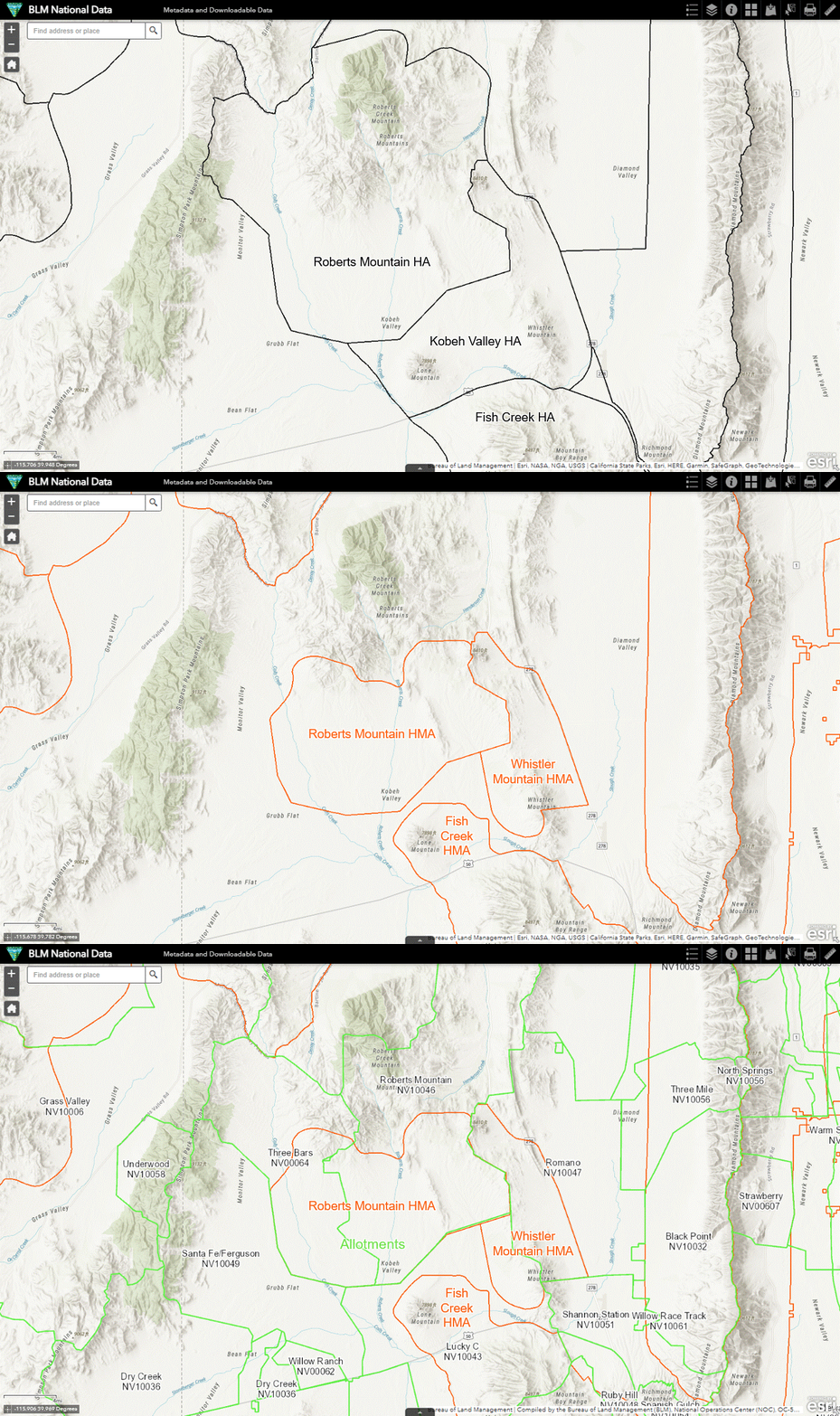
The National Data Viewer shows habitat loss and grazing allotments.  Click on image to open in new tab.

RELATED: Roberts Mountain Roundup Starts Next Week.

Roberts Mountain Complex with Allotments 10-16-23

Virginia Range Darting Update for October 2023

The Campaign Against America’s Wild Horses indicated in the October report that 120 mares received 121 doses of Zonastat-H during the month, 20 given as a primer and 101 as a booster.

Over the life of the program, which began in 2019, 1,961 mares have received an astonishing 8,231 doses of the ovary-killing pesticide.

Of the 169 foals born this year in the primary target zone, 85 have died.

The current population is thought to be 3,498 with 338 horses listed as missing, compared to 3,513 with 356 listed as missing in September.

Not discussed in the report:

  • Long-term population goal
  • Size of breeding population
  • Herd demographics
  • Risk of sterility

The program, now in its fifth year, is at the point of no return.

The report will be submitted to the Nevada Department of Agriculture.

RELATED: Virginia Range Darting Update for September 2023.

Pesticides R Us Better Way 11-07-23

Roberts Mountain Roundup, Day 15

The incident began on October 22.  Results through November 5:

  • Scope: Roberts Mountain, Whistler Mountain, Fish Creek HMAs
  • Purpose: Pest control, resource enforcement, rancher protection
  • Target: Horses
  • Type: Planned
  • Method: Helicopter
  • Category: Cruel and costly*
  • Better way: Sterilize mares with pesticide-laced darts*
  • Captured: 858, up from 817 on Day 13
  • Average daily take: 57.2
  • Capture goal: 1,106
  • Removal goal: 1,068
  • Returned: None
  • Deaths: 9, up from 6 on Day 13
  • Shipped: 774, up from 668 on Day 13

The location of the trap site was not given.

Gather operations concluded on Day 15 but shipping will continue for another day or two.

A filly was put down on Day 15 because of club feet.  Two mares were also dispatched because of blindness.

The death rate is 1.0%.  Horses lost in the Day 9 truck rollover are not included in the total.

The capture total includes 338 stallions, 397 mares and 123 foals.

Youngsters represented 14.3% of the animals gathered, suggesting the herd is growing at a rate of 9% per year.

Of the adults, 46.0% were male and 54.0% were female.

Body condition scores ranged from 3 to 5 on Days 14 and 15.

The HMAs and surrounding lands are subject to permitted grazing.

*According to advocates.

Roberts Mountain Complex with Allotments 10-16-23

Day 15 ended with 75 unaccounted-for animals.

Data quality has been good.

Up to 19 mares will be treated with GonaCon Equine, a fertility control pesticide, before being returned to the range with up to 19 stallions.

Other statistics:

  • Forage liberated to date: 10,296 AUMs per year
  • Water liberated to date: 8,580 gallons per day
  • Forage assigned to livestock: Undetermined
  • Horses displaced from Complex by permitted grazing: Undetermined
  • True AML: Undetermined
  • Stocking rate at new AML: Undetermined
  • Horses removed because of drilling and mining: Ask the advocates

Overpopulation means more horses than allowed by plan, not more horses than the land can support.  If this was not true, you’d see body condition scores of 3 or less.

The roundup was authorized because the horses have been trying to reclaim some of their food from the ranchers, not because they’re starving.

RELATED: Roberts Mountain Roundup, Day 13.

CAAWH Releases Year 4 Darting Summary for Virginia Range

The Year 4 Report has been available for months at its darting resources page, but it contained some incriminating information that has been scrubbed from the summary.

So the statement in today’s announcement about releasing the Year 4 results should say re-releasing (and sanitizing) them for its gullible/uninformed/misinformed audience.

The aim of the Campaign Against America’s Wild Horses is to convince you that removal by pesticide is better than removal by helicopter.

Better Way 10-25-23

They don’t want you asking why removal occurs or if it’s even necessary.

Let’s set the record straight:

  • PZP is a pesticide, not a vaccine.  It’s not reversible.  Damage begins with the first injection and progresses to sterility after five consecutive years.
  • The darting program is now in its fifth year, the point of no return.  Many of the mares are now at risk of sterility.
  • This is intentional, a design feature, not a drawback.  They are not having second thoughts.
  • Additional benefits include abnormal sex ratios, increased death rates and loss of genetic diversity.
  • The goal is to establish a fully contracepted herd that dies off, as the Park Service envisions for the horses at Theodore Roosevelt National Park.
  • Sterilizing mares with pesticide-laced darts does not qualify as conservation or protection.
  • Permitted grazing occurs on BLM land in the south.  Getting rid of the horses helps the ranchers.
  • CAAWH advocates for hunters, ranchers and bureaucrats who manage the public lands for their benefit, not wild horses.

The darting program update for October has not been posted as of this morning but is expected this week.

RELATED: The Superiority Complex of the Wild Horse Advocates.

Pesticide Pushers 07-17-23

Roberts Mountain Roundup, Day 13

The incident began on October 22.  Results through November 3:

  • Scope: Roberts Mountain, Whistler Mountain, Fish Creek HMAs
  • Purpose: Pest control, resource enforcement, rancher protection
  • Target: Horses
  • Type: Planned
  • Method: Helicopter
  • Category: Cruel and costly*
  • Better way: Sterilize mares with pesticide-laced darts*
  • Captured: 817, up from 761 on Day 11
  • Average daily take: 62.8
  • Capture goal: 1,106
  • Removal goal: 1,068
  • Returned: None
  • Deaths: 6, up from 4 on Day 11
  • Shipped: 668, up from 551 on Day 11

The location of the trap site was not given.

A mare was put down for blindness in one eye on Day 12, a non-life-threatening condition, followed by another on Day 13.

The death rate is 0.7%.  Horses lost in the Day 9 truck rollover are not included in the total.

The capture total includes 319 stallions, 379 mares and 119 foals.

Youngsters represented 14.6% of the animals gathered, suggesting the herd is growing at a rate of 10% per year.

Of the adults, 45.7% were male and 54.3% were female.

Body condition scores ranged from 3 to 6 on Days 12 and 13.

The HMAs and surrounding lands are subject to permitted grazing.

*According to advocates.

Roberts Mountain Complex with Allotments 10-16-23

Day 13 ended with 143 unaccounted-for animals.

Up to 19 mares will be treated with GonaCon Equine, a fertility control pesticide, before being returned to the range with up to 19 stallions.

Other statistics:

  • Forage liberated to date: 9,804 AUMs per year
  • Water liberated to date: 8,170 gallons per day
  • Forage assigned to livestock: Undetermined
  • Horses displaced from Complex by permitted grazing: Undetermined
  • True AML: Undetermined
  • Stocking rate at new AML: Undetermined
  • Horses removed because of drilling and mining: Ask the advocates

Overpopulation means more horses than allowed by plan, not more horses than the land can support.  If this was not true, you’d see body condition scores of 3 or less.

The roundup was authorized because the horses have been trying to reclaim some of their food from the ranchers, not because they’re starving.

RELATED: Roberts Mountain Roundup, Day 11.

Advocate Takes McCullough Plea to Casper

This letter to the editor marks her third attempt to forestall the bait-trap removal at McCullough Peaks, which was set to begin on November 1.

She’s so far gone and so lost in the pesticide paradigm that she can’t even see that she’s advocating for the ranchers, not the horses.

Let’s take a closer look.

From the second paragraph: To avoid motorized removal, the BLM implemented a reversible birth control program using Porcine Zona Pellucida.  This program, administered through field darting, reduced the birth rate to 2% annually, keeping the herd’s numbers within the appropriate management level of 70-140 horses.

It’s not reversible!  Damage begins with the first injection and progresses to sterility after five consecutive years.  This is happening at the Virginia Range.  The advocates refer to these mares as self-boosting.

If the birth rate is 2% per year, the growth rate is -3% per year, assuming a 5% death rate, meaning the herd is shrinking.  Exactly what the ranchers want!

Third paragraph: The BLM’s plan involves trapping and removing 41 or more wild horses and using a controversial fertility control vaccine called GonaCon on the mares, for which preliminary evidence indicates permanent sterility.

It’s a pesticide not a vaccine!  Vaccines prevent illness, supposedly.

A 2017 labeling amendment extended the interval between primer and booster from 30 days to 90 days but the BLM ignores it, an issue for law enforcement.

The remark about sterility is likely true, because the agency prefers it almost exclusively to PZP.  Just look at the news releases over the past year.  The condition is sometimes described as long-term infertility.

Fourth paragraph: The aging herd, with a significant portion over 15 years old and 22 horses over 20 years old, requires a population of at least 150 breeding aged adults for genetic viability.  To make matters worse, the operation is scheduled to take place next month, before the impact of winter conditions can be assessed, possibly resulting in a slow decline toward extinction of this cherished herd.

That’s not the concern!  It’s the size of the breeding population that matters.  The 2% birth rate suggests it’s very small and that would be true if the AML was 500.

Describing the herd as “cherished” suggests she walks in lockstep with the Campaign Against America’s Wild Horses, a leader in nonmotorized removal.

No word about resource management and the prevalence of livestock in the HMA.

Next to the federal government, nobody’s getting rid of more wild horses and causing more long-term harm than the advocates.

RELATED: Advocate Doubles Down on McCullough Remarks.

The Superiority Complex of the Wild Horse Advocates

Opposition to wild horses is expected from hunters, ranchers and bureaucrats who manage the public lands for their benefit.

But not from the advocates, who claim to be voices for the horses.

One of the most pressing issues in the wild horse world is to expose, dislodge and dismantle these groups, prohibiting their staff and membership from ever stetting foot in areas identified for wild horses.

Consider this example from the Virginia Range:

Scenario A, man kills stallion with arrow.  Horse not replaced because the advocates have poisoned the mares with Zonastat-H

  • Effect on population: -1

Scenario B, stallion dies of natural causes and is not replaced because the advocates sterilized the mares with Zonastat-H

  • Effect on population: -1

Scenario A is bad, but Scenario B is good, according to the advocates.

Barren mares, shrinking herds and loss of genetic diversity are also good and the advocates are positioning themselves to be leaders in the industry.

Getting Rid of Wild Horses Is Our Job 10-14-23

They use footage from roundups to convince you that removal by pesticide is better than removal by helicopter.

Better Way 10-25-23

They want you to think they have all the answers.  They can’t distinguish between cause and effect, and won’t look at the data, so they don’t even know what the problem is.

Changing the Way Herds are Managed 11-04-23

And they hate dissent.  If you disagree with them, or their allies, you’ll be disappeared by their big-tech minions.

Best Way to Achieve AMLs 10-26-23

This commentary was inspired by the real estate agent and PZP darter in the Minden/Gardnerville area, whose column about inhumane treatment of animals appears in the October edition of Horse Tales, starting at the bottom of page eight.

Naturally, she absolved herself and other field workers from any wrongdoing and couldn’t heap enough praise on the Campaign Against America’s Wild Horses and Wild Horse Eradication, two of the greatest offenders.

Next to the federal government, nobody’s getting rid of more wild horses and causing more long-term harm than the advocates.

RELATED: Combatting Duplicity in the Wild Horse World.

Working Together for a Horse-Free Future 12-21-22