
Compare the comings and goings of family bands in this video to the free-for-all in today’s episode of Foal-Free Friday.
Month: March 2023
Foal-Free Friday, Developing a Critical Eye Edition
In the following video, the advocates see wild horse families being wild and free.
What do you see?
There are no foals, no families.
The natural order has been disrupted.
The mares have been poisoned with a restricted-use pesticide.
The average age of the herd is increasing, along with the death rate.
Females outnumber males by a growing margin.
The Salt River Wild Horse Darting Group is responsible for the destruction, and they want you to pay for it.
They receive support and encouragement from the Campaign Against America’s Wild Horses, a leader in the wild horse removal industry.
RELATED: Foal-Free Friday, Insulating You from the Truth Edition.
Velma Remembered During Women’s History Month
Contrary to remarks in this news release by AEA, today she has few if any disciples.
Most of the advocates want the herds destroyed with their favorite pesticide.
As for the Virginia Range—referred to in the announcement as the hills of the Comstock Lode—supporters of SB90, including the Campaign Against America’s Wild Horses, want it remembered as one of the largest fertility control programs for wild mustangs, not the origin of her efforts to save them.

BLM Setting Stage for Emergency Roundups?
Forage is hard to find and body condition scores in the Triple B HMA are low, according to a story by KTNV News of Las Vegas.
The agency shared the findings on socialist media.
The article did not indicate if the most noble and deserving non-native species on America’s public lands had been similarly affected. Perhaps it is still off season.
Beebe Ranch Fundraiser, Day 10
The grand total, including donations from GoFundMe, checks mailed and contributions at the museum’s web site, has passed $100,000, the first milestone according to today’s update.
The GoFundMe total, representing about two thirds of the grand total, has increased from $60,015 on Day 7.

The museum has 30 days to match the developer’s bid. Donations can be made here.
Cedar Mountain Advocate Mum on Permitted Grazing
She has identified every water source in the HMA and has worked with stakeholders to ensure the water continues to flow.
She’s documented 65 bands, the largest with 13 members.
Bachelor stallions make up 16.3% of the population.
Almost one third of the horses are pintos.
But she doesn’t see any livestock.
The ratio of females to males is not given nor the percentage of foals.
The herd is subject to the Montana Solution according to the February 7 roundup schedule but she does not say if she’s involved.
She’s with the Campaign Against America’s Wild Horses, defender of the ranchers, and you can read her story on the propaganda page hosted by Lucky Three Ranch.
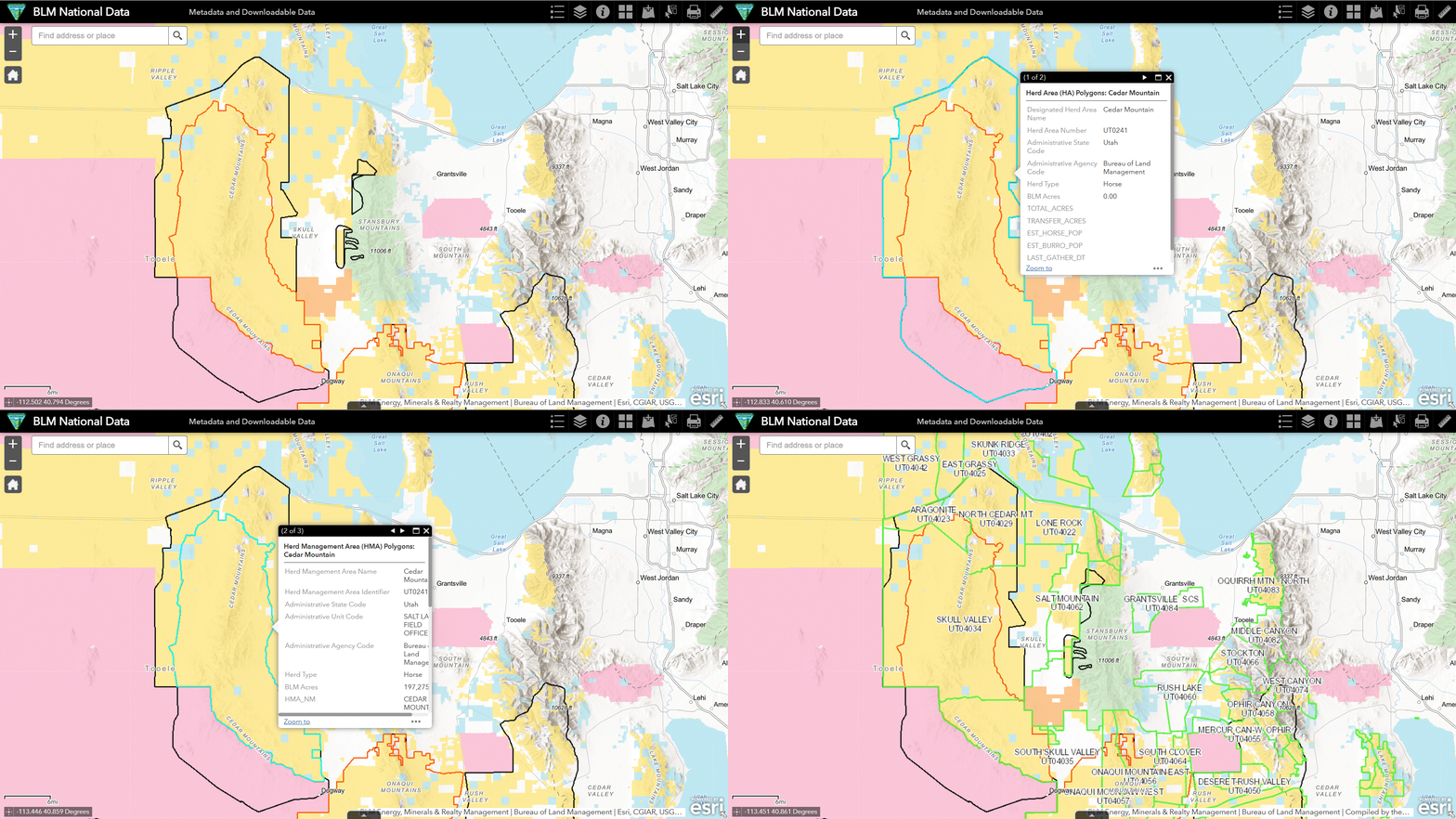
In this map from the National Data Viewer, the HA boundary is black, the HMA border is orange and the allotment boundaries are green. Click on image to open in new tab.
RELATED: How Many Wild Horses Can the Cedar Mountain HMA Support?
SB90 Hearing Today
It’s the only item on the agenda.
The preamble designates the Virginia Range as one of the largest humane management programs for wild mustangs, an insult to Velma’s legacy.
Do you think she’d throw in with the advocates as they poison the mares with a restricted-use pesticide?
The Campaign Against America’s Wild Horses proudly supports the bill, according to a story by the Las Vegas Sun.
No surprise. They are perpetrators of the destruction.
The darting program, now moving into its fifth year, has put many of the mares at risk of sterility.
The bureaucrats and ranchers are following the case with great interest.
Reason for Roundups Revealed
Fragmented by what? Livestock fencing? Cattle guards? Pasture rotation?
Areas identified for wild horses but subsequently zeroed out are now managed almost exclusively for livestock.
How can you be recognized as an authority on wild horses, raking in untold financial support, yet be so out of touch?

Mustang Monday
At Washoe Lake, southwest corner of Virginia Range, with Nomad Drone.
Beebe Ranch Fundraiser, Day 7

Commissioners to Ban Feeding of Placitas Wild Horses?
They’re taking public comment on the proposal, according to a story dated February 24 by the Corrales Comment.
The topic does not appear on their March 8 meeting agenda.
A web page managed by the County indicates that Mt. Taylor Mustangs was hired to apply the Montana Solution to the herd, which is considered the industry standard wildlife fertility control method that has been successfully used for decades.
Success, of course, means gradual extermination.
The fourth quarter update indicates 168 horses roaming in 22 bands, with 80 treatments delivered and six foals born in 2022.
A herd of that size would probably see eight to nine deaths in the same period, meaning the herd is probably shrinking, a hallmark of PZP darting programs.
Western States Horse Expo Resumes This Year?
The event was cancelled last year. Attendance was light the year before.
This year, it’s set for June 9 to 11 at the Murieta Equestrian Center, Rancho Murieta, CA.
No schedule has been posted.
Practice with Forage Allocations
Livestock grazing represents one layer of forage demand on America’s public lands, followed by wild horses and wildlife.
To estimate the carrying capacity of an HMA or WHT, you have to determine the forage assigned to livestock and the number of wild horses displaced thereby.
The Socorro Field Office recently posted a Draft CX for the renewal of five grazing permits in western New Mexico.
Comments can be submitted at the project site through March 12.
Table 1 in the CX provides livestock types, grazing seasons and active AUMs.
The Allotment Master Report at RAS is not working so the management status and public acres were sourced from the Allotment Information Report.
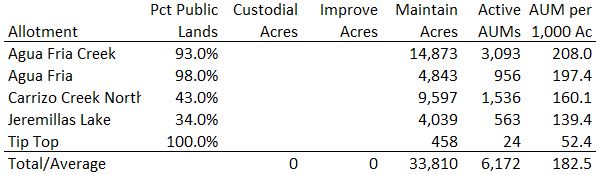
The allotments are not contiguous and don’t overlap any HMAs, but you can still use the data for practice.
The weighted average forage density is 182.5 AUMs per year per thousand public acres, enough to support 182.5 ÷ 12 = 15.2 wild horses per thousand public acres, or 30.4 wild burros per thousand public acres.
Public lands in the western U.S. can only support one such animal per thousand acres according to the BLM (27,000 animals on 27 million acres).
The forage assigned to livestock would support an additional 6,172 ÷ 12 = 514 wild horses.
If the allotments coincided with an HMA that has an AML of 60, the True AML would be 574.
If the current herd was at 4X AML, there would be no excess horses in the HMA but the advocates would try to beat the population down with their favorite pesticide, because they want the ranchers to succeed, not the horses.
RELATED: AMLs and Carrying Capacities.
Beebe Ranch Fundraiser, Day 5

SB90 Dishonors Virginia Range and Velma’s Legacy
It’s not ground zero in the wild horse preservation movement.
It’s not the most glaring example in the western U.S. that contradicts the overpopulation narrative and statements by the bureaucrats and ranchers about how many wild horses the land can support.
Instead, the Virginia Range is one of the largest humane management programs for wild mustangs according to the bill text, a product of the Nevada Department of Agriculture and the Campaign Against America’s Wild Horses.
Did you know that Velma Johnston advocated for humane management of wild horses, a euphemism for destroying their ovaries with a restricted-use pesticide?
A story posted yesterday by KOLO News said the Nevada Senate Committee on Natural Resources will consider the measure on March 7, consistent with the overview at NELIS.
Foal-Free Friday, Insulating You from the Truth Edition
What’s the major difference between roundups and fertility control programs?
The herds bounce back after roundups.
The advocates tell you that PZP is safe and reversible while GonaCon is a sterilant, but the only difference is timing: GonaCon sterilizes with one or two doses while PZP requires five or six.
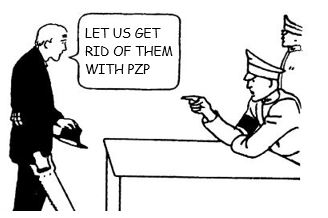
Thus, the Montana Solution is to wild horses as the Final Solution was to Jews.
Gradual extermination of the pests.
The advocates refer to it as “a better way.”
The current lull in gather activity, and a roundup schedule dominated by fertility control programs, means the Campaign Against America’s Wild Horses, its affiliates, offshoots and supporters, are now the undisputed leaders in the wild horse removal industry.
Western Horse Watchers does not expect the pattern to continue, because the ranchers are impatient.
RELATED: Foal-Free Friday, Keeping Them Wild and Free Edition.
Beebe Ranch Fundraiser, Day 4
The numbers are changing minute by minute, but the total as of this evening represents about 6.6% of the goal.

The museum has 30 days to match the developer’s bid. Donations can be made here.
Advocate Can’t Understand Why Pine Nut Horses Disappearing
“They make us happy, we watch them grow, they have names, they have strong family bonds, we practice birth control and watch over them like mother hens. They are magnificent creatures.”
As suggested by this letter to The Record-Courier of Minden, NV, they don’t see themselves as part of the problem.
Adoptions Resume at Wheatland Off-Range Corrals
The facility will reopen after a yearlong closure with an online adoption event scheduled for March 13-20, according to a BLM news release.
The announcement did not indicate that nineteen horses died in those pens because of a strangles outbreak.
TRIC Manager Praises Virginia Range Darting Program
“There is a small faction of people in Nevada pushing for full extermination of wild horses,” according to the writer of a column in today’s edition of The Nevada Independent.
“Some want immediate removal of all wild horses and others want to get rid of wild horses a little at a time by cutting down the size of the herds well below what is needed for healthy breeding by frequent roundups and removals—death by a thousand cuts,” yet he applauds a variant of the latter carried out by the Campaign Against America’s Wild Horses and its army of volunteers.
Many of the mares are now at risk of sterility as the program moves into its fifth year, but because he doesn’t see any adverse effects, it must not be a concern.
The wild horse preservation advocates, as he calls them, look at the Virginia Range as a demonstration project, an opportunity to convince the bureaucrats and ranchers that they have a better way (to get rid of wild horses).
And they want you to pay for it.

 Western Horse Watchers Association