BLM, Media Feed Public Steady Diet of Disinformation

A BLM spokesman told The Grand Island Independent in a story about wild horse adoption at Husker Harvest Days that the herds are growing at a rate of 20% per year.

The article also indicated that climate change has reduced the carrying capacity of the land.

Anybody who reads these pages knows that birth rates of 25%, needed for growth rates of 20%, are rarely seen in roundup data.

For example, the blitzkrieg at South Steens, which took wild horses off the range at an average rate of 175 per day, yielded 19% foals in 525 horses captured.

The operation was so productive that the BLM decided to extend it by 50%.

Followers of this blog also know that permitted grazing has sharply reduced the carrying capacity of public lands, not man-made climate change, which is a hoax.

True AMLs often exceed current AMLs by a factor of four of five because the horses receive just fifteen to twenty percent of the authorized forage, neglecting wildlife.

Wild vs Feral: You Can’t Reason with an Idealogue

Refer to this opinion piece dated September 11 by Rod Miller, columnist for Cowboy State Daily, a reader response dated September 13 by Ross MacPhee of the American Museum of Natural History and this angry retort dated September 13 by Miller.

Why would Miller care about “horses that are munching our public grass?”

His bio says he was raised on the ID Ranch north of Rawlins, WY and has spent half his adult life working on and managing ranches in the West.

South Steens Roundup, Day 3

The incident began on September 10.  Gather stats through September 12:

  • Target: Horses
  • Type: Planned
  • Method: Helicopter
  • Category: Cruel and costly
  • Captured: 525, up from 225 on Day 1
  • Average daily take: 175.0
  • Capture goal: 500
  • Removal goal: 450
  • Returned: None
  • Deaths: 7, up from zero on Day 1
  • Shipped: 476 up from 175 on Day 1

The capture goal has been reached.

The figures above are based on the daily reports, not the totals posted by the BLM.

Five horses were put down on Day 2 due to pre-existing conditions, followed by two more on Day 3.

The death rate is 1.3%.

The capture total includes 194 stallions, 231 mares and 100 foals.

Youngsters represented 19.0% of the animals gathered.

Of the adults, 45.6% were male and 54.4% were female.

The herd can’t be growing at a rate of 20% per year with a birth rate of 19% per year.

A better estimate would be 14% per year, assuming a death rate of 5% per year.

Body condition scores were not provided.

The location of the trap site was not disclosed.

The HMA and surrounding lands are subject to permitted grazing.

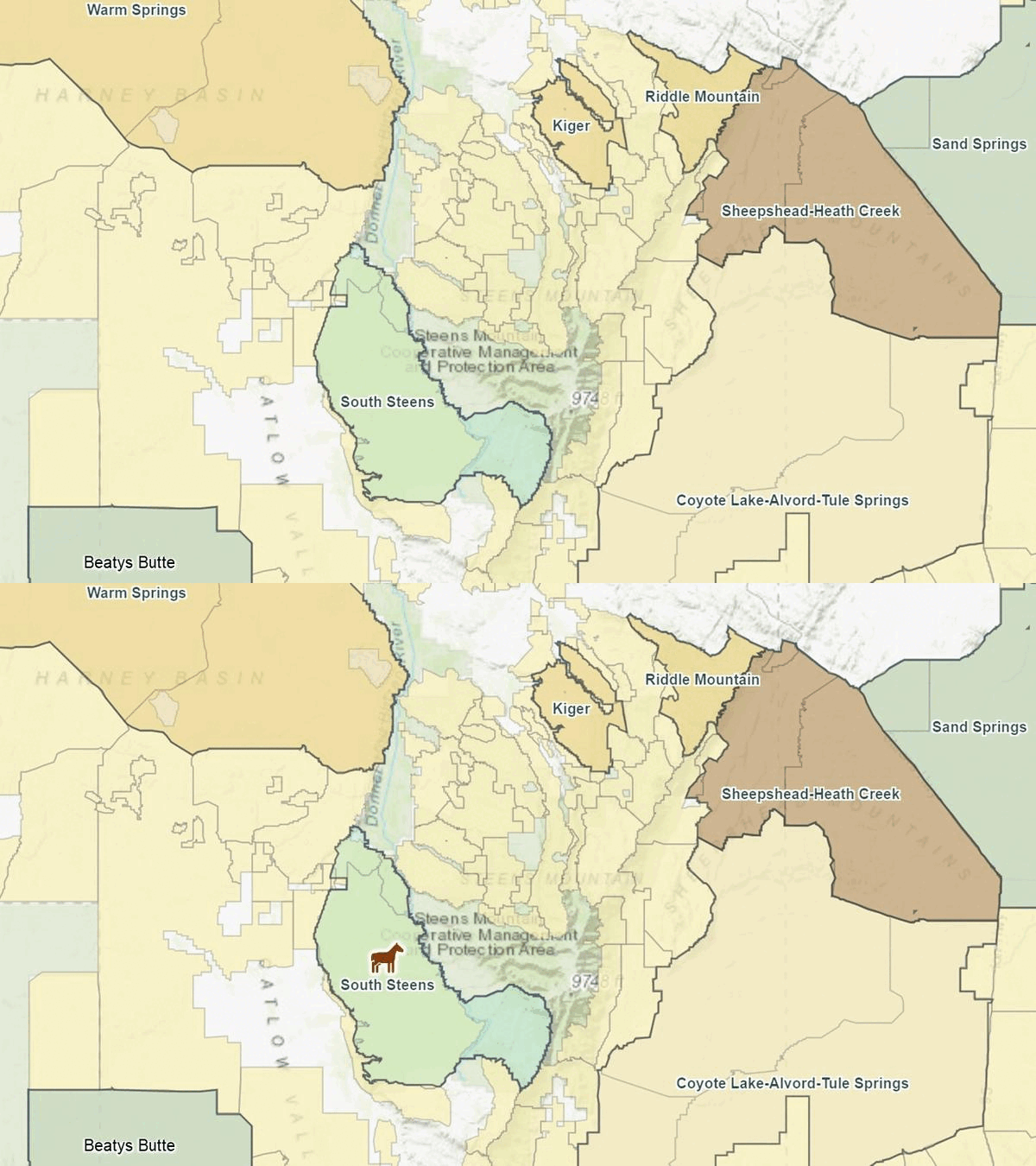
South Steens HMA Map 08-17-22

Day 3 ended with 42 unaccounted-for animals.

Mares treated with fertility control may be returned to the area at a later date.

Other statistics:

  • Horses allowed by plan (AML): 304
  • Forage assigned to horses: 3,648 AUMs per year
  • Pre-gather population: 1,370
  • Forage liberated to date: 6,300 AUMs per year
  • Water liberated to date: 5,250 gallons per day
  • Forage assigned to livestock: 10,299 AUMs per year (estimated)
  • Horses displaced from HMA by permitted grazing: 858
  • True AML: 1,162
  • Stocking rate at new AML: 8.6 horses per thousand acres
  • Horses displaced from HMA by drilling and mining: Ask the advocates

RELATED: South Steens Roundup Begins.

Calico Roundup, Day 3

The incident began on September 10.  Gather stats through September 12:

  • Target: Horses
  • Type: Planned
  • Method: Helicopter
  • Category: Cruel and costly
  • Captured: 235, up from 85 on Day 1
  • Average daily take: 78.3
  • Capture goal: 1,076
  • Removal goal: 1,036
  • Returned: None
  • Deaths: 5, up from 2 on Day 1
  • Shipped: 133, up from 43 on Day 1

The figures above are based on the daily reports, not the totals posted by the BLM.

The figures for Day 1 were updated to include 43 horses shipped.

Three females were euthanized on Day 2 for non-life-threatening conditions.

The death rate is 2.1%.

The capture total includes 90 stallions, 105 mares and 40 foals.

Youngsters represented 17.0% of the animals gathered.

Of the adults, 46.2% were male and 53.8% were female.

The herd can’t be growing at a rate of 20% per year with a birth rate of 17% per year.

A better estimate would be 12% per year, assuming a death rate of 5% per year.

Body condition scores were not provided.

The location of the trap site was not disclosed.

The HMAs and surrounding lands are subject to permitted grazing.

Calico Complex Map 09-07-22

Day 3 ended with 97 unaccounted-for animals.

Mares treated with fertility control may be returned to the area at a later date.

Other statistics:

  • Horses allowed by plan (AML): 952
  • Forage assigned to horses: 11,424 AUMs per year
  • Pre-gather population: 1,593
  • Forage liberated to date: 2,820 AUMs per year
  • Water liberated to date: 2,350 gallons per day
  • Forage assigned to livestock: Unknown
  • Horses displaced from Complex by permitted grazing: Unknown
  • True AML: Unknown
  • Stocking rate at new AML: Unknown
  • Horses displaced from Complex by drilling and mining: Ask the advocates

RELATED: Calico Roundup in Progress.

McCullough Fundraiser Benefits Ranchers Not Horses

The event will be held on September 17 at the Cody Holiday Inn according to an article posted yesterday by the Cody Enterprise.

The advocates at FOAL protect the horses from removal by getting rid of them with PZP.

FOAL Mixing PZP 01-18-22

A representative interviewed for the story said “The [darting] program keeps the herd at a sustainable level to minimize the need for roundups that are costly and also disrupt the family units and social structure within the herd,” exactly what they’re doing!

Livestock in the HMA receive 3.6 times more forage than the horses.

The BLM collects an estimated $8,230 per year in grazing fees from ranching activity inside the HMA while it spends $927,100 per year to care for the 508 wild horses displaced thereby.

That’s what the advocates are trying to protect.

RELATED: Youngsters Hard to Find at FOAL.

Cedar Mountain Pest Removal Starts This Week

The incident will begin on September 17, according to a BLM news release.

Helicopters will force the horses into the traps and operations will be open to public observation, starting on Day 3.

Gather activity on Days 1 and 2 will occur in the Dugway Proving Ground, a military facility not accessible by the public.

The September 7 schedule indicates capture and removal goals of 700 and 400.

The HMA covers 211,592 acres in western Utah, including 204,674 public acres.

The 390 horses allowed by plan require 4,680 AUMs per year.

The stocking rate allowed by plan is 1.9 wild horses per thousand public acres, higher than the target rate across all HMAs of one wild horse per thousand acres.

The pre-gather population is thought to be 920.

Cedar Mountain HMA Map 01-29-22

The HMA intersects four grazing allotments.  Livestock receive over three times more forage than the horses, as explained previously.

The BLM spends 113 times more to care for wild horses displaced from public lands by permitted grazing than it collects in fees from ranching activity inside the HMAs, as discussed yesterday.

Captured animals will be taken to the off-range corrals in Axtell.

Gather stats and daily reports will be posted to this page.

RELATED: Cedar Mountain Added to 2022 Roundup Schedule.

Chemehuevi Roundup, Day 30

The incident began on August 11 and does not appear in the latest schedule.

As of September 9, 194 burros have been trapped, 194 have been shipped and none have died, according to figures at the gather page.

The daily reports provide totals only.

The capture and removal goals are 275 each.

The cumulative total includes 92 jacks, 70 jennies and 32 foals.

Youngsters represented 16.5% of the animals gathered.

Of the adults, 56.8% were male and 43.2% were female.

The herd can’t be growing at rate of 20% per year with a birth rate of 17%.

The location of the trap site was not specified.

Day 30 ended with no unaccounted-for animals.

RELATED: Chemehuevi Roundup, Day 23.

Barren Valley, Indeed

The Alvord Allotment, subject of a grazing permit renewal, lies mostly within the Coyote Lake HMA, as previously noted.

Coyote Lake is one of three HMAs in the Barren Valley Complex of eastern Oregon.

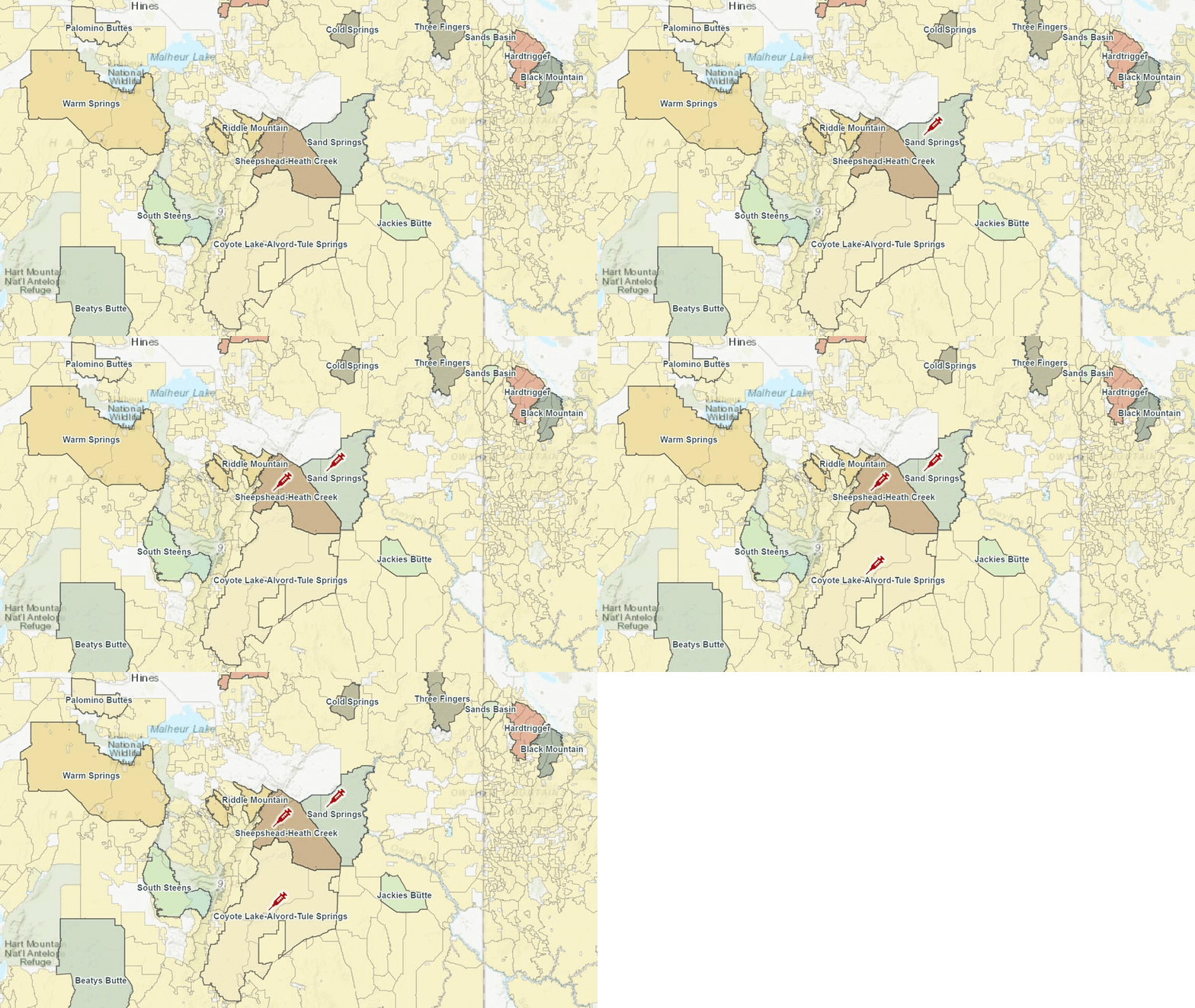
Barren Valley Complex Map 09-11-22

All three are subject to permitted grazing, which means the government is spending 113 times more to care for wild horses displaced by privately owned livestock than it collects in fees from ranching activity inside the HMAs.

For every 12 AUMs per year assigned to livestock inside an HMA, enough to support one wild horse, the BLM collects 12 × 1.35 = $16.20 per year.

The agency spends 1 × 5 × 365 = $1,825 per year to care for a horse removed from his lawful home in favor of a cow/calf pair, assuming he was placed in short-term holding.

The ratio is 1,825 ÷ 16.20 = 112.7.

This is a scam on American taxpayers.

The HMAs are also subject to darting programs of unspecified type, according to the latest roundup and fertility control schedule.

By driving birth rates downward, the advocates protect the ranchers and keep the gravy train rolling.

Would you be surprised if the field workers were ranchers or ranching sympathizers?

The organizers of the effort were not listed in the schedule.

In a news release last month for new grant opportunities, the BLM thanked High Desert Strategies for 150 barren mares on public lands in eastern Oregon.

Western Horse Watchers has been unable to find their home page, but they may have a presence on socialist media.

RELATED: New Grants Available for Wild Horse and Burro Management.

Price of Hay Unchanged

A bale of alfalfa-grass mix was $36 today, the same as July and August, 20 bales minimum.

The single-bale price was $37, also unchanged.

The price in July last year was $19 per bale, 20 bales minimum.

The average horse would need five bales per month, putting the cost of feed at $180 per AUM.

The public-lands ranchers currently pay $1.35 per AUM, a price that’s been stuck in a time capsule with only minor adjustments since the 1960s.

Taxpayers pick up the tab for the removal, processing and stockpiling of wild horses, allowing them to profit handsomely from this government giveaway.

One of their greatest fears is paying market rates to feed their animals.

RELATED: Price of Hay Hits New Record.

How Many Wild Horses Could the Alvord Allotment Support?

Renewal of the grazing permit is not mandatory.  Cancellation is one of the four alternatives evaluated in the revised EA.  Refer to Section 2.5 (page 30 in pdf).

Another rancher could acquire the base property and apply for a permit or shift his preference to Alvord from another allotment.

RMP amendments would be needed to permanently transfer the resources from livestock to wild horses.  Drafting a new HMAP won’t work.

Writing a new AMP to permanently transfer AUMs to livestock that are currently off limits to everybody, including wildlife and wild horses, probably isn’t valid either but that’s what the BLM appears to be doing at Alvord.

Over the last 49 years, the agency has allowed the permittees to access the resource 18 times, according to Section 1.1 of the EA.

The RMP amendments would confine the ranchers to their base properties, operating their businesses on their own land while paying the going rate to feed their animals.

No more gravy train, no more sucking on the government teat at the expense of America’s wild horses.

American Prairie recently flipped several allotments in Montana from livestock to bison.

The advocates, obsessed with the Montana Solution and the welfare of the ranchers, continue their assault on the horses.

If Alternative D was approved, 7,355 AUMs per year would be liberated.

Four of the Alvord pastures are outside the HMA, according to Map 3 of the EA, North and South Foothills, Pike Creek and Alvord Seeding.

Those pastures cover 18,161 acres, according to Table 1, about 7.9% of the acreage in the allotment.

The forage assigned to Alvord livestock inside the HMA would be (1 – .079) × 7,355 = 6,774 AUMs per year, assuming the resource is evenly distributed across the allotment, enough to support 564 wild horses.

This does not include the suspended AUMs.

If the RMPs were revised as noted above, the AML could be increased from 390 to 954.

The allotment covers about a third of the HMA, so the AML could likely go much higher.

The BLM collects $9,145 per year in grazing fees from ranching activity inside the Alvord portion of the HMA while it spends $1,029,300 per year to care for the horses displaced thereby.

The BLM is not asking us to vote on the four alternatives, but as taxpayers, the option that helps the horses and reduces the burden on us is obvious.

RELATED: Alvord Allotment Confusion?

Alvord Allotment Map 09-08-22

Alvord Allotment Confusion?

One permittee holds all of the active AUMs in the allotment, according to Section 1.1 of the revised EA for permit renewal and new AMP.

The Allotment Master Report shows three.

Section 1.1 ties all of the active AUMs to authorization #3602552, which corresponds to Tom Davis Livestock.

The suspended AUMs are on authorization #3601175, T&T Livestock.

Section 1.1 indicates that Davis can lease out portions of the preference to other operators, so Stoddart and T&T may be lessees.

RELATED: AMPs Must Conform to RMPs?

AMPs Must Conform to RMPs?

If a resource management plan puts some of the forage in an allotment off limits to grazing, can an allotment management plan move that resource into active status?

Western Horse Watchers believes the answer is No.

Table 2 and the discussion in Section 1.1 of the revised EA for permit renewal in Alvord Allotment suggest that the 1,892 AUMs in question are still in suspended status in the Andrews Management Unit and Steens Mountain Cooperative Management and Protection Area Resource Management Plans and Records of Decision.

You can’t write a Herd Management Area Plan that assigns 98% of the authorized forage to wild horses when the RMP allocates 84% to livestock, as previously noted.

The project must be preceeded by an RMP amendment.

Likewise, you can’t write an Allotment Management Plan that puts 1,892 suspended AUMs into play without changing the RMPs first?

Further, how do you justify the assignment of those AUMs to privately owned livestock when the pastures in question are in the lawful home of wild horses?

RELATED: Alvord Permit Renewal Out for Review, Again.

Alvord Allotment Map 09-08-22

Cedar Mountain Added to 2022 Roundup Schedule

The capture and removal goals in the September 7 update are 700 and 400, bringing the totals to 23,841 and 20,923.

The totals in the August 10 update were 23,238 and 20,590.

The goals announced in January were 22,000 and 19,000.

An announcement for Cedar Mountain has not appeared at the BLM news site as of this morning but the schedule shows a start date of September 17.

RELATED: Cedar Mountain Decision Issued.

Foal-Free Friday, Barren Mares and Paragliders Edition

The advocates have assured us that herds treated with the Montana Solution suffer no adverse effects and they exhibit the full range of wild behaviors in a natural setting.

Meanwhile, herd sizes go down, death rates go up, females outnumber males and mares become sterile.

Massive human involvement turns those areas into curated horse exhibits.

“Stay Wild” is a ruse.

Lying to the public must be part of the curriculum at the Billings school of PZP darting.

RELATED: Foal-Free Friday, You’re Not Supposed to Notice Edition