Refer to this story by AP News, posted today. The investigation would focus on the slaughter pipeline, not the resource allocations and land-use plans that drive the roundups and downstream programs.
RELATED: New AIP Safeguards in the News.

Western Horse Watchers Association
Exposing the Hypocrisy, Lies and Incompetence of the Wild Horse Advocates
Refer to this story by AP News, posted today. The investigation would focus on the slaughter pipeline, not the resource allocations and land-use plans that drive the roundups and downstream programs.
RELATED: New AIP Safeguards in the News.
The incident began on August 15. Gather stats through August 17:
One death occurred on Day 1 and another on Day 2, both due to pre-existing conditions.
Foals accounted for 26.9% of the horses gathered. Of the adults, 42.8% were male and 57.2% were female.
Body condition scores were fours and fives.
Day 3 ended with no unaccounted-for animals. Gather operations will likely conclude in another day or two.
Other statistics:
RELATED: Stinkingwater Roundup Begins.
A Decision Record for resource enforcement actions in the Sand Wash Basin HMA over the next ten years was signed today, according to a BLM news release.
The Proposed Action, authorized thereby, features gathers and removals to low end of AML, fertility control and sex ratio skewing via selective return. Refer to page 14 in the Final EA, posted with other project documents.
A roundup is set to begin in the area on September 1 per the latest schedule.
RELATED: Comments Invited on Draft EA for Sand Wash Gather Plan.
Management of the Virginia Range mustangs should be left to them.
If you get too close to wild horses, you might receive a citation.
If you feed them you might be accused of unlawful conduct.
If you shoot them with darts you might be charged with animal cruelty.
Not so for the advocates.

This is the double standard of the wild horse world.
The incident started on August 15, with 162 horses captured, 131 shipped and one death. The gather page said body condition scores were four to five.
The announcement by WVEC News did not indicate if the advocates would be discussing their fertility control program and if viewers would be asked to accept statements such as “Few horses remain but we’re darting as many as necessary.”
The writer of the original piece, posted on August 5, criticized the ranchers.
In two subsequent letters, both posted yesterday, the ranchers push back.
The author of one response said the roundup was necessary due to the drought and loss of forage by the Oil Springs fire.
Let’s accept that as true. When conditions improve, are the horses going to be returned? Of course not! The goal was not to save them, but to get rid of them.
What do you suppose will return to normal levels when food and water reappear?
Another letter points to rangeland degradation caused by wild horses, citing the benefits of permitted grazing.
Problem is, the data don’t support the claim: Approximately 74% of BLM grazing land in Colorado does not meet standards for rangeland health.
The area accessible to wild horses in the state is tiny compared to the acreage designated for livestock.
Check out this listing in the Minden/Gardnerville area of western Nevada. The property features wild horses (probably associated with the Pine Nut Mountains HMA).
The agent is a PZP darter and occasionally writes about getting rid of them in Horse Tales, a trade publication from the same area.
BLM announced today that 450 wild horses will be removed from the Stone Cabin HMA, starting on or about August 19, due to inadequate forage.
Horses will be drawn into the traps with water and hay and the incident will not be open to public observation.
The HMA covers 407,700 acres near Tonopah, NV and has an AML of 364. The aimed-at stocking rate is 0.9 wild horses per thousand acres, slightly less than the average rate of one wild horse per thousand acres across all HMAs.
Stone Cabin foals are often dark in color but transition to roan in three or four years, continuing to become more grey until they are nearly white by age 15.
The first roundup under the WHB Act occurred here in 1975.
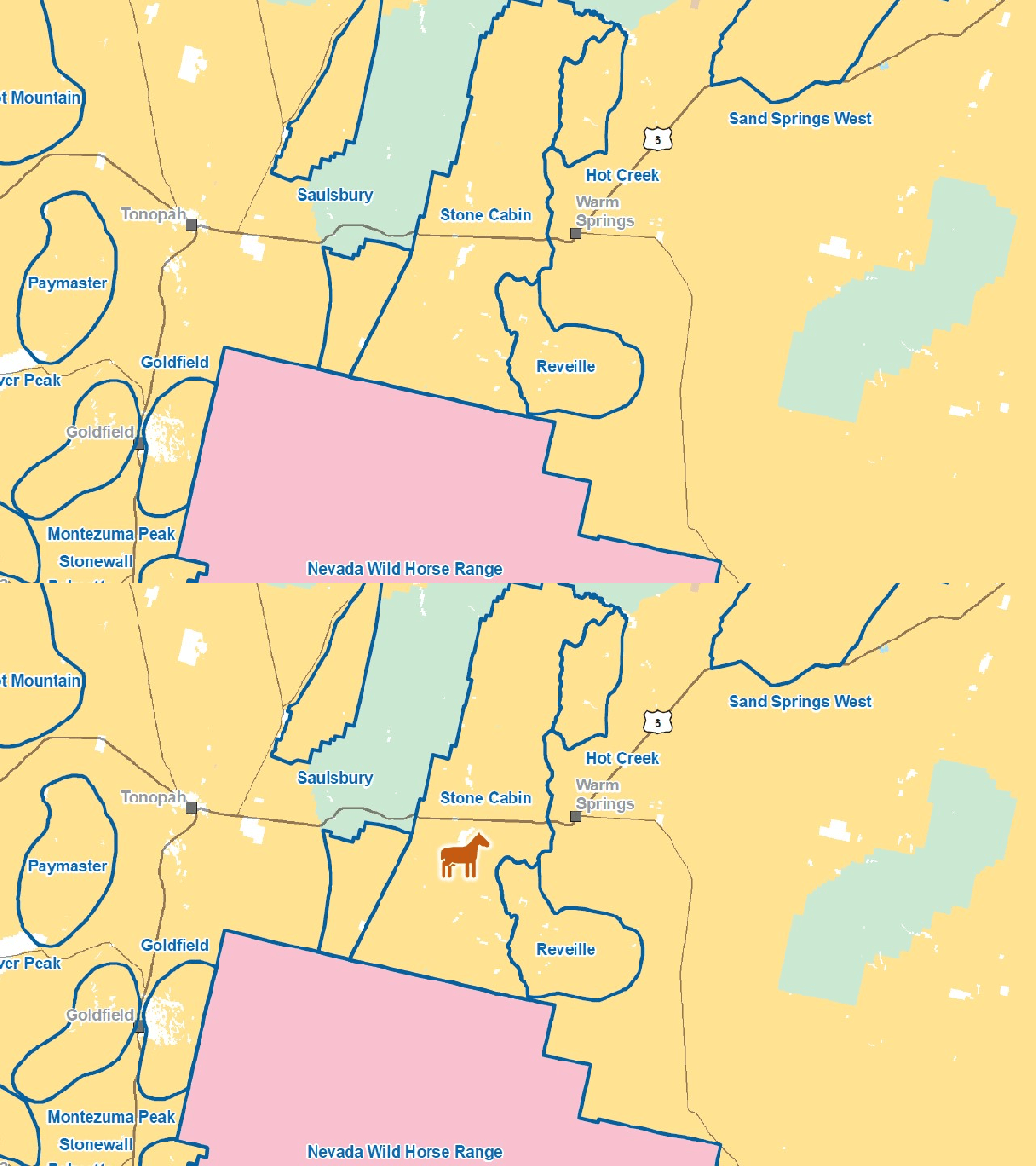
Western Horse Watchers was unable to find an environmental assessment in ePlanning for resource enforcement actions in the HMA, so grazing status is unknown.
Captured animals will be taken to the off-range corrals in Sutherland, UT.
A page for gather stats and daily reports has not been created as of today.
Gather ops concluded on August 13 with 457 horses captured and eleven deaths, but the disposition of 109 unaccounted-for horses is not known. No additional shipments have been reported.
A notice at the gather page says that 52 horses taken near the Utah state line were tested for equine infectious anemia, all negative, but will be separated from other animals at the off-range corrals until they are cleared of any potential infections.
RELATED: West Douglas Roundup Day 19.
The incident began on August 2. Gather stats through August 15:
The death rate is 0.4%.
Foals accounted for 17.8% of the horses gathered. Of the adults, 44.5% were male and 55.5% were female.
Body condition scores were not reported.
The gather page shows 1102 horses captured but the daily figures sum to 1101. The page also shows 962 horses shipped but the daily reports yield 958.
Day 14 ended with 139 unaccounted-for animals.
Other statistics:
RELATED: Antelope Roundup Day 12.
The incident began on August 11. Gather stats through August 15:
One death occurred on Day 5 due to pre-existing conditions. No details were given.
Foals accounted for 27.3% of the horses gathered. Of the adults, 38.6% were male and 61.4% were female.
Body condition scores were not reported.
Day 5 ended with 33 unaccounted-for horses.
Other statistics:
RELATED: Conger Roundup Day 3.
No charges have been filed according to a report by the CBS affiliate in Sacramento, CA.
Voluntary reductions in livestock grazing don’t change land-use plans. When conditions improve, grazing will resume at normal levels. Story by FOX 13 News of Salt Lake City.
RELATED: Onaqui Wild Horses Returned to Range.
On the Salt River with Larry J Dub. No youngsters though, thanks to the advocates.
Refer to this story dated August 13 by the Milwaukee Journal Sentinel. Twenty horses, private water system, no power. Fire department to the rescue.
A growing concern out west is the local utility shutting off your power in the name of public safety.
RELATED: Rural Water Systems – Power.
A story posted August 4 by This Is Reno considers a key finding from a USGS study: Greater sage-grouse populations may continue to decline—by more than 70% within areas where the horses live by 2034—of horse populations continue increasing at current rates.
Let’s take a closer look at ‘areas where the horses live.’ How many of them are not occupied by privately owned livestock? How did the researchers get a clean separation between the effects related to horses and those related to livestock, a problem known as ‘confounding?’ Who commissioned the study?
A subsequent column in the Sierra Nevada Ally dated August 8 asks similar questions.

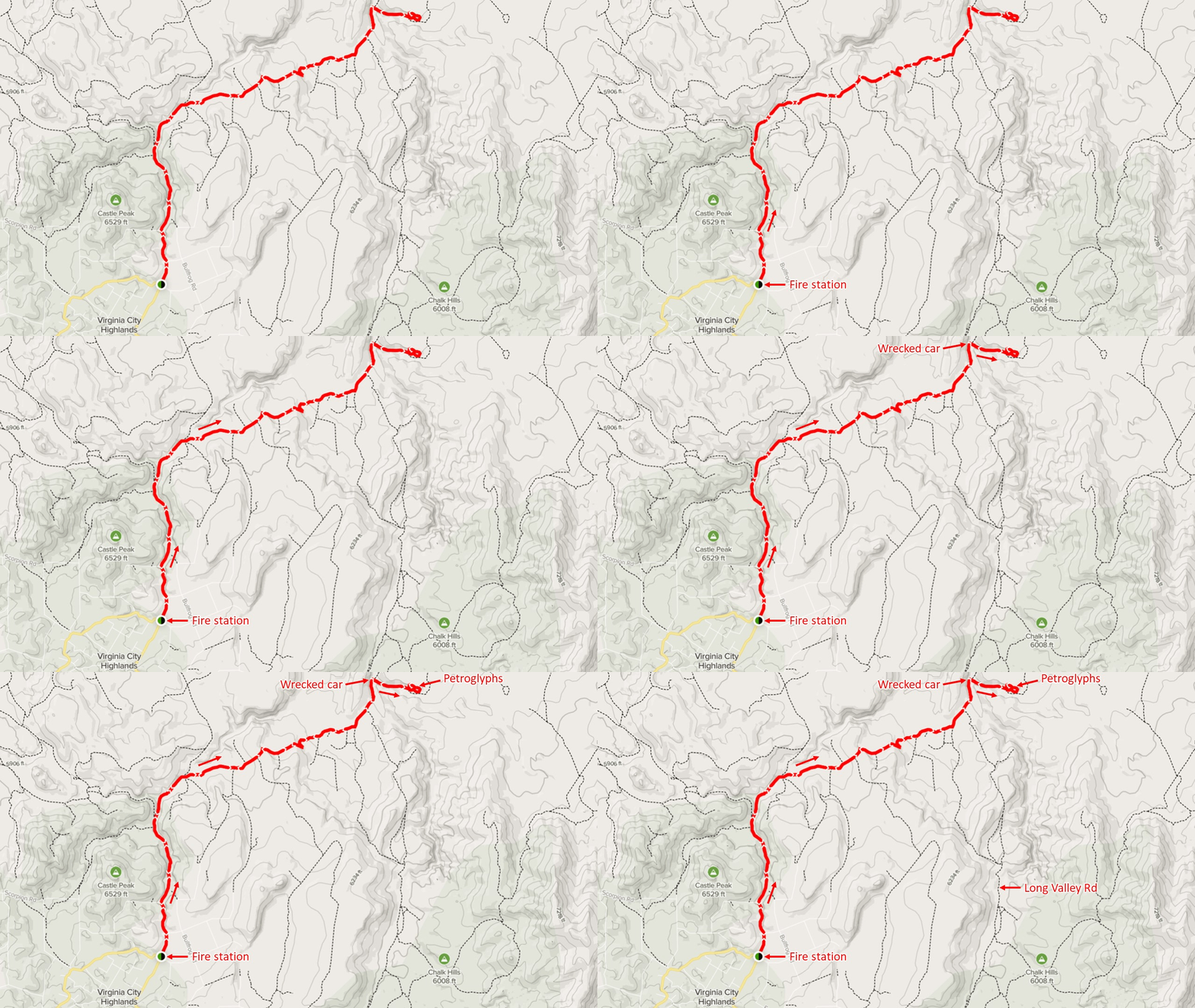
A map at AllTrails dot com shows the route described in the story by Nevada Appeal, starting at the Storey County fire station. It’s about seven miles each way.
An alternate route, mentioned in the article, involves Long Valley Road, which passes by the Chalk Hills.
Western Horse Watchers has not made the journey but it’s on the bucket list.
Most of the land in this area is privately owned.
RELATED: Unexpected Petroglyph at Lagomarsino Canyon?
It’s open season on the equestrians.
The incident began on August 2. Gather stats through August 13:
The death rate dropped to 0.4%.
Foals accounted for 17.1% of the horses gathered. Of the adults, 44.8% were male and 55.2% were female.
Body condition scores were not reported.
The gather page says 730 horses shipped but the daily reports yield 727.
Day 12 ended with 223 unaccounted-for animals (954 – 4 – 727).
Other statistics:
RELATED: Antelope Roundup Day 10.
 Western Horse Watchers Association