Castration Better Than Spaying?

The writer of a letter to the Las Vegas Review-Journal says it’s the easiest and cheapest way to curtail herd growth.

Why would you want to curtail herd growth?

Look at the gather area for the new Desatoya resource enforcement plan, currently out for review.  The boundary, denoted in red, extends well beyond the HMA.

Desatoya Gather Plan Map

When you carve out over 80% of their food and sell it to public-lands ranchers, don’t you think the horses might outgrow the remaining resources fairly quickly and move off the reservation in search of new ones?

That puts them into areas managed exclusively for wildlife and the most noble and deserving inhabitants of America’s public lands: Privately owned livestock.

RTF Tries to Stop Sterilization of Confusion Wild Mares

Return to Freedom filed suit today in federal court to block the plan, according to a news release, arguing that contraceptives should be used to control herd sizes.

The resource allocations and management priorities that leave wild horses with crumbs on public lands in the western U.S., in favor of privately owned cattle and sheep, were not mentioned in the announcement.

The group is a signatory to the rancher-friendly ‘Path Forward,’ a plan to manage wild horse areas primarily for livestock.

RELATED: Why Should You Oppose Sterilization of Wild Mares?

Best Place to See Oregon Wild Horses Is In the BLM Corrals?

That’s what the writer of a letter to the Pagosa Daily Post was told.

As for the number of livestock allowed on America’s public lands, the figure offered by the writer is a fairly good estimate.

The BLM sells about 12 million AUMs per year to public-lands ranchers.  If you assume an average grazing season of six months per year, that’s two million cow/calf pairs.

That forage would support one million wild horses, enough to empty all of the off-range corrals and long-term pastures twenty times over.

Slaughter Debate Continues

Point: Column in the East Oregonian dated December 5.

Counterpoint: Reader response dated December 10.

Neither writer mentions the horses displaced from public lands by privately owned livestock.  Nearly 2,000 at the Pancake HMA and that’s just one of approximately 200 WHTs and HMAs.

Given that the ranchers pay about five cents on the dollar to feed their cattle, the product should be dirt cheap and good way to help the poor.

Range-fed beef.  Yum.

Confusion Roundup Day 11

The incident began on November 29.  Gather stats through December 9:

  • Horses gathered: 303
  • Goal: 500
  • Returned: 1
  • Deaths: 5
  • Shipped: 265

Helicopters were grounded on Day 10 and no deaths were reported on Days 10 and 11.

Foals accounted for 24% of the horses gathered.  Roughly 40% of the captured adults were males and 60% were females.

The cumulative total is 304, according to the gather page.  The discrepancy is probably in the November 30 figures.

Body condition scores on Day 11 ranged from three to five.

The number of unaccounted-for animals is 32.  The contractor may be holding them on site.

The collared mare taken to Swasey may have been part of a research project.  GPS radios are in use at the Frisco HMA, probably elsewhere.

RELATED: Confusion Roundup Day 9.

New Desatoya Gather Plan Available for Review

BLM announced today the beginning of a 30-day comment period on a draft EA for wild horse management actions over the next ten years.

The Proposed Action (Alternative 1) features roundups, contraceptives, IUDs and sex ratio skewing.

The HMA covers 161,678 acres in central Nevada and has an AML of 180, for a stocking rate of 1.1 horses per thousand acres.  The map in Figure 1-1 shows the gather area, denoted by a red boundary.  The HMA has been shaded yellow.

Desatoya Gather Plan Map

The HMA intersects four grazing allotments.  The horses allowed by plan receive 2,160 AUMs per year, compared to 9,608 AUMs per year for livestock, according to data in Table 3-2 of the EA.

Comments will be accepted through January 9.

Delamar Roundup Day 3

The incident began December 6.  Gather stats through December 8:

  • Horses captured: 135
  • Goal: 414
  • Returned: 0
  • Deaths: 7
  • Shipped: 84

A horse died on Day 2 due to injuries related to the roundup but no details were given.

Three horses were put down on Day 2 and two on Day 3 due to pre-existing conditions but no details were provided.  “TBD.”  The death rate is now over five percent.

Foals accounted for 18.5% of the horses gathered.  Roughly 49% of captured adults were males and 51% were females.

Body condition scores are not known.

The number of unaccounted-for animals is 44, as of today.  The contractor may be holding them on site.

RELATED: Delamar Roundup Underway.

Pancake Comment Period Almost Over

A news release published yesterday by Friends of Animals urges you to tell the BLM that you oppose the removal of wild horses from the Complex.

Don’t do it.  BLM already knows that.

The problem is in the RMPs listed in Section 1.0 of the Draft EA and those documents are not up for review at this time.  Your comments will likely be dismissed as outside the scope of the project.

The draft enforcement plan, which is open for discussion, is designed to achieve and maintain AMLs in the four areas that make up the Complex.  Those targets are based on the resource allocations and management priorities of the RMPs.

FOA is on the right track, however.

Keep in mind that drilling and mining, mentioned in the statement, affect anywhere from a few acres to a few thousand acres, while public-lands ranching affects entire HMAs—hundreds of thousands of acres—so keep the focus where it belongs.

RELATED: Pancake Wild Horses Get Short End of Stick.

Pancake Gather Plan

Pancake Wild Horses Get Short End of Stick

The Pancake HMA, largest of the four areas in the Pancake Complex, covers 855,000 acres and has an AML of 493, according to Table 1 of the Draft EA for wild horse management actions therein.

The horses allowed by plan require 493 × 12 = 5,916 AUMs per year and the stocking rate allowed by plan is 493 ÷ 855,000 × 1,000 = 0.6 wild horses per thousand acres.

As noted earlier, fractional stocking rates may indicate large amounts of forage diverted to privately owned livestock.

The HMA intersects six allotments.  Table 3 in the EA provides grazing seasons, livestock types and permitted AUMs.  Although cattle and sheep are allowed in the area, the following calculations are based on cow/calf pairs only, for a direct comparison to wild horses.  The resource requirements of cow/calf pairs and wild horses are said to be equivalent.

The map in Appendix I of the EA (page 78 in the pdf) does not show the allotment boundaries relative to those of the horse areas.

Table 3 does not provide the allotment sizes so those were sourced from the Allotment Master in the Rangeland Administration System.  Five of them are administered by the Bristlecone Field Office and one is managed by the Mount Lewis Field Office.

A footnote in Table 3 says one of the Duckwater pastures has been closed to grazing since 2000 and that may explain why the permitted AUMs in the table are less than those in the RAS report.  The impact on grazing land inside the HMA is not known, but the total calculated acreage exceeds the size of the HMA, suggesting that it’s 100% subject to permitted grazing.

A map like that in Appendix V of the Caliente EA (page 81 in the pdf) would be a nice addition to the Pancake EA, if you’d like to submit that as a comment.

Pancake HMA Calcs-1

The Duckwater permittees would have to place 1,556 cow/calf pairs inside the allotment to graze off 18,667 AUMs in twelve months (18,667 ÷ 12).  The stocking rate would be 1.9 cow/calf pairs per thousand acres (1,556 ÷ 807,662 × 1,000).

The forage available to livestock on the Duckwater allotment inside the HMA is 1 × 18,667 = 18,667 AUMs per year.  The forage available to livestock on the Six Mile allotment inside the HMA is .96 × 1,209 = 1,161 AUMs per year, assuming the resource is evenly distributed across the parcel.

The total estimated forage available to livestock inside the HMA is 23,662 AUMs per year.

The Six Mile permittee would have to place 97 cow/calf pairs inside the HMA to consume 1,161 AUMs in twelve months (1,161 ÷ 12).  The total estimated number of cow/calf pairs inside the HMA is 2,371, with a weighted average grazing season of ten months per year (23,662 ÷ 2,371).

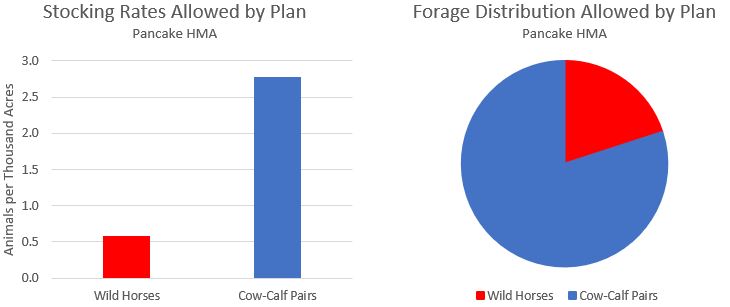
The estimated stocking rate allowed by plan inside the HMA is 2,371 ÷ 855,000 × 1,000 = 2.8 cow/calf pairs per thousand acres.

These figures are compared in the following charts.
Pancake HMA Charts-1

The HMA—an area set aside for wild horses—is managed primarily for livestock.  Cattle receive four times as much forage as the horses with a stocking rate that’s five times higher.

If the current population of horses, thought to be around 1,829 according to Table 1 in the EA, is destroying their habitat at a stocking rate of 2.1 animals per thousand acres, what do you suppose is happening when cattle are turned out a rate of 2.8 cow/calf pairs per thousand acres?

The forage assigned to livestock would support an additional 1,972 wild horses for a true AML of 2,465, which exceeds the current population by a comfortable margin.

There is no need for a roundup and no need for a fertility control program.

Unfortunately, those will be the primary enforcement methods until the management framework changes.  The ranchers prefer roundups while the advocacy groups push for contraceptives.  Nobody’s sticking up for the horses.

RELATED: Initial Thoughts on Pancake Gather Plan, Pancakes and Pie Charts!

Confusion Roundup Day 9

The incident began November 29.  Gather stats through December 7:

  • Horses captured: 270
  • Goal: 500
  • Returned: 1
  • Deaths: 5
  • Shipped: 226

No deaths were reported on Days 8 and 9.

Foals accounted for 24% of the total since Day 1.  Of the captured adults, 40% were males and 60% were females.

The number of horses captured is 271, according to the gather page.  The discrepancy is probably in the November 30 figures.

Body condition scores on Days 8 and 9 were mostly threes and fours.

The number of unaccounted-for animals is 38.  The contractor may be holding them on site.

One mare was collared and returned to the Swasey HMA.  The date when that occurred is not known.  Was it the horse taken to Delta on November 30?

RELATED: Confusion Roundup Day 7.

Confusion Roundup Day 7

The incident began November 29.  Gather stats through December 5:

  • Horses captured: 230
  • Goal: 500
  • Returned: 0
  • Deaths: 5
  • Shipped: 202

Two horses were put down today due to poor body condition.  Although attributed to pre-existing conditions, they’d likely be alive if the roundup didn’t happen.

Foals accounted for 24% of the total.

Of the captured adults, 38% were males and 62% were females.  Do those percentages look like they came from a herd that’s 50% males and 50% females?

The number of horses captured is 231, according to the gather page.  The discrepancy is probably in the November 30 figures.

Body condition scores since the last report were mostly threes and fours.

The number of unaccounted-for animals is 23.  The contractor may be holding them on site.

No horses have shipped to Delta since November 30.

RELATED: Confusion Roundup Day 5.

Grazing Program Giveaways

One of the operators who grazes livestock in the Delamar Mountains HA is eligible for up to 14,826 AUMs per year on two allotments.  The value of that forage, based on a market rate of $25 per AUM, is $370,000.

In exchange, the operator pays the government about $20,000, based on the current fee.

The benefit to the operator is roughly $350,000 per year, to be realized when the cattle are shipped for processing.

How does that compare to your salary?

RELATED: Don’t Be Deceived: Public-Lands Ranching Is Big Business.