
These burros illustrate the importance of teamwork. H/T Think Like a Horse.
Month: October 2019
BLM Needs $5 Billion and Fifteen Years to Fix Wild Horse Problem?
Refer to this AP report, posted today.
You don’t need that much money and that much time. You only need an executive order, effective Monday morning, ending public-lands ranching. The driver of the roundups, and the warehousing of captured animals, will be gone.
There is no ‘two-state solution’ on western rangelands. There is no ‘working together,’ not when the other party wants you wiped off the map.
It’s free-roaming horses or privately owned livestock. Take your pick.
Protests at ‘Horse Rich’ Forum
Refer to this story by KOLO News of Reno, NV, posted last night.
Strangles Outbreak at Delta Off-Range Corrals
The adoption event scheduled for November 1 has been postponed until January 2020, according to a report by FOX13 News of Salt Lake City. Horses removed from the Onaqui Mountain HMA last month were to be offered for adoption or sale.
Incentives Boost WHB Adoptions
BLM announced today that wild horse and burro adoptions in FY 2019 reached their highest level in fifteen years, attributing the jump to the $1,000 incentive and a greater number of adoption events across the country.
The number of animals placed into private care in FY 2019 was 54% larger than FY 2018, according to the news release.
The wild horse outplacement program helps other users of public lands enjoy the full benefit of their permitted AUMs.
RELATED: Adoption Incentive and the IRS.

BLM Acknowledges New Clark Mountain Reward
Refer to this news release, posted today. As reported last week, several new pledges have been received, the largest of which was for $32,000 from the Roy Dunlap Spay & Neuter Foundation.
The reward is available to anyone who provides information leading to the arrest and conviction of the person(s) responsible for the shooting deaths of 46 wild burros on the north side of I-15 in southern California, near the Nevada border.
RELATED: Clark Mountain Reward Increases to $100K.
Corolla Horse Fence Removed
A temporary barrier installed after hurricane Dorian destroyed its predecessor, was removed yesterday, according to a story by The Virginian-Pilot of Norfolk, VA.
The fence, installed after the storm to keep wild horses away from populated areas, also killed salt-water fish, so it was taken down.
Horses that roam into town will be escorted out by a local advocacy group.
The ‘Path Forward’ is Actually a Path Backward
In this video, Celeste Carlisle, RTF scientist and WHBAB member, speaks about wild horse fertility control at the Pathways 2019 Wildlife Conference in Estes Park, CO.
Discussion of the ‘Path Forward,’ to which RTF is a signatory, begins at 15:20.
Yes, they are getting hammered for it, and rightly so.
Wild horse preservationists were barred from the formulation, you see, because they are fringe groups—there would be no advancement in the discussion (16:32).
That’s what happens when you try to reconcile two incompatible views.
How can anyone look at the AUM distribution on lands set aside for the horses, such as in this post, and conclude that fertility control is the answer?
As reported yesterday, the forage allocated to domestic livestock in the Antelope Complex would support over 10,000 wild horses. The forage allocated to livestock on the Triple B Complex would support over 4,000 wild horses.
The problem is not uncontrolled reproduction, it is public-lands ranching.
RELATED: PZP Zealotry on a Global Scale.
Antelope Roundup Moves Into Second Phase
The contracted part of the operation ended on October 8, according to the daily reports, with 911 excess horses removed from their home range. Eleven deaths were reported (1.2%) and 17 animals were returned to the HMAs.
Body condition scores were not given.
The removal of horses outside the HMAs began on October 17, using BLM’s equipment and personnel.
The forage allocated to domestic livestock in the Antelope Complex, which includes the HMAs affected by this roundup, would support over 10,000 wild horses.
The ‘Path Forward‘ is clearly wrong. The problem is public-lands ranching.
RELATED: Roundup Starts Next Week in Lower Half of Antelope Complex.
UPDATE: The reports said 946 horses gathered, not 918, minus seven from phase two, minus 17 returned, for a total of 922 removed in phase one.
‘Horse Rich’ Forum to Push ‘Path Forward’
The panel discussion tomorrow at the Nevada Museum of Art will focus on the ‘Path Forward,’ a plan to remove 75% of the wild horses on western rangelands and slow or stop the growth of the remaining herds, according to a story posted yesterday by KOLO News of Reno.
The goal of the forum is to ‘inform’ the public about the ‘benefits’ of the proposal.
The meeting organizer said she wants those in attendance “to come away with enough information to contact our congressional leadership and let them know what they think of the measure moving through Washington.”
RELATED: Horse Rich Dirt Poor.
High Desert Travelers
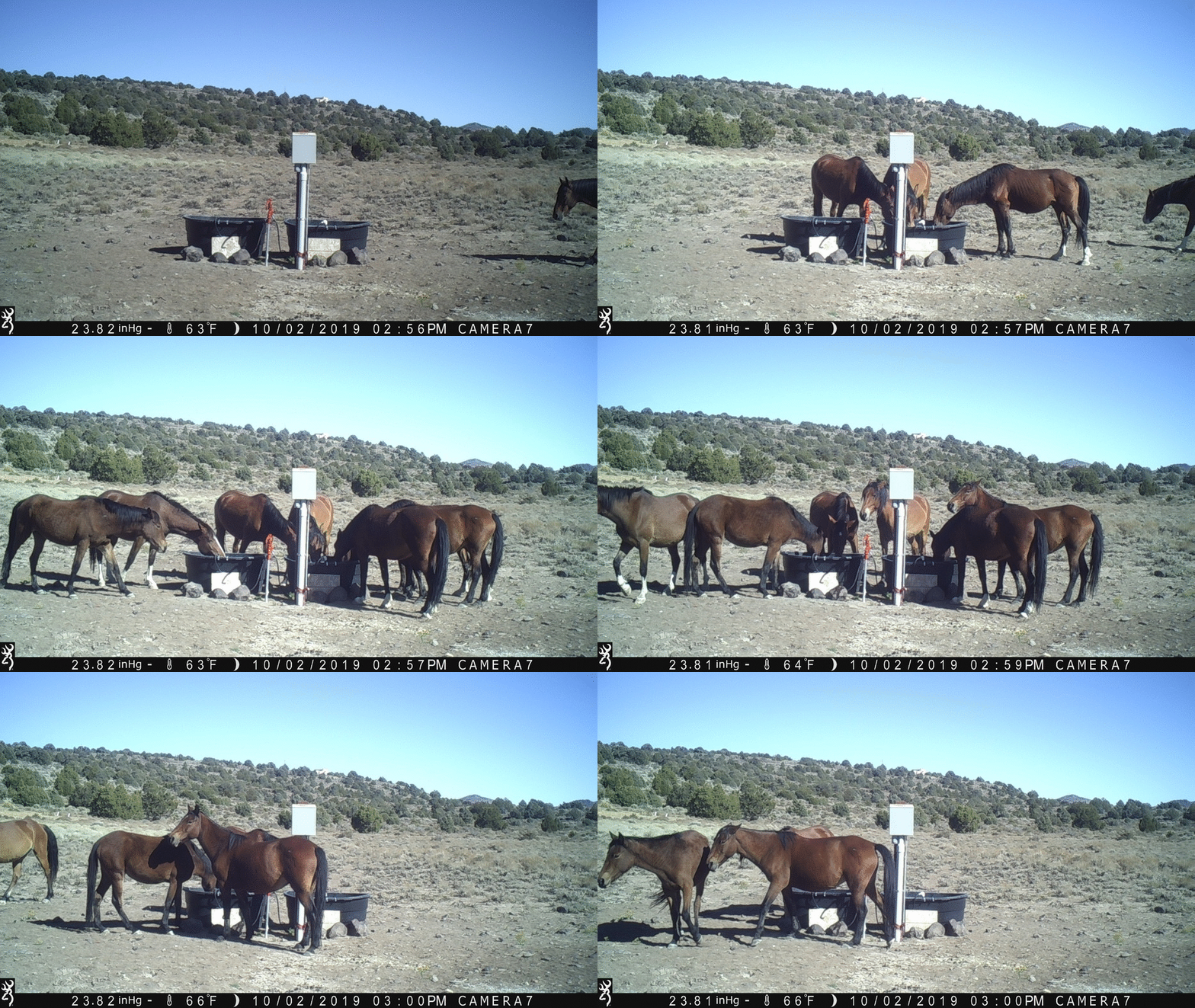
Some Virginia Range mustangs gather briefly at the water tanks on 10-02-19.
Range Creek Gather Complete, No News Release
The roundup ended 10-02-19, with 154 wild horses removed from the HMA. One death was reported and no horses were returned to their home range.
A filly was put down on 09-30-19 due to injuries sustained during the roundup.
Body condition scores were 4’s.
Captured animals were taken to an off-range facility in Axtell, UT.
RELATED: Range Creek Gather This Month.
Mustang Monday
On the Pine Nut Mountains Herd Area with Lauri Duke.
Drink and Dash
Some Virginia Range mustangs make a pit stop on 10-02-19.

Bullfrog Roundup Ends, No News Release
The gather ended on September 30, with 690 excess burros removed from their home range. One death was reported (0.1%) and no animals were returned to the HMA.
A 20+ year old jack was put down due to a qualifying defect. Survivors were taken to the off-range corrals in Axtell, UT.
RELATED: Bullfrog Gather in Progress.
Buffalo Hills / Granite Range Roundup Ends, No News Release
The operation concluded on October 12, with 100 excess horses and 176 excess burros removed from their home range. Four deaths occurred (1.4%), according to the daily reports, and no animals were released back to the HMAs.
One nine year old mare died of a broken neck and three other horses, older, were put down due to qualifying defects.
Helicopter roundups, prohibited by the original WHB Act, allow these operations to be carried out with brutal efficiency. The wranglers hired for the work refer to the on-range casualties as ‘capture shock.’
RELATED: Buffalo Hills / Granite Range Roundups Begin Next Week.
Horses Being Horses
Scuffle at Sand Wash Basin HMA, by Susan Hutchinson. Bachelors?
UPDATE: How many people will look at this and say “OMG they’re going to kill each other!” Nonsense. The wild horse hate groups know most people don’t understand horses and use imagery like this to gin up support for their removal from public lands in the western U.S. The opening scene in Horse Rich & Dirt Poor is one example.
Fall Arrives in the Mountains
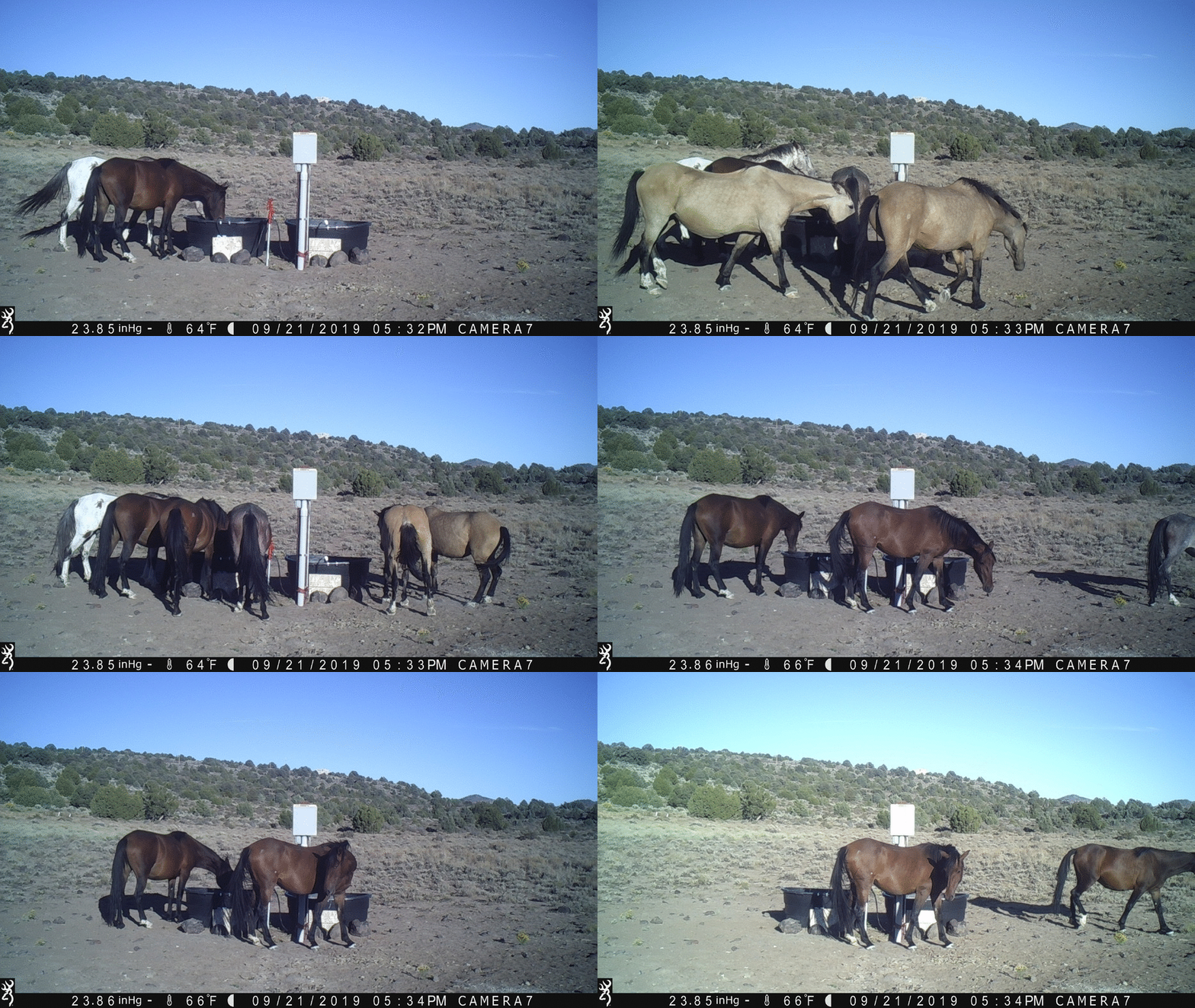
Trailcam photos of some Virginia Range mustangs coming in for a drink of 09-21-19.
East End of Westbound Horses
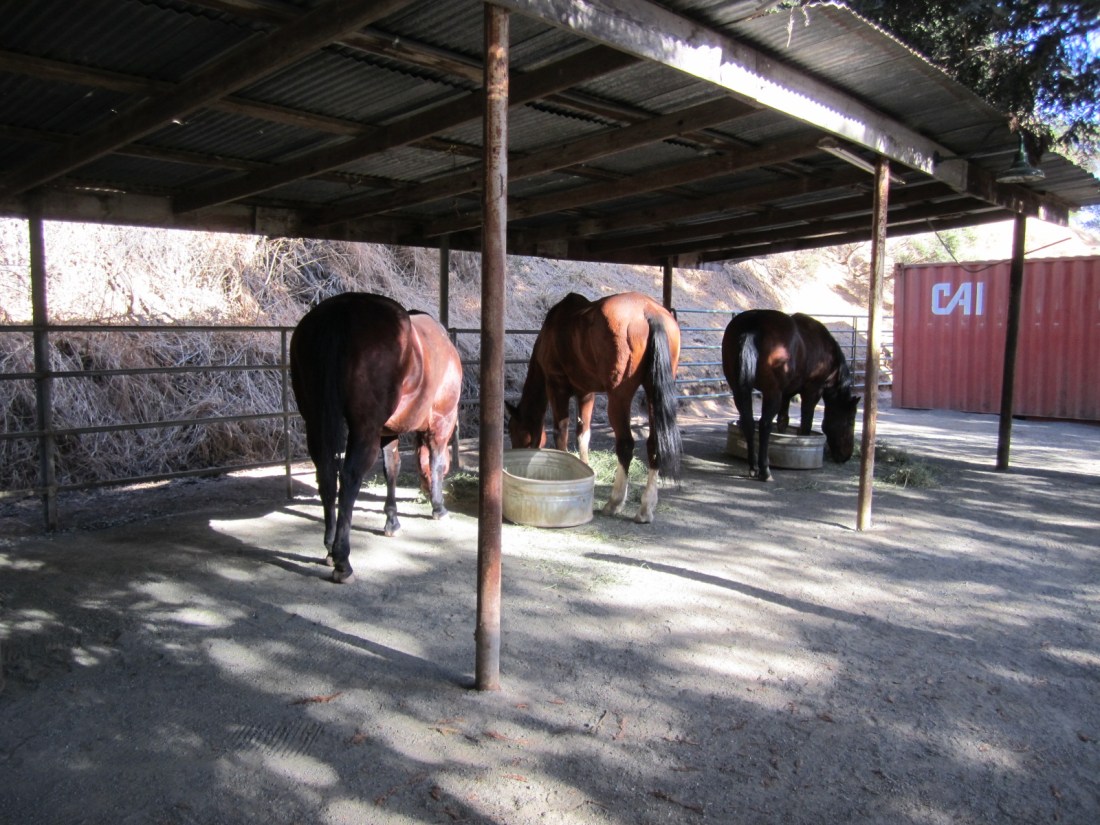
This was the view yesterday while cleaning their corrals. They usually flip the troughs over, spread the hay around, eat the leafy material first, then the stems.
Yes, they’re well fed and spoiled rotten! Winter coats in progress.

Land Use Planning 101
Privately owned livestock on a 475,000 acre parcel set aside for wild horses receive eight times as much forage as the horses. The AML represents 11% of the capacity of the land.
(a) Should the next roundup be carried out with helicopters or bait traps?
(b) How many of the mares should be darted with contraceptives?
(c) What percentage of the herd should be shipped off to private sanctuaries?
If you tried to answer those questions, you’re part of the problem. If you said “This is nuts!” you’re part of the solution.
 Western Horse Watchers Association