Religion and politics, oh my! H/T Michael Voris and the folks at Church Militant.
See also this post by Ann Barnhardt, dated 07/29/18.

Western Horse Watchers Association
Exposing the Hypocrisy, Lies and Incompetence of the Wild Horse Advocates
Religion and politics, oh my! H/T Michael Voris and the folks at Church Militant.
See also this post by Ann Barnhardt, dated 07/29/18.
If Pam Rutherford filmed it, it’s going to be good. Features some Virginia Range mustangs.
Mustangs adopted from BLM Oregon in 2015. Colt, left, born at ranch. Mom (right) and filly (center) appeared in the wild horse loading video at this post. Mom was pregnant when captured. Filmed 08/02/18.
Gentling technique: Patience. No strings, no ropes, no confined spaces, no ‘respect my space,’ no ‘show that horse who’s boss.’
As for the colt, no imprinting and no weaning. Hands off for the first three months to let mom teach baby how to be a horse.
“These wild and free-roaming horses, over years and generations, have reverted to their wild state, especially through their offspring who have never known anything other than wild.”
Part of the Kisatchie National Forest. Go to this FB page for the latest. More info at the Pegasus Equine Guardian Association blog.
Twelve minute video lecture on training methods by Rick Gore. WTWT.
As for your newly adopted mustang, the question is not how long before you can trust him, but how long before he can trust you.
Hand feeding not recommended. Filmed in West Virginia on the Hatfield McCoy Trails.
H/T Cheyenne Bullard.
RELATED: How to Make Your Horse Pushy and Disrespectful.
See the report posted today at Intermountain Farm & Ranch about the Red Desert gather, which may begin next week. The story addresses concerns about captured horses going to slaughter.
“Interested buyers are required to sign paperwork.”
No problems there. Barack Obama took an oath to uphold the Constitution (and his administration was lawless).
The article also indicates that Wyoming is home to more than 7,000 wild horses, but the Appropriate Management Level is 3,725 horses. Another case of misuse of figures.

The BLM spokesperson quoted in the article said research projects are underway that will help find more effective facility [sic] control methods, probably meaning fertility control methods, which is a code word for fertility prevention methods.
The report did not mention if AUM curtailment would be considered as a means of preventing overgrazing or if the grazing fee on public rangelands would be raised from $1.41 per AUM to $25 per AUM, in line with the costs of private ranching.
The government serfs are riding a gravy train and they know it. And who pays? Our wild horses and burros.
RELATED: Red Desert Gather Announced.
Stallions can reproduce, geldings can’t, because they’ve been castrated. The procedure is not 100% effective.
There are no geldings in the wild, unless they escaped from their owners or were turned loose, or were selectively returned to the range after being rounded up and ‘processed’ by the managing agency.
In this example, the horse has a twig and berries, not a gelding.
History Repeating by the Propellerheads.
Wild horses in Placitas, NM, north of Albuquerque. Managing agency unknown.
H/T Kyla Wood.
BLM announced yesterday that it had issued a Special Recreation Permit to Black Rock City LLC for Burning Man, to be held on public lands near Gerlach, NV. The festival will run from 08/26/18 through 09/03/18.

The permit allows up to 70,000 participants on approximately 4400 acres, for a population density of 15,909 humans per thousand acres.
As for the wild horses and burros that surround the place, they’ll probably just keep their heads down and avoid the chaos, trying to carry on their legacy at an average density of one animal per thousand acres.
RELATED: Vendor Advisory for 2018 Burning Man.
Chris Stewart (R-UT) sponsored a roundtable yesterday in Salt Lake City to discuss WHB management in his state. He’s no friend of the horses. There are too many of them and they go outside their herd management areas, according to a report posted 08/01/18 by KMYU-TV.
The estimated WHB population in Utah is 5,000 animals, with an AML of 2,500 (stats cited in the story, numbers from the BLM put the AML at 1,911).
This is another example of misuse of figures. You can’t compare 5,000 to 2,500 because they don’t have the same land-basis.

The ranching industry appeared to be under-represented at the conference, judging by the list of guests, but maybe that was by design. Perhaps the event was held to give the impression he’s interested in the advocacy viewpoint? You know, they always kiss you before they screw you.
Chris Stewart is no conservative paragon. Almost certainly he’s in the back pocket of the beef lobby. He received a Liberty Score® of ‘D’ (67%) at Conservative Review.
Two photos of the Virginia Range, about six weeks apart, showing the condition of a seasonal pond. This is normal for the area and not due to drought.
06/15/18

07/27/18
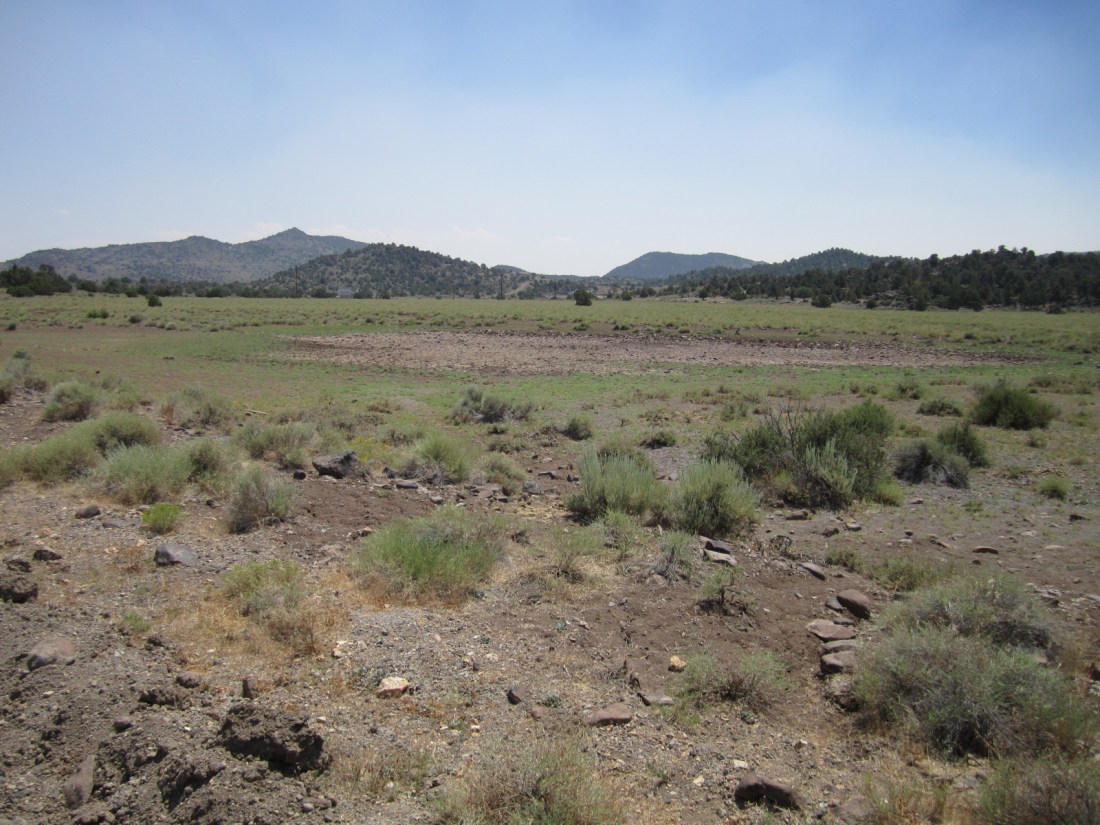
Stock tanks placed on private property for the Pine Nut wild horses now have bullet holes in them and the Douglas County Sheriff’s Office is asking for assistance in identifying the person(s) responsible. The tanks were valued at $1400. Refer to the report posted today at Nevada Appeal, with similar coverage in Carson Now.
Although the wild horse gather on the Pine Nut Mountains HA has been placed on hold, the gather on the HMA is moving ahead as planned.
RELATED: Fish Springs Gather On Hold.
Bait traps will be used to remove approximately 800 wild horses from the Nevada Wild Horse Range, according to a BLM news release posted this morning. Helicopters will not be used.
Insufficient water was cited as the reason for the roundup, which begins today or tomorrow. Gather operations will not be open to the public.

The HMA covers 1,301,637 acres and has an AML of 500, for a target population density of 0.38 animals per thousand acres. It is the largest HMA in the Nevada, perhaps in the nation, but is part of Nellis Air Force Base and therefore has no public access.
The Nevada Wild Horse Range is one of three areas in the western U.S. managed primarily for wild horses. Livestock grazing does not occur there.
Captured animals will be taken to the Palomino Valley Holding Corrals north of Reno, NV and Ridgecrest Holding Corrals in Ridgecrest, CA, where they will be checked by a veterinarian and prepared for adoption. On the bright side, this will be the first time these horses have been seen by the public, due to the security requirements of their home range.
Gather stats and day-to-day reports can be found at this page.
On 07/27/18, the BLM asked for public input on an environmental assessment for bait trapping in the Spring Creek Basin HMA. Refer to this news release for details. No wild horse removals are planned at this time. The HMA is in southwest Colorado near the Utah border.
An advocacy group that works with the BLM to manage the herd gives some background on the case at this post. Like other HMAs, the Spring Creek horses are subject to fertility control.

The HMA covers 21,932 acres and has an AML of 65, for a aimed-at population density of three animals per thousand acres, a bit higher than the national average of one animal per thousand acres (all HMAs). Note from the map that the herd area (red border) is about twice the size of the herd management area (blue border). HAs don’t have AMLs and are not managed for WHB due to inadequate resources.
The horses may graze the entire area if they’re not fenced in. Not a big problem unless livestock have been placed there. The ranchers will protest and eventually demand a roundup.
Keep in mind the red border marks an area set aside for horses in 1971.
The news release did not indicate if livestock were present on the HMA.
Now for some wild horse tech. The following chart shows the population target for HMAs in Utah as a function of HMA size. Conclusions drawn therefrom:
There are eight HMAs with an average size of 55,000 acres and average AML of 44 (some data points are so close to each other they overlap on the chart). A line starting at (0, 0) would pass through (55, 44).
If population is proportional to size, an HMA four times as large as the reference group should have an AML four times larger than that group. If x = 220, y= 4 × 44 = 176. The two HMAs of that size (Onaqui Mountain and Muddy Creek) have an average AML of 168, which is close.
Extending the line to x = 440 gives y = 352, a bit less than the nearest observed AML of 390, but not bad. That data point represents the largest HMA, Cedar Mountain.
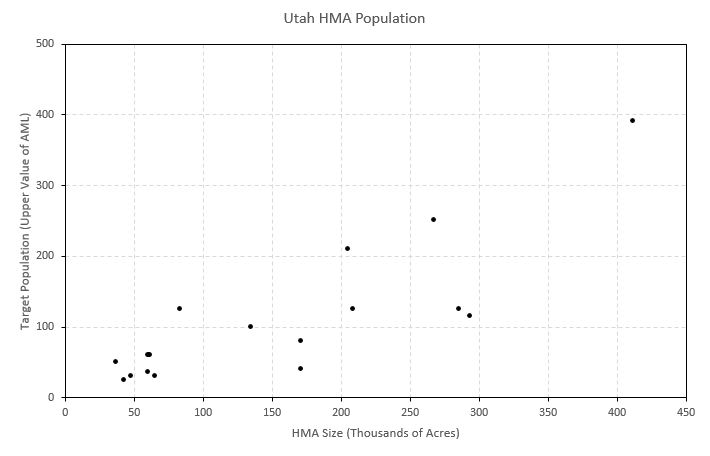
If WHB population is proportional to HMA size, population density should be constant across the HMAs (and can be estimated from the slope of the imaginary line). That will be the subject of the next post in this series.
RELATED: Utah HMA Stats.
 Western Horse Watchers Association