Might be in southern Colorado, near the town of San Luis, not far from Sanchez reservoir and the New Mexico border. Land ownership unknown (public or private).
This article in The Taos News, dated 02/29/16, may be relevant.
Anyone with more info, please post to comments. H/T Bonnie Scherer for video.
Twenty six wild horses will be returned to the Sands Basin HMA in western Idaho on 06/13/18, according to this news release from the BLM. The action follows an emergency gather in 2015 of all horses due to the Soda Fire.
Horses in the nearby Hardtrigger and Black Mountain HMAs were also affected. Refer to page nine in the BLM rehab report for more information. The fire was started by lightning.
The Sands Basin HMA covers 11,724 acres and has an AML of 64, for a target population density of 5.5 horses per thousand acres.
One of the most respectable professions out there. WTWT. About 44 minutes. Video owner does not allow embedding. From the 2010 TV series Last American Cowboy.
No government serfs here. Nobody trying to graze cattle on public rangelands at fire-sale prices*, especially the areas set aside for wild horses in burros in 1971.
Do not let the U.S. become a nation of renters, tenants and sharecroppers.
A few, they can be found in the Warm Springs HMA, south of Burns, along with an occasional mule. State route 205 marks the eastern boundary of the HMA, second largest in the state.
The target population density of the HMA is 0.42 animals per thousand acres (based on upper range of AML), compared to a state average of 0.97. The likelihood of actually seeing a burro or mule in the area is small, unless they tend to hang out in one place and you know where it is.
A WHB specialist based in Burns or Hines may be able to help you find them.
Refer to BLM Instruction Memorandum 2015-070 for care of animals managed by the WHB Program, including deworming, vaccination, evaluation of condition and determination of an appropriate end-of-life action.
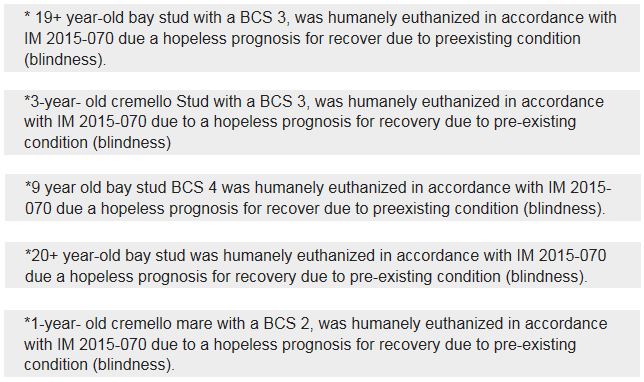
Refer also to the daily reports from the Triple B gather earlier this year. Note that some of the horses, although they survived the chase, were put down due to blindness. Keep in mind they were strong enough to travel across the range, perhaps for several days, to the trap site.
In the first three cases, none of the horses were emaciated, according to their body condition scores (BCS). The body condition of the fourth horse was not given. The fifth horse had a score of 2, which put her in the emaciated category, subject to euthanization according to section A of Attachment 2, Animal Evaluation and Response. But the reason for ending her life was blindness.
When did the nineteen year old stud go blind? Yesterday? Or was he like that since birth? The case of the cremello mare suggests that blindness can occur early in life. If it is a hopeless prognosis, how did the twenty year old stud stay alive for so long in such harsh conditions?
The term ‘blindness’ does not appear anywhere in Attachment 2. That it provides justification for euthanasia must be the interpretation of the specialist on the case.
Maybe the prognosis is hopeless because nobody wants to adopt blind horses and most rescues are not interested in them? If so, then why not let them stay on the range with their seeing-eye helpers? How can you refer to these life-ending actions as ‘humane?’
Two year old colt, left, with his mom, 05/26/18. No imprinting, no weaning. Mom still making milk. Three year old sister present but out of frame. Adopted 2015 from BLM.
A new Nevada license plate, promoting the Virginia Range mustangs, is now in design review, according to this post at the Fund Hidden Valley Wild Horse Protection Fund FB page. Hopefully, the plate will go into production later this year.
Refer to the report dated 05/30/18 in the Colorado Springs Gazette.
Really, the perp(s) should step forward, admit their guilt, and join forces with the Population Bomb-ers of the wild horse world, where darting mares with PZP is considered humane, not harassment.
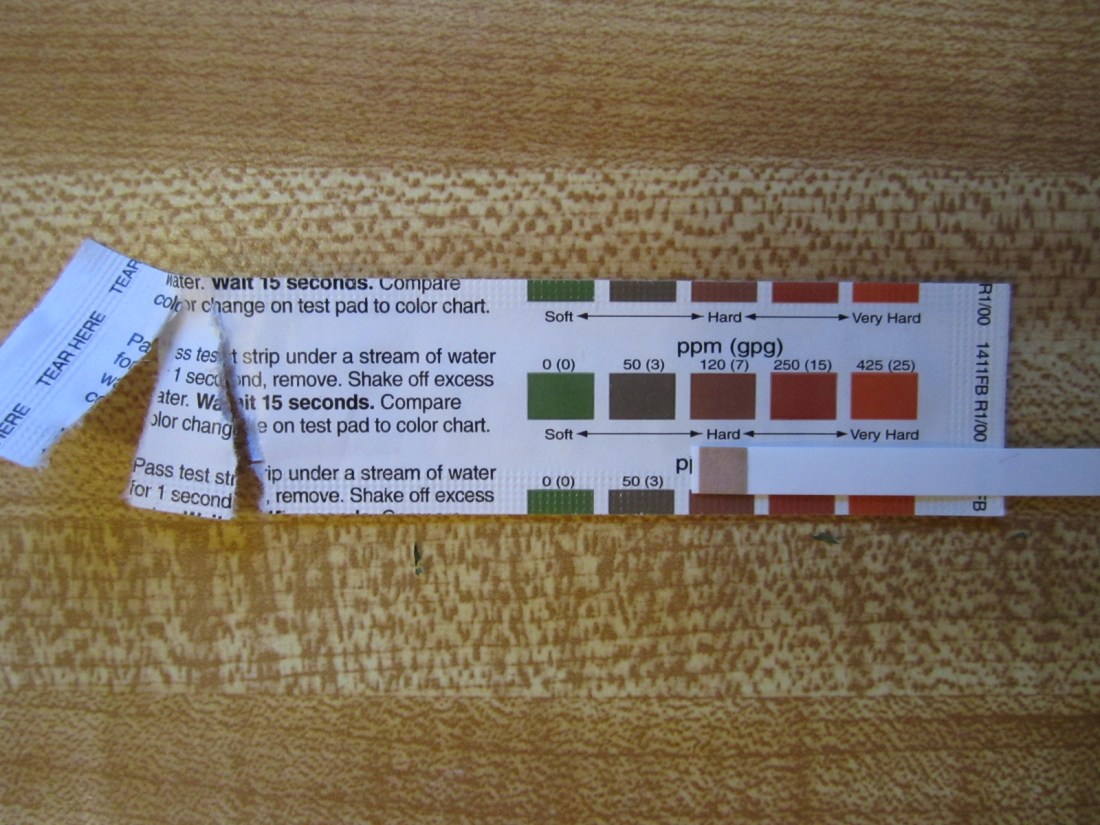
Your water treating supplier can give you test strips to monitor the hardness of water from your well and downstream of the treatment system. In the example below, there is no green tint, no orange tint, so the hardness is around seven grains per gallon. Photo was taken about an hour after the test so the indicator may have faded.
Your supplier may also have kits that measure other properties of your water, such as pH, hardness and alkalinity. If not, try a pool equipment vendor. The kit may also test for chlorine, which typically is not present in rural water systems.
The addition of chlorine or bleach to water creates hypochlorous acid, among other things, which kills bacteria. If you have a pool at your ranch or other body of water you’re trying to disinfect, it’s important to keep the pH between seven and eight so the HA can do it’s job.
Look at a bottle of Vetericyn, a common treatment for wounds in the horse world. The active ingredient is hypochlorous acid.
New adoption site now available according to a news release from the BLM dated 05/18/18.
First-time users will have to create an account at the home page.
In a related news release, BLM announced that four saddle-trained horses would be offered for adoption at the Western States Horse Expo, June 8 – 10, 2018 in Sacramento, CA.
The last step in installing a pump in your well is to connect it to the water and power systems.
In the photo below, black poly tubing brings water into the pump house, transitioning to white PVC pipe inside the wall. It connects to the water system at the pressure switch, the small grey box above the PVC pipe with corrugated metal conduits on either side.
The wall-mounted box with orange label is the controller for the pump. To the left is a smaller box that monitors for dead-heading and dry-running.
The colored wires going into the slab provide power to the pump, 480 feet down.
The grey panel near the door provides power to all circuits in the pump house. The receptacle at the lower left of the panel lets you plug in your portable compressor, in case the air in the pressure tanks needs to be topped off.
Now you have water to the surface! You’ll want to cycle the system several times to flush out any turbidity (cloudiness). Connect a hose to the drain valve on one of your pressure tanks and let the water run out until the pump comes on (40 psi). When the pump shuts off (60 psi), open the valve and drain the tank(s) again. Repeat until the water is clear.
After you install a treatment system, you’ll have clean, fresh water for your horses.
In this video, posted 05/25/18, Tucker Carlson, Fox News host, interviews Dave Duquette, spokesman for Protect the Harvest and cheerleader for the buck-forty-oners. Topic is horse slaughter. Broadcast date unknown. Notice the AQHA logo on Duquette’s jacket.
On the subject of horse meat, Duquette reported “There was one meat buyer…in the south of…in Florida…that said he had 2.3 million Hispanics down there that would eat it…every day if they could get it.”
A few moments later he said “Mexico, if you’ve eaten tacos on the beach in Cabo, you’ve eaten some horse meat.”
Maybe he’s on a public relations tour to build support for the recent BLM Report to Congress.
But his comments are a reminder that we have people coming into the country who don’t share our values, especially the sovereignty of the individual and the proper role of government in the civil society. We need to keep them out.
Yet in November, many of the so-called wild horse advocates, including the PZP zealots, will join The Diversity in voting for the party of open borders.
As hard as it is to listen to this guy, it’s harder to watch the images of horses that begin at 1:08.
Halters in arenas and pastures, horses locked in stalls, stud chains over their nose, all because they’re owned or cared for by idiots. Nevertheless, these things indicate the horses are wanted and are unlikely to be taken to auction.
If you need overnight accommodations, check out Horse Motels International, a listing of individuals and businesses that board horses on a daily basis.
Be sure to read the travel tips before you hit the road. Health certificates (for your horses) will probably be required, especially if you’re crossing state lines.
Horses move other horses by applying pressure. If a lower horse yields to a higher horse, pressure is released. When the lower horse moves, he may protest with a tail swish or kick. If the pecking order is not well established, the lower horse may challenge the higher horse by pushing back, biting, rearing or kicking.
You use the same technique to communicate with your horse. A good horseman tries to achieve a result with the least amount of pressure. For example, he’ll ask his horse to back up with a simple voice command, nod of his head, or light touch to the chest.
If the horse doesn’t respond, he’ll turn up the heat.
Please
Pretty please
You better
You should have
When the horse moves, he gets release. That’s the right answer, and the horse just learned it. No hugging and kissing, no verbal praise, those are pressure.
The mom in this video starts in stage 1 but ends up in stage 4, where she lays down the law. The segment of interest runs from 1:24 to 13:58.
Trailcam photo of no Virginia Range mustangs on 05/21/18. Same for 05/27/18, none in sight, after driving through an area of hundreds of acres.
Keep in mind that the population density of the VR is ten times higher than your average HMA, 9.4 horses per thousand acres vs. 0.8 on BLM rangelands in Nevada.