BLM Starts Emergency Gather at Nevada Wild Horse Range

Bait traps will be used to remove approximately 800 wild horses from the Nevada Wild Horse Range, according to a BLM news release posted this morning.  Helicopters will not be used.

Insufficient water was cited as the reason for the roundup, which begins today or tomorrow.  Gather operations will not be open to the public.

Nevada_Wild_Horse_Range_Map-1

The HMA covers 1,301,637 acres and has an AML of 500, for a target population density of 0.38 animals per thousand acres.  It is the largest HMA in the Nevada, perhaps in the nation, but is part of Nellis Air Force Base and therefore has no public access.

The Nevada Wild Horse Range is one of three areas in the western U.S. managed primarily for wild horses.  Livestock grazing does not occur there.

Captured animals will be taken to the Palomino Valley Holding Corrals north of Reno, NV and Ridgecrest Holding Corrals in Ridgecrest, CA, where they will be checked by a veterinarian and prepared for adoption.  On the bright side, this will be the first time these horses have been seen by the public, due to the security requirements of their home range.

Gather stats and day-to-day reports can be found at this page.

BLM Seeks Comments on Future Gathers at Spring Creek Basin

On 07/27/18, the BLM asked for public input on an environmental assessment for bait trapping in the Spring Creek Basin HMA.  Refer to this news release for details.  No wild horse removals are planned at this time.  The HMA is in southwest Colorado near the Utah border.

An advocacy group that works with the BLM to manage the herd gives some background on the case at this post.  Like other HMAs, the Spring Creek horses are subject to fertility control.

Spring_Creek_HMA_Map-1

The HMA covers 21,932 acres and has an AML of 65, for a aimed-at population density of three animals per thousand acres, a bit higher than the national average of one animal per thousand acres (all HMAs).  Note from the map that the herd area (red border) is about twice the size of the herd management area (blue border).  HAs don’t have AMLs and are not managed for WHB due to inadequate resources.

The horses may graze the entire area if they’re not fenced in.  Not a big problem unless livestock have been placed there.  The ranchers will protest and eventually demand a roundup.

Keep in mind the red border marks an area set aside for horses in 1971.

The news release did not indicate if livestock were present on the HMA.

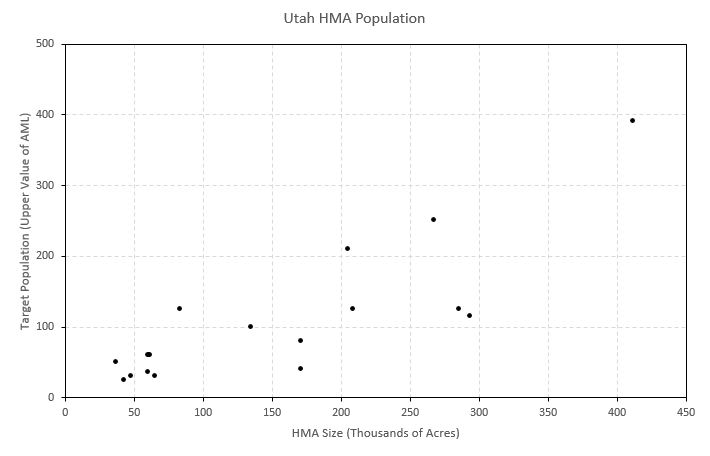
Utah HMA Population

Now for some wild horse tech.  The following chart shows the population target for HMAs in Utah as a function of HMA size.  Conclusions drawn therefrom:

  • Most HMAs are smaller than 300,000 acres
  • Most AMLs are 300 animals or less
  • AMLs are more-or-less proportional to HMA size

There are eight HMAs with an average size of 55,000 acres and average AML of 44 (some data points are so close to each other they overlap on the chart).  A line starting at (0, 0) would pass through (55, 44).

If population is proportional to size, an HMA four times as large as the reference group should have an AML four times larger than that group.  If x = 220, y= 4 × 44 = 176.  The two HMAs of that size (Onaqui Mountain and Muddy Creek) have an average AML of 168, which is close.

Extending the line to x = 440 gives y = 352, a bit less than the nearest observed AML of 390, but not bad.  That data point represents the largest HMA, Cedar Mountain.

UT-AML-HMA-1

If WHB population is proportional to HMA size, population density should be constant across the HMAs (and can be estimated from the slope of the imaginary line).  That will be the subject of the next post in this series.

RELATED: Utah HMA Stats.

BLM Plan for Sterilization Puts Wild Mares at Risk

“It is a dangerous procedure.  They’re doing it sort of the cheapest way.  Therefore, there’s a potential for basically fatal complications.”

Agree.  See the report posted today by Oregon Public Broadcasting.  Both sides of the debate are presented.  The story did not indicate if a reduction in livestock AUMs was under consideration to alleviate damage attributable to overgrazing.

RELATED: Sterilization Research Proposed for Wild Horses.

Readers Debate Wild Horse Sterilization

Two opinion pieces in the East Oregonian:

How many elements of the wild horse narrative can you find in the response?

AMLs tell you how many animals can inhabit a parcel of land.  They don’t tell you anything about the available resources and how they’re allocated across that land.

The total AML of 26,690, cited in the response, corresponds to HMAs covering 26.7 million acres, for an average population density of one animal per thousand acres on lands managed by the BLM.  (The population density of the Virginia Range, not managed by the BLM, is ten animals per thousand acres.)

The estimated population of 81,951 animals probably corresponds to HMAs and lands outside HMAs, wherever WHB are found, for an unknown number of acres.  You can’t compare 81,951 to 26,690 because the figures don’t have the same land-basis.

Population_and_AML-1

Instead of looking at AMLs, we should be looking at pie charts that show how the available resources are allocated among the various consumers (horses, burros, cattle, sheep, antelope, deer, etc).  A chart may indicate that, although the wild horse population of a given area is three times larger than AML, the horses only account for half the available resources.  The situation isn’t as serious as originally portrayed.

UPDATE: Added graphic.

RELATED: Sterilization Research Proposed for Wild Horses.

Wild Horse Narrative

Trailcam image of free-roaming bucks on the Virginia Range.  Probably the last ones, thanks to those damn horses.

  • They’re a non-native species
  • They’re overpopulated
  • They have no natural predators
  • They’re not special (mostly escaped ranch stock)
  • They damage rangelands
  • They’re a threat to wildlife

Livestock are blameless, always.  That’s the wild horse narrative in a nutshell.  You’re supposed to conclude that wild horses are bad for the environment and should be removed.  Removal was the answer all along, but it had to be justified.

IMG_7245-1

Wild Horse Gather Set for Muddy Creek

BLM announced today that 149 horses would be removed from the Muddy Creek HMA in central Utah, beginning in August.  Overpopulation and dry conditions were cited as the reasons for removal.  Fertility control will be applied to the remaining horses to slow population growth.

Muddy_Creek_Sinbad_HMA_Map-1

The news release did not indicate if helicopters would be used for the roundup and if it will be open to public observation.  The presence of livestock on the HMA was not discussed nor the destination of captured animals.

A link for the gather reports and daily stats was not provided.

The Muddy Creek HMA covers 283,400 acres and has an AML of 125, for a target population density of 0.44 animals per thousand acres.  It’s managed for wild horses and burros.

Wild Horse Propaganda

Here’s a presentation about wild horses for a professional communications course at Colorado State University.  Purpose of this post is not to criticize the speaker but to question the content of the speech.  Maybe the student did what he had to do to get a passing grade from his Marxist professor.

Where did he get his information?  From the ranching industry?  Presentation seems to be very one-sided.  Includes the infamous photos from the Cold Creek herd in 2015 and contains several elements of the wild horse narrative.

  • Habitat damage
  • Competition for scarce resources with other native species
  • No natural predators
  • Overpopulation

The talk even mentions climate change, a sure sign the speech was produced by liberals for consumption by liberals.  The discussion beginning at 3:01 blames wild horses for damaging riparian habitats, when it was the fence that caused it, by interfering with the free-roaming nature of these animals and their search for food and water.

Wild Horse Awareness

Posting this video as a guest commentary.  More people are learning about these icons of the American West, and that’s a good thing.  Additional remarks:

  • BLM allows oil and gas exploration and production on public lands, along with timber harvesting and mining, but the greatest threat to WHB comes from the ranching industry
  • The conflict goes back many years
  • Horses and burros removed from public lands are also placed in off-range pastures
  • BLM spends about $50 million annually to care for animals removed from western rangelands
  • BLM tries to place these animals into private hands through adoption and sale
  • PZP is a contraceptive, extended use may lead to sterilization
  • BLM is moving ahead with sterilization research as a potential long-term ‘solution’ to the wild horse ‘problem’

H/T to Laura, a new voice for our wild ones at Gone to the Horses.

BLM Plans Roundup at Little Bookcliffs Wild Horse Range

This has been in the news for a few days but was not formally acknowledged by the BLM until yesterday.  Bait trapping will be used beginning in late August, to remove up to 60 horses from the Little Bookcliffs Wild Horse Range near Grand Junction, CO.

Overpopulation was cited as the reason for the gather.  Horses younger than five years of age will be the focus of the operation.

Little_Bookcliffs_HMA_Map-1

Captured animals will be taken to a BLM facility in Cañon City, CO, where they will be checked by a veterinarian and prepared for adoption.

Little Bookcliffs Wild Horse Range is one of just three areas in the western U.S. managed primarily for wild horses.  Livestock grazing does not occur there.

The post-gather population density, based on 130 horses remaining and 36,113 acres of land available for grazing, is 3.6 animals per thousand acres, considerably higher than the national average of one animal per thousand acres on BLM-managed lands.  But it’s one of the smaller HMAs managed by the agency.

A page for viewing day-by-day gather statistics has not been created as of today.

See also this report in The Daily Sentinel posted 07/27/18.

Fish Springs Gather On Hold

A spokesperson for the Pine Nut Wild Horse Advocates said the planned roundup of wild horses on the Pine Nut Mountain Herd Area won’t happen, according to a report published yesterday in Nevada Appeal.

BLM argued there is not enough food and water to support the 78 horses that currently roam there and was preparing to remove all but 26.  The Herd Area covers more than 100,000 acres, which means the post-gather population density would be less than 0.26 animals per thousand acres, almost nothing.

See also this story in Carson Now, posted 07/27/18.

RELATED: One if by Helicopter, Two if by Trap.