Emergency Gather at Owyhee Complex Begins This Week

The BLM will gather 1,175 wild horses from HMAs affected by the Martin Fire in July of this year, starting on or about September 21, according to a news release issued today.

Of this amount, 875 horses, classified as ‘excess,’ will be permanently removed from the area.  Some mares, no more than 150, will be treated with contraceptives and returned to the range, along with an equal number of stallions.

Helicopters will be used to push the horses into the traps and the operation will be open to public observation.

The fire started near Paradise Valley, NV on 07/04/18 and spread eastward, consuming over 435,000 acres (BLM announcement says 07/09/18).

Little_Owyhee_HMA_Map-1

The Owyhee Complex includes the Little Owyhee, Owyhee, Snowstorm Mountains, Little Humboldt and Rock Creek HMAs.  The complex covers about 1.06 million acres and has a combined AML of 999, for an aimed-at population density of 0.94 animals per thousand acres.

The average population density across all HMAs is one animal per thousand acres.

The announcement did not acknowledge the presence of livestock on these HMAs, nor did it indicate if AUMs would be curtailed as a result of the fire.  Don’t worry though, it’s the oil and mining companies behind this madness.  Those industries require thousands of tons of forage every year to keep their machinery running, and they’re not going to let some stupid horses steal it from them.

Captured animals will be taken the Palomino Valley Corrals north of Reno, NV (already flooded with horses from other roundups), where they will be checked by a veterinarian and prepared for adoption (already saturated with horses from other roundups).

Gather stats and daily reports can be found on this page.

RELATED: BLM Seeks Information on Martin Fire.

Wildfire Reported at Sand Wash Basin HMA

About 200 acres have burned, according to a story posted today by The Denver Post, but it has not harmed any horses and they are still able to access water normally.  However, volunteers are concerned that the fire has consumed forage in an area already suffering from drought.

Personnel from Wild Horse Warriors have been hauling water to the Sand Wash horses since July, avoiding an emergency gather.  The HMA covers 157,730 acres in northwest Colorado.

Wild Horses Roam Freely at TRIC

The Tahoe Reno Industrial Center is home to some well known companies, such as Tesla and Walmart.  It’s also home to some Virginia Range mustangs, and TRIC wants to keep it that way.  Refer to this article posted today by The Nevada Independent to see what these and other companies are doing to keep the horses on the range.

Unlike most of the wild horses in Nevada, the Virginia Range mustangs are managed at the state level by the Department of Agriculture.  Like most of the wild horses in the western U.S., they are despised by certain individuals and agencies who believe their numbers should be permanently reduced.

Refer also to the Youtube audio of the Board of Agriculture meeting on 09/05/18 for a discussion of their status and future.

RELATED: Virginia Range Mustangs Back on BOA Agenda.

Advocacy in North Carolina

Personnel with the Cajun Navy help flood victims in New Bern.  No, they’re not administering birth control to all the women.

Shouldn’t the government be rescuing those people?

What an individual can do, society should not take over, and what small societies can do, larger societies should not take over.  That is the principle of subsidiarity.

Nowadays too many people have given up control of their lives, instead, receiving their sustenance from government.  Can you think of an example on western rangelands?

Investigators Unable to Identify Cause of Waipio Horse Deaths

Experts cannot explain the deaths of thirteen wild horses on the Big Island of Hawaii in June and July of this year, according to a news release posted today by the Department of Agriculture.

All of the sick horses were from one band on the west side of the Waipio Valley.  None of the other bands in the area or any of the trail riding horses were affected.

See also this story in West Hawaii Today.

RELATED: Illness Affecting Waipio Valley Horses Still Not Identified.

Warm Springs Gather to Yield Test Subjects for Spay Research

BLM announced yesterday that it will remove 652 excess wild horses from the Warm Springs HMA in southeastern Oregon, beginning in early October, to thin the herd and collect test subjects for sterilization research.  Refer to the news release issued by the Burns office.

Helicopters will be used to drive the horses into the traps and the operation will be open to public observation.

The HMA covers 475,460 acres and has an AML of 202, for an aimed-at population density of 0.42 animals per thousand acres.  The average density across all HMAs is one animal per thousand acres.  (The lower the density the higher the wild horse dispersion, which pleases the public-lands ranchers, their cheerleaders, and overlords in the livestock industry.)

Warm_Springs_HMA_Map-1

The news release stated that the AML was 178, which differs from the figure at the HMA description.

Warm_Springs_HMA_AML-1

The new AML means even greater wild horse dispersion (0.37 animals per thousand acres, almost nothing).  The announcement did not indicate if livestock were present on the HMA or surrounding lands but a reduction in AML, if true, would further pacify the government dependents and will probably be overlooked by the public.

Captured animals will be taken to the Wild Horse Corral Facility in Hines, OR, where they will be prepared for adoption, or in the case of some of the mares, placed into the hands of the on-site Mengeles, who have been tasked with removal of their ovaries.

Gather stats and daily reports can be found on this page.

This so-called research sets a low-water mark for the BLM, an unelected bureaucracy acting against the wishes of the American people.  They have their fanboys however, who see this effort as another step in the process of nullifying the WHB Act.

When is a Wild Horse ‘Excess?’

Answer: When he competes with privately owned livestock for food and water—on lands set aside for him.  The term is often used to justify roundups.

“The BLM plans to gather and remove approximately 300 excess wild horses.”

An article published yesterday by the left-leaning digital news service Circa, offers a lengthy discussion of the issues on western rangelands.  As usual, the debate revolves around the horses for most of the story (overpopulation, mismanagement, excessive costs and what to do about them).

The issue of public-lands ranching is not reached until the end of the report.

“Grazing on public land costs cattle farmers a tiny fraction of what they’d pay on private farms.”

The amount of land available to the horses has been going down.  The number of cattle and sheep has been going up.  What could possibly go wrong?

The ranchers—along with their overlords, cheerleaders and political allies—are not going to let some pesky advocates interfere with this gravy train.

Florence Reaches Outer Banks

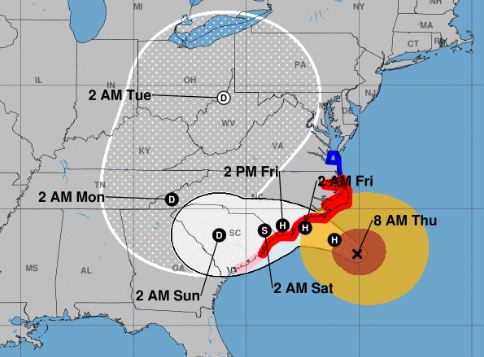
Rain bands are now dumping water on the Banker Horses, as the storm pushes the sea inland.  Conditions will deteriorate as the day progresses.

Florence_Track_09-13-18_AM-1

The track has straightened out a bit and the storm should move inland before drifting to the west.  Flooding and flying objects remain the greatest threat to persons (and horses) in the Outer Banks.  Escape routes will soon be cut off.

RELATED: Left Turn Ahead for Florence.

More Land for Pryor Mountains Wild Horse Range?

Ginger Kathrens of The Cloud Foundation hopes to expand the wild horse herd and the land available to them.

“We want to expand the range so we can have a bigger population.  One hundred fifty horses are the bare minimum, genetically.”

See the report posted today by KTVQ in Billings, MT.

RELATED: How Large Should HMAs Be?, Judge Orders Two Week Delay in Pryor Mountains Gather.

Left Turn Ahead for Florence

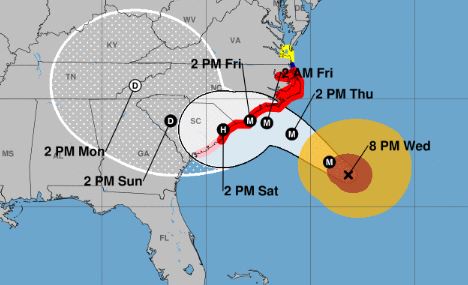
The Banker horses will probably be feeling the full effects of the storm Thursday evening, with high winds and major flooding.  Flying debris and falling trees may also be a problem.  Inland waterways probably started to rise today.  Tides will be a factor.

Florence_Track_09-12-18_PM-1

There may be a high pressure system to the north, impeding forward movement and steering the storm down the coast.  The map above, from the NHC, suggests it will retain hurricane strength until Saturday.

RELATED: Florence Landfall Moving South.