
Is the BLM trying to nullify the WHB Act? Refer to the guest commentary that appeared today in The Denver Post. Why? Who benefits?
Volunteers Keep Sand Wash Horses on the Range
Emergency gather avoided on Sand Wash Basin HMA. Another fine example of wild horse advocacy. H/T HighStakesRanch.
RELATED: Volunteers Brave Dust Storm to Help Sand Wash Horses.
The Horse Carries Your Burdens
Fundraiser set for 11/11/18, help them if you can. Save a Mustang Save a Vet.
Like They Own the Place!
On Theodore Roosevelt National Park. H/T Dean and Emilie Travel Blog.
Big Bands on the Virginia Range
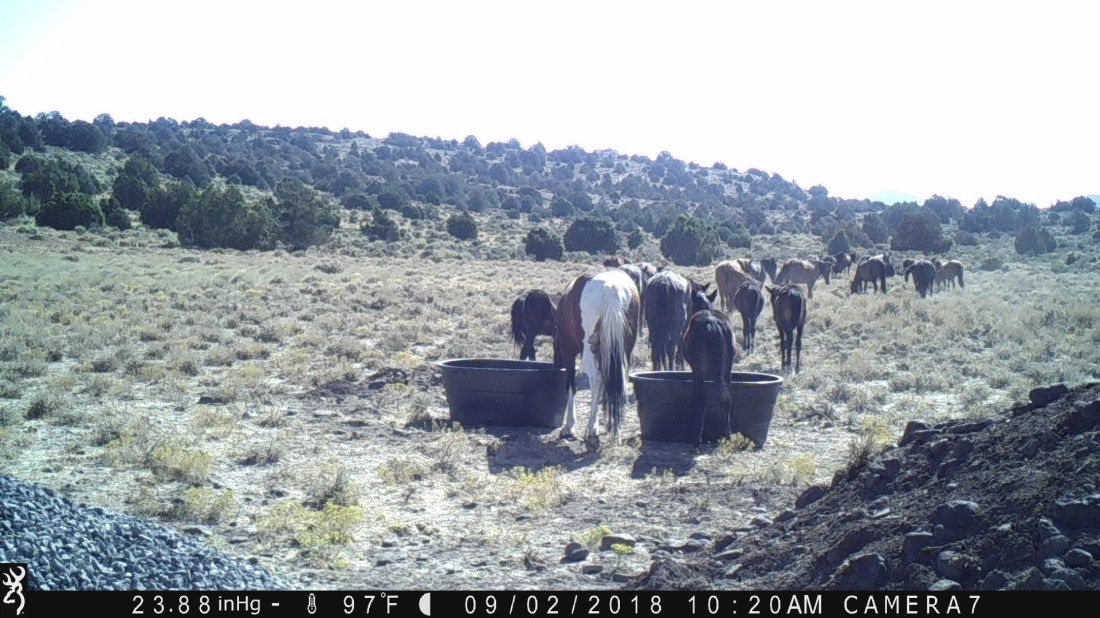
No, it’s not Tommy Dorsey’s birthday. Just a large group wild horses searching for some shade before the afternoon heat kicks in.

WHB Cash and Carry Event Coming to Belton, TX
BLM announced yesterday that 50 wild horses and burros would be offered for direct purchase to good homes at the Bell County Expo Center October 12 – 13. Gentling demonstrations will occur both days. Refer to this news release for details.
The event was made possible by a BLM rule change on 05/24/18. If you could find it in your heart to buy 10, 15, or maybe 25 horses, you would be doing the BLM—and the public-lands ranchers—a huge favor.
The more captured horses they can unload, the more wild horses they can remove from the range, to be replaced with cattle and sheep—on lands set aside for the horses.
And don’t forget, the Mexican border is only 300 miles away.
Field Survey of Shackleford Horses in Progress
NPS announced this morning that a census of the horses began on 09/24/18 and that the herd appears to have survived Hurricane Florence. Refer to this FB post.
RELATED: Still No Word on Shackleford Wild Horses.
Nibble, Move, Repeat
Wild horses grazing on the Virginia Range, just after sundown on 09/21/18. Staying in one spot and chewing it down to bare dirt is not their style.


Ride a Side-by-Side to See the Pryor Mountains Horses
Gotta love the colors, ponies too. H/T Steven Green.
RELATED: Best Way to See the Pryor Mountains Horses.
Virginia Range Mustangs Stop By for a Drink
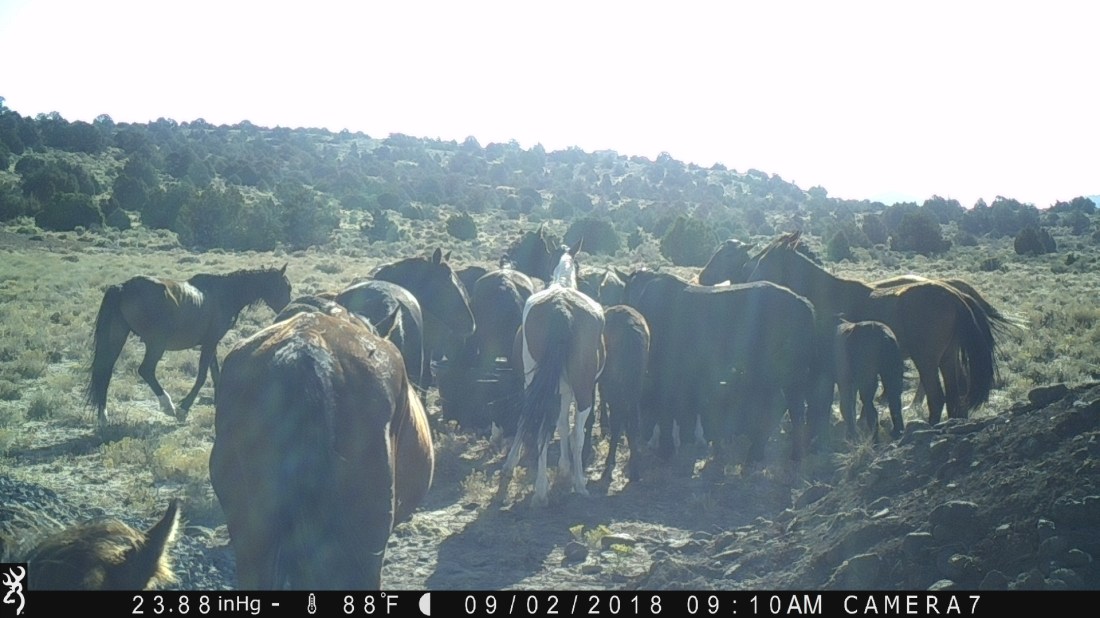
Stock tanks have been received very well by the horses. One of them is now on float control, which means it should always stay full.
Salt River Advocacy Group Rescues Abandoned Horse
Personnel with the Salt River Wild Horse Management Group rescued a gelding in the Tonto National Forest, according to a news release posted today on their web site.
They will make sure he ends up in a good home, along with another gelding rescued earlier in the same area.
Volunteers Still Feeding Salt River Horses
Dry conditions persist in some parts of the western U.S. H/T KJZZ Phoenix.
RELATED: Advocates Bringing Hay to Salt River Horses.
BLM Dictates Terms of Surrender to Fish Springs Advocates
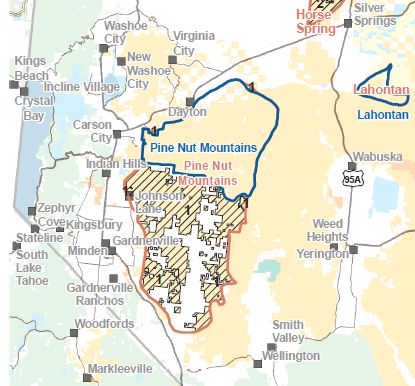
The number of wild horses in the Fish Springs area must be reduced from 78 to 58 by 2020, according to a report posted 09/21/18 in The Record-Courier.
“If you need our help with panels or bait trapping to get that reduction done, we will schedule that help.”
The requirement, part of a plan for managing the horses, was laid down by Mike Courtney, acting director of the BLM in Nevada.
He also stressed the importance of ‘healthy rangelands.’
“That means no more than moderate utilization 40-60 percent forage species between wild horses and livestock.”
Yep, the number of horses in the Pine Nut HA (south of the Pine Nut HMA) must be reduced by 25% and livestock will get 50% more forage than the horses—on lands set aside for the horses.
Will the advocates help the BLM set the traps, as was done a few weeks ago at Little Bookcliffs? How much PZP will be required to impose a negative birth rate on these horses? How many poor ranchers will be hurt by the mandatory AUM curtailment?
There is no curtailment.
Courtney said the planned roundup of horses in the HMA should happen sometime between November and January.
This is what happens when an unelected bureaucracy caters to a special interest against the wishes of the American people. The special interest, of course, is the oil and gas industry, as indicated by all the drilling rigs, frac tanks and generator sets in the Fish Springs area.
The last things you’ll see are stock tanks, cattle gates and T-post fencing.
RELATED: Status of Fish Springs Horses to be Discussed Tonight.
What is a Freeze Mark?
It’s an identification symbol burned into the hide of a wild horse or burro after capture, usually on the upper left side of the neck. The procedure is often carried out in the field before the animals are brought to BLM corrals for adoption.

The last four digits correspond to the number on the neck tag worn by the animal at adoption. Freeze marks can be hidden by manes and will change in appearance as the horse ages and as his winter coat comes and goes.
RELATED: The Mark of Authenticity.
BLM Concludes Eagle Gather
BLM announced today that the helicopter roundup ended on 09/21/18, with 303 horses removed from the Eagle HMA in eastern Nevada. Three were euthanized and none were returned to the range. Refer to this news release, posted earlier today.
Captured animals were taken to the Palomino Valley Wild Horse and Burro Center north of Reno, NV, to be prepared for adoption or transfer to long-term segregated holding in off-range pastures.
Gather stats and daily reports can be found at this page.
No livestock were harmed in the process.
More Trouble for ISPMB
A man who bought a 660 acre ranch from the ISPMB so it could be leased back has sued the organization for $135,000 in delinquent rent, according to a report in AP News posted earlier today.
The International Society for the Protection of Mustangs and Burros, established by Velma Johnston, gave up most of its horses in 2016 when a whistleblower revealed the conditions at the ranch. The horses were placed into private hands the following year through an adoption program coordinated by Fleet of Angels.
RELATED: ISPMB Update.
Still No Word on Shackleford Wild Horses
Status of horses still unknown in an area hit hard by the onshore flow from Hurricane Florence. Refer to this story in The News & Observer posted 09/23/18.
Personnel from NPS are still unable to reach the island on the Outer Banks, which is accessible only by boat. Updates will be posted to their FB page.
Kickfest on the River
Somewhere along the Salt River, east of Phoenix, AZ. H/T Robin Bender Knight.
Carbon Capitalists Greatest Threat to WHB?
An opinion piece posted today in the left-wing blog Down to Earth states that wild horses and burros in the western U.S. are ‘…under siege by oil, gas, mining and other special interests.’ They are not. The greatest threat to WHB is public-lands ranching.
The writer mentions livestock grazing in the essay but most of the blame is placed on the oil and gas companies, which she refers to as ‘Carbon Capitalists.’
Thus it is possible she takes this position not because she cares about the horses but because she’s a liberal.
How many frac tanks and drilling rigs do you see at this post? How many excavators and dump trucks do you see in this post?
How many oil companies have written Zinke demanding that wild horse populations be reduced to AMLs immediately? How many mining companies have been outspoken cheerleaders for the ovary cutters at the BLM?
Wake up, people. These companies do not require tens of thousands of acres to go about their business. Public-lands ranchers do. That’s why the space available to WHB has been going down, along with the AMLs attached thereto.
Acceptance of this trend as axiomatic, a given, is at the root of the ‘humane management’ paradigm, which can only result in total defeat for the horses (and great satisfaction for their enemies).
Mustang Monday
On Theodore Roosevelt National Park. H/T Curtis Starck.

