Partnership Benefits McCullough Peaks Ranchers

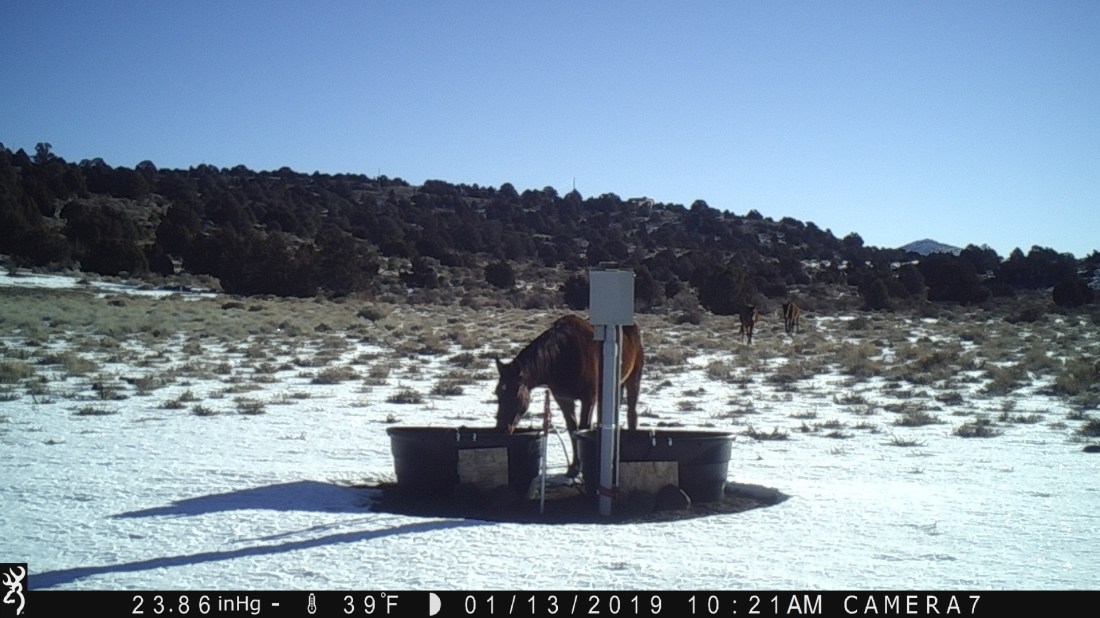
BLM reported today that its alliance with Friends of a Legacy provided ‘healthy wild horses and healthy rangeland in 2018.’  As suggested last week, those terms are euphemisms for ‘getting rid of the horses and giving their food and water to livestock.’

The volunteers, who convinced the state legislature to rename a highway east of Cody, are also known for their use of contraceptives to keep the size of the herd in check.

Birth rates have been reduced 70% according to the announcement.

Fertility_Control_Puzzle_Solved-1

This is not wild horse advocacy and certainly not wild horse preservation.

It is assent to the overpopulation narrative and capitulation to the anti-horse agenda.

RELATED: Livestock Grazing in Wyoming.

Advocates Fight ‘Arrogant Special Interest Agency’

No, it’s not the BLM.  It’s the New Mexico Livestock Board and its ‘long-term culture against wild horses.’

Wild horse enthusiasts, who won the release of the Alto horses last year, are pushing back against a bill that would put the NMLB in charge of the state’s wild horses, arguing that the agency has a ‘clear vendetta’ against the animals.  See this report, posted today by Ruidoso News.

Instead, they favor a bill known as the Wild Horse Protection and Habitat Act that would, among other things, conduct a census of wild horse herds, develop educational materials, create a fencing program and work with the DOT on safety issues.

They also support a bill that would provide for a special vehicle registration plate expressing support for wild horses.

RELATED: New Plate Captures the Struggle of America’s Wild Horses.

BLM Preps Pine Nut Mountains for Spring Turnout

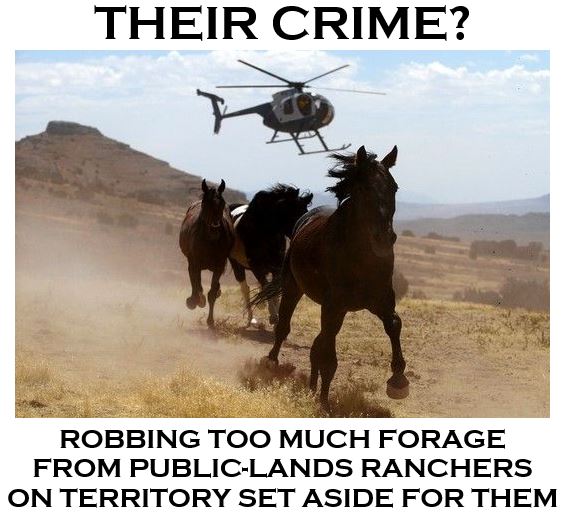
The contractor has pushed 294 wild horses off the HMA, through 02/11/19, liberating 3,500 AUMs per year and returning them to their rightful owners.

Refer to the figures at this page, which change as the gather progresses.  To date, no deaths have been reported and no animals have been returned to the range.

Robbing_Too_Much_Forage-1

Captured animals have been shipped to the off-range corrals at Palomino Valley.

RELATED: Pine Nut Roundup Set for Next Week.

Nominations Sought for WHBAB

BLM requested applications today for three positions on the nine-member Wild Horse and Burro Advisory Board, in the areas of humane advocacy, livestock management and wildlife management.

The Board advises the BLM and USFS on matters pertaining to free-roaming horses and burros on public lands administered by those agencies.

Board members serve three-year terms without pay, meeting twice a year, but travel and per diem expenses related to their service are reimbursed.

Nominations are due 45 days after the notice appears in the Federal Register, which should happen tomorrow.  Refer to this news release for application details.

The last WHBAB meeting occurred in Salt Lake City, UT, October 9 – 11, 2018.

Investigation of Heber Wild Horse Deaths Continues

A news release posted yesterday by the Forest Service said most of the dead animals were found outside the WHT, which is subject to multiple grazing allotments (see map on page seven of this document).

Ten of the horses have evidence of gunshots, which is unchanged from last week.

Anyone with information about the case is asked to contact the Navajo County Sheriff’s Office at 1-800-78CRIME.

RELATED: More Wild Horses Found Dead at Heber WHT.

WHB Adoption This Weekend In Wickenburg, AZ

A BLM news release posted yesterday said wild horses and burros would be offered for adoption and sale February 15 – 17 at the Everett Bowman Rodeo Grounds.

The announcement did not indicate how many animals would be available.

Inmates from the Arizona Department of Corrections will demonstrate the gentling and training process on Friday and Saturday.

If you can’t adopt, tell your U.S. representative that you’d rather see these guys wild and free on western rangelands, not privately owned cattle and sheep.

IMG_5882

Placitas Wild Horse Preserve Needs New Home

An organization known as Placitas Wild has been asked to vacate a preserve on which they’ve kept about 70 wild horses for almost four years, according to a story by KRQE News in Albuquerque, NM.

The report did not indicate why the horses were there or what would be done with the land after they are gone.

One of the volunteers told this writer that the preserve has been “operated by several old ladies working only from donations who have been caring for these horses for 15 years or more.  We cannot find the land, the funds, or the younger volunteers needed to continue to operate a free roaming preserve.”

Grazing Fee for 2019 Pending

The government shutdown filled the public-lands ranchers with anxiety, according to a report by Tri-State Livestock News, causing undue stress about turnout dates and grazing fees.  One thing they won’t have to worry about is the price escalating into a range that brings it in line with the cost of private-sector ranching.

The current fee, which expires at the end of the month, is 4.7¢ per cow/calf pair per day, or $1.41 per AUM.

Try feeding your horse for that.  Or your parakeet.

Wild horse critics like to point at the expense of animals in long-term holding, for which the government spends around $50 million per year.  The cost of feed is about $2 per day, or $60 per AUM.

Given nine million AUMs allocated to livestock annually, with room for three million more, the government receives about $13 million each year from the ranchers.

Add the costs of roundups, adoptions, transport and the like and you have the government spending around $60 million each year so it can collect $13 million from the ranchers.

If you restrict the revenue to lands subject to the roundups, you’d have the government spending at least ten times as much as it hopes to collect in grazing fees.

Those nine million AUMs would support 750,000 wild horses and burros, enough to empty all the off-range corrals and long-term pastures fifteen times over.

Their position is untenable and they know it.  That’s why they spew all the BS about wild horse overpopulation and damage to western rangelands.

If it was really about the money, the government would leave the horses on the range and tell the ranchers to go pound sand.

RELATED: Dire Condition of Wild Horses and Burros in Western U.S.
IMG_8139

Colville Gather Underway

The helicopter-assisted process started this week, according to an announcement in the Tribal Tribune of Nespelem, WA, long on headcount but short on details.

Tribal leaders changed the rules to allow the use of motorized vehicles in wild horse capture and increased the payoff to tribal members to $383 per horse removed.

Captured animals will likely be shipped to slaughter.

Any time you see actions like these justified by a need for ‘healthy rangelands’ or ‘healthy animals,’ you’re probably being lied to.

Perhaps tribal leaders were propositioned by ranchers to allow cattle on the affected lands, or livestock were already there but were losing too much forage to the horses.

Regardless, it’s a fine example of cultural annihilation on BIA lands.

RELATED: Colville Roundup Moving Ahead.