Pine Nut Helicopters Grounded, Bait Traps Next

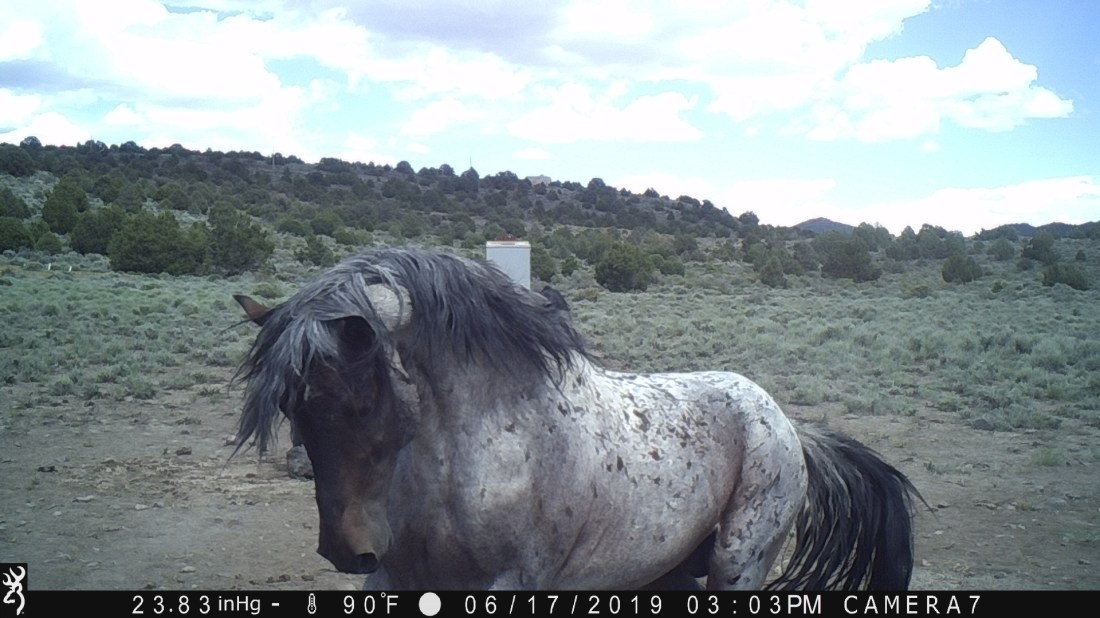
BLM said today that 36 wild horses were forced off their home range this week, with additional horses to be removed later this month.

Captured animals were taken to the Palomino Valley Off-Range Corrals 20 miles north of Sparks, NV, according to the news release.

One death was reported.  An adult mare with a broken leg was put down on 07/31/19.

RELATED: Pine Nut Roundup to Resume Next Week.

North Hills Gather Plan Inches Closer to Implementation

A story published yesterday by St. George News of St. George, UT said the BLM issued a Finding of No Significant Impact, allowing a plan to move forward that would remove most of the wild horses from the North Hills Joint Management Area in southwest Utah.

The JMA includes the North Hills HMA and North Hills WHT.  It contains 50,127 acres of BLM land (shown in tan on the following map), 24,006 acres of USFS land and 10,511 acres of state and private lands (shown in light green), for a total of 84,646 acres.

North Hills JMA Map-1

The herd size is now about 270 wild horses, according to the report, for a pre-gather population density of 3.1 animals per thousand acres.

A district ranger interviewed for the story went slightly off narrative, saying “The land is supporting that number right now, but that doesn’t mean that that’s a healthy herd.”

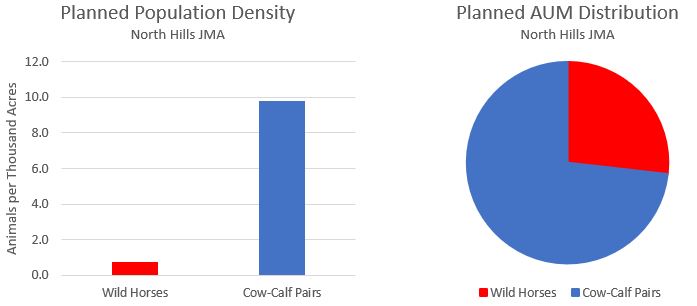
The aimed-at population density, based on an AML of 60, is 0.7 horses per thousand acres (60 ÷ 84,646 × 1,000).  The horses would consume 720 AUMs annually (60 × 12).

The Forest Service prohibits domestic livestock grazing on the WHT but the BLM allows it on the HMA, which is intersected by five allotments.  Privately owned cattle and sheep are eligible for 1,967 AUMs per year inside the HMA, according to page 27 of the plan.

Given an average grazing interval of roughly four months (see page 28), the AUM budget converts to 492 cow/calf pairs (1,967 ÷ 4).  This yields an aimed-at population density of 9.8 cow/calf pairs per thousand acres (492 ÷ 50,127 × 1,000).

These figures are presented in the following charts:

North Hills JMA Charts-1

The proposed gather will come very close to achieving these goals.  As usual, the horses get the short end of the stick, on land set aside for them.

It’s time to end public-lands ranching.

Double Devil Corrals Emptied

A report posted yesterday by the Herald and News of Klamath Falls, OR said all of the wild horses that were shipped to the Double Devil Corrals in Alturas, CA have been placed into homes, by sale or adoption.

The Forest Service is moving ahead with plans to remove another 500 horses from the Devil’s Garden Plateau WHT later this year, according to the report.

Estimates before the 2018 gather put the herd size at nearly 4,000 animals.

After forcing approximately 1,000 wild horses off their home range, the herd is now thought to contain about 1,800 horses, including this year’s foal crop!

If the figures from last year were truthful, the herd should be twice that size, assuming a 20% growth rate:

(4,000 – 1,000) × 1.2 = 3,600

This may explain why the 2019 goal is now 500 broomtails, down from 1,000.

RELATED: Forest Service: You Adopt, We Haul Devil’s Garden Horses.

Silver King Horses Get Short End of Stick

The announcement yesterday of a gather involving the Silver King HMA, among others, included a link to the final environmental assessment for a large roundup that occurred there in late 2018.

The EA looks at the effects of a proposed action along with those of its alternatives.

Table 1 on page 5 of the document says the HMA has an AML of 128 wild horses and a size of 606,000 acres, for an aimed-at population density of 0.2 animals per thousand acres.  The average density for all HMAs is one animal per thousand acres (27,000 wild horses and burros on 27 million acres).

The 128 horses allowed by plan would consume 1,536 AUMs annually, given they graze 12 months per year.

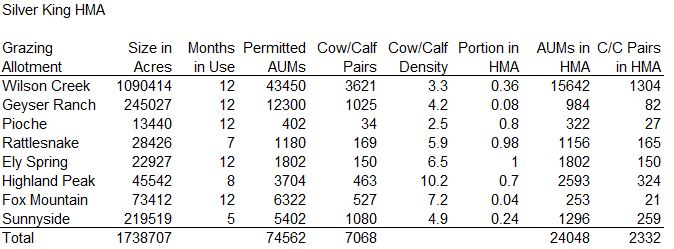
Table 3.3 on page 73, titled ‘Grazing Use Within Silver King Herd Management Area,’ shows eight livestock grazing allotments overlapping the HMA.  Only four percent of the Fox Mountain allotment falls within the HMA, compared to Ely Spring, which lies completely within the HMA.

The forage allocated to livestock must be calculated according to the percentage of land falling within the HMA.  For example, the Wilson Creek allotment contributes 43,450 × 0.36 = 15,642 AUMs, because 36% of its land is inside the HMA (assuming that forage is uniformly distributed across the parcel).

The eight fractions, added together, yield 24,048 AUMs for livestock inside the HMA.

In a similar manner, the forage allocations can be converted to cow/calf pairs using the annual grazing period (also given in table 3.3).  Wilson Creek livestock graze 12 months per year, so the number of cow/calf pairs inside the HMA would be 15,642 ÷ 12 = 1,304.

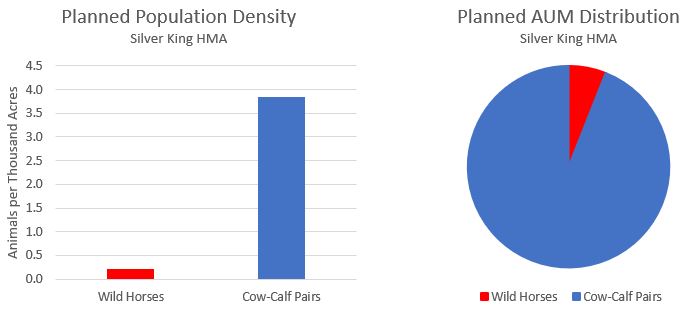
These eight results yield 2,332 cow/calf pairs inside the HMA, for a population density of 3.8 animals per thousand acres.  Note that one cow/calf pair is equivalent to one wild horse in terms of its resource loading.

These figures are presented in the following charts:
Silver King Charts-1

Land that can only support 0.2 wild horses per thousand acres can support eighteen times as many privately owned livestock.  Wild horses receive 1/15 (6%) of the forage allocated to livestock.

There’s your thriving ecological balance, on land set aside for the horses.

These alternatives were rejected in section 2.6 of the EA:

  • Raising the AML
  • Reducing or removing livestock
  • Managing the HMA principally for wild horses

Instead, the plan calls for additional roundups, fertility control and sex ratio skewing.

Table 3.3 in the EA also gives the allotment sizes, from which the planned population densities can be computed.  First, determine the number of cow/calf pairs on each allotment (inside and outside the HMA) using the permitted AUMs and annual grazing periods.  Then, divide those results by the size of the allotments.

For example, the number of cow/calf pairs on Wilson Creek, allowed by plan, would be 43,450 ÷ 12 = 3,621.  The population density would be 3,621 ÷ 1,090,414 × 1,000 = 3.3 pairs per thousand acres.
Silver King Allotment Densities-1

Note that the Ely Spring allotment, all of which falls within the HMA, can support 32 times as many cow/calf pairs as wild horses (6.5 ÷ 0.2).

These data provide more evidence that the WHB Act, which has been altered several times by ranching interests, no longer affords the protections sought by Velma.

The numbers also suggest that AMLs do not reflect the carrying capacity of the land.

Mustangs to Be Removed from Eastern Nevada Starting Today

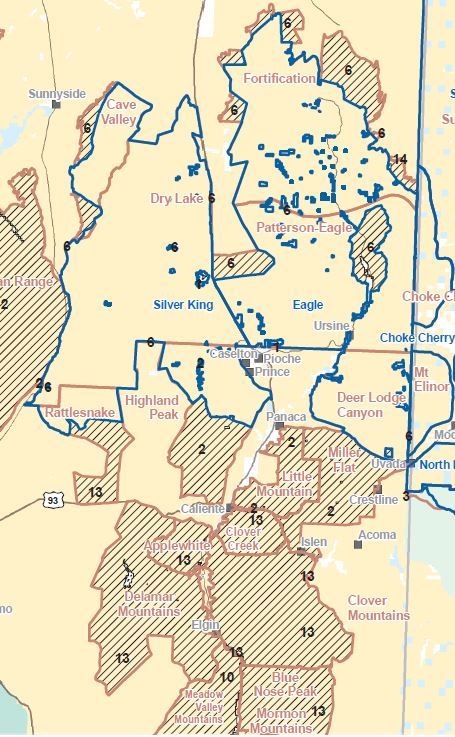
BLM announced this morning that up to 100 wild horses would be gathered from the Caliente HA Complex, Eagle HMA and Silver King HMA starting today.  All three areas were the subjects of roundups last year, although Caliente was blocked by legal action.

Operations will not be open to public observation.

The free-roaming animals are crossing roadways and damaging private property, according to the news release, which failed to mention that Nevada is a fence-out state.

The announcement did not say if the removal was authorized on an emergency basis.

Caliente - Eagle - Silver King Map-1

Captured animals will be taken to the Indian Lakes off-range corrals in Fallon.

Gather stats and daily reports will be posted to this page.

RELATED: BLM Urged to Fight Caliente Legal Action, BLM Concludes Eagle Gather, BLM Ends Silver King Roundup.

Comments Invited on EA for Range Creek Gather Plan

BLM announced on 07/12/19 the beginning of a comment period for an environmental assessment of the Range Creek HMA Gather Plan.  The assessment looks at the effects of a proposed action along with those of its alternatives.

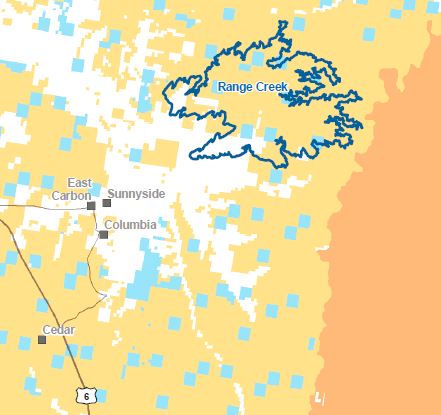
The HMA, in eastern Utah, contains 55,023 acres, according to the EA.  (The HMA page says 83,410 acres.)  The upper limit of the AML is 125, for an aimed-at population density of 2.3 animals per thousand acres.  The current population, estimated to be 282 wild horses, yields a pre-gather density of 5.1 animals per thousand acres.

The density target for all HMAs managed by the BLM is one animal per thousand acres.

Range_Creek_HMA_Map-1

The plan allocates 3,267 AUMs per year to privately owned livestock.  The allocation for wild horses is 1,500 AUMs per year (125 × 12).

The AUM budget for livestock yields 544 cow/calf pairs, assuming they graze six months per year, for a population density of 9.9 pairs per thousand acres.  (The resource loading for one wild horse is the same as one cow/calf pair per BLM guidelines.)

These figures are summarized in the following charts:

Range Creek Charts-1

There’s your thriving ecological balance.  Land that only support 2.3 wild horses per thousand acres can support almost five time as many cow/calf pairs.

The proposed action (page 12 in the EA) would remove up to 263 wild horses from the HMA, skew the sex ratio of the remaining herd, and apply contraceptives to mares returned to their home range.

The proposal will shift approximately 3,100 AUMs per year from the horse column to the cattle column, on land set aside for the horses.

This is because the WHB Act no longer affords the protections sought by Velma.

RELATED: Livestock Grazing in Utah, Range Creek Gather Ended.

Emergency Gather Ordered for Red Rock HMA

BLM said today that approximately 225 wild horses would be removed from the Red Rock HMA west of Las Vegas, starting July 28.  The roundup was prompted by lack of water and rangeland degradation, according to the news release.

Operations will not be open to public observation and captured animals will be taken to the off-range corrals in Ridgecrest, CA (site of the July 4 – 5 earthquakes).

The HMA covers 162,000 acres and has an AML of 27, for an aimed-at population density of 0.2 animals per thousand acres.

Red Rock HMA Map-1

Gather stats and daily reports can be found at this page.

The announcement did not indicate if any advocacy groups had offered to haul water to the horses and if ‘other authorized users’ were present on the HMA.

Roughly half of the 11,000 wild horses and burros gathered from public lands in 2018 were removed on an emergency basis.

Chincoteague Ponies Make Annual Swim

The first leg of the event was yesterday.  Auction was held today, with the return swim set for tomorrow.

The Assateague ponies are split into two herds, one on the Maryland side of the state line and the other on the Virginia side.  The following video by WJZ News in Baltimore covers the Virginia herd, sometimes referred to as the Chincoteague ponies.

How can a herd of 150 animals produce 70 foals annually?  That’s a 50% growth rate, well above the rate seen on public lands in the western U.S.  Sex ratio skewing?

Unwinding the Mess in the Wild Horse World

Off-range corrals are flooded with wild horses and burros because the WHB Act no longer affords the protections sought by Velma.

The original Act, which passed unanimously in Congress, reflected the will of the American people.  The current Act reflects the will of the public-lands ranchers.

It’s time to boot the ranchers off public lands and restore the Act to its original form.

Let them buy their own land, like everybody else, pay market rates for grazing their livestock, and stop sucking on the government teat.

Another Spay ‘Study’ Nears

A story posted today by Oregon Public Broadcasting says it could happen as early as next month at the Off-Range Corrals in Hines.

“The BLM has long been under pressure to bring down horse herd numbers across 10 Western states,” according to the report, “without resorting to slaughter.”

So who’s applying the pressure?

Oil companies?

Mining companies?

Timber companies?

Nope, none of the above.  It’s all being done to please the public-lands ranchers, their overlords, cheerleaders and political allies.

RELATED: BLM Abandons Wild Horse Sterilization Research.

PSA_178-1

Wild vs. Feral: Are America’s Horses a Re-Introduced Species?

Nobody disputes the story of horses arriving in the New World with Spanish explorers 500 years ago.  According to the narrative, they evolved in North America but were wiped out around 10,000 years ago, making them a re-introduced species.

Now, a researcher who studied the fossil record and interviewed native peoples, says they were here all along, making them indigenous.

Refer to this story, posted today by the Navajo-Hopi Observer.

Pine Nut Roundup to Resume Next Week

BLM said today that another 148 wild horses will be forced off their home range, starting next Monday, with 39 to be returned.  Mares released back onto the HMA will be treated with PZP, according to the news release.

The roundup will be open to public observation and will require five days.

Captured animals will be taken to the Palomino Valley Off-Range Corrals about 20 miles north of Sparks, NV.

Gather stats and daily reports can be found on this page, which contains data from the first part of the operation in February.

The roundup will protect herd health, prevent overgrazing of wildlife habitat and address public safety concerns.

It has nothing to do with pubic-lands ranching.

Yeah, right.

RELATED: Pine Nut Gather Called Off.

Forest Service: You Adopt, We Haul Devil’s Garden Horses

The Forest Service will ship ten unadopted horses at the Double Devil Corrals to your ranch if you’ll take them, according to a report posted this evening by Action News Now of Chico, CA.

These animals were forced off their home range last October in a roundup at the Devil’s Garden Plateau WHT.  Another gather will occur this fall.

RELATED: Horses at Double Devil Corrals Now ‘Three Strikers’, Ranchers Encouraged by Devil’s Garden Roundup.