Defending the Ranchers

“They have a right to be here,” according to the narrator of a video about Sand Wash Basin HMA, an area set aside for wild horses but shared with privately owned sheep.

Seriously?  You have a right to place your property on land you don’t own?

Since when do you need a permit to enjoy your rights?

My truck has been out in the rain for years but it didn’t have to be that way.  All I needed to do was to go next door and demand my rights.

Livestock grazing on public lands is a privilege, not a right.  What the government gives, the government can take away.  Please read The Bill of No Rights.

The remarks run from 09:16 to 12:11 in the video.  Would sympathies for the ranchers correlate with participation in fertility control programs?

You bet it would.

RELATED: Ties Between PZP Zealots and Public-Lands Ranchers Revealed.

Solving Wild Horse ‘Problem’ Will Be Hard Pill to Swallow

So says the writer of an opinion piece that appeared last week in the East Oregonian.

The solution “will require the removal of at least 60,000 horses, most of them through killing, and a commitment to remove by one means or another 5,000 per year to maintain an appropriate level.”

That’s about 70% of the horses currently on public lands in the western U.S., in line with the rancher-friendly ‘Path Forward.’

After all, the government just killed hundreds of bison in Yellowstone National Park to protect cattle, so why not horses?

The population limit set by the government, approximately 27,000 wild horses and burros on 27 million acres (which works out to one animal per thousand acres), is not a function of available resources.  Rather, it is the number of animals the land can support after diverting most of the food and water to privately owned cattle and sheep—on lands set aside for the horses and burros.

If you don’t think that’s true, just look at this example.  If you do believe it, you’re just seeing a “nefarious motive,” according to the author.  Leave the poor ranchers alone.

The fences that hold livestock in also keep horses out.  That may not be a problem on allotments with grazing seasons of two or three months per year, but what about areas that are in use for eight to twelve months per year, with stocking rates five to ten times higher than the horses?

Would that explain the movement of horses off their HMAs?

Would it account for conditions that don’t meet standards for rangeland health?

Have the most productive areas been given to the public-lands ranchers?

Stop imagining things!!!  There is no nefarious motive (even though it looks like sabotage).  If anything, it’s just an ‘unintended consequence’ of the grazing program.

WHB Act Has Been Nullified

On the Little Bookcliffs WHR in western Colorado, one of four areas set aside for wild horses and burros (out of roughly 200) that’s managed principally for wild horses and burros, per the statute.

The denominator doesn’t include areas where WHB were found in 1971 that have been commandeered for other mandated uses of public lands.

What about the other 196 areas set aside for WHB?  Most of the resources have been diverted to the other mandated users, a truly sad state of affairs for these animals.

The roundups, adoption incentives, training programs, off-range warehousing, darting programs, sterilization research, sanctuaries and preserves reflect that reality.

RELATED: Suggestion for the Big-Name Advocacy Groups, Hypothesis Revisited.

Nuisance Gather Plan for Southern Nevada Approved

BLM announced today the completion of an Environmental Assessment (EA) and Finding of No Significant Impact (FONSI) for management actions involving wild horses and burros in the Southern Nevada District.

The decision authorizes the removal of those animals on public and private lands to (1) mitigate safety concerns near roads, (2) reduce landowner complaints, and (3) respond to emergencies.

The scope does not include the removal of horses and burros to achieve AML, but does include the removal of excess horses and burros outside of HMAs and HAs.

Section 1.4 in the final EA says that wild horses and burros will be removed from private property after “reasonable efforts to restrict the animals…have failed,” suggesting that state fence-out rules are a factor in responding to landowner complaints.

RELATED: Comments Invited on Southern Nevada Nuisance Gather Plan.

EPA Ordered to Reconsider PZP Registration

A U.S. District Court Judge ruled yesterday in favor of Friends of Animals regarding the detrimental effects of PZP, a pesticide applied to wild horses and burros to reduce herd sizes.  Long-term use can result in sterilization.

Many of the so-called advocacy groups accept and promote wild horse fertility control, with some of them actually providing it, to the delight of the public-lands ranchers.

A news release by FOA said that the EPA will now be required to review the “evidence of unintended—and previously undisclosed—side effects on both targeted mares and wild horses in general.”

Stallions on the Maryland side of Assateague Island. where contraceptives have been applied for many years, have a high mortality rate, the sex ratio of the herd is far from normal and genetic diversity may be compromised.  But the PZP zealots point to it as a model of wild horse management.

RELATED: Assateague Herd Declines in Latest Census.

Who Affects Rangeland Health?

The Livestock Probability Map, supplied with other scoping documents for permitted grazing on the Sonoran Desert National Monument, says this about the “limited mobility” of cattle on page 5 (citations omitted):

The location of water and salt play a large role in the movement of cattle across a landscape.  In general, livestock do not travel more than 2 miles from water on flat terrain and no more than 1 mile in rough terrain.  Distance from water and slope are two common variables used to predict livestock distribution in almost every environment.  Furthermore, range condition is generally related to the distance from livestock water points.

And you thought only wild horses and burros were responsible for rangeland impacts near water sources?

What about the last statement ?  How does rangeland health vary with respect to distance from water?  The farther the better?

If that’s true, animals with greater mobility (and lower stocking rates), such as wild horses and wildlife, would be expected to have a smaller impact.

RELATED: Management of Western Rangelands in 2018.

Suggestion for the Big-Name Advocacy Groups

Many of the areas currently set aside for wild horses and burros are managed primarily for cattle and sheep, privately owned of course.

Other areas, where horses and burros were found in 1971, don’t have enough food and water to support them, although other users of public lands seem to do quite well.

Paragraph 1332(c) of the WHB Act says the land will be devoted principally for horses and burros.

CFR 4710.3-2 says “We’ll do that if we feel like it.”

Which viewpoint prevails?

Only four of the areas currently designated for wild horses and burros are managed primarily for them, out of roughly 200 areas so designated (HMAs and WHTs).

Here is the issue in a nutshell:

Can a federal regulation supersede a duly enacted statute?

Can the unelected bureaucracy override the legislative process?

That is for the court to decide.

A ruling in favor of the advocacy groups wouldn’t improve anything: It would only put things back where they should have been in the first place.

After that, the hard work begins.

How to Compute ‘Horses Denied’

Yesterday’s post about wild horses denied a spot on their home range only considered areas currently designated for horses.

What about areas no longer designated?  There are many of them, but let’s take a look at the Caliente Complex in eastern Nevada, which consists of nine former HMAs.

An estimated 39,920 AUMs per year have been diverted to privately owned livestock.

How do you determine the number of horses that the resource could support?

Horses graze twelve months per year, so divide the livestock AUMs by 12.

In this example, 3,327 horses have been denied a place on their home range.

That brings the total in yesterday’s post to 40,000, which accounts for 80% of the horses in off-range holding.

Contraceptives are not the answer.  The problem is public-lands ranching.

PSA 12-07-19

Hypothesis Revisited

This statement appeared on these pages back in November:

The number of wild horses and burros in off-range holding (around 50,000) can be explained by the misappropriation of forage on just a few dozen HMAs.

How’s the theory holding up?

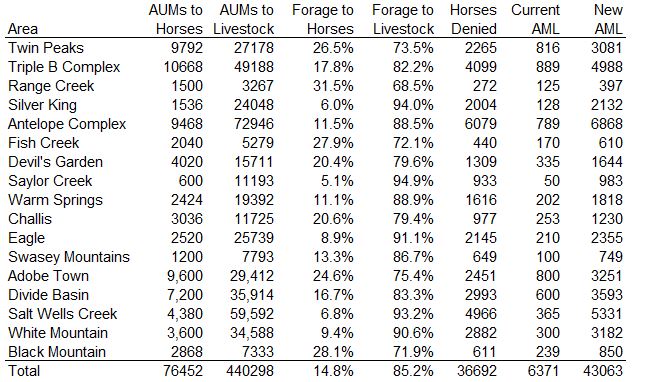
Let’s look at the numbers for the areas reviewed in a series of posts called ‘Short End of Stick’ (refer to sidebar on the right).  All calculations were based on horses and cow/calf pairs, even in areas designated for burros and sheep.

Short End of Stick Calcs-1

In the seventeen areas reviewed so far, 36,692 wild horses have been denied a spot on their home range because of privately owned livestock.  That’s about 73% of the horses in off-range holding.

How many more areas would need to be reviewed to bring the total to 50,000?  If the pattern holds, only about six.  So the theory seems to be correct.

Note that livestock receive 85% of the forage overall, with 15% to the horses—on land set aside for the horses.

If livestock were removed, the total AML (for the 17 areas) could be increased from 6,371 to 43,063.  A warrant for contraceptives can not be found in these data.

Thriving Ecological Balance Rev 2

Assateague Herd Declines in Latest Census

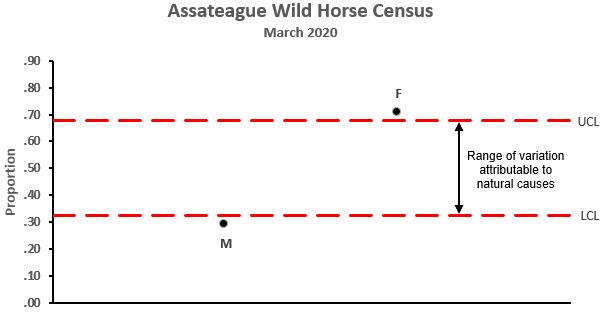
WBOC News of Salisbury, MD reported this morning that the March 2020 survey yielded 21 stallions and 51 mares, for a total of 72, compared to 76 in March of 2019.

One new foal was observed but its sex was not provided.  A few more foals may appear in the coming weeks.

The herd (Maryland side of the island) is subject to humane management practices and has been cited as a paragon of wild horse management by some ‘advocates.’

Assateague Census Chart March 2020-1

The chart tells you that the latest results cannot be produced by a simple random process centered at 50% males / 50% females.  Accordingly, one or more assignable causes should be sought.

Why is the sex ratio skewed in favor or females?  Why do males have a high mortality rate?  Is the management program making things better for the horses or worse?

The upper and lower limits of the chart are computed from basic statistical formulas, where p-bar = .50 and n = 72.

RELATED: New Assateague Foal.

Laramie County Commissioners Special Meeting This Week

Commissioners will meet on March 25 to fill a vacancy on the Board.  Refer to the agenda for more information.

The Board is currently considering, among other things, a rule change that will allow the construction of a high-density horse feeding operation near Burns, WY, despite the objections of nearby residents and the county Planning Commission.

With the impending closure of three HMAs in the western part of the state, and the downsizing of a fourth, the facility would be very convenient to the BLM.

RELATED: Laramie County Commissioners Favor Rule Change?