Success was limited, but what else did they find? Sorry, no drilling rigs or strip mines.
Thanks to DJ&Jules for putting this together.

Exposing the Hypocrisy, Lies and Incompetence of the Wild Horse Advocates
Success was limited, but what else did they find? Sorry, no drilling rigs or strip mines.
Thanks to DJ&Jules for putting this together.
A mare injured in the December, 2019 incident has a new colt, according to a report posted yesterday by WDRB News of Louisville, KY. Mom and baby are pintos.
They’re not, but if you’re a shill for the public-lands ranchers, anything that gets wild horses and burros off the range is good.
Being a wild horse on western rangelands is like moving into a five bedroom home and then being told that you can only use one bedroom. The four remaining bedrooms are reserved for other authorized users, which you’re not allowed to talk about, just like the writer of this opinion piece appearing today in The Salt Lake Tribune.
BLM said today that testing of a new fertility control vaccine began last week at the Northern Nevada Correctional Center in Carson City, NV. Researchers believe that a single dose may prevent pregnancy for three years or more.
The current wild horse and burro population in the western U.S. is thought to be around 95,000 according to the news release.
The number of privately owned cattle and sheep trying to graze the same land was not given in the announcement.
RELATED: Fertility Control Study Approved.
The Virginian-Pilot said today that the Chincoteague pony swim set for July 29 has been cancelled. The annual event, which involves the Assateague horses on the Virginia side of the island, helps to control the size of the herd, according to the report.
The horses know where to go when conditions deteriorate. A turn to the northeast with an increase in forward speed is expected later today. Rain accumulations of one to three inches are likely, with some areas receiving up to five inches.
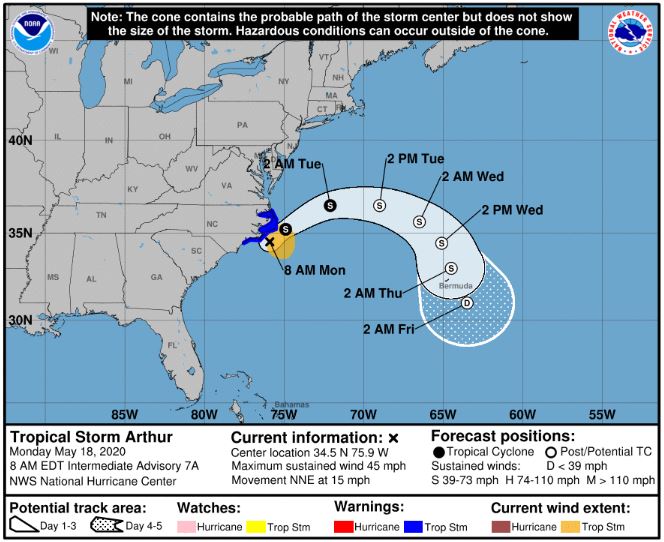
Winds will switch from onshore to offshore as the system moves into open waters.
RELATED: Arthur to Drench Banker Horses?
On the Salt River with Dubeyscape.
The mare and foal have reunited, according to a report posted today by AP News.
Tropical storm warnings were posted this morning, according to a report by OBX Today of Nags Head, NC. The system will bring onshore flow to the area as it approaches from the south. Flooding in low lying areas is expected, with seas building to eight to ten feet.

The storm arrives two weeks ahead of the official start of the Atlantic hurricane season, which occurs June 1.
Three men who tried to capture the foal for photos separated it from its mother, which puts the foal at risk of death, according to a story posted Friday by OBX Today of Nags Head, NC. The report did not indicate if the two had been reunited.
The barrier island can only be accessed by watercraft.
Medium cycle, extra rinse.
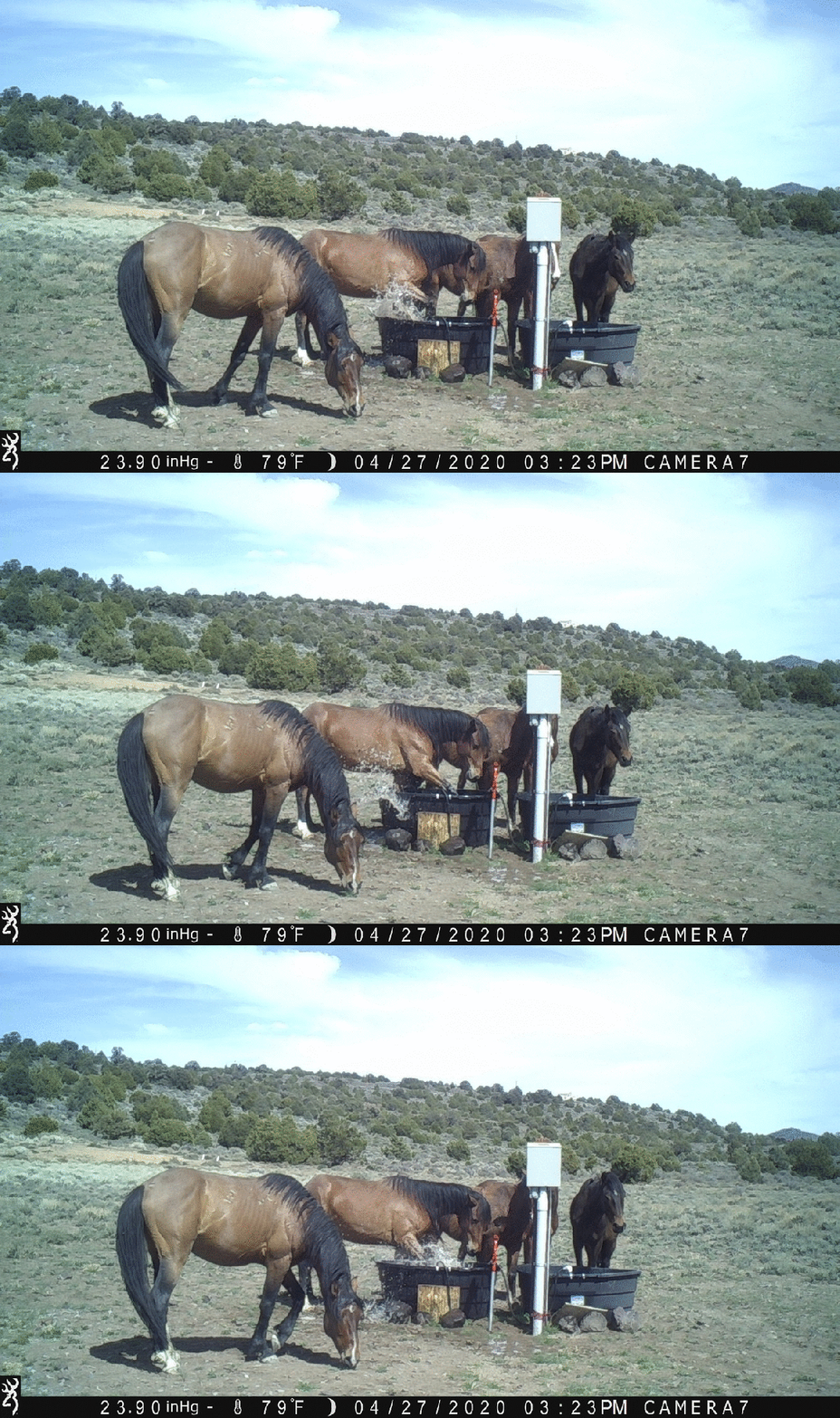
Yesterday I was asked by one of the Virginia Range darters if they could ply their trade on my property. No unfair advantage or anything.
When the project was announced a year ago, it was to occur on land owned by Blockchains LLC in the Tahoe Reno Industrial Center.
But apparently it has morphed into mass targeting of all wild horses across the Virginia Range, which is held up as a model of success. Trailcam photo taken 05-15-20.
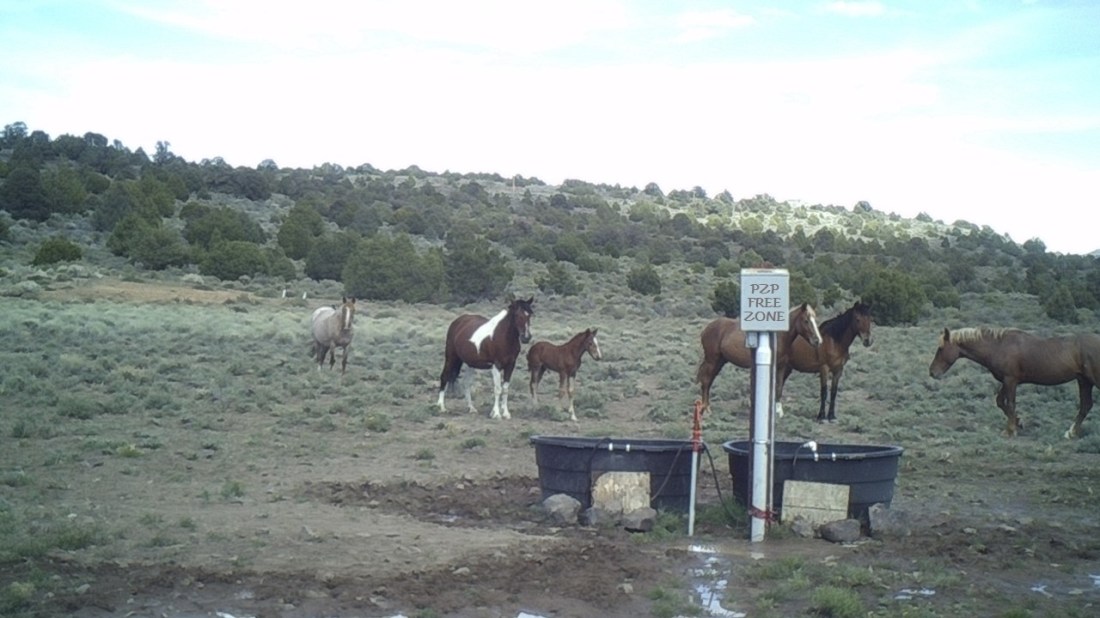
You try to do them a favor…
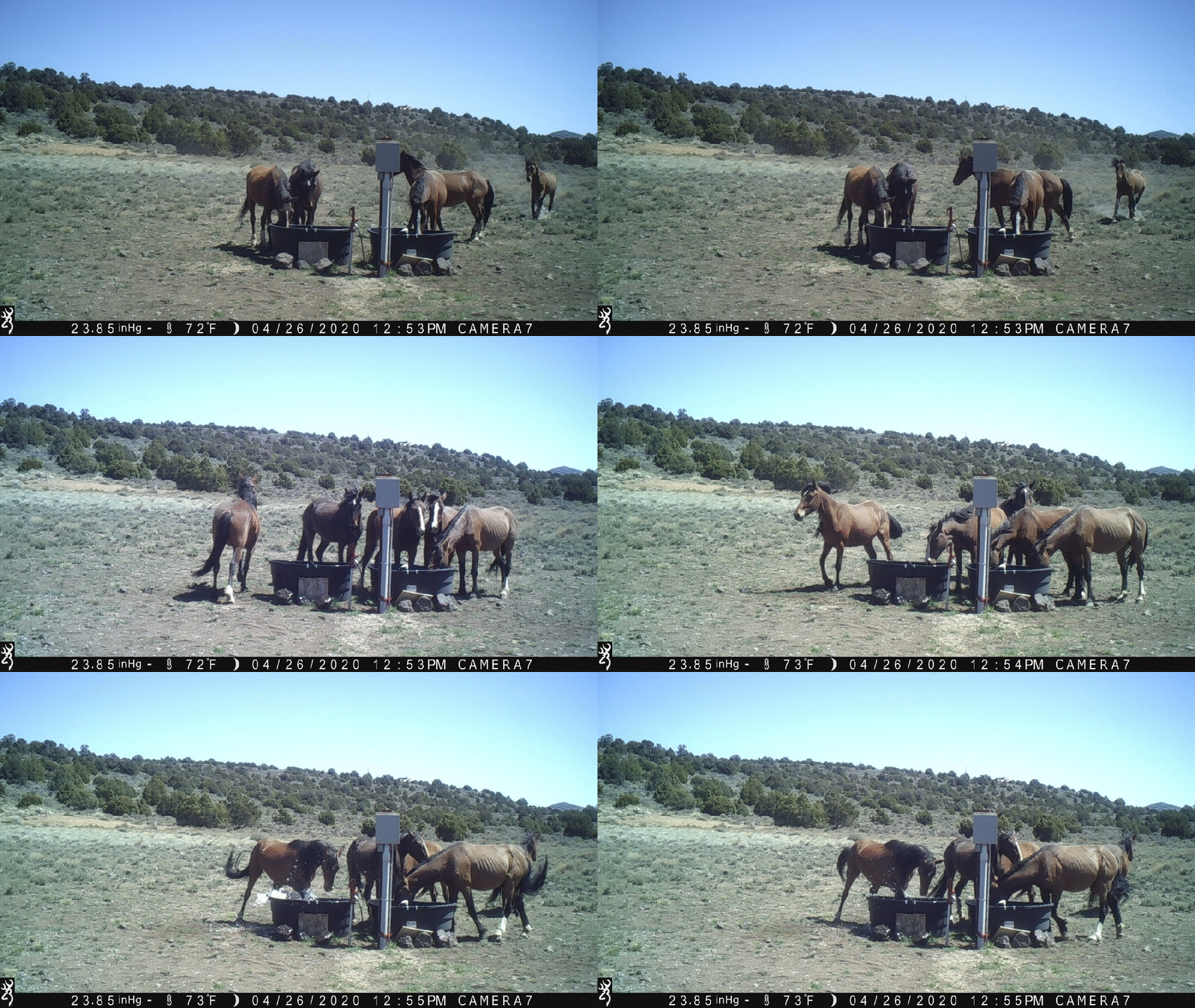
The introductory material in the new WHB management plan, beginning on page 2, is not complete. You might get the impression that wild horses are the problem.
Mustangers were not ordered to harvest them for commercial purposes, such as the production of dog food. That’s how they got rid of the carcasses. They were hired by ranchers to clear the range of anything that robbed forage from their livestock.
Yes, the WHB Act has been amended by Congress on four different occasions—at the behest of ranching interests. That part was not stated. The original Act protected the horses from ranchers, not drillers, loggers and miners.
Velma understood the issues. Today, most wild horse ‘advocates’ do not. In their zeal for contraceptives, they’ve sided with the ranchers.
Yes, the number of wild horses on western rangelands has grown, while the amount of land reserved for them has gone down. That part was carefully omitted. When the Rock Springs RMP amendments are implemented, the loss will be roughly 50% (of the land inhabited by these animals in 1971).
Lands no longer managed for wild horses and burros don’t have enough resources to support them, but somehow, privately owned livestock seem to do just fine.
If nothing is done to reduce growth rates, the on-range population of wild horses and burros could reach 2.8 million by 2040. OK, why is that a problem? Because it will lead to catastrophic harm to the land and to other species—meaning it will put the livestock operators out of business.
This plan is nothing but a shameless defense of the public-lands ranchers, who hide in the shadows while the government does their dirty work. It’s one of the best examples of crony capitalism you’d ever want to investigate.
RELATED: WHB Strategy in the News.
BLM said today that wild horse and burro adoptions increased 91% during the first year of the program, which pays adopters $500 within 60 days of adoption and $500 within 60 days of receiving title.
The number of animals placed into forever homes was not given in the announcement.
RELATED: Incentives Boost WHB Adoptions.
He’s plus 150 pounds and minus six mares, but otherwise okay, according to a report posted today by The News & Observer of Raleigh, NC. Band stallions have the toughest job on the range—or beach, as the case may be.
A syndicated report by AP News is making its way across major news outlets.
The plan calls for the removal of 20,000 wild horses and burros per year from western rangelands until the population target of 27,000—known as ‘AML’—is achieved.
The current population is 88,000 animals, with herd sizes doubling every five years.
The plan also requires more contraceptives and sterilizations, more adoptions and more off-range warehousing.
All of this to prop up an industry that’s outlived its usefulness.
The 33-page strategy is not necessary, just two sentences:
RELATED: Strategy for Implementing ‘Path Forward’ Sent to Congress.

Look at the photos on page 25 of the new strategy for controlling wild horse and burro populations on western rangelands. You’re supposed to conclude that the changes were due to free-roaming horses. Wildfires, droughts and overgrazing were not involved.

Why worry about forage and nutritional values? The horses take what they can get.
Zoom in on the storyboard. The photos were taken on the Spruce Allotment, which intersects the Spruce-Pequop HMA.
The tragedy is not that the horses are suffering from malnutrition, but that the land is now less useful to the poor ranchers.
RELATED: Strategy for Implementing ‘Path Forward’ Sent to Congress.
The $21 million authorized in December for the disastrous management plan is another step closer to obligation, according to a news release by Animal Wellness Action, a lobbying group in Washington, DC.
Congress withheld funding until the BLM developed a comprehensive and detailed plan for controlling wild horse and burro populations on public lands in the western U.S.
The plan was issued last week and Congress has 60 days to review it.
The news release did not indicate if it was a draft, subject to revision, or if it would be posted for public comments.
A simple way to assess the validity of the plan is to search it for terms such as ‘AUM,’ ‘livestock,’ ‘forage allocation,’ ‘permit’ and ‘grazing season.’
They’re not in there, as if the grazing program was independent of the WHB program, not intertwined. Everybody knows that AMLs must go down if permitted AUMs go up!
The plan puts the crosshairs on America’s wild horses and burros while shielding the ranchers from public scrutiny.
HMAs were supposed to be safe havens for wild horses and burros but the government has turned them into breeding grounds for privately owned livestock.
Meanwhile, the BLM is ‘modernizing’ the grazing program, to streamline the permitting process, provide greater flexibility for managing resources and further enrich the public-lands ranchers.
BLM will remove 120 wild burros from the Havasu HMA starting this month, because they are damaging private property. The operation, not announced on the BLM news page, will be carried out with bait traps and will not be open to public observation.
The HMA covers 450,790 acres in western Arizona, with land on both sides of the Colorado River. The AML is 166 wild burros, equivalent to 83 wild horses.
The stocking rate allowed by plan is equivalent to 0.2 wild horses per thousand acres, compared to a target rate of one wild horse per thousand acres across all HMAs.

Captured animals will be taken to the off-range corrals in Florence.
Gather stats and daily reports will appear on this page.
BLM did not indicate if any resources on the HMA had been diverted to other users of public lands.
As noted last month, stocking rates below 1.0 may denote large percentages of resources assigned to privately owned livestock. The environmental assessment for management actions on the HMA would have to be reviewed to find out if that’s the case.

