Emergency Roundup Scorecard

Montezuma Peak HMA

  • Animals gathered: 5 horses, 43 burros
  • Goal: 50 horses, 25 burros
  • Animals shipped: 2 horses, 43 burros
  • Animal deaths: 0
  • Method of capture: Bait trap
  • Last update: August 4
  • Gather stats

Nevada WHR

Antelope Valley HMA

Triple B / Maverick-Medicine HMAs

  • Animals gathered: 247 horses
  • Goal: 360 horses
  • Animals shipped: 184
  • Animal deaths: 4
  • Method of capture: Bait trap
  • Last update: August 10
  • Gather stats

Jackson Mountains HMA

RELATED: Emergency Roundup Scorecard, August 10.

Wyoming Not Top Bidder for Checkerboard Lands

The state will not be purchasing private parcels and mineral rights offered by Occidental Petroleum along the I-80 corridor, according to a syndicated report posted yesterday by The Salt Lake Tribune.

The area includes public lands affected by the Rock Springs RMP amendments.

The story did not indicate who submitted the successful bid or how the lands would be used but did note that they could be leased for grazing or alternate energy projects.

RELATED: New Twist in Rock Springs RMP Amendments?

Sulphur Wild Horse Roundup Starts This Weekend

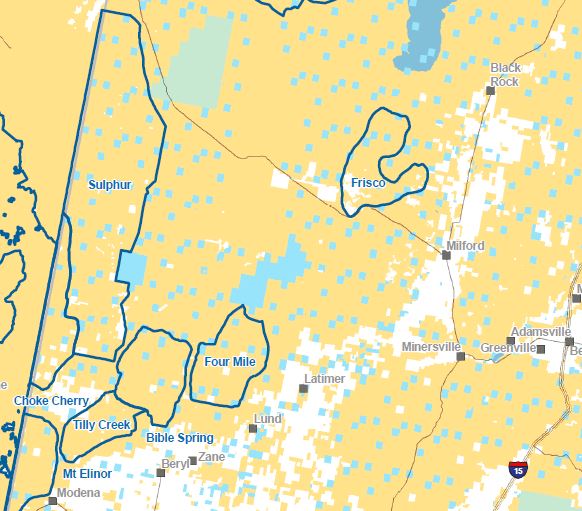
Approximately 600 animals will be removed from the Sulphur HMA beginning August 15, according to a BLM news release issued today.

The operation, to be carried out with helicopters, will be open to public observation.

The HMA covers 265,711 acres in western Utah and has an AML of 250, for an aimed-at stocking rate of 0.9 horses per thousand acres.
Bible_Springs_Complex_Map-1

The announcement did not refer to the NEPA project that authorized the roundup, but this one, initiated in 2015, may be relevant.

Table 3.2 in the Final Environmental Assessment indicates that the HMA intersects nine grazing allotments.  The total estimated forage available to livestock inside the HMA is 10,256 AUMs per year, compared to 3,000 AUMs per year for the horses.

The current population of 1,193 horses would consume 14,316 AUMs per year.

Captured animals will be taken to the off-range corrals in Axtell, UT.

A link to the gather stats and daily reports was generating an error message at the time this report went live.

Shawave Roundup, Day 8

Helicopters were grounded over the weekend.  Gather stats through August 10:

  • Horses captured: 852
  • Burros captured: 0
  • Animal deaths: 7

Mares outnumbered studs by 62.  Foals represented 20.7% of the total.

The HMA, part of the Blue Wing Complex, covers 13% of the massive Blue Wing-Seven Troughs allotment but the horses receive just four percent of the authorized forage.

The operation started August 3 with the goal of removing 1,600 horses and 200 burros from the HMA and surrounding lands.  The AML is 136 horses, burros not allowed.

RELATED: Shawave Roundup, Day 5.

Emergency Roundup Scorecard

Montezuma Peak HMA

  • Animals gathered: 5 horses, 43 burros
  • Goal: 50 horses, 25 burros
  • Animals shipped: 2 horses, 43 burros
  • Animal deaths: 0
  • Method of capture: Bait trap
  • Last update: August 4
  • Gather stats

Nevada WHR

Antelope Valley HMA

Triple B / Maverick-Medicine HMAs

  • Animals gathered: 224 horses
  • Goal: 360 horses
  • Animals shipped: 184
  • Animal deaths: 4
  • Method of capture: Bait trap
  • Last update: August 8
  • Gather stats

Jackson Mountains HMA

RELATED: Emergency Roundup Scorecard, August 8.

Another Lesson from Industrial Quality Control

The analyst, looking at data from a process, faces two problems:

  • Searching for trouble that doesn’t exist
  • Overlooking trouble that does exist

The statistical methods used by Western Horse Watchers are designed to minimize the losses from these mistakes.  There are no probabilities, no underlying distributions.

The formulas help you decide, by calculation, if the results from a process should be attributed to chance or whether they should be associated with one or more assignable causes (nameable, knowable, findable).

Do these data look like they were produced by a simple random process?

If you’re talking about the Assateague herd, the answer is ‘No.’

Data from the recently concluded gather at Nevada WHR look like they were.

This doesn’t mean that wranglers weren’t on horseback cutting mares from the herd, to skew the sex ratio, there’s just no evidence of that in the data.

RELATED: A Lesson from Industrial Quality Control.

Emergency Roundup at Nevada WHR Ends

BLM announced today that the operation concluded on August 8, with 126 wild horses removed.  Three deaths occurred on August 7.  Details can be found in the daily reports.

Foals represented 22% of the total.

The number of studs and mares found in the traps could be accounted for by a simple random process centered at 50% males / 50% females.

RELATED: Nevada WHR Emergency Roundup Starts Next Week.

Shawave Roundup, Day 5

The daily reports indicate 675 wild horses gathered through August 7.  No burros have been captured and seven deaths have occurred (1%).

Foals accounted for 20.4% of the total.

On August 5, 44 mares were treated with contraceptives.  A booster will be applied after 30 days, followed by return to the HMA.

The goal is remove 1,600 horses and 200 burros from the HMA, which represents about 28% of the land in the Blue Wing Complex.

RELATED: Shawave Roundup, Day 3.

Emergency Roundup Scorecard

Montezuma Peak HMA

  • Animals gathered: 5 horses, 43 burros
  • Goal: 50 horses, 25 burros
  • Animals shipped: 2 horses, 43 burros
  • Animal deaths: 0
  • Method of capture: Bait trap
  • Last update: August 4
  • Gather stats

Nevada WHR

  • Animals gathered: 102 horses
  • Goal: 125 horses
  • Animals shipped: 61
  • Animal deaths: 0
  • Method of capture: Bait trap
  • Last update: August 6
  • Gather stats

Antelope Valley HMA

Triple B / Maverick-Medicine HMAs

  • Animals gathered: 195 horses
  • Goal: 360 horses
  • Animals shipped: 89
  • Animal deaths: 1
  • Method of capture: Bait trap
  • Last update: August 5
  • Gather stats

Jackson Mountains HMA

RELATED: Emergency Roundup Scorecard, August 6.

In Praise of PZP

Refer to this guest column, appearing this morning in the Las Vegas Sun.

If you believe that most of the problems on public lands in the western U.S. are due to privately owned livestock, why would you promote a technology associated with wild horse overpopulation?

The writer cites AWHC’s war on the Virginia Range mustangs as a PZP success story, but does not mention the disastrous long-term effects of PZP on the Assateague herd or the recent court order requiring the EPA to reconsider its registration of the pesticide.

Extended use, necessary for maintaining AMLs, leads to sterilization.  The horses are said to be ‘self boosting.’

PZP doesn’t protect wild horses, it prevents them.

While that might appeal to some, the idea does not have broad support among ranching interests because darted mares still eat.  Removal, the centerpiece of the glorious ‘Path Forward,’ is still the best option.

RELATED: Management of Western Rangelands in 2018, Livestock Grazing in Nevada.

AEA Ties PZP Amendment to Wild Horse Darting Machine

Refer to this press release by American Equine Awareness, issued yesterday.

Should Congress direct some of the money to a pilot program that tests the new system, so it can be refined for commercial use?  Would the Rolling Stones support the idea?

The House spending bill, which includes the amendment, still has to be considered by the Senate.

RELATED: If the PZP Amendment Carries, How Will the Money Be Used?