Most of the AUMs in the HMA are assigned to the ZX Ranch.

A 1994 report by AP News says it’s owned by the J.R. Simplot Company. A 2017 story by American Cowboy provides details.
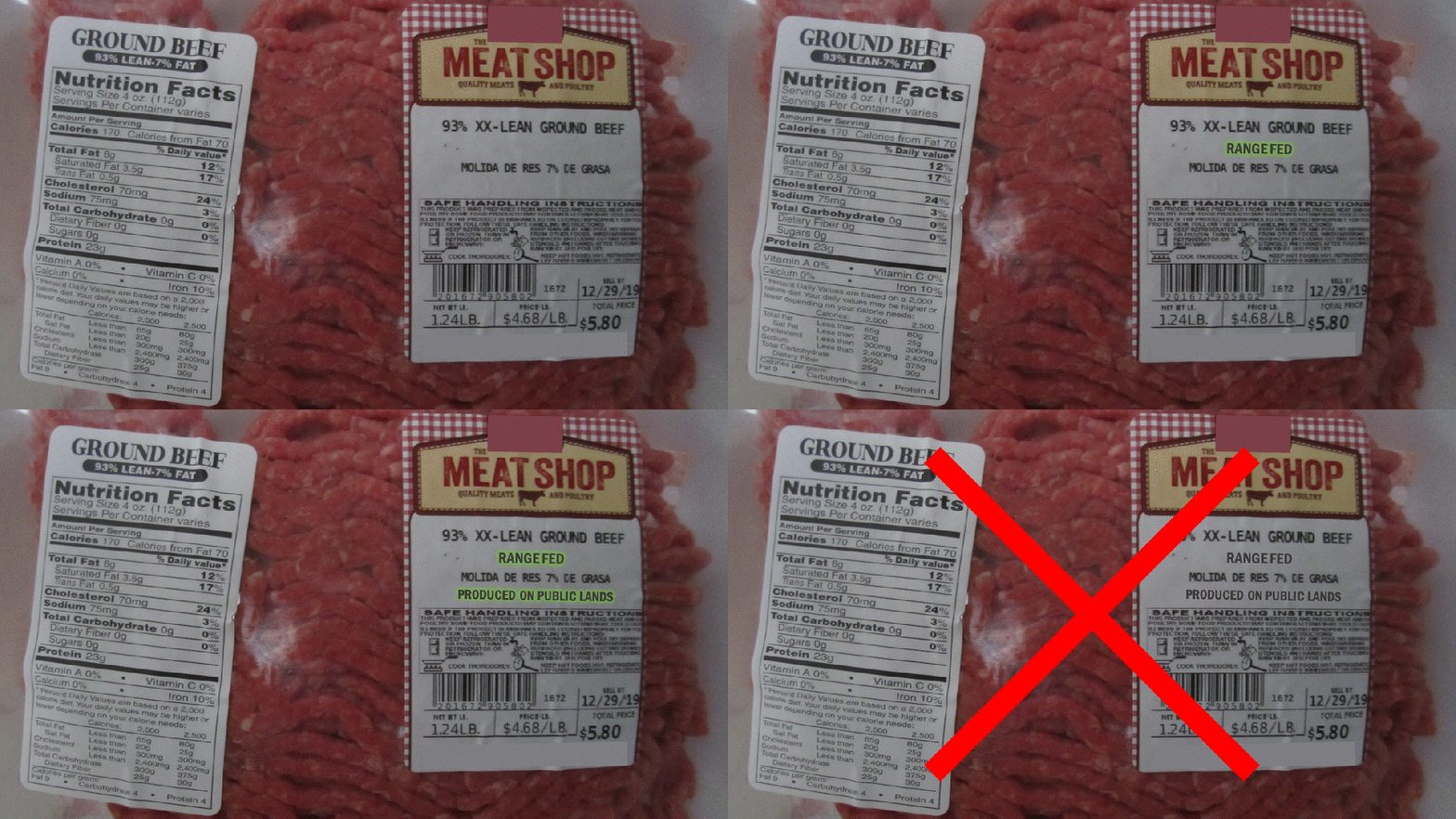
If you knew it would you buy it?

Exposing the Hypocrisy, Lies and Incompetence of the Wild Horse Advocates
Most of the AUMs in the HMA are assigned to the ZX Ranch.
A 1994 report by AP News says it’s owned by the J.R. Simplot Company. A 2017 story by American Cowboy provides details.
If you knew it would you buy it?
Volunteers with Wild Horse Connection are using unnatural methods “to make sure the horses stay in their natural habitat,” according to a story posted today by KOLO News of Reno. If feeding wild horses is a good idea, why is it illegal?
RELATED: Volunteers Needed for Virginia Range Feeding Program.
Here are the forage allocations for the Paisley Desert HMA, as presented in Table 1 of the Final EA for wild horse management actions therein.
The HMA intersects four allotments and has a Herd Area Management Plan (HMAP).
Would you say it’s managed principally for wild horses?
The Saint Patricks allotment is 100% inside the HMA but livestock receive over 20 times more forage than horses on that parcel.
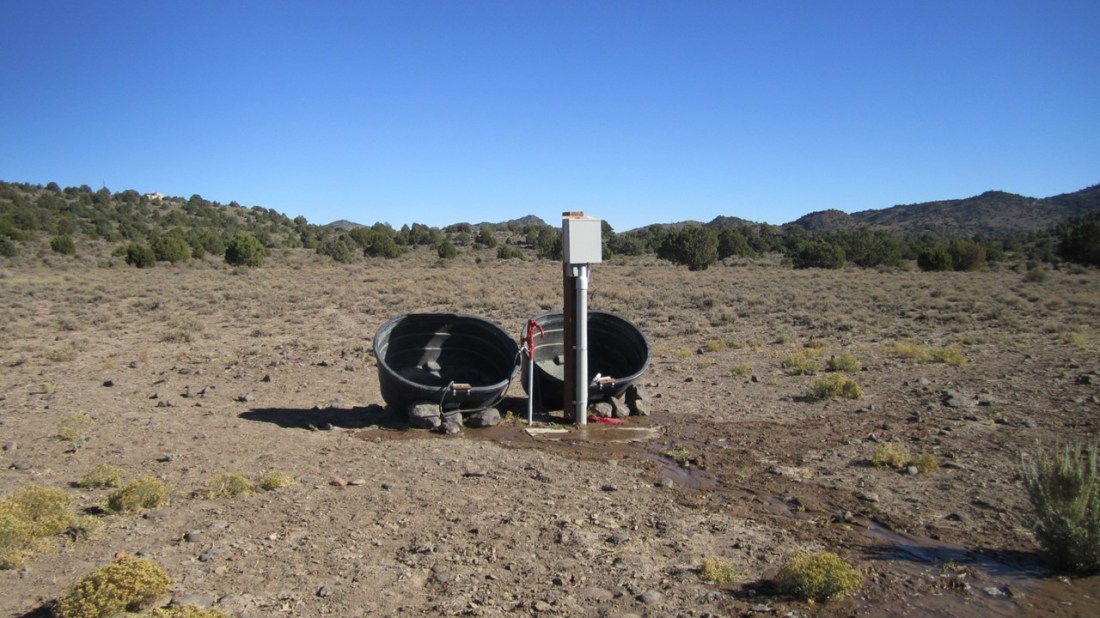
The EA said on page 27 that solar-powered wells were proposed for the HMA to provide water for the horses but over 700 of them were removed last month due to lack of water.
The event started October 10. Gather stats through October 31:
No deaths were reported over the last three days.
Foals accounted for 22.4% of the horses gathered since October 10. Of the captured adults, approximately 46% were males and 54% were females. Body condition scores are not known.
Three more horses were returned to their home since the last update. The number treated with fertility control is now 59.
The number of unaccounted-for horses is 1,672 – 4 – 118 – 1,055 = 495. The contractor may be holding them on site.
The reports don’t say where the horses were captured or returned. Five HMAs are involved in the roundup.
RELATED: Red Desert Roundup Day 19, Roundup Checks and Balances.
Yeah, it’s a tarantula, photographed September 20.
Happy Halloween from Western Horse Watchers!

These people are helping the government manage wild horse areas principally for livestock, by enforcing RMPs that are biased in favor of the public-lands ranchers.
Many of the so-called advocacy groups are involved. Don’t give them a penny!
RELATED: Future of Wild Horses in Hands of U.S. Senate?
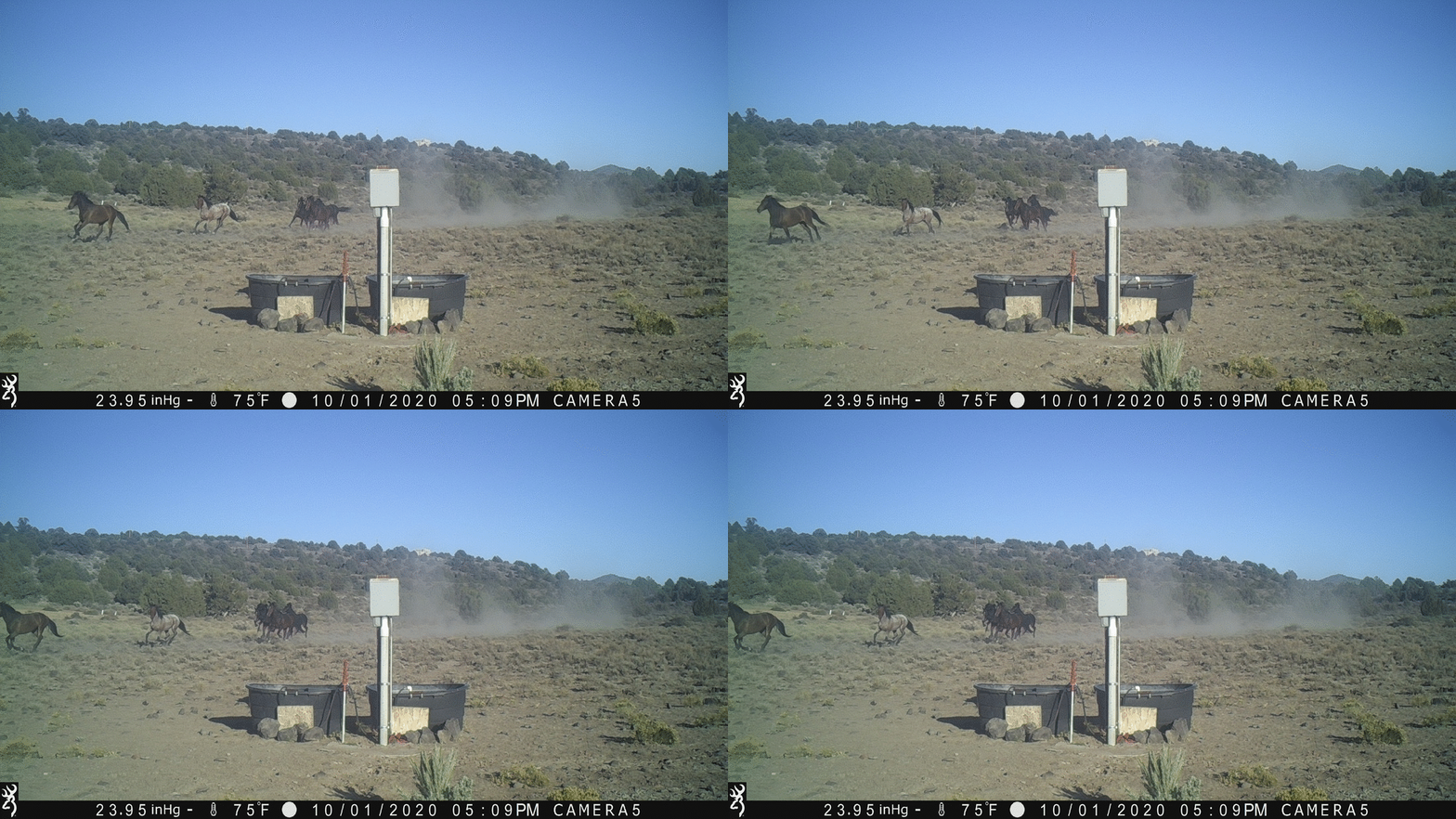
Animals like these are the “not necessarily exclusively” part of the “managed principally but not necessarily exclusively” clause of the original WHB Act. There was no provision for livestock.

The roundup may be over but the investigation continues, according to staff at the BLM Ridgecrest Field Office. Forty six burros were found dead on their home range in 2019.
BLM said today that it has requested bids for new short-term holding facilities in Idaho, Nevada and Utah. Capacities of 500 to 10,000 wild horses and burros are desired, according to the news release.
Animals delivered to the corrals will be held temporarily before transfer to off-range pastures or adoption/sale locations across the country.
Proposals will be accepted through November 30.
The construction of a high-capacity animal feeding operation was the subject of a heated debate earlier this year in Laramie County, WY.
RELATED: BLM Seeks Off-Range Corrals.

It’s when the poor ranchers can enjoy the full benefit of their permitted AUMs.
Consider this example from Appendix VII of the Final EA for wild horse management actions in the Caliente Complex:
To reestablish the health to the rangeland in the Areas we currently run Cattle the population of Wild Horses must be managed properly. Current numbers indicate a gross overpopulation of Wild Horses on our allotments as well as many others. We currently have an allotment that is supposed to allow us up to 327 Cattle (1312 AUMS) on our Sheep Flat permit. The damage because of overpopulation of Wild Horses has made it to where we can barely run 100 head on this Allotment and not for the full grazing season. We have to gather cattle and move them to rented pasture in Barclay to finish out the summer season.
Can you imagine that? Having to pay market rates to feed your cattle? You wouldn’t wish that on your worst enemy.

Instead of laying the expense off on taxpayers (in the form of roundups).
The event started on October 10. Gather stats through October 28:
No activity on Day 18 due to weather. One death occurred on Day 19.
Foals accounted for 22.5% of the total. Of the captured adults, approximately 47% were males and 53% were females. Body condition scores are not known.
Twenty five horses were returned to their home range over the last few days, bringing the total to 115. The release may signify the end of gather operations in one the HMAs.
The reports don’t say where the horses were captured or returned. Five HMAs are involved in the roundup.
There are 393 unaccounted-for horses as of October 28. The contractor may be holding them on site.
RELATED: Red Desert Roundup Day 16.
Two years ago, in the Caliente Complex, a decision by the BLM authorized wild horse management actions in an area not managed for wild horses.
Legal action by several advocacy groups halted the plan, although a nuisance gather occurred there last year.
The Complex includes nine HAs that were demoted from HMAs around the same time as Moriah, except for one that was dropped in 2000.

Like Moriah, they were evaluated for forage, water, cover, space and reproductive viability and found to be deficient in one or more of those characteristics and therefore deemed unsuitable for wild horses. Refer to Section 1.1 of the Final EA for the removal of wild horses from the Complex.
The EA does not say which HMA suffered from what condition and does not explain how 1,744 horses could be living there at the time it was published.
Curiously, the 26 allotments that intersect the Complex were not zeroed out, although a few were idled voluntarily. See Table 3.2 and the Appendix V map in the EA.
The forage assigned to livestock, approximately 40,000 AUMs per year, would support 3,300 wild horses at a stocking rate of four animals per thousand acres.
Together, Moriah and Caliente represent nearly one million acres of public lands originally designated for wild horses but now managed almost exclusively for privately owned livestock.
RELATED: What Happened to the Moriah HMA?
Wild Horse Education announced today that it has taken legal action opposing a decision by the BLM earlier this month authorizing certain wild horse management actions in the Confusion HMA.
The plan, which included sterilization of mares at private facilities (not open to public observation), would ensure over the long run that the Confusion wild horses consume no more than their fair share—around 12%—of the total authorized forage in the HMA.
RELATED: Confusion DR Setting New Precedent in WH Management?
Refer to this story by Coastal Review Online. No other details are known at this time.
In a story posted yesterday by the Paulick Report, a news service devoted to the horseracing industry, Dr. Tom Lenz, WHBAB member representing veterinary medicine, said “I think the problem we have today is that the public, through Congress, is managing the horses, rather than the BLM managing them through scientists.”
OK, people, it’s time to ‘fess up.
Who among you have been writing and approving the RMPs that allocate eighty percent or more of the forage in HMAs to privately owned livestock?
How many of you have been demanding the roundups and other population controls that enforce those resource allocations?
Which one of you secured funding for the ‘Path Forward,’ which will ultimately remove seventy percent of America’s wild horses and burros from their home range and place them into off-range pastures and private sanctuaries?
Who benefits as HMAs are zeroed out, predators are decimated and invasive species, such as pinyon pines and juniper trees, are eradicated?
Who pushed for changes to the WHB Act, rendering it ineffective?
Avoid the consequences. Identify yourselves in the comments. Do it now!
The operation started on September 23. Gather stats through October 23:
Foals accounted for 14.2% of the total. Of the captured adults, approximately 53% were jacks and 47% were jennies. The cumulative total says 300 animals captured.
One death occurred on October 23, when a four year old jenny was put down due to a broken neck. Her foal was adopted out. Neither animal was included in the Day 31 figures so the incident may have occurred in a holding pen involving animals previously gathered. Should the foal be counted as an animal shipped?
There were 302 – 2 – 253 = 47 unaccounted-for burros as of October 23. BLM staff may be holding them on site.
RELATED: Black Mountain Roundup Day 17.
The operation concluded on October 23 with 126 burros gathered, 126 shipped and no deaths. The goal was 80. The number of animals remaining in the HA is not known.
Foals accounted for 20.6% of the total. Of the captured adults, 42% were jacks and 58% were jennies.
A foal refused to follow its mother into the trap on the last day of the roundup so the mom was released.
Figures courtesy of BLM, Ridgecrest Field Office.
RELATED: Clark Mountain Roundup in Progress.
The incident started on October 10. Gather stats through October 25:
No activity on Days 13 and 16 due to weather. The haul on Day 14 was 263, the largest of the operation so far. The cumulative totals show 1,062 horses captured.
One death occurred on Day 14 and another on Day 15.
Foals accounted for 22.6% of the total. The sex ratio of captured adults is approximately 47% males, 53% females.
The reports do not indicate where the horses were captured. Five HMAs are involved in the roundup.
Body condition scores are not known.
There are 1,060 – 3 – 90 – 688 = 279 unaccounted-for horses. The contractor may be holding them on site.
RELATED: Red Desert Roundup Day 11.
At Theodore Roosevelt National Park with slussejs.

