Propping Up a Failed Industry

“Nevada’s livestock industry would not exist without ranchers’ ability to graze on public land,” according to the Nevada Rangelands Resources Commission, because most of the land is owned by the federal government.

Nevada is also home to half of America’s wild horses.

Western Horse Watchers is unable to determine if NRRC is a government entity or a trade group masquerading as a government entity.  The state seal appears on their home page.  An email seeking clarification in November 2019 was never answered.

Federal ownership of land in other western states is considerably less, but we see the same pattern of roundups and biased RMPs.

Do you think the rancher-friendly ‘Path Forward‘ applies only to Nevada?

“Healthy horses on healthy rangelands” is a lie.

Roundups enforce resource allocations of RMPs, which assign eighty percent or more of the forage to privately owned livestock, not because the ranchers are on the verge of bankruptcy but because they have co-opted a federal agency to suit their agenda.

The wild horse and burro program has been turned into a grazing program ancillary.

Cut them off.  The west is settled.  They are destroying an irreplaceable natural resource.

How many tears were shed when manufacturers of vacuum tubes went out of business with the advent of the transistor?

Who cried for makers of carburetors when fuel injectors hit the market?

Can you imagine the federal government spending hundreds of millions of dollars to marginalize Henry Ford so it can protect the jobs of those who make buggy whips?

It’s time to end public-lands ranching and restore the WHB Act to its original form.

Thriving Ecological Balance-3

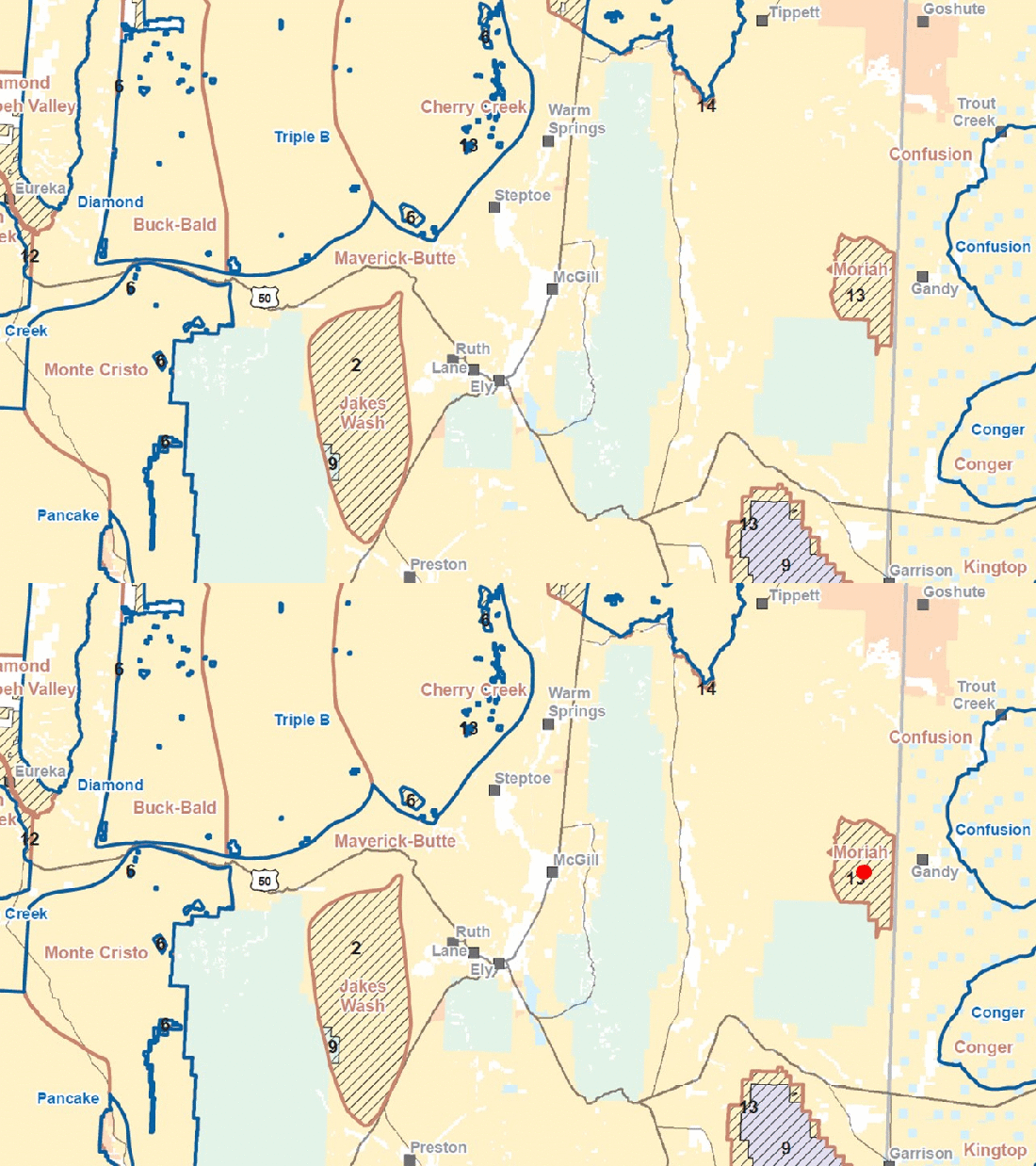
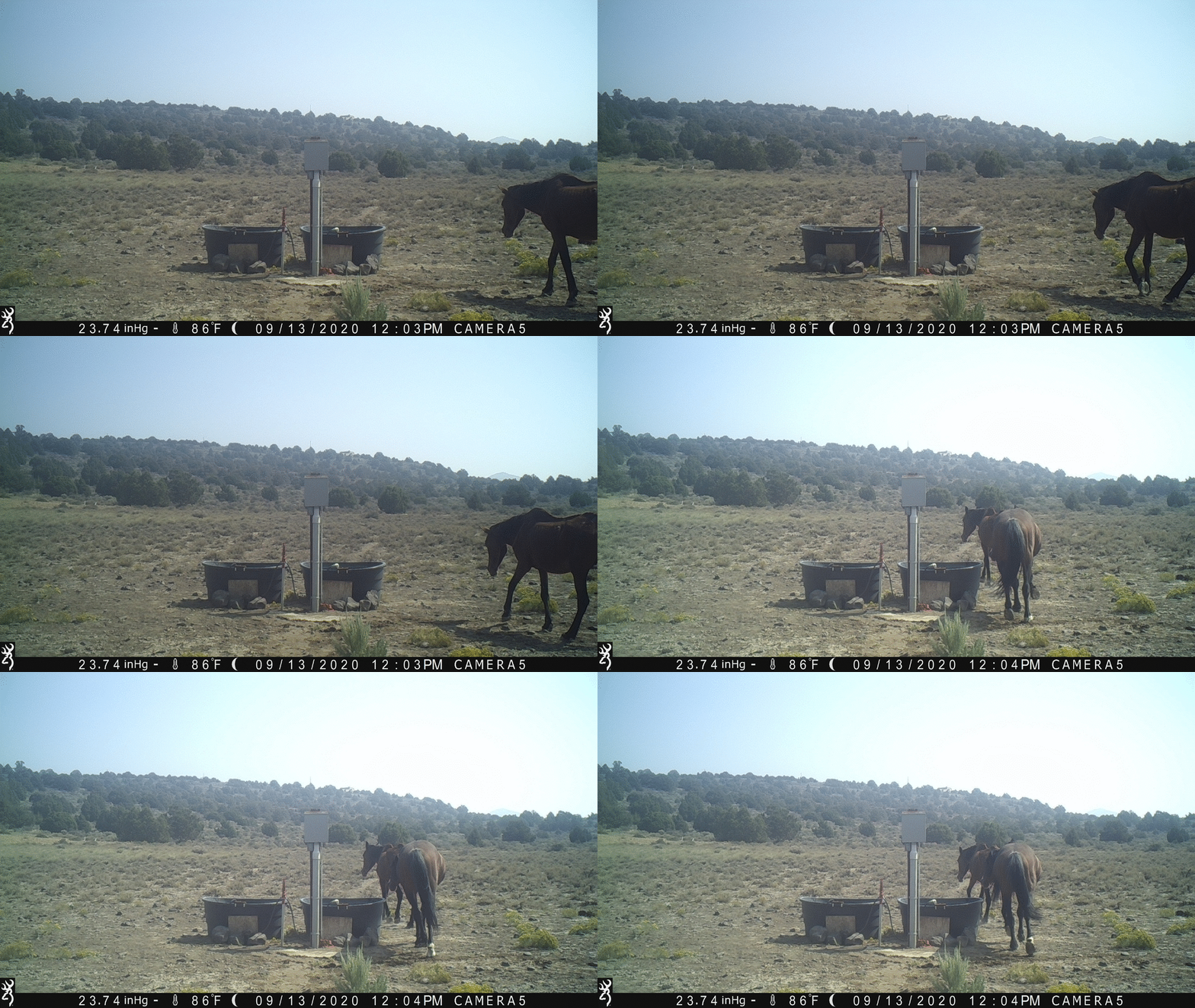
What Happened to the Moriah HMA?

It was chartered in 1983 with an AML of 29, according to Section 4.1.2 of the Final EA for wild horse management actions therein.

To quality as an HMA, an area must supply forage, water, cover, space, and reproductive viability, according to Section 1.1.  In 2007, Moriah was evaluated for wild horse suitability and “failed to meet one or more of the five required habitat components resulting in the decision, under the land-use plan, to drop its HMA status.”

But the EA does not say which requirements were not met and does not explain the 714 wild horses currently living there.

There must be another reason.  The allotments that overlap the HA were not zeroed out so perhaps it had resources coveted by the public-lands ranchers.

The initial comments in Appendix V of the EA support that theory.

RELATED: Moriah Roundup Pending.

Moriah Roundup Pending

BLM announced today the signing of a Decision Record for wild horse management actions at the Moriah HA in eastern Nevada, allowing a roundup to occur after a 30-day appeal period.

The DR authorized the Proposed Action (Alternative A) in the final Environmental Assessment.

The HA covers 53,300 acres on the Utah border and has no AML.  It was deemed unsuitable for horses in 2008 and demoted from an HMA, yet an estimated 714 horses live there today.

Moriah HA Map

The HA intersects five allotments and is almost entirely subject to permitted livestock grazing, as shown in Figure 1 of the EA.

The Proposed Action will remove all wild horses from the area.

RELATED: Comments Invited on Moriah Gather EA.

Oregon Fact Sheet: It’s All About the Missing Numbers

Earlier this week, BLM released a fact sheet for public lands in Oregon and Washington during FY 2019.

Key management indicators can be computed for the wild horse and burro program in Oregon, using data on page 29 of the pdf.  (There are no HMAs in Washington.)

Animals allowed by plan = 2,697 (some burros present but assumed to be 100% horses)

Authorized land = 2,698,902 acres

Current population = 5,878 (assumed to be 100% horses)

Required forage allocation = 2,697 × 12 = 32,364 AUMs per year

Current herd size  = 5,878 ÷ 2,697 = 2.2X AML

Stocking rate allowed by plan = 2,697 ÷ 2,698,902 × 1,000 = 1 horse per thousand acres

What about livestock?  Unfortunately, the data provided on page 30 don’t include the acreage designated for grazing and the average grazing season.

The number of cow/calf pairs can be estimated if you guess the grazing season but the stocking rate can’t be determined.

Authorized forage = 659,201 + 69,141 = 728,342 AUMs per year

Grazing season = 6 months (assumed)

Authorized herd size = 728,342 ÷ 6 = 121,390 cow/calf pairs

Stocking rate allowed by plan = ?

Livestock receive 22 times more forage than horses.  But a more detailed comparison of management practices in Oregon is not possible, thanks to the missing numbers.

Paisley Desert Roundup Day 10

The incident started on October 11.  Gather stats through October 20:

  • Horses captured: 707
  • Goal: 750
  • Deaths: 13
  • Returned: 0
  • Shipped: 642

Foals accounted for 20.5% of the total.  Three horses were put down on Day 10 due to pre-existing conditions, bringing the total to 13.

The daily results yield 642 horses shipped but the cumulative total says 654.

Body condition scores are not known.

There are 707 – 13 – 642 = 52 unaccounted-for horses.  The contractor may be holding them on site.

If 70% of the horses had to be removed from the HMA due to lack of water, what was the impact on privately owned livestock?

RELATED: Paisley Desert Roundup Day 8.

Red Desert Roundup Day 11

The incident started on October 10.  Gather stats through October 20:

  • Horses captured: 671
  • Goal: 2,400
  • Deaths: 1
  • Returned: 90
  • Shipped: 475

No activity on Day 10 due to weather.  Foals accounted for 23.8% of the total.  The sex ratio of captured adults is approximately 44% males, 56% females.

The reports did not indicate the HMA(s) where the horses were captured.

Body condition scores are not known.

There are 671 – 1 – 90 – 475 = 105 unaccounted-for horses.  The contractor may be holding them on site.

Five HMAs are involved in the roundup.

RELATED: Red Desert Roundup Day 9.

Rangeland Stewardship Awards Go to Public-Lands Ranchers

We know that cattle and sheep are intelligent, hard working and dedicated to the improvement of western rangelands, so they should be recognized for their efforts.

Unlike wild horses and burros, who are destroying their habitat.

What’s the difference?  Human involvement.

Are local advocacy groups allowed to participate?

No!  You only need to look at the Sinbad roundup to see what happens when volunteers try to help wild horses and burros.

Every year, 50% of grazing receipts or $10 million, whichever is greater, goes back into the program for rangeland improvements.  Wells, tanks and water lines, road, fence and gate repairs, etc.  Other funds go to predator management and vegetation control.

In exchange, the ranchers pay the government almost nothing.

What’s invested in the WHB program?

The news release sounds like a mutual admiration society.  The president of the Public Lands Council, a cheerleader group for the public-lands ranchers, said “Grazing on federal lands is a critical part of our country’s food supply…,” which it isn’t.

You could end the program tomorrow and nobody would notice.

Horse Takes Barrel Racer on Hell Ride

Only a few seconds earlier she had been digging it into his gums, spurring him on to victory.  Then the bit broke—allowing him to give her some feedback on her riding style.

He bolted from the arena, with her on top, down the driveway and over to a busy highway, according to a story posted this morning by the Nashville Tennessean.

He ran wild for 15 minutes but does not appear to be a wild horse.  The incident stopped with the help of a firefighter and nobody was hurt.

But what will happen to the horse?

Clark Mountain Gather Update

The start date is not known.  Gather stats through October 16, courtesy of BLM:

  • Burros captured: 117
  • Goal: 80
  • Deaths: 0
  • Returned: 0
  • Shipped: 117

Foals accounted for 21.4% of the total.  The sex ratio of captured adults is approximately 43% male, 57% female.

The method of capture is bait traps.  Animals removed from the HA have been taken to the off-range corrals in Ridgecrest.

The operation will probably conclude this week.

RELATED: Clark Mountain Roundup in Progress.

Paisley Desert Roundup Day 8

The incident started on October 11.  Gather stats through October 18:

  • Horses captured: 596
  • Goal: 750
  • Deaths: 10
  • Returned: 0
  • Shipped: 330

Foals accounted for 21% of the total.  All of the deaths were attributed to pre-existing conditions.

The daily results yield 330 horses shipped but the cumulative total says 436.

Body condition scores are not known.

The imbalance is 256 horses.  Some of the gap may be due to the discrepancy in the horses shipped.  The contractor should be holding the remainder on site.

The operation will likely conclude this week.

RELATED: Paisley Desert Emergency Roundup in Progress.

Red Desert Roundup Day 9

The incident started on October 10.  Gather stats through October 18:

  • Horses captured: 598
  • Goal: 2,400
  • Deaths: 1
  • Returned: 90
  • Shipped: 339

No activity on Day 8 due to weather.  Foals accounted for 23.7% of the total.  The sex ratio of captured adults is approximately 45% males, 55% females.

The reports did not indicate the HMA(s) where the horses were captured or released.

Of the horses returned, 46 were “treated with fertility control.”  No details were given.

Body condition scores are not known.

The imbalance is 168 horses.  The contractor may be holding them on site.

The release of horses back to their home range may indicate the operation is finished in one area and will resume in another.  Five HMAs are affected.

RELATED: Red Desert Roundup Day 7.

Back to the Fast-Disappearing Days

The following remarks were delivered at the October 2019 WHBAB meeting by a representative of the Society for Range Management, an organization that believes rangelands should be used for livestock grazing and not much else.

Although the group accepts wild horses and burros on those lands, they insist that their numbers be limited to those that existed when the WHB Act became law (0:23 to 0:36).

This is where they’re going with the ‘Path Forward.’

We know from President Nixon’s remarks that only 9,500 wild horses and 11,000 wild burros remained on western rangelands in 1971.  That’s equivalent to 15,000 wild horses today on 27 million acres, for a stocking rate of 0.6 horses per thousand acres.

A number that low means only one thing: Large amounts of forage diverted to privately owned livestock.

No new laws are required.  Just enforce the plans that are already on the books.

RELATED: ‘Path Forward’ Extinction Target.