1. Here is the original video.
2. Here is a review of the video.
3. Here is the blowback.

Exposing the Hypocrisy, Lies and Incompetence of the Wild Horse Advocates
According to 43 CFR 4710.1, a federal regulation, management activities affecting wild horses and burros shall be in accordance with approved land use plans.
This is government writing its own rules, perhaps at the behest of special interests.
It’s not necessarily a bad idea. You don’t want to place 1,600 wild horses in an area that can only support 1,200.
Unfortunately, there is no requirement that the plans assign most of the resources to wild horses, which explains what you see today in many wild horse areas.
Now that the link to the statute is broken, you’ll find 200 wild horses in an area that can support 1,200, accompanied by hundreds or thousands of privately owned livestock.
The advocates, unfazed by the practice, worry instead about the best way to get rid of ‘excess’ animals, horse #201 and so on.
The current herd, consisting of 800 to 900 horses, looks healthy, according to a report posted yesterday by 9News of Denver.
So why are they going to be removed in an emergency roundup?
All together now: Because most of the resources have been assigned to privately owned livestock. It’s not about saving the horses, it’s about protecting the ranchers, an obsession of the federal government.
Most of the horses won’t be adopted. By the end of the year, the system will be flooded with ‘excess’ animals, whose fate we’ll never know.
This letter to the Herald Times of Meeker, CO may be a little over the top but it points to an important concept: Consent of the governed.
The writer states that the West Douglas roundup is “currently taking place without allowing timely input from the public, who legally own these public lands.”
Public comments are usually invited on new/proposed resource enforcement actions, sometimes referred to as wild horse gathers and removals, but those projects don’t address—and can’t change—the resource allocations and management priorities that drive the actions.
Yes, the American people have a voice in their government through their elected representatives. But do those representatives call the shots on America’s public lands?
Not necessarily. They may establish a framework through the legislative process, such as the WHB Act, but the grunt work is carried out by the unelected bureaucracy that operates with another set of rules that they invent, known as federal regulations.
Those rules fill in the gaps or correct perceived deficiencies in the statutes.
Can the bureaucracy be influenced by special interests? Of course.
The rules for wild horse management seem to reflect that.
For example, the statute defines a range as the amount of land necessary to sustain an existing herd or herds of wild free-roaming horses and burros, which does not exceed their known territorial limits, and which is devoted principally but not necessarily exclusively to their welfare in keeping with the multiple-use management concept for the public lands. No change from 1971.
But a regulation says they are at the discretion of government: Herd management areas may also be designated as wild horse or burro ranges to be managed principally, but not necessarily exclusively, for wild horse or burro herds. Only four out of roughly 200 are.
The writer makes a good point. Can regulations override statutes? Can the bureaucracy put special interests above the will of the people?
That is the case that should be taken to court.
The job posting still appears at Idealist. With so many advocates down with the program, the position should have been filled by now.
Ability and willingness to go on camera and lie to the American people about your intent, loyalties and methods will put you in the driver’s seat.
What about someone from the Maryland side of Assateague Island? That program was shut off five years ago and, as of this year, the herd has only been able to produce a 7.8% birth rate. Excellent qualifications.
RELATED: Candidate for Virginia Range Darting Program Coordinator?

The incident began on July 26. Gather stats through August 5:
No gather operations occurred on Day 11.
The death rate is 1.7%. The summary at the gather page shows four deaths but the daily reports show five.
Body condition scores were not reported.
Foals accounted for 20.1% of the horses gathered. Of the adults, 42.6% were male and 57.4% were female.
Day 11 ended with 80 unaccounted-for horses.
Other statistics:
RELATED: West Douglas Roundup Day 9.
The incident began on August 2. Gather stats through August 4:
A mare suddenly expired on Day 3. A foal died (was put down?) on the same day due to pre-existing conditions, boosting the death rate to 1.1%.
Foals accounted for 20.5% of the horses gathered. Of the adults, 48.3% were male and 51.7% were female.
Body condition scores were not given.
Day 3 ended with 103 unaccounted-for horses.
Other statistics:
RELATED: Antelope Roundup in Progress.
Refer to this photo of the Dragon Trail gas plant taken by fire crews on June 28.
The burned area included lands in the West Douglas HA.
The facility’s footprint is probably less than five acres, enough to displace 1/200th of a wild horse at typical stocking rates.
If the area is subject to permitted grazing, how many wild horses have been displaced by those operations? Dozens? Hundreds?
Suppose it’s 50. The impact of grazing on wild horses would be 10,000 times greater than the gas plant.
Yet the advocates would have you believe that drilling and mining are the greatest threats to America’s wild horses.
Undeniable Truth #3.
Refer to this guest column appearing today in The Bulletin of Bend, OR.
What was the source of the writer’s enlightenment? A letter to The Salt Lake Tribune by a BLM retiree?
A story posted yesterday by Vail Daily provides an account of the roundup on Day 6.
Body condition scores, not reported at the gather page, are mostly 4s (healthy).
Of special interest are the pictographs and petroglyphs on sandstone walls in the area dating back at least 800 years. Many feature horses, which is not consistent with the wild horse narrative.
The article did not indicate if the area was subject to permitted grazing, and if the resource shortage associated with the drought and Oil Springs Fire—drivers of the roundup—had affected grazing operations.
RELATED: West Douglas Roundup Day 9.
BLM said today that 73 wild horses will be gathered and removed from the HMA and surrounding lands, starting August 9, due to inadequate water.
The animals will be drawn into the traps with water, according to the news release, and the incident will not be open to public observation.
The operation was preceded by a categorical exclusion signed on June 24.
The HMA covers 17,147 acres in western Nevada, including 16,319 public acres.
The AML is 124, for a stocking rate of 7.3 wild horses per thousand acres, considerably higher than the average rate of one wild horse per thousand acres across all HMAs.
The stocking rate on the Virginia Range, before the advocates got involved, was ten wild horses per thousand acres.
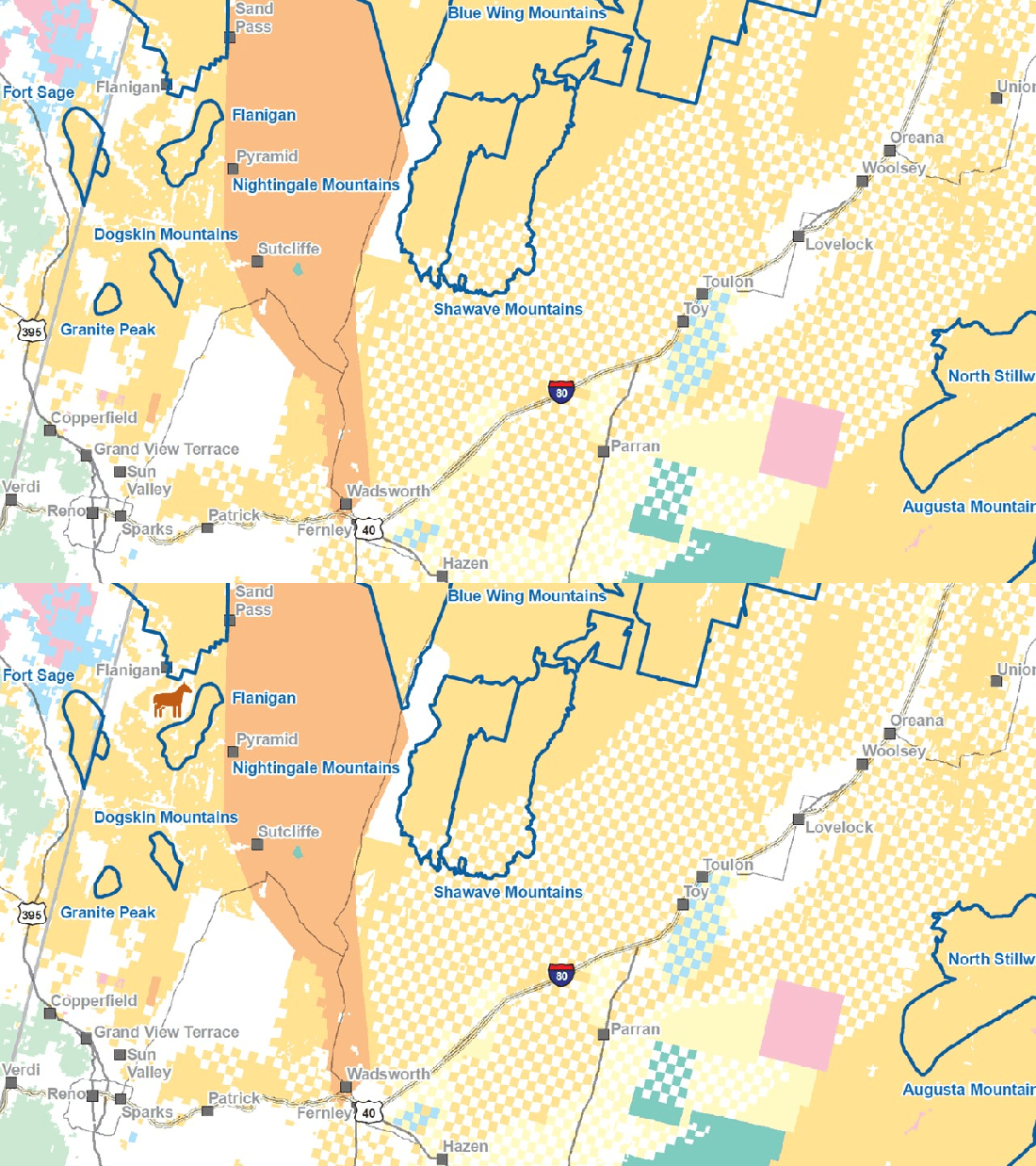
The HMA intersects three grazing allotments according to Table 10 in a 2011 EA for resource enforcement actions in the area. Livestock receive an estimated 5,400 AUMs per year inside the HMA, subject to verification in RAS.
The horses allowed by plan receive 1,488 AUMs per year.
Captured animals will be taken to the off-range corrals at Palomino Valley.
Gather stats and daily reports will be posted to this page.
There are about 500 wild horses out there, but only one was spotted in this story by the CBS affiliate in Phoenix. Includes video.
They may be protected by the state of Arizona but not from the advocates.
The incident began on July 26. Gather stats through August 3:
A stud was put down on Day 9 due to injuries related to the roundup, increasing the death rate to 1.7%.
Foals accounted for 19.2% of the horses gathered. Of the adults, 42.7% were male and 57.3% were female.
Day 9 ended with 98 unaccounted-for horses.
Other statistics:
RELATED: West Douglas Roundup Day 7.
BLM said today that 296 wild horses will be removed from the Conger HMA, starting on August 11, due to drought.
Helicopters will push the horses into the traps and the incident will be open to public observation.
Some may be returned to the area to maintain herd genetic diversity, according to the news release.
The HMA covers 170,993 acres west of Delta, UT, including 151,506 acres of public lands. The AML is 80 and the aimed-at stocking rate is 0.5 horses per thousand acres.
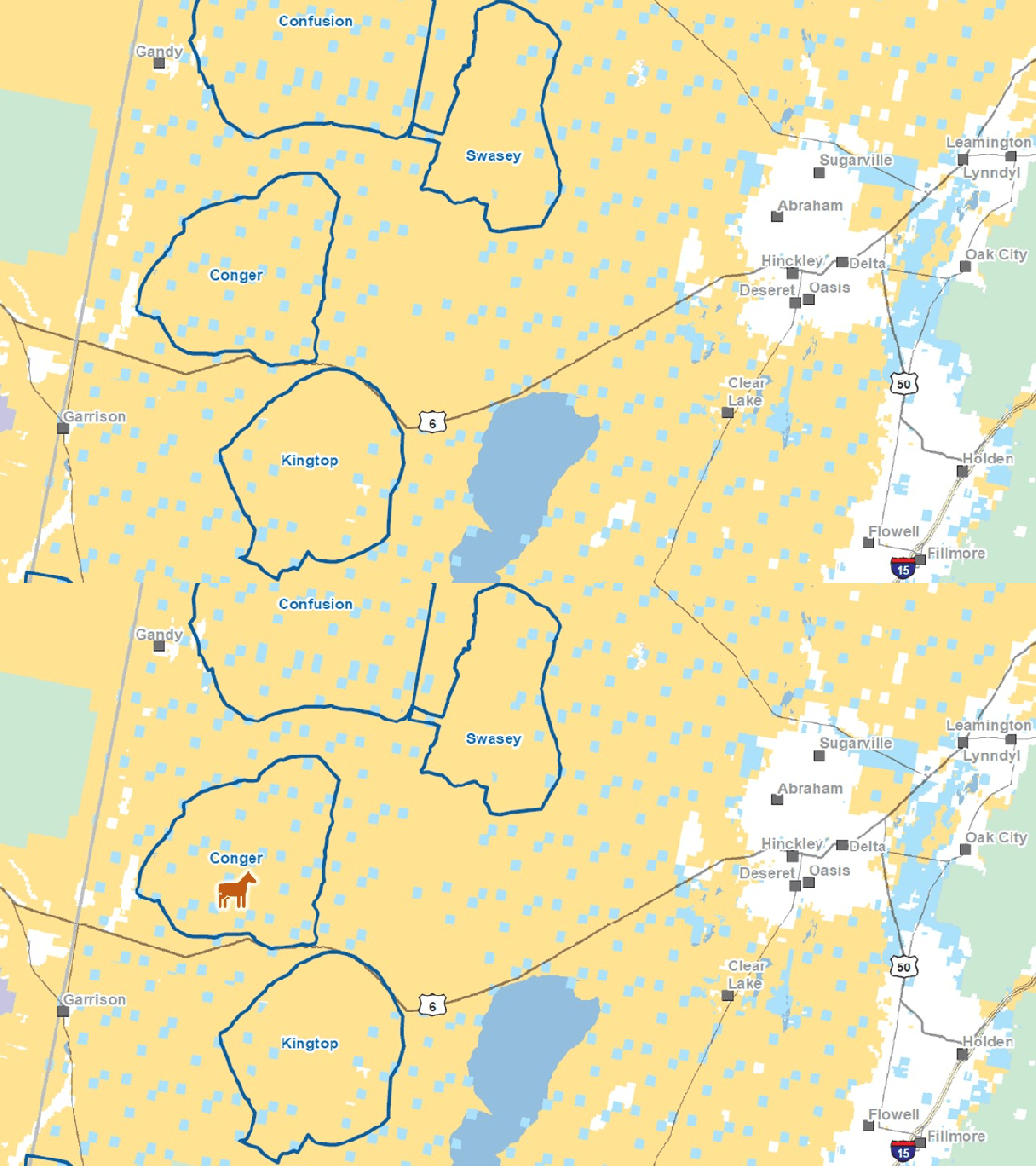
The HMA intersects seven grazing allotments, according to Section 3.2 of an EA from 2016. Livestock receive an estimated 3,400 AUMs per year inside the HMA, compared to 960 AUMs per year for the horses.
Captured animals will be taken to the off-range corrals at Axtell, UT.
Gather stats and daily reports will be posted to this page.
So says the writer of a letter to The State Journal of Frankfort, KY.
RELATED: Letter Seeks Delay of Roundups But Not Darting Programs?
Refer to this story by AP News. The FY 2021 removal goal is now 18,000, consisting mostly of wild horses.
Western Horse Watchers estimates that at least 200,000 horses have been displaced from their home range by privately owned livestock, on top of the 86,000 currently out there.
There is no overpopulation, only gross mismanagement by government bureaucrats.
RELATED: More Emergency Roundups in the Works.
CORRECTION: Over 200,000 on top of the 27,000 currently allowed by plan.
Day 1 ended with 12 horses captured, according to the gather page, including seven studs, three mares and two foals. No deaths were reported.
RELATED: Antelope Complex Emergency Roundup Starts This Weekend.
UPDATE: Added video.
Report by KTVZ News of Bend, OR.
The Currituck mare found dead over the weekend, Hazel, was was known for sneaking off to visit other bands where youngsters were present.
If she was past her prime, was she still being darted by the advocates?
Bidders paid $420,150 this year, breaking last year’s record of $388,000, according to a report posted today by AP News.
A buyback pony—to be returned to the herd—fetched $25,500.
RELATED: Chincoteague Pony Auction Next Week.

