The federal government has been operating on a series of continuing resolutions since October 1 because Congress has not produced a FY24 spending bill.
So how is the BLM going to pay for additional gathers and removals?

Exposing the Hypocrisy, Lies and Incompetence of the Wild Horse Advocates
The federal government has been operating on a series of continuing resolutions since October 1 because Congress has not produced a FY24 spending bill.
So how is the BLM going to pay for additional gathers and removals?
In the Spring Mountains National Recreation Area with Sheri Lind.
They needed 45 minutes to free this woman’s lips from the BLM’s ass.
RELATED: How CAAWH Stands Up to the Federal Government.
The incident was set to begin on or about November 27.
As of today, no activity has been reported.
The advocates don’t think the roundup is necessary.
They’re praying for the older horses to die.
They’re praying for foals to be killed by predators.
They’re praying for the herd to shrink on its own, aided by pesticide-laced darts, so ranchers can access most of their food and water.
Why are you still giving them money?
RELATED: McCullough Roundup Looms?

They need $200,000 from you by the end of the year to fund their important work.
Their representative doesn’t want to talk about wild horses and burros, she wants to talk about wild horse and burro management.
Reading from a carefully prepared script, she mentions fertility control four times in three minutes.
Adjectives used in the presentation: Beautiful, Magnificent.
From public comments at the WHBAB meeting on December 14.
RELATED: After Raking in $147K, CAAWH Wants More.
She no longer appears in the list of staff.
That would explain the recent solicitation for Communications Director.
Did she finally come to her senses or join another ranching advocacy group?
Despite the loss, the list is large and growing, which explains why they need more of your financial support.
RELATED: After Raking in $147K, CAAWH Wants More.
Using the National Day of the Horse as a backdrop, the Campaign Against America’s Wild Horses, a leader in nonmotorized removal, announced earlier this week an ambitious goal to raise $200K by the end of the month.
Adjectives used in the news flash: Iconic, Cherished.
“Hitting this goal will set our 2024 wild horse protection agenda.”

“By making a contribution towards our end-of-year goal, you can help ensure AWHC has the resources we need to stand up to the federal government and be a voice for these voiceless animals.”
What a bunch of crap!
They’re not standing up to the federal government, they’re working hand-in-hand with the federal government to poison as many mares as possible, liberating more and more resources for the public-lands ranchers.
RELATED: CAAWH Rakes in $146,690 on Defund the Advocates Day.
Six incidents have occurred in the past month according to a report by KTVN News.
How many did the advocates get rid of during the same period?
Their only rival is the federal government. Not shooters, not motorists, not hunters, ranchers, drillers or miners.
RELATED: Reno to Install New Barrier for Virginia Range Mustangs.
Imagine the tedium day after day assuring your supporters that you care about wild horses while you’re telling the bureaucrats you’re getting rid of them.

The dissonance would overwhelm a normal person but we’re not talking about normal persons, we’re talking about the advocates.
If you keep referring to ovary-killing pesticides as humane fertility control, your donors might get wise.
If you keep referring to animals you’re trying to eradicate as “cherished” your followers might catch on.
Western Horse Watchers has the answer: A randomly generated term from an Excel spreadsheet to put in your reports, guest columns, news flashes and action alerts.
Cherished today, treasured tomorrow, majestic the next day. There’s no pattern, no predictability.
Keep in mind that random means some terms may repeat while others go through dry spells.
RELATED: Foal-Free Friday, Surveying the Adjectives Edition.

The incident concluded today, with 309 horses captured, 137 shipped, 165 released and seven dead.
There were no unaccounted-for animals.
The capture and removal goals were 350 and 138, respectively.
The death rate was 2.3%.
The capture total included 92 stallions, 187 mares and 30 foals.
Youngsters represented 9.7% of the animals gathered, consistent with a herd growth rate of five percent per year.
Of the adults, 33% were males and 67% were females, not what you’d expect from a herd that’s 50% males / 50% females.
All but three of the mares returned to the WHR were treated with Gonacon Equine, but apparently just one dose.
The event was billed as catch-treat-release and was not open to public observation.
The news release does not discuss death rates, birth rates or abnormal sex ratios.
RELATED: Nevada WHR Roundup Starts This Week.
The herd on the Maryland side of the island consisted of 15 bands and 81 horses according to the December 6 inventory, no change from October.
Two horses were in a bachelor band and one was alone.
Only seven foals were born this year, seven years after the darting program was shut off.
The pesticide of choice was Zonastat-H, a favorite of the advocates.
Not included in the report:
The BLM WHB Handbook indicates the breeding population should exceed 50 animals to maintain an acceptable level of genetic diversity.
The herd likely has an abnormal sex ratio, which the advocates describe as mares living longer, and this may explain why there are so few unattached stallions.
The Assateague Island Alliance updates the lists.
RELATED: Assateague Pony Census, October 2023.
The schedule dated October 16 called for 8,826 animals to be captured and 8,214 to be removed but the schedule dated December 8 calls for 20,942 animals to be captured and 19,870 to be removed.
That’s a 137% increase in gathers and 142% increase in removals.
The North Lander Complex has been added, rivaling the East Pershing Complex in size.
Kiger and Riddle will see action, first time since 2015.
Marietta will lose horses and burros, along with Twin Peaks and Blue Wing.
Triple B and Maverick-Medicine have also been added.
Four gathers will occur during foaling season.
The first section in the schedule covers nonmotorized removals, the domain of the wild horse advocates.
These incidents support the three tenets of rangeland management.
“Resource not present” according to Table 3-1 in the Final EIS.
What about livestock grazing?
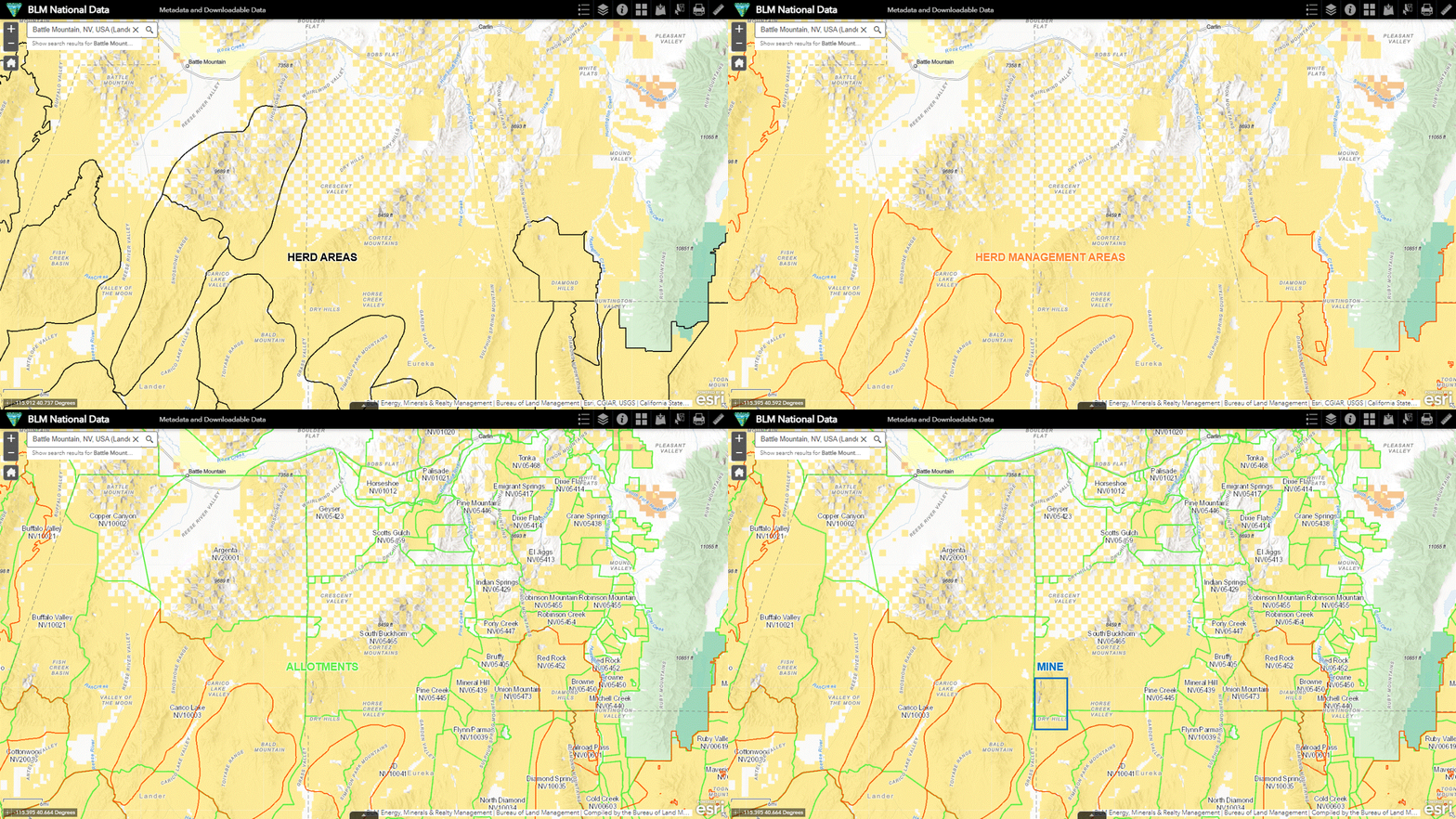
Figure 1-1 in the SER for grazing management shows the location of the mine relative to the towns of Battle Mountain and Carlin, NV (page 12 in the pdf).
Figure 2-1 shows the affected allotments (page 21).
Table 2-1 indicates the four allotments offer 70,430 active AUMs on 1,193,627 public acres, or 59.0 AUMs per thousand public acres, equivalent to 4.9 wild horses per thousand public acres.
This brings more embarrassment to the bureaucrats, ranchers and advocates who claim that public lands in the western U.S. can only support one wild horse per thousand acres (27,000 animals on 27 million acres).
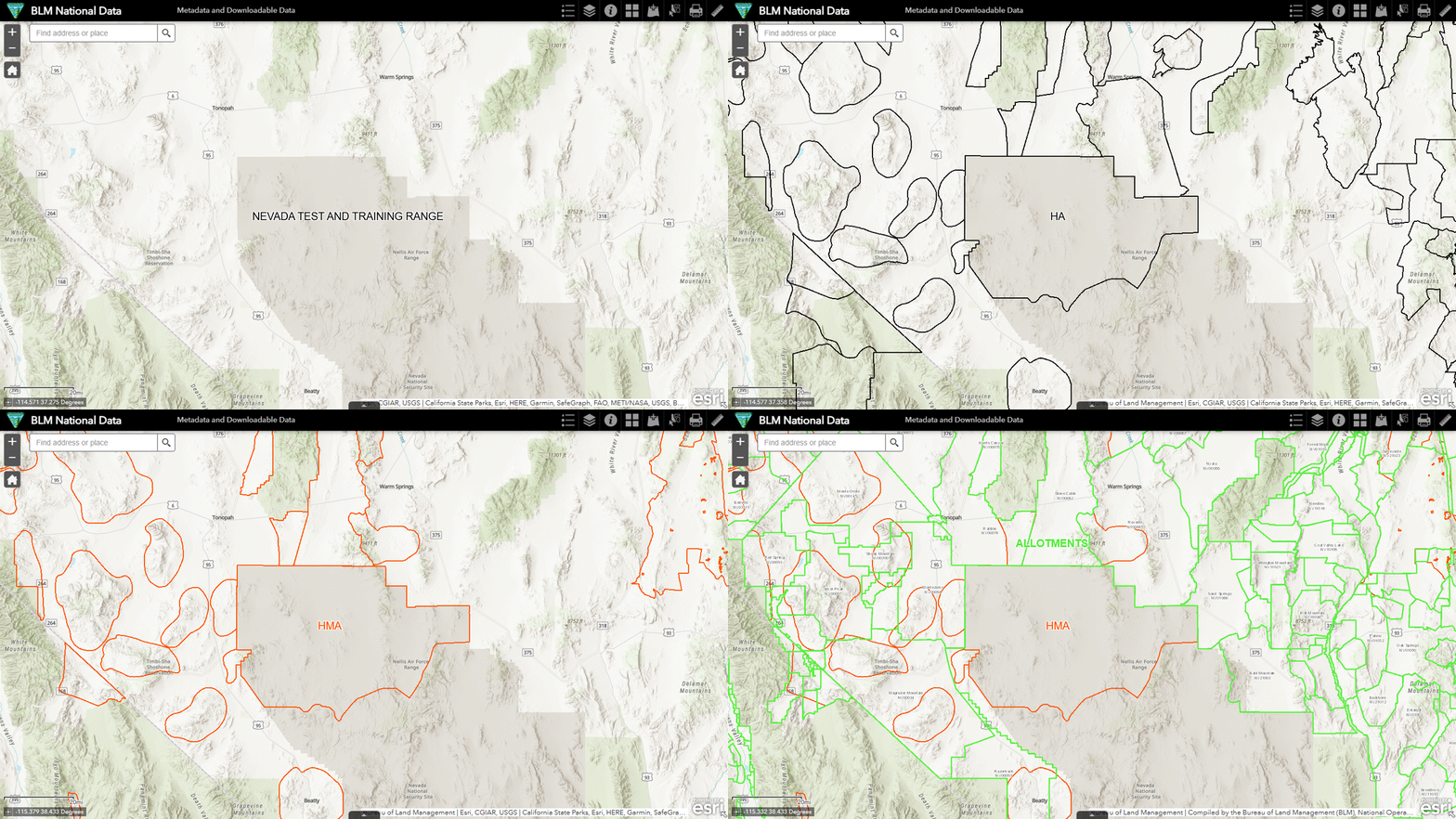
The mine is hard to find in the National Data Viewer if you’re looking at the wild horse areas but if you turn on the grazing allotments it’s a piece of cake.
Wild horses don’t pay much attention to HMA boundaries unless they’re marked with fences, so the conclusion of no impact could be open for dispute.
The EIS and related documents have been copied to the project folder in ePlanning.
A December 12 news release indicates the BLM has given it the green light.
The incident began on December 8. Results through December 12:
The death rate is 0.7%.
The capture total includes 88 stallions, 180 mares and 30 foals.
Youngsters represented 10.1% of the animals gathered, consistent with a herd growth rate of 5% per year.
Of the adults, 32.8% were male and 67.2% were female. These figures don’t look like they came from a simple random process centered at 50% males / 50% females.
Body condition scores were not given.
The WHR is not subject to permitted grazing but surrounding lands are.
*According to advocates.
Day 5 ended with 198 unaccounted-for animals.
Up to 106 mares will be treated with GonaCon Equine, a fertility control pesticide, before being returned the range with up to 106 stallions.
Operations will likely conclude this week.
Other statistics:
RELATED: Nevada WHR Roundup, Day 3.
Meeting materials have been posted to the WHBAB home page.
Day 1 is a field trip to Lake Pleasant HMA. No livestream.
Refer to the agenda for details.
RELATED: Next WHBAB Meeting Set for December 14.
Grants awarded under this opportunity will support the agency’s mission of managing and protecting wild horses and burros on public lands, according to the news release.
Projects should align with the three tenets of rangeland management and could involve, for example, application of fertility control to slow herd growth, monitoring herd and land health, and improving rangeland habitat.
A useful topic in the area of land health would be to determine the forage allocations for wildlife, wild horses and livestock in every HMA and attach those results to existing pages about the HMAs, so the American people can see how resources are managed.
Then they will realize that overpopulation means more horses than allowed by plan, not more horses than the land can support, and that all of the off-range corrals could be emptied several times over if the ranchers were confined to their base properties or discouraged from using public lands by bringing grazing fees in line with market rates.
RELATED: BLM Offers $7.5 Million for WHB Adoption Partnerships.
The incident began on December 8. Results through December 10:
The capture total on Day 1 was changed from 59 to 60.
A stallion was released (escaped?) on Day 3. No details were given.
A mare was dispatched on Day 2 due to a fractured radius (leg bone).
The death rate is 1.6%.
The capture total includes 36 stallions, 69 mares and 18 foals.
Youngsters represented 14.6% of the animals gathered.
Of the adults, 34.3% were male and 65.7% were female.
Body condition scores were not given.
The WHR is not subject to permitted grazing but surrounding lands are.
*According to advocates.
Day 3 ended with 62 unaccounted-for animals.
Up to 106 mares will be treated with GonaCon Equine, a fertility control pesticide, before being returned the range with up to 106 stallions.
Other statistics:
RELATED: Nevada WHR Roundup Begins.
At the Ozark National Scenic Riverways with Adventures With Crystal.
Handpicked for those who support the defeatists, pesticide pushers and ranching sympathizers at the Campaign Against America’s Wild Horses and its affiliates.
On the cost of off-range holding.
Previous audio snippets can be found in the Index under Microcasts.
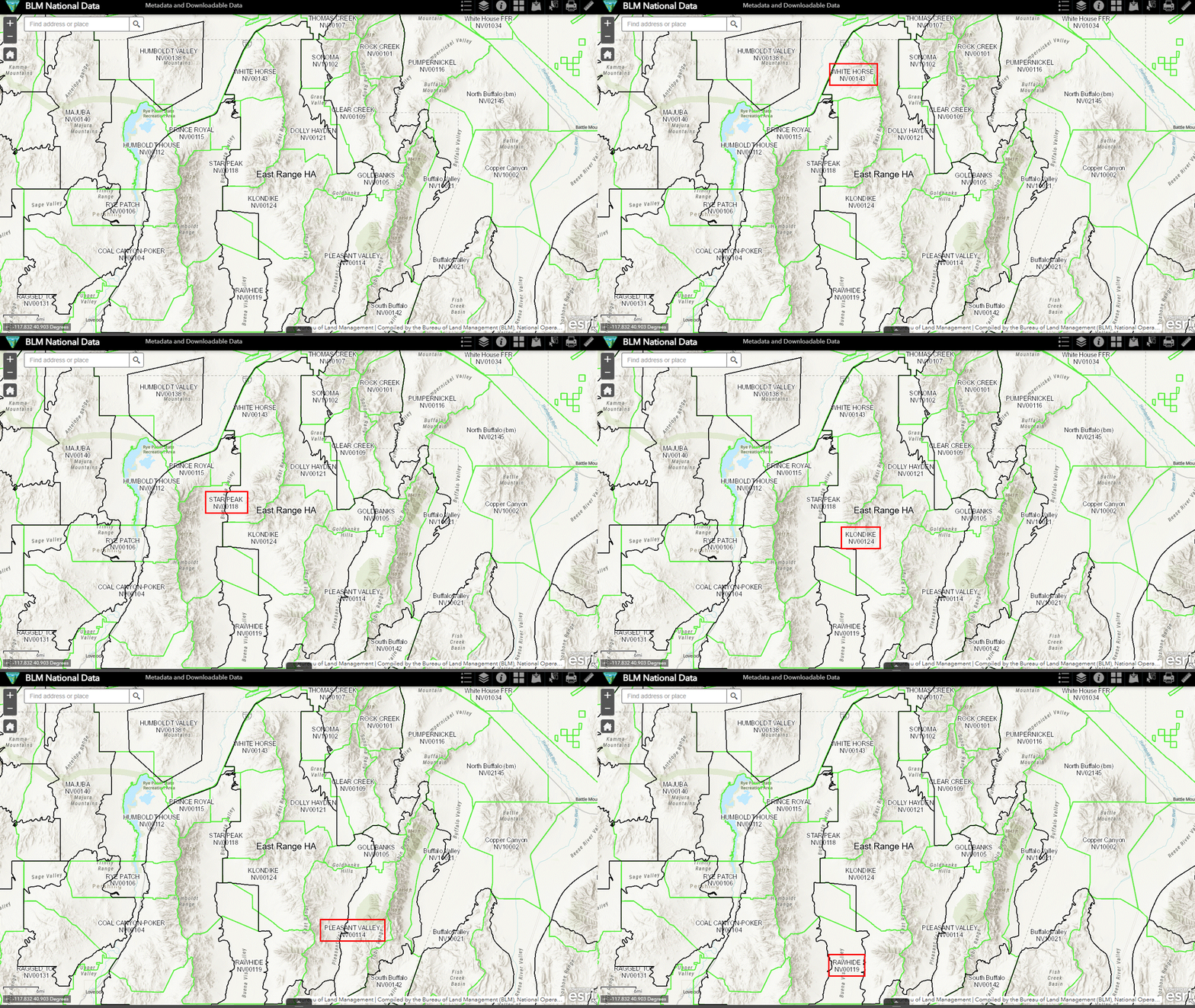
It’s the second of three areas identified for wild horses in the East Pershing Complex that’s now managed principally for livestock.
Table 9 in the Final EA for pest control and resource enforcement indicates seven allotments that intersect the HA.
The figures for overlap in the last column seem reasonable based on inspection of the parcels in the National Data Viewer.
The NDV indicates that the northern half of the HA is mostly checkerboard lands while the southern half is mostly public lands.
The Allotment Master Report provides management status, acreage and active AUMs.

Around 55% of the public lands are in the Improve category.
The condition of Klondike is unknown. The custodial category is usually reserved for allotments covering a small percentage of public lands.
Low forage density in Star Peak and Dolly Hayden suggests they are not very useful from a grazing viewpoint. Rawhide may be recovering from overuse, wildfire or some other deficiency.
The forage assigned to livestock inside the HA is 15,356 AUMs per year, equivalent to 1,280 wild horses. The current AML is zero so the True AML would be 1,280.
The HA covers 451,904 total acres, including 321,328 public acres, so the stocking rate at the new AML would be four wild horses per thousand public acres.
This brings great embarrassment to land managers who for years have stated that public lands in the western U.S. can only support one wild horse per thousand acres (27,000 animals on 27 million acres).
These same managers collect 15,356 × 1.35 = $20,730 per year from ranching activity inside the HA, while spending 1,280 × 5 × 365 = $2,336,000 per year caring for the horses displaced thereby.
Would you say that’s a wise use of the public lands?
A 160-acre checkerboard parcel inside the HA and Dolly Hayden allotment was offered for sale earlier this year. The listing included photos of wild horses.
The EA and related documentation can be found in the project folder at ePlanning.
RELATED: How Many Wild Horses Can the Sonoma Range HA Support?