The incident started today as advertised, with 142 horses captured, none shipped, none released and no deaths.
The location of the trap site was not disclosed.
RELATED: East Pershing Roundup Starts Next Week.

Exposing the Hypocrisy, Lies and Incompetence of the Wild Horse Advocates
The incident started today as advertised, with 142 horses captured, none shipped, none released and no deaths.
The location of the trap site was not disclosed.
RELATED: East Pershing Roundup Starts Next Week.
They were found dead of natural causes, according to a report posted today by the Maryland Coast Dispatch.
The herd consisted of 81 horses earlier in the month.
General Harker was a band stallion according to the AIA list dated December 6.
Yankee was unattached.
The loss keeps the sex ratio skewed in favor of females, a documented effect of PZP.
The list shows just two other bachelors, unusual for a herd of wild horses.
The article said the Park Service completes a full census of the horse population six times per year but did not mention that it stopped publishing the results to the Assateague news page four years ago, when the long-term effects of the fertility control program became obvious.
At the time the herd size was 75 and there were 2.4 mares for every stallion.
The darting program was shut off in 2016.
RELATED: If PZP Is Reversible, Why Hasn’t Assateague Herd Rebounded?
A record of decision will be published in early 2024 according to today’s news release.
The EIS was copied to the project folder on December 22.
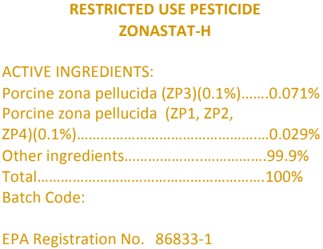
Unlike Zonastat-H, a pesticide applied to cherished wild horses, none of the new ingredients could be found in the RUP Report.
RELATED: BLM to Trial New Herbicides on Cherished Plants and Weeds.

The Applegate Field Office has proposed the removal of juniper trees in northeastern California to stimulate the development early seral grass and forb species preferred by mule deer and other sage-steppe obligate species.
Curiously, the project area, which covers 13,790 public acres, coincides roughly with the Nelson Corral Allotment. Refer to Figure 1 in the DNA.
Perhaps there are other intended consumers of the tender young plants not mentioned in the analysis?
The Allotment Master Report puts Nelson Corral in the Maintain category.
The allotment offers 1,802 active AUMs on 12,849 public acres, or 140.2 AUMs per year per thousand public acres, equivalent to 11.7 wild horses per thousand acres.
This brings more embarrassment to land managers who claim that public lands in the western U.S. can only support one wild horse per thousand acres.

The big-name advocacy groups are so far gone they can only be salvaged by complete house cleanings.
They’ve been overrun by defeatists, pesticide pushers and ranching sympathizers.
They’re a disgrace to Velma’s legacy and don’t deserve a penny of your financial support.
Refer to this list of organizations to avoid.

If the NDA allowed you back on the Virginia Range in 2019 and you pounded the mares with pesticide-laced darts through 2023, how long have you been poisoning the herd?
Elapsed time = Final year – Initial year + 1 = 2023 – 2019 + 1 = 5 years
How long does it take to sterilize a mare?
Five years.
Aren’t you concerned about the long-term viability of the herd?
We have a better way to get rid of wild horses. There’s no need to spend tens of millions of dollars every year on roundups and off-range holding. The bureaucrats and ranchers just need to be patient.
RELATED: CAAWH Now an Appendage of BLM, Wants Ranchers to Win.
The Campaign Against America’s Wild Horses said in a news flash last week that it is providing logistical, financial and darting support for the fertility control program in Nevada’s Pine Nut Mountains, “further proving the feasibility of this approach to keeping wild horses wild and in balance with their environment.”
In balance with their environment?
Sounds like they’re reading from the BLM playbook.
That means shrinking the herds so they fit into the tiny resource boxes the bureaucrats have given them, with most of their food and water going to the public-lands ranchers.
They’re still referring to PZP as a fertility control vaccine, not an ovary-killing pesticide.
As for the Land Conservancy Project, are they going to turn it into a pig farm with laboratory to produce more poison? Maybe call it Billings Unit 2.
With 3,300 acres, there’s plenty of room for a PZP darting school complete with free-roaming horses for target practice.
Who would support these efforts, besides its uninformed and misinformed base?
RELATED: CAAWH Continues Work of Wild Horse Annie?

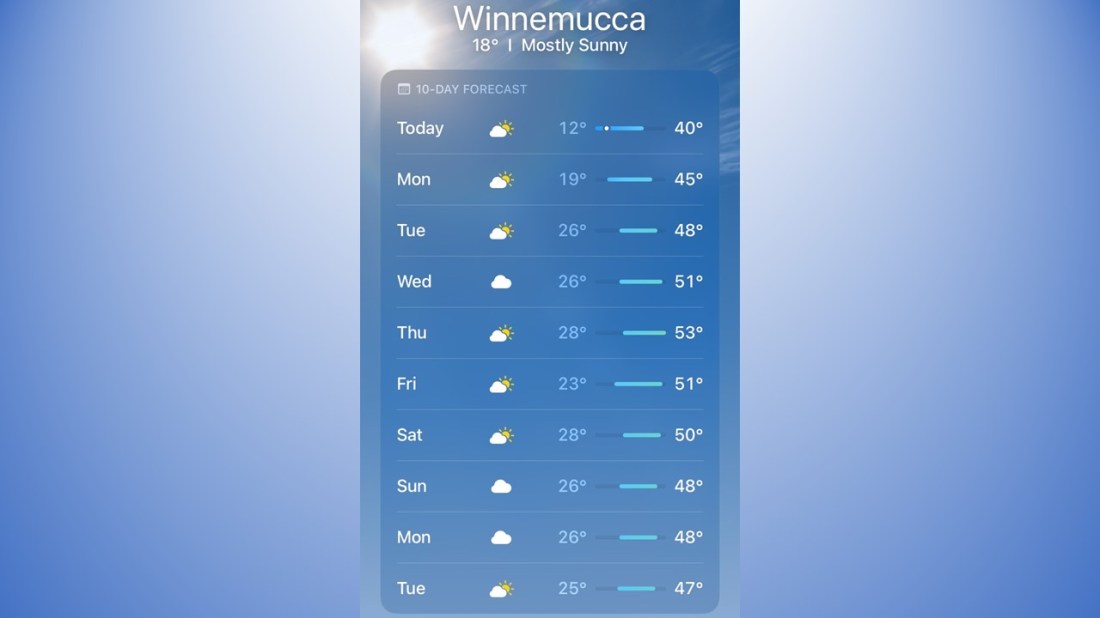
The roundup is set to begin on December 28, which is Thursday.
No rain in the forecast with temperatures reaching the low 50s.
Rain is predicted on the other side of the Sierra but will not reach this area, apparently.
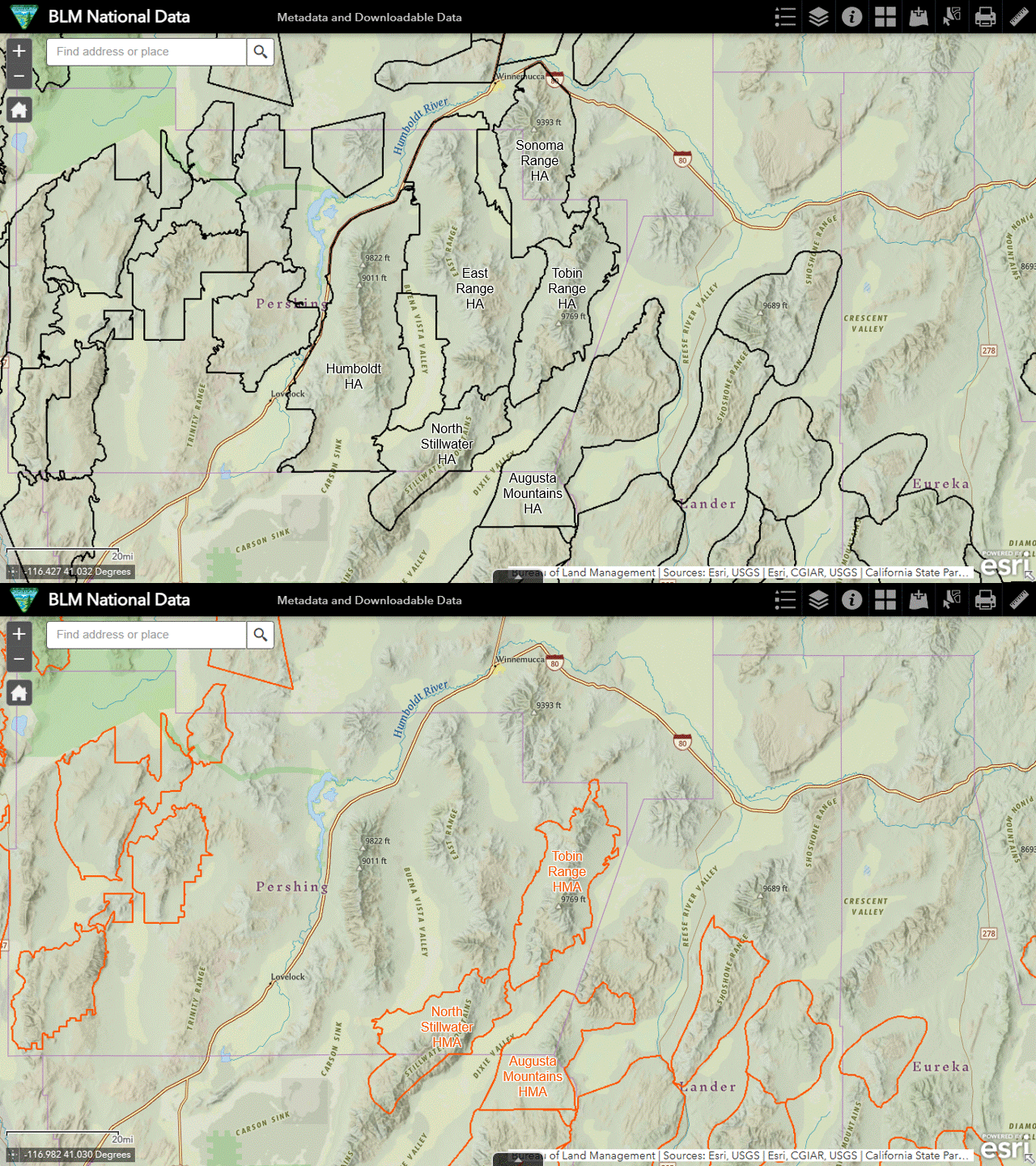
The Complex is south of Winnemucca and the off-range corrals are to the north.
The privately owned corrals can accommodate 4,000 horses on 100 acres, equivalent to 4,000 cow/calf pairs on 100 acres, proving there is no need for ranchers to be anywhere near public lands.
RELATED: East Pershing Roundup in the News.
There’s not enough water and forage to support the current number of horses according to a story dated December 22 by AP News.
Actually, there is.
The last paragraph in Section 3.12 of the Final EA for pest control and resource enforcement explains: “Livestock are currently experiencing direct competition by wild horses for available forage and water, both within HMAs and HAs.”
It’s not about rangeland health and endangered species.
The bureaucrats have assigned most of the resources to the public-lands ranchers, so the horses have to go.
RELATED: East Pershing Roundup Starts Next Week.
The incident will start on or about December 28 according to today’s news release.
The capture and removal goals are identical, 2,875 each.
No animals will be treated with fertility control and none will be released, at least not intentionally.
A helicopter will push the horses into the traps and operations will be open to public observation.
Horses not dispatched in the field will be taken to the privately owned corrals in Paradise Valley.
Gather stats and daily reports will be posted to this page.
The National Data Viewer shows the six original HAs and three remaining HMAs.
The Complex is managed primarily for animal agriculture as discussed in this video.
The roundup supports three tenets of rangeland management.
RELATED: Introduction to the East Pershing Complex.
Zonastat-H may be applied only to female horses and burros capable of doing environmental damage, as specified on the label.
Application to control animals that interfere or could interfere with animal agriculture, or pose safety hazards to motorists, constitutes unlawful use of the pesticide and should be investigated by law enforcement.
Administering two doses of GonacCon Equine less than 90 days apart also constitutes unlawful use of the pesticide and should be investigated by law enforcement.
Application of these products without the proper PPE also constitutes unlawful use.
This applies to the bureaucrats, ranchers and advocates who authorize or carry out such uses on public or private lands.
The horses removed this summer have returned, at least some of them, but they are now in private care, according to a story dated December 21 by the Pahrump Valley Times.
The status of the burros was not given.
RELATED: Pahrump Residents Working to Reverse Johnnie Roundup.
The incident concluded on December 14 with 1,605 horses captured, 1,392 shipped, 190 released and 23 dead, yielding a net removal of 1,415.
The capture and removal goals were 1,594 and 1,381.
The daily reports indicate 1,394 horses shipped. The discrepancy may be related to two domestic horses caught on November 23.
There were no unaccounted-for animals according to figures in the sidebar.
The capture total included 658 stallions, 737 mares and 210 foals.
Youngsters represented 13.1% of the animals gathered, consistent with a herd growth rate of seven to eight percent per year.
Of the adults, 47.2% were male and 52.8% were female, providing no evidence of an abnormal sex ratio.
Eighty-one mares were returned to the HMA after receiving two doses of GonaCon Equine just 30 days apart, constituting unlawful use of the pesticide.
They were accompanied by 109 stallions.
To date, an announcement marking the end of the roundup has not appeared at the BLM news site.
The HMA is subject to permitted grazing.
RELATED: Clan Alpine Roundup Announced.
The capture and removal goals are 1,000 and 960 according to the latest schedule.
A helicopter will push the burros into the traps and operations will be open to limited public observation.
The news release did not include a link to the gather stats and daily reports.
Animals identified for removal will be taken to the off-range corrals in Florence.
Jennies involved in the Platero Project will receive another dose of PZP and be returned to the area near the capture site.
The HMA contains the old mining town of Oatman, known for its furry panhandlers, and is subject to permitted grazing.
Application of PZP to control animals that interfere with animal agriculture, or pose safety hazards to motorists, constitutes unlawful use of the pesticide.
The National Data Viewer shows habitat loss and grazing allotments. Click on image to open in new tab.
The 2022 roundup took nearly 1,100 animals off the range.
The incident supports three tenets of rangeland management.

Yep, “Velma B. Johnston, or Wild Horse Annie, was a tireless advocate for wild horses and burros, and her legacy lives on through the work AWHC does and through the Wild and Free-Roaming Horses and Burros Act of 1971.”
You didn’t know Velma was a defeatist, pesticide pusher and ranching sympathizer?
“Today, 52 years later, the Act has been significantly weakened thanks to the lobbying efforts of special interest groups.”
Such as the American Petroleum Institute?
They’re not trying to reverse those changes. They’re working with the bureaucrats and ranchers to implement them.
Adjectives used in the news flash: Beloved, Incredible, Innocent.
Just as the Democrat Party has convinced millions of voters to act against their own interests, CAAWH has duped thousands of donors into funding its anti-horse agenda.
RELATED: How CAAWH Stands Up to the Federal Government.

If your savings account earns 6% per year, how long before your money doubles?
According to the Rule, 72 ÷ 6 = 12 years.
If you want your money to double in eight years, what interest rate is needed?
Same calculation, 72 ÷ 8 = 9% per year.
If a wild horse herd is growing at a rate of 12% per year, how long before it doubles?
Six years.
If it doubles every eight years, what is the growth rate?
Nine percent per year.
The formula doesn’t care if you’re counting horses or dollars.
The growth rate for horses is not the same as the birth rate.
The birth rate will be five to six percentage points higher to account for deaths.
For a herd to grow at a rate of 12% per year, a birth rate of seventeen to eighteen percent per year will be needed.
What happens when the birth rate is zero or nearly so, because the advocates poisoned the mares with pesticide-laced darts?
The herd shrinks, as is the case at the Salt River and Virginia Range.
Issue a news release about overpopulation and excess animals.
Say nothing about forage allocations and the prevalence of livestock.
Float the idea of motorized removal.
They’ll be begging for nonmotorized removal, with ovary-killing pesticides, and they’ll provide it themselves at no cost to the government.

The federal government has been operating on a series of continuing resolutions since October 1 because Congress has not produced a FY24 spending bill.
So how is the BLM going to pay for additional gathers and removals?


