Snippet from statute: It is the policy of Congress that wild free-roaming horses and burros shall be protected from capture, branding, harassment, or death
Snippet from manual: To protect wild horses and burros from unauthorized capture, branding, harassment or death
The figures above are based on the daily reports.
Three horses were euthanized on Day 18 for preexisting conditions.
The death rate is 0.9%.
The capture total includes 268 stallions, 322 mares and 157 foals.
Youngsters represented 21.0% of the animals gathered, enough to support a herd growth rate of 16% per year.
Snippet from statute: It is the policy of Congress that wild free-roaming horses and burros shall be protected from capture, branding, harassment, or death
Snippet from manual: To protect wild horses and burros from unauthorized capture, branding, harassment or death
The figures above are based on the daily reports.
The death rate is 0.7%.
The capture total includes 302 stallions, 318 mares and 149 foals.
Youngsters represented 19.4% of the animals gathered, enough to support a herd growth rate of 14% per year.
Snippet from statute: It is the policy of Congress that wild free-roaming horses and burros shall be protected from capture, branding, harassment, or death
Snippet from manual: To protect wild horses and burros from unauthorized capture, branding, harassment or death
The figures above are based on the daily reports.
The death rate is 0.6%.
The capture total includes 241 stallions, 277 mares and 132 foals.
Youngsters represented 20.3% of the animals gathered, enough to support a herd growth rate of 15% per year.
Snippet from statute: It is the policy of Congress that wild free-roaming horses and burros shall be protected from capture, branding, harassment, or death
Snippet from manual: To protect wild horses and burros from unauthorized capture, branding, harassment or death
The figures above are based on the daily reports.
The death rate is 0.7%.
The capture total includes 284 stallions, 301 mares and 142 foals.
Youngsters represented 19.5% of the animals gathered, enough to support a herd growth rate of 14% per year.
Snippet from statute: It is the policy of Congress that wild free-roaming horses and burros shall be protected from capture, branding, harassment, or death
Snippet from manual: To protect wild horses and burros from unauthorized capture, branding, harassment or death
The figures above are based on the daily reports.
The death rate is 0.8%.
The capture total includes 191 stallions, 219 mares and 105 foals.
Youngsters represented 20.4% of the animals gathered, enough to support a herd growth rate of 15% per year.
Of the adults, 46.6% were male and 53.4% were female, no indication of an abnormal sex ratio.
Snippet from statute: It is the policy of Congress that wild free-roaming horses and burros shall be protected from capture, branding, harassment, or death
Snippet from manual: To protect wild horses and burros from unauthorized capture, branding, harassment or death
The figures above are based on the daily reports.
The death rate is 0.7%.
The capture total includes 270 stallions, 278 mares and 132 foals.
Youngsters represented 19.4% of the animals gathered, enough to support a herd growth rate of 14% per year.
Of the adults, 49.3% were male and 50.7% were female, no indication of an abnormal sex ratio.
Despite that, the allotment offers 15,077 active AUMs on 239,802 public acres, equivalent to 5.2 wild horses per thousand public acres.
That includes the area that can’t support any wild horses.
If conditions improved and the suspended AUMs moved back into the active column, the allotment would support livestock equivalent to 9.9 wild horses per thousand public acres—almost ten times higher than the target stocking rate across all HMAs of one wild horse per thousand public acres.
This is another example of double standard in resource management on America’s public lands.
Like the advocates, your faithful public servants aren’t playing for the home team.
Who said they don’t have a credibility problem?
Would the allotment make a good wild horse preserve?
It overlaps an area already identified for wild horses, which is a showstopper.
Numerous authorizations are attached, so you’d have to buy multiple base properties to access all of the AUMs.
Probably not a good investment.
The bureaucrats, who never have to face the voters, are trying to change the grazing rules to stop the conversion of allotments into wild animal preserves, not because it’s illegal but because the ranchers, especially the crybabies in Montana, don’t like the idea.
The proposal should not be taken as a barrier to your conservation project.
Snippet from statute: It is the policy of Congress that wild free-roaming horses and burros shall be protected from capture, branding, harassment, or death
Snippet from manual: To protect wild horses and burros from unauthorized capture, branding, harassment or death
The figures above are based on the daily reports.
A horse was euthanized on Day 13 for a preexisting condition. No details were given.
The death rate is 0.9%.
The capture total includes 151 stallions, 184 mares and 92 foals.
Youngsters represented 21.5% of the animals gathered, enough to support a herd growth rate of 16% per year.
Of the adults, 45.1% were male and 54.9% were female, no indication of an abnormal sex ratio.
Snippet from statute: It is the policy of Congress that wild free-roaming horses and burros shall be protected from capture, branding, harassment, or death
Snippet from manual: To protect wild horses and burros from unauthorized capture, branding, harassment or death
The figures above are based on the daily reports.
A colt was euthanized on Day 13 for a preexisting condition.
The death rate is 0.8%.
The capture total includes 250 stallions, 255 mares and 122 foals.
Youngsters represented 19.5% of the animals gathered, enough to support a herd growth rate of 14% per year.
Of the adults, 49.5% were male and 50.5% were female, no indication of an abnormal sex ratio.
The AML for the Pryor Mountain HMA did not increase in the updated management plan but the interval between high and low decreased, suggesting the birth rate will be going down and the death rate will be going up (as the age of the herd increases).
The range between the endpoints is usually based on a doubling of herd size every four to five years, which might make sense in areas where nature is allowed to run its course.
For example, at the Fifteenmile HMA in Wyoming, the AML is 100 to 230.
What about HMAs where the advocates are involved?
At Stewart Creek, where WYWHIP poisons the mares with PZP, the range is 125 to 175.
The closer the endpoints the lower the growth rate.
The previous AML at Pryor, 90 to 120, yields a growth rate of roughly 5.9% per year for five years.
The new AML, 107 to 120, yields a growth rate of 2.3% per year over the same period.
You can determine the growth rate by solving this relationship for GR, where AMLH is upper endpoint, AMLL is the lower endpoint, GR is the growth rate in percent and n is the period in years.
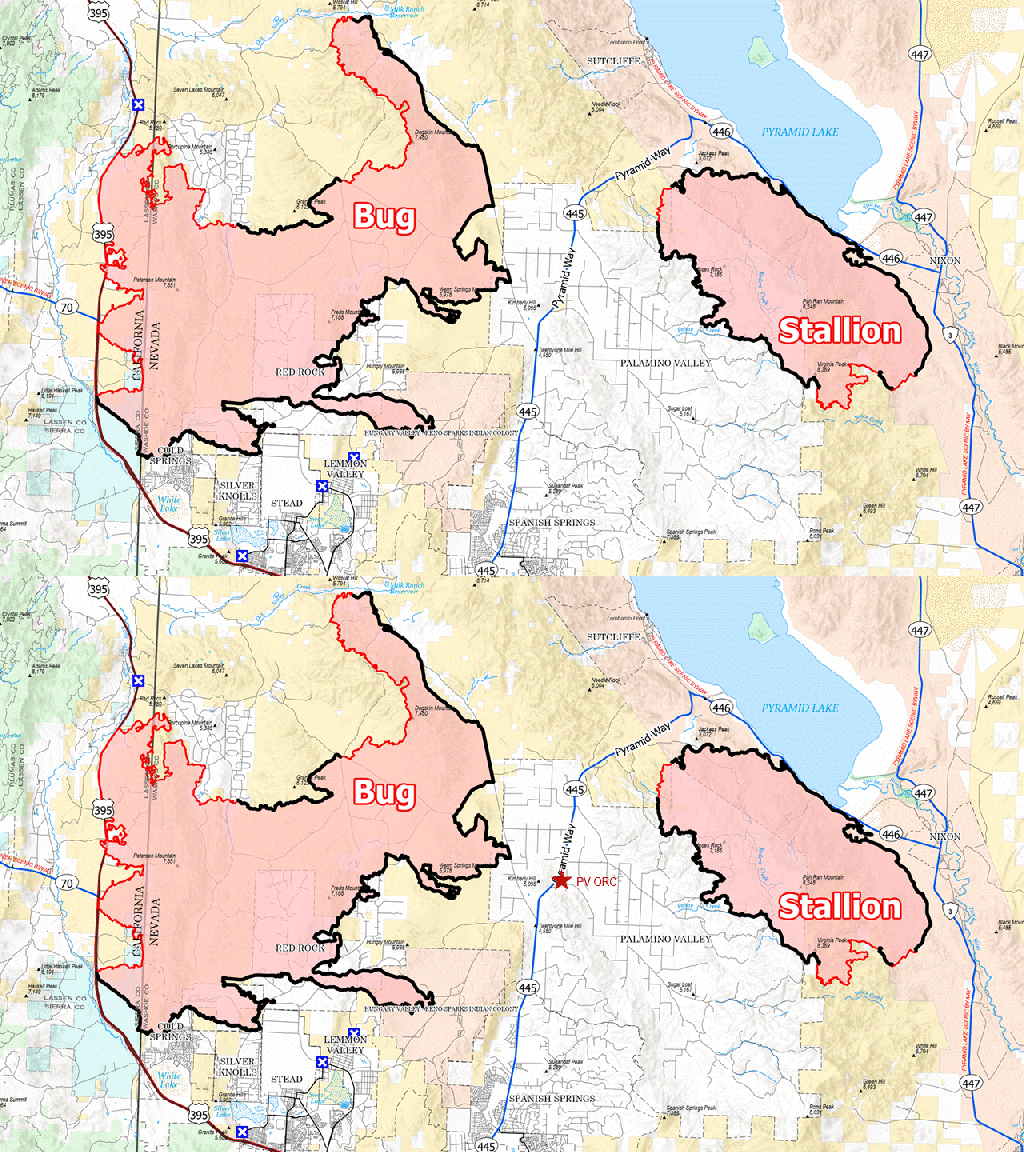
The Bug Fire is a few miles to the west and the Stallion Fire is a few miles to the east according to the August 13 map at Inciweb.
Both fires are believed to be human caused.
A report by KRNV News says that over 1,600 wild horses and burros will remain at the facility, the safest option for their welfare according to a BLM spokesperson.
The HMA is not subject to permitted grazing but is surrounded by allotments on all but the east side.
The announcement contains two incompatible statements:
The AML is 107 to 120 horses
The gather will help ensure the herd remains healthy and genetically diverse
The narrow range of the AML implies heavy use of fertility control, as discussed previously, which destroys the breeding population and ends genetic mixing.
Removal of horses cannot improve or maintain genetic diversity if the remnant is too small and/or the mares have been ruined with PZP, which is the case at Pryor.
The advocates, evil beyond imagination, are 100% on board with the idea.