Morons and Malice at the Salt River

The morons are those who lap this stuff up without question.

The malice comes from those who post it, trying to give the impression that all is well while sweeping the mass sterilization program under the rug.

They deserve your contempt not your money.

RELATED: What’s Harder to Find Than a Salt River Foal?

► Get the truth about wild horses and the wild horse advocates at westernhorsewatchers.com.

Three Days Until Defund the Advocates Day

They’re selling mass sterilization as wild horse conservation.

They want you to think that drillers and miners are the greatest threats to wild horses.

They want privately owned cattle and sheep to have most of the food and water in the lawful homes of wild horses.

Send them packing on December 2.

PREVIOUS: One Week Until Defund the Advocates Day.

► Get the truth about wild horses and the wild horse advocates at westernhorsewatchers.com.

Why Ranchers Like Public Lands

An ad in the November edition of Horse Tales puts the value of forage in a rented pasture at $125 per AUM, assuming a horse can survive without supplemental feed.

Why pay the going rate when you can graze the public lands for $1.35 per AUM?

The grazing fee, which does not give the American people a fair price for the use of their public lands, is set by a formula in the Public Rangelands Improvement Act.

► Get the truth about wild horses and the wild horse advocates at westernhorsewatchers.com.

Should Rangeland Degradation Correlate with Resource Loading?

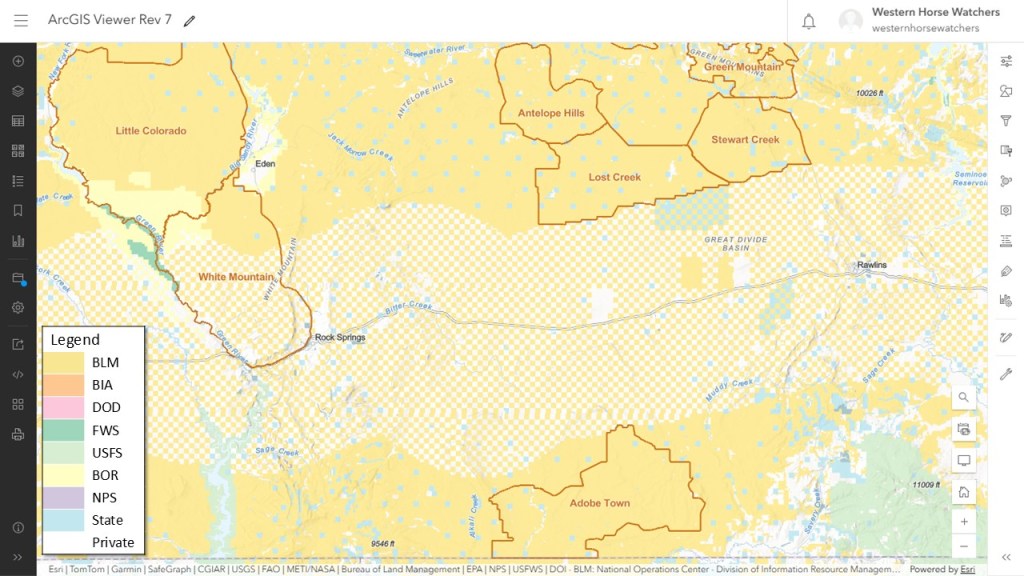
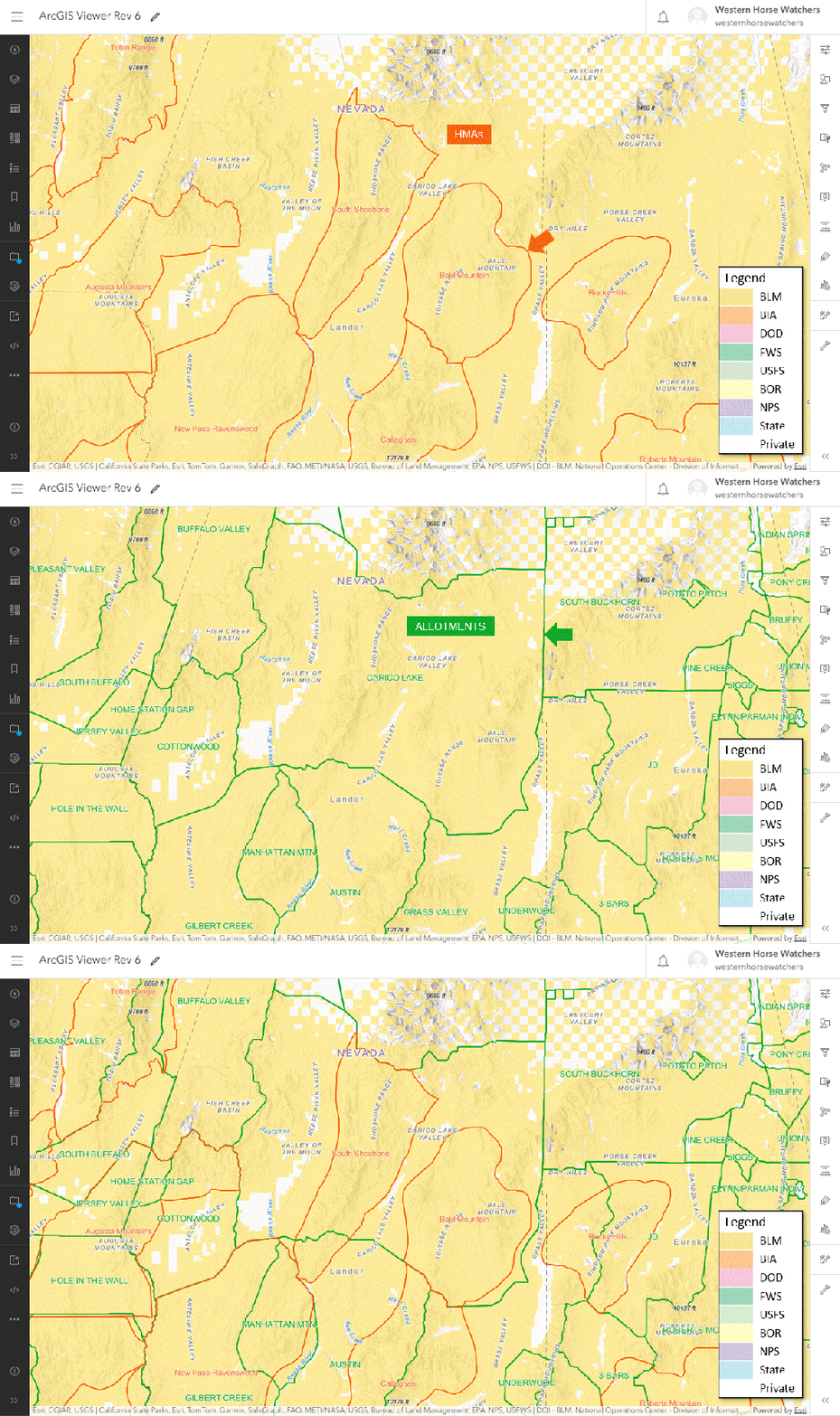
The Stewart Creek HMA lies within the Stewart Creek Allotment with a little room to spare in the northeast corner.

Size

Animals allowed by plan

  • HMA – 175 wild horses
  • Allotment – Livestock equivalent to 689 wild horses

Resource loading

  • HMA – 1.1 wild horses per thousand public acres
  • Allotment – Equivalent to 4.2 wild horses per thousand public acres

The HMA would be well over 3X AML with no wild horses.

Livestock exert 3.8 times more grazing pressure than horses.

If the land can only support 1.1 wild horses per thousand acres but routinely carries the equivalent of 5.3 wild horses per thousand acres, then rangeland degradation must be a goal, not a defect of permitted grazing.

Another possibility is that the land can support more wild horses than the bureaucrats admit.

The advocates won’t talk about it because it undermines the rationale for their darting programs.

RELATED: Resource Management in the Beaty Butte Allotment.

► Get the truth about wild horses and the wild horse advocates at westernhorsewatchers.com.

If Wild Horses Had Principal Use of North Turkey Track

The allotment, about 30 miles southeast of Roswell, sustains cattle and horses in a 12-month grazing season according to the authorization use report.  (The figures in the report are not correct.  Twenty horses would require 240 AUMs per year not 127.)

The allotment master report puts it in the Improve category, suggesting that your stewards of the public lands are not taking their responsibilities seriously.

The permittee receives 15,106 active AUMs on 126,373 public acres, equivalent to 1,259 wild horses or ten wild horses per thousand public acres.

Your faithful public servants claim that public lands in the western U.S. can only support one wild horse per thousand acres (25,600 animals on 25.6 million acres according to the last page of the 2025 population dataset).

The advocates ratify and reinforce the narrative with their darting programs.

If the allotment was an HMA, the AML would be 126 and 1,133 wild horses would be consigned to off-range holding because of permitted grazing.

The area would be held to a small fraction of carrying capacity to accommodate large numbers of livestock, placed there by high-net-worth individuals who pay almost nothing for the resources they consume and the services rendered on their behalf by the government.

BLM allotments in New Mexico support livestock equivalent to 153,225 wild horses on 12,234,818 public acres, or 12.5 wild horses per thousand public acres.

Wild horses can be placed on public lands not identified for their use by acquiring base properties associated with grazing allotments and flipping the preference to horses.

RELATED: The Allotments Tell the Story: They’re Lying, All of Them.

► Get the truth about wild horses and the wild horse advocates at westernhorsewatchers.com.

Advocates Remove Currituck Stallion from Beach

He was taken to their farm after they determined he was a threat to humans according to a report by WRAL News.

The article said he was becoming too reliant on people giving him food.

It’s not clear if he was a bachelor or band leader.

RELATED: Advocates Dispatch, Eulogize Currituck Stallion.

UPDATE: For some background on Topnotch, the subject of this post, go to Action 1D on page 9 of the minutes of the May 15 Wild Horse Advisory Board meeting.

► Get the truth about wild horses and the wild horse advocates at westernhorsewatchers.com.

How to Help the Pine Nut Advocates Buy Pesticides

Refer to their ad in the November edition of Horse Tales:

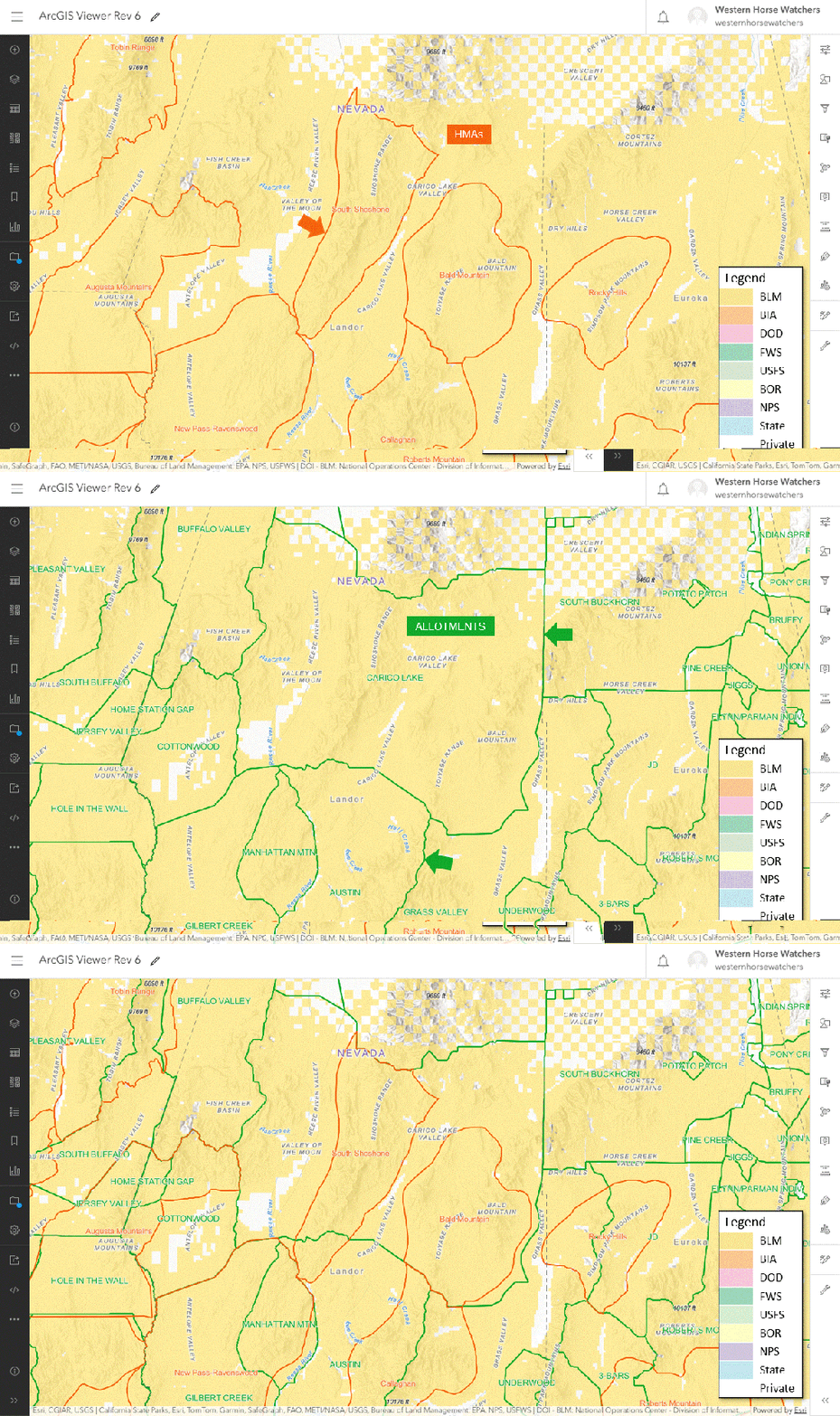
Here’s what it looked like three years ago:

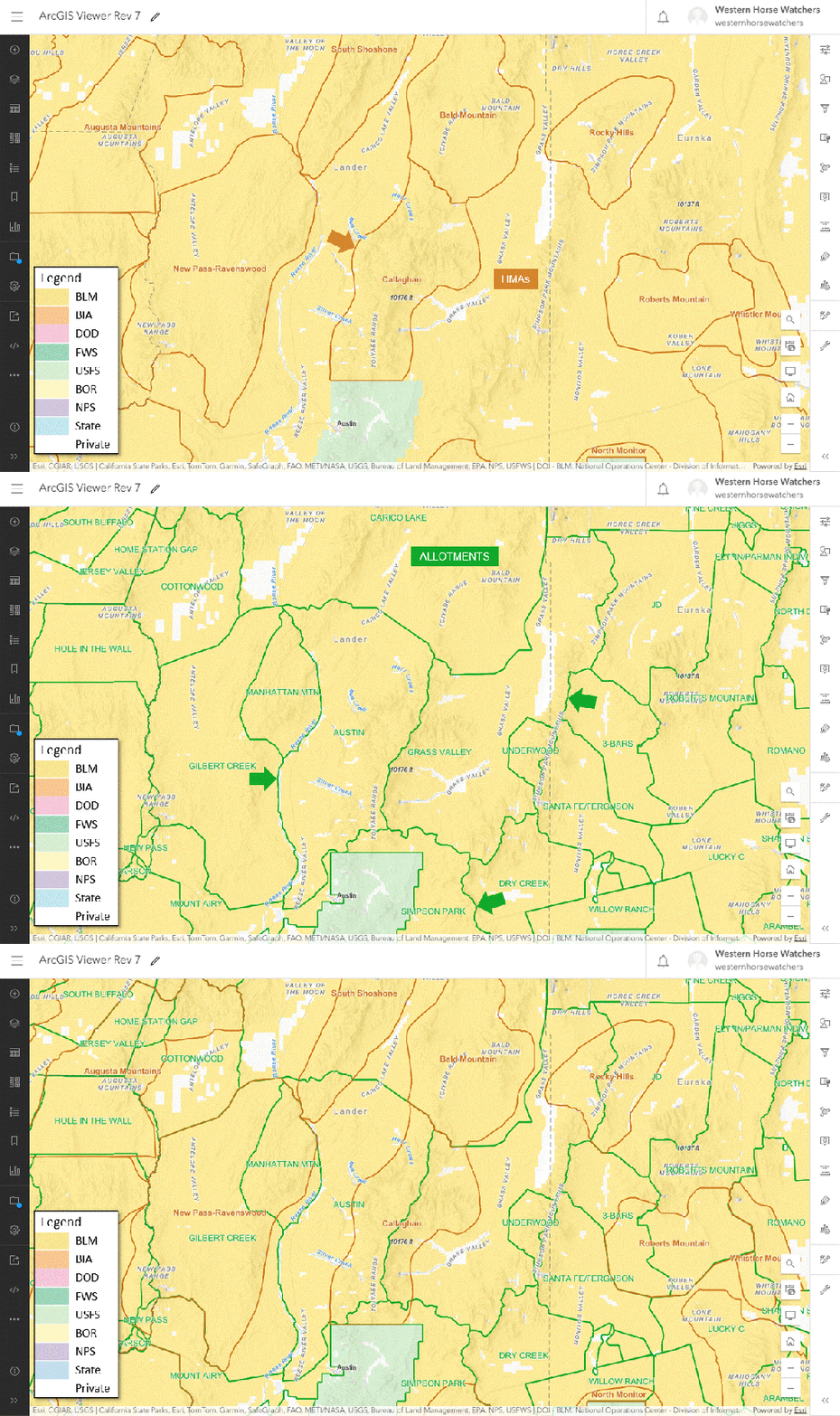
About half of the HMA was zeroed out so it could be managed principally for livestock.

The advocates want the plan enforced with PZP not helicopters.

That means you might be disappointed if you were expecting to find images of mares with foals in the calendar.

► Get the truth about wild horses and the wild horse advocates at westernhorsewatchers.com.

Resource Management in the Beaty Butte Allotment

The HMA contains 399,725 public acres and lies mostly within the allotment.

The 250 wild horses allowed by plan require 3,000 AUMs per year.

The stocking rate allowed by plan is 0.6 wild horses per thousand public acres.

The allotment offers 26,121 AUMs per year on 506,985 public acres, equivalent to 2,177 wild horses or 4.3 wild horses per thousand public acres.

The allotment master report puts it in the Improve category.

If the land can only support 0.6 wild horses per thousand acres and the bureaucrats pack it with livestock equivalent to 4.3 wild horses per thousand acres, then rangeland degradation must be a goal, not an unintended consequence of permitted grazing.

Another possibility is that your faithful public servants are lying about the carrying capacity of public lands.

► Get the truth about wild horses and the wild horse advocates at westernhorsewatchers.com.

Blue Ribbon Panel to Study Miller Creek Horses

It’s not clear if any state agency has the authority to manage wild horses in Montana, but Missoula County officials plan to bring together experts in land and livestock management, ecology and law enforcement to explore potential options for managing the herd and provide staff with recommendations.

A story by KPAX News said the situation is unique, as the animals roam freely in neighborhoods and parks, which may be true for Montana but not Nevada.

The Virginia Range, where residents have front-row seats to the largest attempted eradication of wild horses, is one example.

Comments at the Missoula County Voice, an online platform for public engagement, were largely in favor of leaving the horses alone.

► Get the truth about wild horses and the wild horse advocates at westernhorsewatchers.com.

Centennial Roundup Begins, Ends During Government Shutdown

The incident concluded on October 7 with 120 horses captured, 120 shipped, none released and no deaths.

The figures for Day 2 indicate five unaccounted-for horses.

The capture total consisted of 42 stallions, 49 mares and 29 foals.

The contractor also captured and shipped 142 burros. including 66 jacks, 61 jennies and 15 foals.

The capture goal was 270 but the split between horses and burros was not determined in advance.

There were no plans to treat any of the females with fertility control pesticides and return them to the range.

RELATED: BLM to Remove Wild Horses and Burros from Centennial HMA

► Get the truth about wild horses and the wild horse advocates at westernhorsewatchers.com.

Foal-Free Friday, Uh-Oh Edition

Are people finally waking up to these frauds or is Google now in the business of fabricating search results?

The Campaign Against America’s Wild Horses not only peddles mass sterilization as a humane alternative to motorized removal, but its volunteers have put it into practice on the Virginia Range.

Same for its partners at the Salt River and Pine Nut Mountains.

Can you think of a better way to win the support of the bureaucrats and ranchers?

PREVIOUS: Foal-Free Friday, Wailing and Gnashing of Teeth Edition.

► Get the truth about wild horses and the wild horse advocates at westernhorsewatchers.com.

Somebody Messed Up at Google

Western Horse Watchers is such a potent threat to the Love Triangle that its players have gone all out to hide it from their supporters.

Normally the site does not appear in searches for “wild horse” and “wild horses.”

But today it did, even without personalization.  (In the old days they called it shadow banning—your site appears when you run the search but nobody else sees it.)

There has been no traffic from socialist media in 45 days, suggesting that the site has been banned therefrom.

Maybe the advocates are worried that their pesticide businesses will suffer as a result of commentary by Western Horse Watchers.

RELATED: What Makes the Advocates Evil?

► Get the truth about wild horses and the wild horse advocates at westernhorsewatchers.com.

Exploring AIA Wild Horse Data

The database at the Assateague Island Alliance horse page puts the current population at 78.

The filtering option gives the following breakdown:

  • Stallions – 22
  • Mares – 34
  • Colts – 11
  • Fillies – 11

The island was a proving ground for mass sterilization with PZP.

The darting program was shut off in 2016 and since then the population has gone sideways, proving that the pesticide is not reversible as the advocates claim.

A few years ago they pointed to the island as a paragon of wild horse management but now that the results are public, they’ve lost interest.

They know you know they’ve been lying.

Note the abnormal sex ratio—1.5 mares for every stallion—a well-known side effect the advocates dismiss as “mares living longer.”

RELATED: Assateague Herd Grows Slightly.

► Get the truth about wild horses and the wild horse advocates at westernhorsewatchers.com.

BLM Approves Lincoln County Public Lands Sale

Some of the parcels are in areas identified for wild horses.

The news release, dated October 16 but not published until yesterday due to the partial government shutdown, said the date of sale will be announced separately along with details such as the location and fair market value of each parcel.

A draft environmental assessment was not issued for public review.  The project jumped from scoping to decision in six months.

RELATED: Scoping Begins for Lincoln County Public Lands Sale.

► Get the truth about wild horses and the wild horse advocates at westernhorsewatchers.com.

If Wild Horses Had Principal Use of Mustang

The BLM recently authorized the drilling of a water well in the allotment, which borders the Silver King HMA.

The news release gave few details about the project.

The allotment master report puts it in the Improve category, suggesting that your stewards of the public lands are not taking their responsibilities seriously.

Note that there are more AUMs in the suspended column than active.

The Mustang permittees receive 1,134 active AUMs on 23,877 public acres, equivalent to 95 wild horses or four wild horses per thousand public acres.

Your faithful public servants claim that public lands in the western U.S. can only support one wild horse per thousand acres (25,600 animals on 25.6 million acres according to the last page of the 2025 population dataset).

The advocates support the narrative with their darting programs.

If the allotment was an HMA, the AML would be 24 and 71 wild horses would be consigned to off-range holding because of permitted grazing.

The area would be held to a small fraction of carrying capacity to accommodate large numbers of cattle or sheep, placed there by high-net-worth individuals who pay almost nothing for the resources they consume and the services rendered on their behalf by the government.

BLM allotments in Nevada support livestock equivalent to 173,144 wild horses on 40,194,360 public acres, or 4.3 wild horses per thousand public acres.

Wild horses can be placed on public lands not identified for their use by acquiring base properties associated with grazing allotments and flipping the preference to horses.

RELATED: The Allotments Tell the Story: They’re Lying, All of Them.

► Get the truth about wild horses and the wild horse advocates at westernhorsewatchers.com.

Trump Nominates Pearce for BLM Director

A November 5 article by The Hill suggests that he’s not on board with the ruinous carbon-is-a-pollutant-men-can-be-women-and-water-flows-uphill agenda.

The choice must be confirmed by the Senate.

The BLM leadership page indicates that Bill Groffy currently serves as acting director.

The position of Division Chief for the Wild Horse and Burro Program is filled internally and not subject to Senate confirmation.

RELATED: Sgamma Nomination Withdrawn.

► Get the truth about wild horses and the wild horse advocates at westernhorsewatchers.com.

Bullfrog Emergency Roundup?

Yesterday the BLM news site populated with announcements dating back to the second day of the partial government shutdown.

An October 6 news release indicated that bait-trap removal of 250 burros would begin on or about October 7.

The incident would not be open to public observation.

Captured animals would be taken to the Axtell off-range corrals.

As of today, there are no links for roundups in FY26 at the Nevada gather page.

The HMA surrounds the town of Beatty.

RELATED: Bullfrog Off-the-Record Roundup Starts Today?

► Get the truth about wild horses and the wild horse advocates at westernhorsewatchers.com.

Mustang Monday

At Spring Creek Basin HMA with Lynn Northrup.

References to “TJ” correspond to TJ Holmes, the head pesticide-pusher in charge who’s managing the herd to extinction.

The 2025 population dataset indicated 78 horses in the HMA, a bit short of the 150 to 200 animals needed for genetic diversity (refer to 4.4.6.3 in H-4700-1).

If you deduct the number of mares ruined by Holmes, the breeding population is likely in the single digits, completely inadequate for long-term viability.

That’s what the advocates bring to the table.

► Get the truth about wild horses and the wild horse advocates at westernhorsewatchers.com.

Protecting the Tonto Ranchers

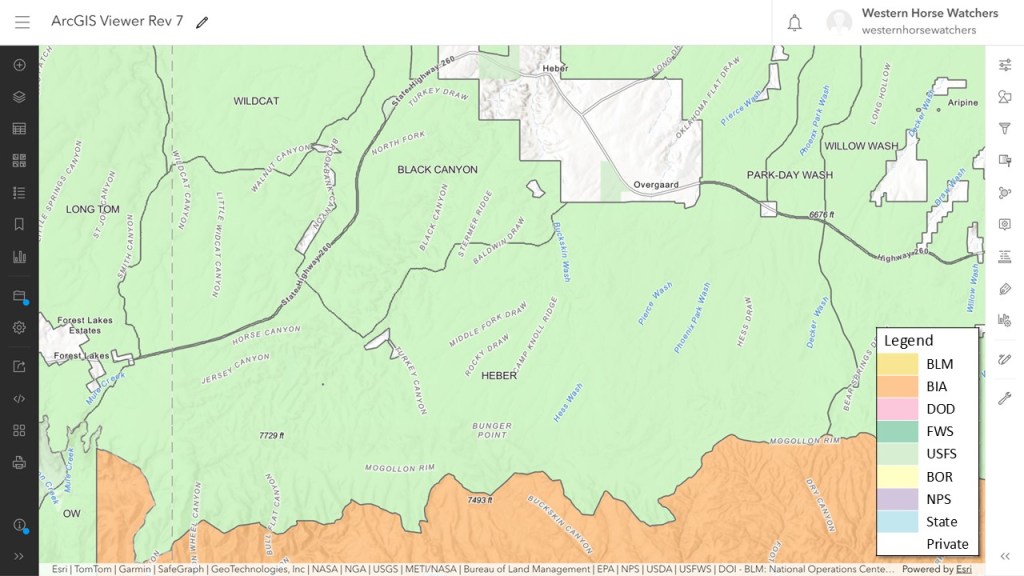
The people of Arizona made clear nine years ago that they wanted approximately 450 wild horses living in freedom at the Salt River.

Today, the population is somewhere around 280 thanks to the mass sterilization program inflicted on the herd by the Salt River Wild Horse Darting Group in cooperation with the Campaign Against America’s Wild Horses.

The best course of action would be to start a special fund to acquire a base property tied to one or more allotments in the Tonto National Forest, flip the preference to horses, and move the herd there.

But the advocates won’t do it because it might be taken as an affront by their allies and idols—the public-lands ranchers.

RELATED: Salt River Darting Program by the Numbers.

Get the truth about wild horses and the wild horse advocates at westernhorsewatchers.com.