BLM Ends Pancake Gather

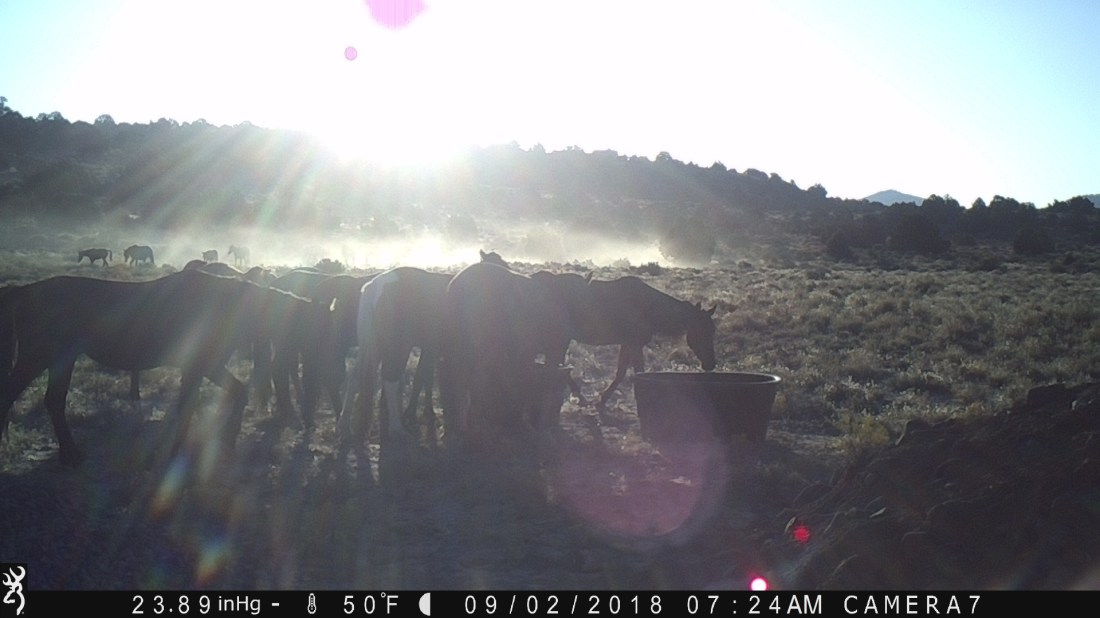
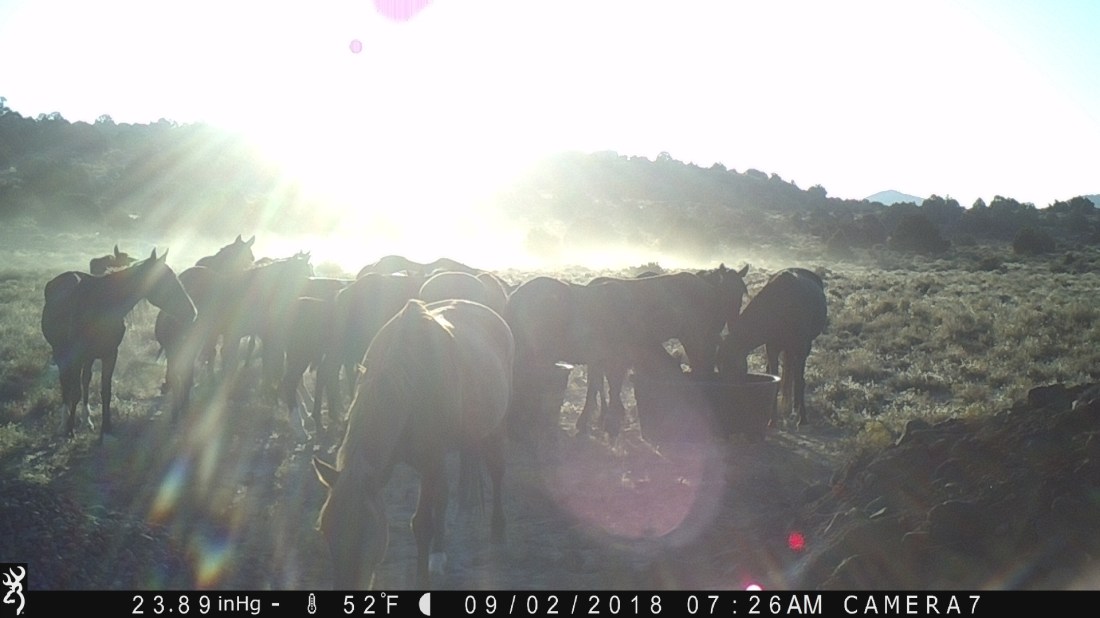
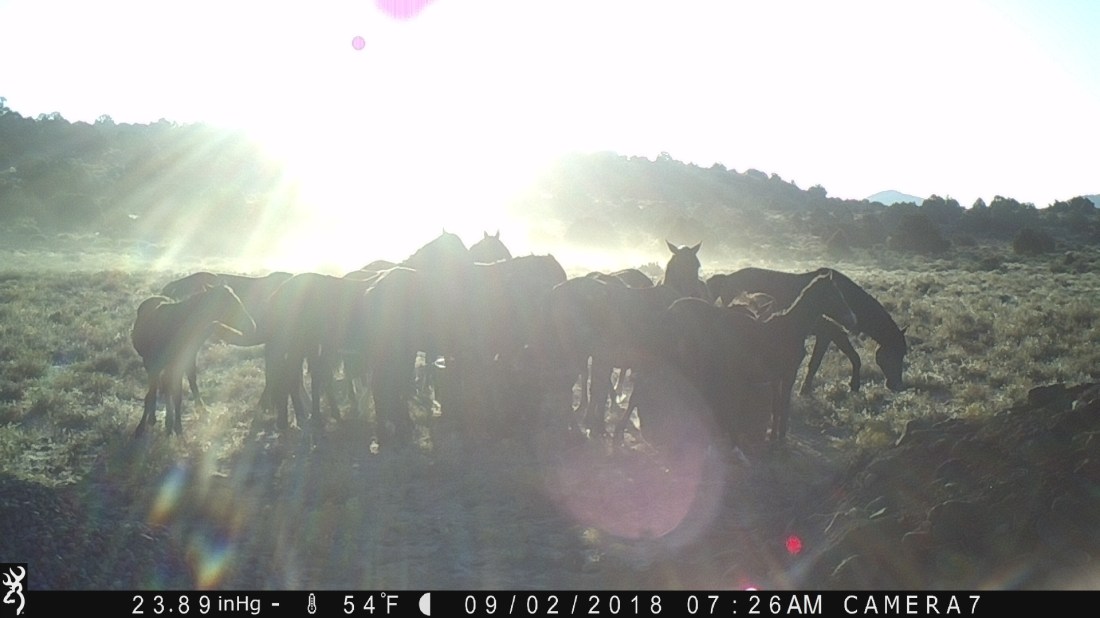
Bait trapping ended 09/04/18, with 89 wild horses removed from the Pancake HMA, according to a news release issued today.  Three deaths were reported and no animals were returned to the range.  A foal was euthanized on the first day due to injuries received when she was kicked by another horse inside the trap.

The gather was delayed for several weeks due to unfavorable weather.

Captured animals were taken to the Indian Lakes off-range corrals in Fallon, NV, where they will be placed into the WHB adoption program.

Livestock grazing has not been allowed in the area since 2000.

RELATED: Emergency Gather of Pancake Horses to Begin Next Week.

Muddy Creek Gather Starts Next Week

The roundup originally planned for August will begin on September 11, according to a BLM news release issued yesterday.  The removal target is still 149 animals.  The gather will be open to public observation.  Visitors are advised that low flying helicopters will be involved in the operation

The Muddy Creek HMA covers 283,400 acres in central Utah per the announcement and has an AML of 125, for an aimed-at population density of 0.44 animals per thousand acres.

The HMA description says 208,810 acres.

Captured animals will be taken to the Wild Horse Facility in Delta, UT, where they will be prepared for adoption.

Gather stats and daily reports can be found at this page.

The announcement did not indicate if livestock were present on the HMA.

RELATED: Wild Horse Gather Set for Muddy Creek.

Report Says Shackleford Herd Grew Slightly in 2017

The wild horse herd on the barrier island of Shackleford Banks added 14 foals in 2017, while losing five adults and one foal, for a net increase of eight horses.  The population at the beginning of 2018 was 120 horses.

Fertility control has not been applied since 2009.  The AML is 130 and the area where the horses roam covers 3000 acres, for an aimed-at population density of 43.3 animals per thousand acres.

No roundups are planned.  Livestock are not present in the area.

Refer to the story in Coastal Review Online dated 09/04/18.

The report published by NPS indicated that, of the horses aged twenty years and older, 17 out of 20 are mares (85%).  Assuming that mortality is evenly distributed among genders (p = .5), you’d expect to find between four and sixteen mares in the group, using np-chart limits with n = 20.

That you have 17 mares (and 3 stallions) suggests that mortality favors stallions at Shackleford Banks.  This result should be attributed to a special cause.

The report did not say if any of the three stallions were band leaders.

Wild horse herds on the east coast barrier islands have been on U.S. soil longer than those of the American west.

How Large Should HMAs Be?

Given:

  • Wild horse herds should contain at least 150 animals for genetic viability
  • Average population density on BLM lands is one animal per thousand acres

Therefore, every HMA should have at least 150,000 acres.

There are a total of 117 HMAs in Nevada, Oregon and Utah (66% of the HMAs in the U.S.) and 67 are smaller than 150,000 acres (57%).

The Pryor Mountains and Little Bookcliffs Wild Horse Ranges, which have been in the news of late, have 38,000 and 36,113 acres respectively.

The problem is not too many horses, the problem is not enough land.

IMG_6962

BLM Plans Another 100% Gather at Beatys Butte HMA

Helicopters would be used to gather all wild horses on Beatys Butte HMA, followed by the return of 100 studs and mares to the range, according to a news release issued yesterday by the Lakeview office.  Mares would be treated with a contraceptive (such as PZP).  Public comments must be received by 09/28/18.

The HMA is in southern Oregon on the Nevada border.  It contains 437,120 acres and will have a population density of 0.23 animals per thousand acres at the end of the process, almost nothing.

The announcement did not indicate if the goal was to have the area horse-free within ten years, but it sure sounds like it.  Also omitted from the remarks was the innovative Beatys Butte Wild Horse Training Facility.

Beatys_Butte_HMA_Map-1

A 100% gather was completed in 2015, the result of a new cooperative program between ranchers and the BLM.

The proposed gather marks the next phase of a long-term strategy developed by ranchers, wild horse advocates, environmental groups, elected officials, and state and federal fish and wildlife agencies, according to the announcement.

How many advocates want to see horses removed from western rangelands, families broken up, breeding patterns determined by government?  Who benefits from this arrangement?

The wild horse population on Beatys Butte was over 1000 in 2015.  Today it’s around 250.  The number of livestock in and around the HMA was not provided.

Common Causes, Special Causes

The trailcam photo below shows an underweight horse on the Virginia Range.  A WHB specialist might give it a BCS of 3.  A wild horse critic (ahem, cough-cough, hater) might argue the horses are overpopulated and need to be removed from the range.

Would that be a fair statement?

A ‘common cause’ belongs to the system and affects all horses in an area.  The illness affecting the Waipio Valley horses would be an example.  It will probably be attributed to common causes, something in their environment.  Ditto for the Sand Wash horses, who are threatened by fencing and drought.

A ‘special cause’ is outside the system and affects only individual herd members.  An example would be the horse recently removed from Big Summit WHT.

If you saw many horses with low body condition scores, you’d be thinking common causes, such as excess animals / not enough land / insufficient forage.

In this example you only see one such horse, so you’re looking for a special cause, like illness, injury or loss of teeth.

Two mistakes are possible: (1) attributing a problem to a special cause when it was produced by common causes and (2) attributing a problem to common causes when it was produced by a special cause.

Calling a horse ‘stupid’ because he wandered onto a road and was hit by a car is an example of Mistake #1.  Any of the horses in his band could have done that, because a new subdivision is chewing up their land and now they must find food elsewhere.

The critic above is wrong.  He has made Mistake #2.

IMG_7397-1

BLM Ends Roundup at Nevada Wild Horse Range

Bait trapping ended 08/29/18, according to a news release issued today, with 801 horses removed from the Nevada Wild Horse Range, the largest HMA in Nevada.

Thirty one deaths were reported (3.9%) and the number of horses returned to the range was not stated.  Captured animals were taken to the Palomino Valley Center near Reno, NV and the Ridgecrest Regional Corrals in Ridgecrest, CA.

Gather stats and daily reports can be found on this page.

RELATED: BLM Starts Emergency Gather at Nevada Wild Horse Range.

Are There Any Wild Horses Left in Utah?

The state has been ‘ground zero’ for wild horse gathers this year, with the Range Creek, Cedar Mountain, Four Mile, Bible Springs, Tilly Creek, Sulphur and Muddy Creek HMAs targeted for removals.  Next on the list is the Onaqui Mountain HMA.

An article posted today in the Odgen-based Standard-Examiner looks at a proposed roundup that would remove 84% of the horses.  Opposing viewpoints are considered.

“BLM does review range health when they renew grazing permits, but it’s true there are hundreds more cattle and thousands more sheep permitted than there are wild horses on the Onaqui.”

At what point do we start calling it collusion?