On Big Summit WHT. Not a fight, just horses being horses. H/T Joe Hudspeth.
Category: Range
On the range
In Search of the Salt River Horses
They’re overpopulated, don’t ya’ know? H/T Carol & Gary’s See America Tour.
Big Bands on Onaqui Mountains
No, it’s not Glenn Miller’s birthday. H/T Flyin T Hangin A.
RELATED: BLM Puts Crosshairs On Onaqui Mountain Horses.
Mustangs Share Trail with Hiker
On the south edge of Little Bookcliffs WHR. H/T Dylan Brewer.
Volunteers Seek Fencing for Sand Wash Horses
Commissioners in Moffat County, CO are concerned about public safety on state route 318 due to recent collisions between vehicles and wild horses. Personnel from Wild Horse Warriors have asked for fencing but officials want a solution that satisfies all stakeholders. Refer to this story, posted today by the Craig Press.
On Her Timeline
Momma mustang on Christmas Day, freeze mark obscured by winter coat. Still can’t touch her. Worth the wait.

Heber Management Plan Drafted
A working group, chartered by Arizona State University, has created a blueprint for managing the 19,700 acre Heber Wild Horse Territory, according to a report that appeared today in the White Mountain Independent of Show Low, AZ.
The proposal, assembled by a diverse group of citizens under the guidance of professional facilitators, will be reviewed by the Forest Service.
A management plan was mandated in 2007 when the WHT was established. The goal is to balance the needs of horses, livestock and wildlife relative to the available resources.
Approximately 300 wild horses live in the territory, for a population density of 15 animals per thousand acres. That figure differs appreciably from the typical one animal per thousand acres on HMAs, many of which lie in the Great Basin.
The article did not indicate how many cattle are allowed in the WHT.
“There is also perception that ranchers don’t want any horses on the landscape because of alleged overgrazing from horses that impacts cattle forage abundance, water, etc.”
It’s not a perception, it’s the truth.

Things may turn out well for the horses if the stakeholders and regulatory agencies remember that’s it’s a HORSE TERRITORY not a cow territory.
RELATED: Conflict Between Livestock and Horses Plays Out at Heber WHT.
Placitas Horse Freed from Gully
A wild horse trapped in an arroyo near Placitas, NM was rescued by volunteers who called in a backhoe to cut a ramp so the horse could climb out. H/T JD Reynolds.
Mustang Monday
On Sand Wash Basin HMA. H/T High Stakes Ranch.
Cumberland Island Horses
TRNP in the News
Officials in Medora, ND are worried that the government shutdown may hurt their tourism-based economy, due to lack of services and possibly reduced hours at Theodore Roosevelt National Park. Refer to this syndicated report, which appeared yesterday in The Charlotte Observer.
The park, known for its prairie dogs, bison and wild horses, was created in 1947.
The horses you see today have no historical significance, they are only an exhibit.
The native horses were rounded up and sold 20+ years ago. Some were purchased by Leo Kuntz and moved to his ranch near Linton, ND. He called them ‘Nokotas.’
The descendants of these northern plains horses can be seen today at the Nokota Horse Conservancy in Linton.
RELATED: Story of the Nokota Horses.
Ranchers Protest Malheur Horse Transfer
Several wild horses were moved last week from the Ochoco National Forest (Big Summit WHT) to the Malheur National Forest (Murderer’s Creek WHT) and some public-lands ranchers caught the Forest Service doing it, according to a story that appeared today in the Capital Press of Salem, OR.
These people never want to see wild horses coming into their allotments, only going out.
“Wild horses are a contentious subject in the Malheur National Forest, where ranchers say the animals trample stream banks to the detriment of federally-protected fish, preventing cattle from being allowed to graze on affected allotments.”
The transfer may have been carried out to improve the genetic diversity of the Murderer’s Creek horses, a common practice in the Riddle Mountain and Kiger HMAs, where herd sizes are too small to maintain genetic viability.
An explanation of the incident is expected soon, according to the report.
Hickison Burros Go Off the Reservation, Prompt Gather
BLM said today that twenty wild burros would be removed this week from private land west of the Hickison HMA in central Nevada. Refer to this news release for details.
The 57,000 acre HMA has an AML of 45, for an aimed-at population density of 0.8 animals per thousand acres. It’s about 20 miles east of Austin.

The land owner complained that the burros have been damaging fences and consuming privately owned hay.
The announcement did not indicate if the private land was a base property for livestock grazing. The HMA and lands to the west are subject to grazing allotments.

Captured animals will be taken to the Palomino Valley Wild Horse and Burro Corrals north of Reno, where they will be checked by a veterinarian and prepared for adoption.
Leo Kuntz Remembered
He may be gone but his horses live on. Refer to this article in the December, 2018 issue of East Coast Equestrian.
RELATED: Story of the Nokota Horses.
BLM Ends Silver King Roundup
Gather operations concluded on 12/16/18, with 996 ‘excess’ horses removed from the HMA, according to a news release posted today. No horses were returned to the range and 228 were allowed to remain.
Twenty deaths were reported (2.0%). Details appear at the bottom of this page.
The 575,000 acre HMA is subject to permitted livestock grazing.
The pre-gather population density was 2.1 horses per thousand acres.
The agency entrusted with the care of the horses claims they’re overpopulated when their density reaches two or three animals per thousand acres, then turns around and allows the public-lands ranchers to place roughly eight cow/calf pairs per thousand acres on grazing allotments in Nevada. In many cases, it’s the same land.

The post-gather population density of 0.4 animals per thousand acres means the Silver King HMA now looks like a horse-free zone.
RELATED: Silver King Update, Livestock Grazing in Nevada.
Mustang Monday
On Carova Beach, NC. H/T Beach Realty & Construction / Kitty Hawk Rentals.
PZP Darter’s Convention at Board of Agriculture Meeting
Most of the public comments were deferred to the end of the meeting. All were directed to the ‘humane management’ of the Virginia Range mustangs. The diversionary feeding project was not mentioned.
One person cited examples of zero population growth on HMAs in Colorado, Wyoming and Idaho, thanks to PZP. She thinks it’s great. So do the public-lands ranchers.

Another person mentioned the adverse reaction that can occur at the injection site of a contraceptive, acknowledging that it’s probably uncomfortable for the horses and provides bad optics for the public. Yet, she is undeterred.
Did you know these ‘advocates’ name the horses? That justifies everything.
A representative of Blockchains, LLC, largest landowner in the Tahoe Reno Industrial Center, also spoke in favor of PZP darting of the Virginia Range mares. Was this based on first-hand knowledge of wild horse herds or was he just reading a script drafted for him by the wild horse ‘advocates’ the company has consulted?
Board members appeared to be unmoved by any of the comments.
RELATED: Nevada Board of Agriculture Meets this Week, NDA OKs Diversionary Feeding of Virginia Range Mustangs?
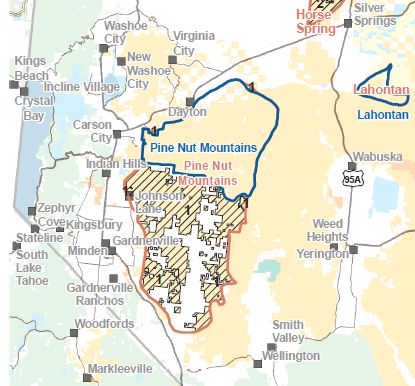
BLM Puts Crosshairs On Onaqui Mountain Horses
Helicopters, traps and contraceptives are needed to balance the wild horse population at Onaqui Mountain HMA with ‘other uses and values,’ according to a news release issued yesterday.
Sadly, they just can’t bring themselves around to admitting what those other uses are.
“Chronic wild horse overpopulation is damaging to the long-term health of wild horse herds, other wildlife and the land on which they all depend.”
An allotment map from 2011 suggests the HMA is subject to permitted livestock grazing.

Could it be that the horses are robbing too much forage from the public-lands ranchers?
Currently there are 586 horses on the 205,000 acre HMA, for a population density of 2.9 animals per thousand acres. The herd is at 2.8X AML, with 376 ‘excess’ horses.
The agency that claims 2.9 horses per thousand acres is unsustainable allows 9.8 cow/calf pairs on public lands in the same state.
This is insane! The land was set aside for wild horses.

The AML of 210 has nothing to do with the carrying capacity of the land. It represents the forage loss the ranchers and their allies at the BLM are willing to tolerate.
Oddly enough, it usually works out to one animal per thousand acres. Take the size of the HMA in acres and knock off the last three digits. There’s your AML.
RELATED: Livestock Grazing in Utah, Population Densities on Western Rangelands.
Livestock Grazing in California
Data from the BLM rangeland grazing page and wild horse management page in California:
- 6.1 million acres available to livestock
- 2.5 million acres available to horses and burros
- 472,000 AUMs available to livestock
- 2,200 wild horses and burros allowed
Assuming that livestock graze six months per year, the AUM figure yields 78,600 cow/calf pairs on public lands in the state (472,000 divided by 6). The population density for these animals would be 12.9 cow/calf pairs per thousand acres (78,600 divided by 6.1 million times 1,000).
The population density for horses and burros is 0.9 animals per thousand acres (2,200 divided by 2.5 million times 1,000).
Land in California can support fourteen times as many cow/calf pairs as horses and burros (12.9 divided by 0.9). On HMAs subject to grazing allotments, it’s the same land!

Given that horses graze twelve months per year, they would consume roughly 26,400 AUMs annually (2,200 times 12). If they were at 4X AML they would consume less than one fourth of the forage allocated to livestock (4 times 26,400 divided by 472,000).

Even the casual observer should be able to look at these charts and realize that wild horse overpopulation is nothing more than a bullshit storyline intended to protect the ranching hegemony on western rangelands.
But the overpopulation narrative will continue, and most of the so-called advocates will demand more PZP for the horses, because nobody bothers to look at the data.
RELATED: Livestock Grazing in Nevada.

USFS Ends Tribal Horse Gather
Over 500 horses from the Fort McDermitt Paiute and Shoshone Tribe were removed from public lands in northern Nevada earlier this month, according to a report published 12/12/18 by KOLO News in Reno. They were returned to their owners.
The USFS said in a news release that the horses were competing with livestock and wildlife for forage and were damaging ecosystems, fences and stock-watering facilities.
Gather stats and daily reports can be found on this page.