
In front of the Gila River Sand & Gravel plant on Highway 347 by James Joseph.
Category: Range
On the range
Eagle Roundup Day 4
The daily reports indicate 351 horses gathered through 01-19-20, with five deaths (1.4%) and no foals. Roughly 44% percent of the captured animals were male and 56% were female. The thriving ecological balance is only 1,250 horses away.
RELATED: Eagle Roundup Day 2, Eagle Wild Horses Get Short End of Stick.

Rock Star at Sand Wash Basin?
Report from Sand Wash Basin HMA by Denver7 – The Denver Channel.
Mustang Monday
On the Pryor Mountains WHR with A. Renee Faber.
Management of Western Rangelands in 2018
Refer to the Grazing Program Fact Sheet provided last week when proposed changes to livestock grazing regulations were announced.
Data from 2018, provided in the fact sheet, along with other relevant statistics, were copied into a spreadsheet to compare the treatment of livestock on public lands with that of wild horses.
Although privately owned cattle and sheep were allowed on those lands in addition to wild horses and burros, the calculations pertain to cow/calf pairs and horses only, for purposes of simplicity. Horses and cow/calf pairs are said to be equivalent in terms of their resource requirements.
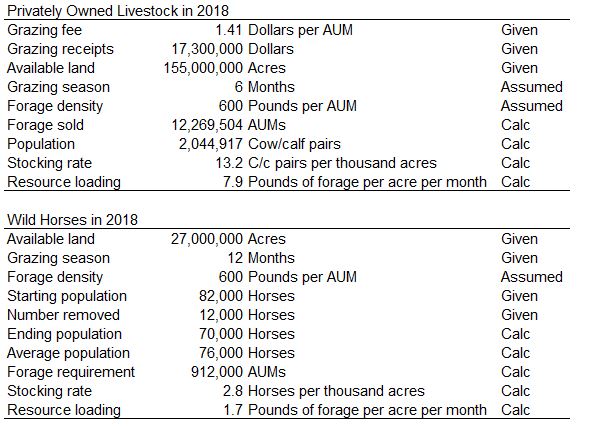
These figures are compared in the following charts. An AUM corresponds to about 600 pounds of dry forage, depending on quality and type.
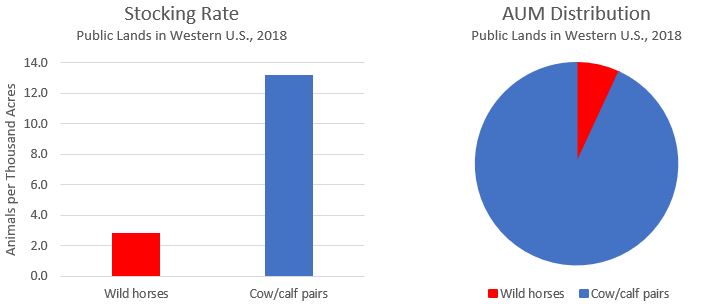
Wild horses had a much smaller footprint and environmental impact in 2018, compared to livestock, yet they were blamed for most of the problems. That is the deceit.
The AUMs consumed by the horses would support an additional 152,000 cow/calf pairs, with a value of $150 million or more, which explains why the ranchers and their allies in government want to get rid of them. That is the greed.
If the horses are denuding the landscape at a stocking rate of 2.8 per thousand acres, what do you suppose is happening when cow/calf pairs are turned out at a rate that’s almost five times higher?
RELATED: BLM to Modernize Grazing Regulations on Public Lands.
Eagle Roundup Day 2
The daily reports indicate 183 horses captured through January 17, with no foals.
Is that what you’d expect for a herd that’s growing at a rate of 20% per year?
No, you’d expect to find 153 adults and 30 foals, although it is a bit early in the season.
A simple model for population growth would be 100 adults last year plus 20 foals this year, so the youngsters would represent 16.7% of the herd (20 out of 120).
RELATED: Eagle Roundup Begins.
Latest on Heber Shootings
News releases from the Forest Service, updated yesterday.
Article by AZ Central, posted today. Includes history of herd.
Story by the White Mountain Independent, posted today.
Report by AP News, posted today.
Curiously, nobody wants to talk about the livestock grazing allotments that intersect the Heber WHT. See map on page 7 of the management plan drafted in November, 2018.
RELATED: Heber Wild Horses Use Water That ‘Other Animals’ Need?
Targeted Grazing Included in Regulations Revamp
Changes to regulations announced yesterday that affect domestic livestock on public lands in the western U.S. include targeted grazing, a technique that falls under the broader heading of outcome-based grazing.
The idea is to reduce [edible] fuels that might lie in the path of a wildfire.
The fact sheet includes a photo of an infamous fence experiment, where domestic cattle graze vegetation down to stubble. Normally, when you see imagery like this, wild horses and burros are on the other side of the fence.

If the goal is to selectively denude the landscape—the supposed domain of wild horses and burros—why aren’t those animals doing the job?
Because the preferred outcome is to enrich the public-lands ranchers.
RELATED: BLM to Modernize Grazing Regulations on Public Lands, Comments Invited on Targeted Grazing Project in Nevada.
Heber Wild Horses Use Water That ‘Other Animals’ Need?
An Arizona congressman believes that “some people are frustrated with the wild horses because they use the water tanks or use resources that other animals in the area also need,” according to a report posted this evening by AZFamily of Phoenix.
Who do you suppose that might that be? Is he suggesting a culprit or motive?
RELATED: Residents Want Answers About Heber Wild Horse Shootings, Gossip About Motives in Heber Wild Horse Shootings?

BLM to Modernize Grazing Regulations on Public Lands
The project will streamline the grazing permit process and provide greater flexibility for land and resource management, according to a news release posted today.
Public comments can be submitted until February 28. Project documentation can be found at this page.
As always, comments should be substantive. For example, “The United States does not receive fair market value for forage consumed by domestic livestock on public lands, as required by FLPMA; the fee should be brought in line with market conditions.”
It’s one of the few things that hasn’t been touched by inflation. If gasoline was priced like the grazing fee, you’d be paying about seventeen cents per gallon.
Be sure to compare the allotment map to the HMA map. In which state is public-lands ranching the most prevalent? Where is the largest grazing allotment?
The grazing program fact sheet says that the BLM collected $17.3 million for livestock grazing in 2018. The fee that year was $1.41 per AUM, so 12.3 million AUMs were sold to the public-lands ranchers.
That’s two million cow/calf pairs on 155 million acres, assuming a six month grazing season, for a stocking rate of 12.9 cow/calf pairs per thousand acres.
The stocking rate for wild horses on BLM land is currently about three animals per thousand acres.
Now, which species is overpopulated?
Wild horses on public lands consume about one million AUMs per year.
The forage sold to public-lands ranchers would support ONE MILLION wild horses.
Approximately 50,000 wild horses are warehoused in off-range corrals and pastures.
Livestock allowed on public lands are worth over TWO BILLION DOLLARS, assuming half of them ship to slaughter.
Advocacy groups that push PZP are so far gone—and so out of touch—that you should not be giving them any of your money.
RELATED: Livestock Grazing in Nevada, Public-Lands Ranching Is Big Business.

Eagle Roundup Begins
Eighty wild horses were captured yesterday according to the daily reports, with no deaths reported.
RELATED: Eagle Roundup Delayed?
Residents Want Answers About Heber Wild Horse Shootings
Thirty federally protected horses have been found dead of possible gunshot wounds in the last 15 months and the investigation has not turned up any suspects or motives.
Some residents and visitors to the forest are worried that the shooter could pose a threat to the public, according to a report posted today by the White Mountain Independent.
Floyd County Horse Deaths Prompt Legislative Action
A resolution was introduced yesterday in the Kentucky state senate calling for the creation of an Abandoned Horse Task Force. If approved, the group would discuss the problems caused by abandoned horses, ways to stop individuals from abandoning their horses and ways to remove horses currently running at large, according to a report posted today by the Louisville Courier Journal.
The three surviving horses are still roaming the area near the mine and the reward for information on the shootings has risen to $23,000.
CSM Shills for the PLRs
You can’t judge a book by its cover but you can certainly discard an editorial on the basis of its preamble.
Perhaps the best solution is just to slaughter the horses.
Have at it.
The linked article, cited as a ‘cover story,’ also gives cover to the public-lands ranchers.
More on that tomorrow.

Eagle Roundup Delayed?
Nothing has been posted to the daily reports as of this evening. There must be wailing and gnashing of teeth on those allotments.
RELATED: AWHC Seeks Postponement of Eagle Roundup.
Necropsies Performed on Heber Wild Horses
Investigators have confirmed that 12 of the 15 animals died from gunshot wounds but the cause of death for the remaining three was not determined, according to a report posted today by FOX10 News of Phoenix.
The story by ABC15 News has a few more details.
RELATED: WMI Says Dead Horses Part of Heber Herd.
WMI Says Dead Horses Part of Heber Herd
The eight horses discovered last Friday were from the Heber WHT, according to a story posted this morning by the White Mountain Independent. They were not domestic.
These free-roaming horses are protected by federal law whether they are on their designated territory or not.
RELATED: Heber Death Toll Grows.
Local Advocacy Group Opposes Salt River Fencing
One of the group’s organizers says it will concentrate too many horses with too many people in one area, leading to safety problems, according to a report posted this evening by FOX10 News of Phoenix, AZ.
RELATED: Additional Fencing Coming to Salt River.
Heber Death Toll Grows
KPNX News is reporting that seven more horses have been found dead since the original eight were discovered, bringing the total to 15.
RELATED: More Horses Found Dead Near Heber WHT.
Seaman Roundup Ends
BLM said today that operations concluded on January 12, with 420 wild horses gathered from two Herd Areas. Eleven deaths were reported (2.6%) and no horses were returned their home range. Refer to this news release for details.
The gather stats indicated that the captured horses included 48 foals. Is that what you’d expect to find in a herd that’s growing at a rate of 20% per year?
RELATED: Seaman Roundup Continues.

