Surprises at Surprise Complex

All six allotments in the Surprise Complex are in the Improve category, according to the Allotment Master Report in RAS.  This may mean that they are not meeting one or more standards for rangeland health.

If so, how much of the shortfall can be attributed to wild horses and burros?  Refer to Sections 1.6 and 3.2.4 in the Draft EA.

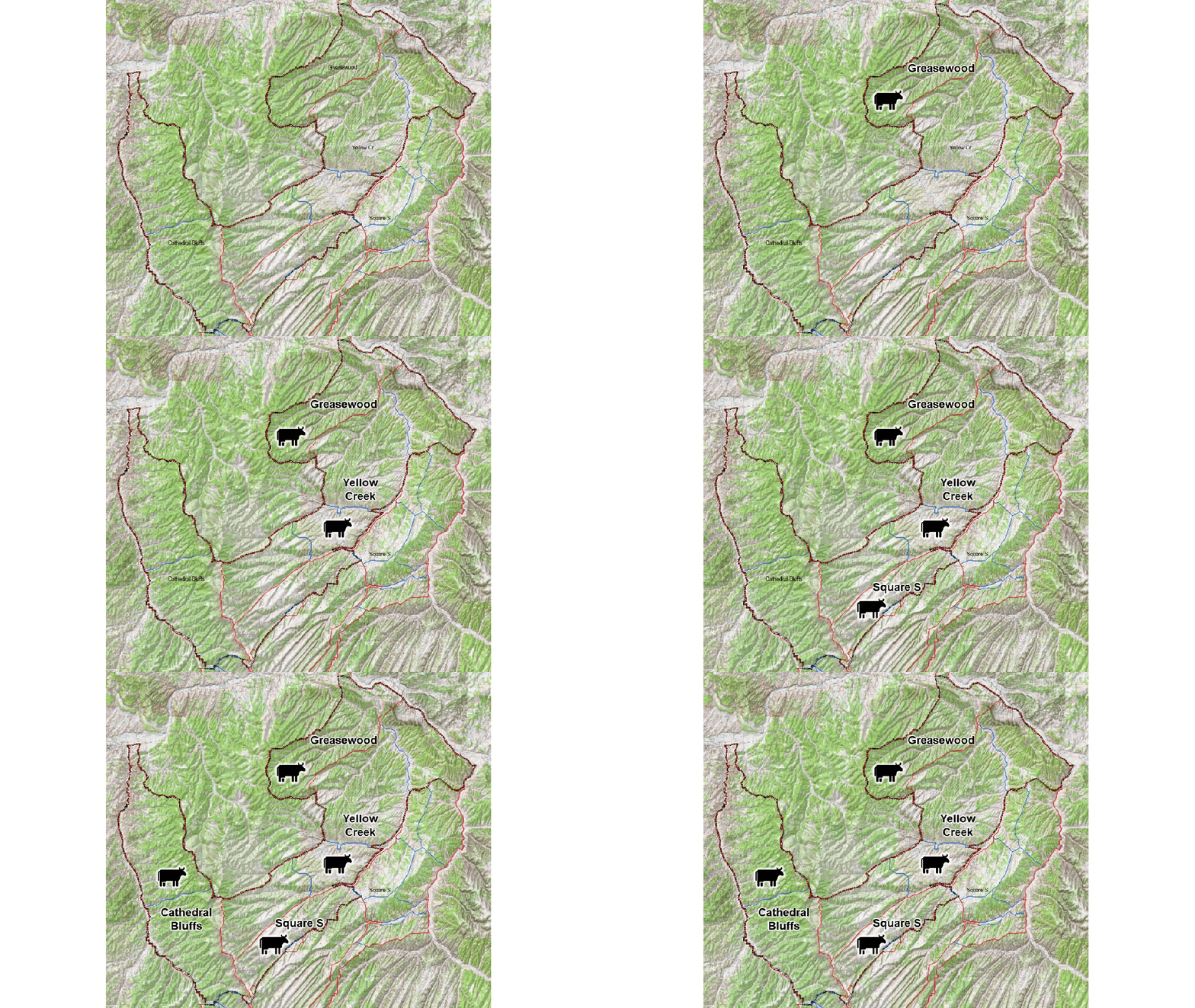
Surprise Complex Allotment Map

The Wall Canyon HMA coincides with the Wall Canyon East allotment, so it is a good candidate for a ‘Short End of Stick’ report.

The management plan assigns 300 AUMs per year to the horses (Table 1-2), compared to 3,215 AUMs per year to cattle (Table 3-2).  That’s about 9% of the forage to horses and 91% to cattle, in an area set aside for the horses.

The proposed gather plan cannot change the resource allocations and management priorities in the Complex.  It can only enforce them.

RELATED: Comments Invited on Draft EA for Surprise Complex.

Eagle Roundup Day 10

The incident began on January 6.  Gather stats through January 15:

  • Horses captured: 412
  • Goal: 1,131
  • Returned: 0
  • Deaths: 5
  • Shipped: 289

No deaths were reported on Days 9 and 10.

No youngsters have been gathered.  Roughly 44% of captured adults are males and 56% are females.  Some of the mares are probably within a few weeks of foaling.

Body condition scores are not known.

The HMA of origin was not reported.  Three HMAs are involved in the roundup.

The number of unaccounted-for animals is 118.  They are probably being held on site.

Some of the mares will be treated with contraceptives and returned to the range.

RELATED: Eagle Roundup Day 8.

Pahrump Wild Horses Share Park with Residents

They’re congregating in an area known as the Calvada Eye, according to a report published today by the Pahrump Valley Times.

A Nye County Animal Control Officer urged the public not to feed them, lest they become dangerous and subject to removal from the range.

Last year, commissioners approved a resolution opposing helicopter roundups within the county.

RELATED: Where to Find Wild Horses in Pahrump, Nevada.

Comments Invited on Draft EA for Surprise Complex

BLM announced today the release of a preliminary environmental assessment for wild horse and burro management actions in the Surprise Complex over a ten year period.

Six HMAs in northwestern Nevada are affected: Massacre Lakes, Bitner, Nut Mountain, Wall Canyon, High Rock and Fox Hog.  They are managed by the Applegate Field Office in California.

An environmental assessment looks at the consequences of a proposed action, along with those of one or more alternatives.  Alternative 1, the Proposed Action, includes roundups, fertility control and sex ratio skewing.  Refer to Section 2.2.3 in the EA.

The Complex covers 396,674 acres and has a combined AML of 496 horses.  Although burros have been observed in the Complex, the AML for them is zero.  The stocking rate allowed by plan is 1.3 wild horses per thousand acres.

Surprise Complex Map

The Complex intersects six grazing allotments.  Table 3-2 gives the total authorized forage but does not show how much of it falls inside the Complex.  That would be a substantive comment.

Western Horse Watchers estimates that 80% of the allotment acreage falls inside the six HMAs, based on the map in Appendix G.  If forage is evenly distributed across those parcels, then roughly 24,500 AUMs per year have been allocated to cattle inside the Complex, compared to 6,000 AUMs per year for the horses.

The Complex is managed primarily for livestock.

The forage assigned to cattle would support an additional 2,000 horses, for a true AML of 2,500.  The current population, thought to be around 1,300 wild horses and burros according to the news release, is well within that range.

Comments will be accepted through February 14.

Eagle Roundup Day 8

The incident began on January 6.  Gather stats through January 13:

  • Horses captured: 331
  • Goal: 1,131
  • Returned: 0
  • Deaths: 5
  • Shipped: 253

A mare was put down on Day 6 due to injuries related to the gather.  Another mare was put down on Day 7 due to pre-existing conditions.

No youngsters have been gathered.  Roughly 45% of captured adults were males and 55% were females.  Some of the mares are probably within a few weeks of foaling.

Body condition scores are not known.

The HMA of origin was not reported.  Three HMAs are involved in the roundup.

The number of unaccounted-for animals is 331 – 5 – 253 = 73.  The contractor is probably holding them on site.

Some of the mares will be treated with contraceptives and returned to the range.

RELATED: Eagle Roundup Day 5.

Shackleford Herd Grows In Latest Census

The Park Service said in a news release today that 117 horses were living on the barrier island at the end of 2020, up from 111 at the end of 2019.  The growth rate was 5.4%.

The average lifespan was eleven years and no mares were treated with contraceptives in 2020, according to the annual report.

The herd was 38% male and 62% female.

The expected range of variation, based on rudimentary statistical formulas with n = 117 and p-bar = .50, is 36% to 64%.

The observed percentages fall within those limits so they could be attributed to chance, the result of a simple random process centered at 50% males / 50% females.

Subject-matter knowledge may suggest otherwise.

RELATED: Park Service Reports Shackleford Census Results.

Eagle Roundup Day 5

The incident began on January 6.  Gather stats through January 10:

  • Horses captured: 195
  • Goal: 1,131
  • Returned: 0
  • Deaths: 3
  • Shipped: 77

Three horses were put down on Day 4 due to pre-existing conditions.  They would likely be alive today if it wasn’t for the roundup.

No youngsters have been gathered.  Roughly 44% of captured adults were males and 56% were females.  Some of the mares are probably within a few weeks of foaling.

Body condition scores are not known.

The HMA of origin was not reported.  Three HMAs are involved in the roundup.

The number of unaccounted-for animals is 115.  The contractor is probably holding them on site.

Some of the mares will be returned to the range after treatment with contraceptives.

RELATED: Eagle Roundup Day 3.

Bruneau Beef

Open the allotment master report for the Bruneau Field Office, created on January 9, and search (CTRL+F) for Simplot.  Western Horse Watchers found 18 occurrences in the Operator Name field.

Now, search the authorization use report, created on the same date, for occurrences of Sheep in the Livestock Kind field.  You won’t find any.  It’s all cattle.

There are no wild horse areas inside the field office boundary.

In other areas where the allotments intersect HAs, HMAs and WHTs, beef and wool production occur at the expense of America’s wild horses and burros.

RELATED: Rangeland Conditions In Horse-Free Areas, Paisley Desert Beef.

Pancake Gather Plan

Forest Service Responds to Heber Wild Horse Deaths

A news release posted today says four horses were lost, all due to bullet wounds.

A $5,000 reward has been offered for information leading to the arrest and conviction of the person(s) responsible, according to the announcement.

The news release appeared on the Alerts & Notices page for the Apache-Sitgreaves National Forests, not the Horse Incidents page.

RELATED: Forest Service Acknowledges Heber Wild Horse Deaths.

Eagle Roundup Day 3

The incident began on January 6.  Gather stats through January 8:

  • Horses captured: 116
  • Goal: 1,131
  • Returned: 0
  • Deaths: 0
  • Shipped: 0

No youngsters have been gathered.  Roughly 42% of captured adults were males and 58% were females.  Some of the mares are probably within a few weeks of foaling.

Body condition scores are not known.

The HMA of origin was not reported.  Three HMAs are involved in the roundup.

The number of unaccounted-for animals is 116.  They are probably being held on site.

Some of the mares will be returned to their home range after receiving GonaCon, a contraceptive that may actually work like a sterilant.

RELATED: Eagle Roundup Begins.