Ending Public-Lands Ranching

The first step is to build public support for the plan—just like Velma did—and to find individuals in Congress who believe in freedom/ruggedness/self-reliance and want to conserve something that’s right and good.

This automatically excludes liberals.

Individuals who signed on to the new wild horse management plan, the PZP zealots and others that have bought into the overpopulation narrative (indicated by their support of wild horse gathers, adoption incentives and expanded training programs) are of no use to the effort.

RELATED: Mass Training Is Not the Answer!

PSA_178-1

Mass Training Is Not the Answer!

Holding pens are flooded with wild horses and burros because the WHB Act no longer functions as Velma intended.  The safeguards that would keep these animals on public lands in the western U.S. are gone.

Meanwhile, back on the range, privately owned livestock graze peacefully on land that belongs to the horses and burros.

The alternative is not slaughter and euthanasia, it is to end public-lands ranching and roll back the changes to the statute.

RELATED: PZP Is Not the Answer!

PZP Is Not the Answer!

Public-lands ranchers can access six times as much acreage and twelve times as much forage as America’s wild horses and burros.  Off-range corrals and long-term pastures are flooded with these animals because the WHB Act no longer affords the protections sought by Velma, not because there are too many of them!

How exactly do contraceptives roll back the changes to the Act, fix the AUM imbalance and put an end to the crony capitalism?

The PZP zealots are on the same side of the debate as the public-lands ranchers, differing only in methodology.  The ranchers want the horses gone now while the darters want their numbers to decline gradually.  Not quite what Velma had in mind.

RELATED: Sanctuaries Are Not the Answer!

Sanctuaries Are Not the Answer!

The adoption pipeline is flooded with wild horses and burros because the WHB Act no longer affords the protections sought by Velma Johnston.  These animals are being forced off public lands in the western U.S. to make way for privately owned cattle and sheep.  The problem is not wild horse overpopulation, it is public-lands ranching.

RELATED: Private Sanctuaries: End-Game of Wild Horse Management Plan.

Burning Man Starts Tomorrow

Nine days of moral depravity on the high desert, in the middle of wild horse country.

Burning_Man_Location-1

Radical inclusion, a core principle of the festival, is a leftist code word for acceptance and celebration of all manner of disease, filth and perversion.  The event should not be allowed on public lands, even if it is a favorite of rich white liberals from the Bay Area.

RELATED: BLM to Renew Burning Man SRP.

The Land Can Only Support 27,000 Wild Horses and Burros

Statements like that are misleading and incomplete.

Truth is, public lands in the western U.S. can only support that many wild horses and burros because they’ve been consigned to ‘other mandated uses,’ such as the grazing of privately owned cattle and sheep.

Wild Horse Overpopulation Planned-1

Section 3 in the Original WHB Act, which calls for a ‘thriving natural ecological balance’ on public lands, orders the Secretaries of Interior and Agriculture to confer with state agencies to ensure that wildlife have access to sufficient resources and are not squeezed out by the horses and burros, especially endangered species.

“All management activities shall be at the minimal feasible level and shall be carried out in consultation with the wildlife agency of the State wherein such lands are located in order to protect the natural ecological balance of all wildlife species which inhabit such lands, particularly endangered wildlife species.”

There is no provision for domestic livestock!  (That’s one of the ‘errors’ in the WHB Act that the public-lands ranchers and their political allies, mostly Democrats, ‘corrected’ when they drafted FLPMA.)

Statements about roundups and other actions, that they are required by the WHB Act of 1971, are also misleading.  That statute is gone, destroyed by the ranchers.

Off-range corrals and long-term pastures are flooded with (former) wild horses and burros as a consequence.

Current herd management practices are justified by the WHB Act of 1976/1978/2004.

RELATED: Wild Horse Overpopulation?, Unwinding the Mess in the Wild Horse World.

Thriving Ecological Balance-1

Wild Burros Bad for Business?

For years we’ve heard that taxes and regulations are destroying businesses—weakening our competitive position—but now we’re learning that wild burros are the culprit, at least in Arizona.

They’re trampling the ground, reducing vegetation, invading farmland, breaking fences  and releasing livestock, according to a story posted Thursday by the U.S. Small Business Administration Office of Advocacy.

They have no natural predators and compete with domestic cattle for resources.

While all of these things may be true, the author did not indicate if they were occurring on public lands set aside for the burros.

If not, were those lands designated as open range, where the owners are responsible for keeping the burros out (by constructing suitable fences)?

Whatever the answers, the ranchers want the burro populations reduced and are willing to look at all options.

Complaints about the burros from oil companies, mining companies, timber companies, hikers, campers and tourists appeared nowhere in the story.

Red Rock Gather in the News

Refer to this story in Drovers, posted yesterday.  Those 237 horses were ‘relocated,’ not  ’rounded up’ or ‘removed from their home range.’

Changing the vocabulary and redefining terms, to hide something evil or unpleasant, are sure signs that liberals are involved.

Abortion is not baby murder, it’s ‘women’s health’ or ‘family planning.’

Shooting wild mares in the ass with contraceptive darts is not harassment, it’s ‘humane management.’

RELATED: Red Rock Gather Complete.

IMG_3534

Horses in Antelope Complex Get Short End of Stick

The Antelope Complex in eastern Nevada includes the Antelope HMA, Antelope Valley HMA, Goshute HMA and the infamous Spruce-Pequop HMA, site of a wild horse shooting in August 2018.

A roundup begins this week at the Antelope and Antelope Valley HMAs so let’s see how resources will be allocated once the gather plan has been fully implemented.

The ranchers and their allies want AMLs achieved ASAP, you know.

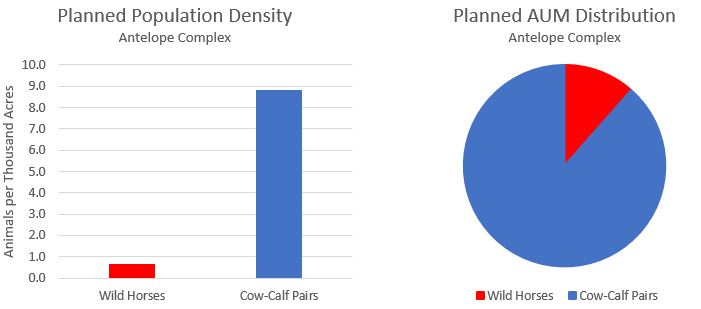
The complex, which covers 1,183,340 acres, has a combined AML of 789 wild horses, according to Table 1.  The forage demand would be 9,468 AUMs per year and the target population density would be 0.7 animals per thousand acres.

The average density for all HMAs is one animal per thousand acres.

The four HMAs are overlapped by 31 grazing allotments per Table 8.  The forage allocation for livestock inside the complex can be estimated as the sum of 31 AUM fractions, each based on the percentage of the allotment falling inside the complex.

For example, the Boone Springs allotment, which is permitted for 2,947 AUMs per year, lies entirely within the complex.  Therefore, it contributes 2,947 AUMs per year to domestic livestock grazing.  Only 5% of the Cherry Creek allotment falls within the complex, so it contributes just 454 AUMs per year to privately owned livestock.

The total forage contribution is 72,946 AUMs per year.

The AUM fractions can be converted to cow/calf pairs by dividing them by the annual grazing periods.  The Boone Springs allotment is active for five months.  Therefore, it can accommodate 2,947 ÷ 5 = 589 cow/calf pairs.  The Cherry Creek allotment, active for 12 months per year, can host 38 cow/calf pairs.  (Wild horses and cow/calf pairs are said to be equivalent in terms of their resource loading.)

The total number of cow/calf pairs is 10,429, which yields a planned population density of 8.8 cow/calf pairs per thousand acres.  (The weighted-average grazing period across all 31 allotments is 7 months per year.)

These figures are presented in the following charts.
Antelope Complex Charts-1

Another fine example of ‘thriving ecological balance,’ on land set aside for the horses!

A Finding of No Significant Impact (FONSI), one of the steps in approving plans like this one, must pertain to everything but wild horses.

The forage allocated to livestock in those 31 allotments, 124,466 AUMs per year (inside and outside the complex), would support 10,370 wild horses, about 1/8 of those roaming freely on public lands in the western U.S.

That these and other lands can only support 27,000 wild horses and burros is pure BS.

RELATED: Roundup Starts Next Week in Lower Half of Antelope Complex.

PLF: Window Into the BLM?

The mission of the Public Lands Foundation, according to the statement on the first page of their Summer 2019 Newsletter, is to keep America’s public lands in public hands, which, of course, means keeping them in the hands of the federal government.

The belief is explained in a position statement.  Political orientation: Liberal.

The organization has many members who have retired from the BLM, according to the page with other position statements.  Where do they come down on other issues?

Centralized Government – PLF opposes the relocation of the BLM headquarters from Washington, D.C. to Grand Junction, CO, which is consistent with the principle of subsidiarity.  Political orientation: Liberal.

Climate Change – “…the warming of the Earth’s climate system is unequivocal as is now evident from observations of global average air and ocean temperatures, widespread melting of snow and ice, and rising global average sea level,” according to their position statement.  Political orientation: Liberal.

Wind and Solar – PLF says they are needed to alleviate greenhouse gas emissions from traditional energy conversion technologies.  Political orientation: Liberal.

Illegal Immigration – PLF believes that policies should be changed so illegal aliens can enter the country legally “…through established ports of entry…instead of…crossing fragile public lands on foot and in vehicles.”  Political orientation: Liberal.

Public-Lands Ranching – PLF supports it.  They are as hostile to WHB as the ranchers, see item 7 on page 4 of their position statement.

Wild Horses and Burros – PLF believes the “WHB program is unsustainable” and that roundups should be increased “…to achieve AML as soon as practical, selling, without limitation, un-adopted WHBs that have been gathered.”

How would you classify the last two statements, given they were written by a left-leaning organization located just outside of Washington D.C.?  How closely do they correspond to the beliefs of current BLM administrators and staff?

Unwinding the Mess in the Wild Horse World

Off-range corrals are flooded with wild horses and burros because the WHB Act no longer affords the protections sought by Velma.

The original Act, which passed unanimously in Congress, reflected the will of the American people.  The current Act reflects the will of the public-lands ranchers.

It’s time to boot the ranchers off public lands and restore the Act to its original form.

Let them buy their own land, like everybody else, pay market rates for grazing their livestock, and stop sucking on the government teat.

Another Spay ‘Study’ Nears

A story posted today by Oregon Public Broadcasting says it could happen as early as next month at the Off-Range Corrals in Hines.

“The BLM has long been under pressure to bring down horse herd numbers across 10 Western states,” according to the report, “without resorting to slaughter.”

So who’s applying the pressure?

Oil companies?

Mining companies?

Timber companies?

Nope, none of the above.  It’s all being done to please the public-lands ranchers, their overlords, cheerleaders and political allies.

RELATED: BLM Abandons Wild Horse Sterilization Research.

PSA_178-1

Public Lands at Risk Because of America’s Wild Horses?

That’s what Ethan Lane, executive director of the National Cattlemen’s Beef Association and the Public Lands Council, told a Senate Subcommittee on 07/16/19.  Refer to this story in the Natural Resource Report.

He said public lands in the western U.S. can only support 26,000 wild horses and burros, compared to the current population of 88,000 animals.

If that’s true, how do you explain the millions of privately owned cattle and sheep on those same lands?

There is no wild horse population crisis on western rangelands, only deceit and greed of the public-lands ranchers, their cheerleaders and political allies.

RELATED: Executive Summary of Senate Hearing on WHB Program.

Does the Livestock Grazing Fee Reflect Market Conditions?

If $1.35 per AUM (4.5¢ per day) is a fair price to charge the public-lands ranchers, why is the BLM paying $60 per AUM ($2 per day) for horses in long-term holding?

Probably because $60 represents the market rate, which means the ranchers are getting a sweetheart deal.  That needs to change because many of those horses were forced off the range to pacify the ranchers.

Given that roughly nine million AUMs are sold to the ranchers annually, the additional revenue—at a fee of $60 per AUM—would amount to $528 million per year, a nice offset to the costs of the WHB program.

RELATED: 2019 Grazing Fee Announced.

IMG_8108