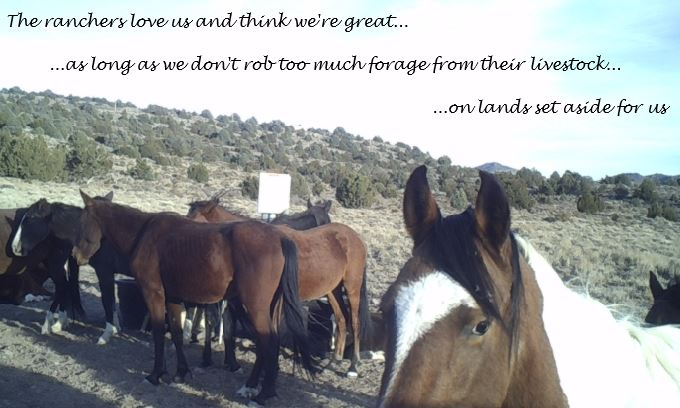
Devil’s Garden Quiz

Suppose the Devil’s Garden ranchers gave up their permits because the grazing fee had been brought in line with the cost of warehousing wild horses in off-range pastures ($60 per AUM vs. the current $1.35).  By how much could the AML be increased?

A. 1,309

B. 1,064

C. 897

D. 436

E. 149

Answer: A (15,711 ÷ 12).

On top of the 402 wild horses already allowed by plan.

RELATED: Devil’s Garden Horses Get Short End of Stick.

Lunacy at Warm Springs

The Warm Springs HMA can support 1,800 wild horses, but only 200 are allowed, because most of the forage has been sold to public-lands ranchers.

Many of the former inhabitants have been languishing in BLM corrals for a year, at a cost of $5 per day per head.  That’s almost $1.5 million per year for 800 horses.

The HMA has enough capacity to empty those corrals twice.

The ranchers pay $26,000 per year to graze livestock on the same territory.

Yep, the government is spending $1.5 million per year to warehouse wild horses so they can collect $26,000 per year from the ranchers, on land set aside for the horses.

Eventually, most of the captives will be moved to long-term holding, at a cost of $2 per head per day.

Even then, the economics stink.  Nobody in the private sector would do that.

The situation reeks of politics, favoritism and special interests, all at the expense of America’s wild horses.

RELATED: Warm Springs Quiz.

Who Added ‘Path Forward’ to Senate Spending Bill?

The legislation was drafted by the Subcommittee for Interior, Environment and Related Agencies and approved by the Senate Committee on Appropriations last week.  It still has to be put to a vote of the full Senate and be reconciled with the bill in the House.

The House authorized $6 million for a ‘Path Forward’ pilot program earlier this year.

The Senate authorized $35 million for the ‘Path Forward’ in FY 2020.

Almost all of the senators on the Subcommittee are liberals.  The two in the ‘minority’ are not paragons of conservatism (grades from Conservative Review).

  • Lisa Murkowski, Chair, R-AK, F
  • Tom Udall, Ranking Member, D-NM, F
  • Lamar Alexander, Member, R-TN, F
  • Roy Blunt, Member, R-MO, F
  • Mitch McConnell, Member, R-KY, F
  • Shelley Moore Capito, Member, R-WV, F
  • Cindy Hyde-Smith, Member, R-MS, F
  • Steve Daines, Member, R-MT, C
  • Marco Rubio, Member, R-FL, D
  • Dianne Feinstein, Member, D-CA, F
  • Patrick Leahy, Member, D-VT, F
  • Jack Reed, Member, D-RI, F
  • Jon Tester, Member, D-MT, F
  • Jeff Merkley, Member, D-OR, F
  • Chris Van Hollen, Member, D-MD, F

Look at the first page of the ‘Path Forward.’  There are no endorsements from oil companies, mining companies, timber companies.

So who on the Subcommittee is in bed with the public-lands ranchers?  Which senators would benefit from fewer wild horses in their state?

The BLM manages wild horses and burros in ten western states, while the Forest Service manages wild horses and burros in nine western states.

The demonic plan was not discussed in the Appropriations Committee meeting last week, even though the Bill for Interior contained a large expenditure for the new item.

You can listen to the audio here.  Remarks about the bill run from 30:37 to 43:30.

Apparently, the guilty parties don’t want to be identified.

IRRC Wins Stewardship Award

The Idaho Rangeland Resources Commission, the propaganda arm for public-lands ranching in the state, was recognized today by the BLM for involving students in rangeland education and policy formation.  The award was presented at the annual meeting of the Public Lands Council (another propaganda organ).

Also commended was their promotion of recreational activities involving livestock grazing, according to the news release.

RELATED: IRRC Expands Propaganda.

Dorian Achieves Same Results as ‘Path Forward’

Sixty percent of the Cedar Island herd is gone.  You could argue that genetic diversity was lacking before the storm.  If not, it is now.  Can they recover?

The same thing could happen out west.  A fast moving wildfire, a harsh winter or a fatal disease could ruin one or more HMAs.

Even in the face of these threats, the PZP zealots will not rethink their position, because they, like the public-lands ranchers, believe there are too many wild horses on western rangelands.

The glorious Path Forward, with its plan for massive roundups and widespread use of contraceptives, will make those rangelands look like they were hit by a natural disaster, at least from a wild horse viewpoint.

The fences will still be there.  The forage will still be there.  And the livestock will still be there, as they were before that pesky Wild Horse Annie got involved.

RELATED: Cedar Island Horses Swept Away by Dorian.

New Mexico Ranchers Pay $43 Per AUM for McGregor Range

Yesterday the BLM announced that local ranchers bid $35 to $43 per AUM to graze eight parcels on withdrawn lands in southern New Mexico.

The McGregor Range covers 606,000 acres on the west side of Otero Mesa, between Alamogordo, NM and El Paso, TX, according to the news release.  It was a part of Fort Bliss and supported live fire exercises with new missile systems.
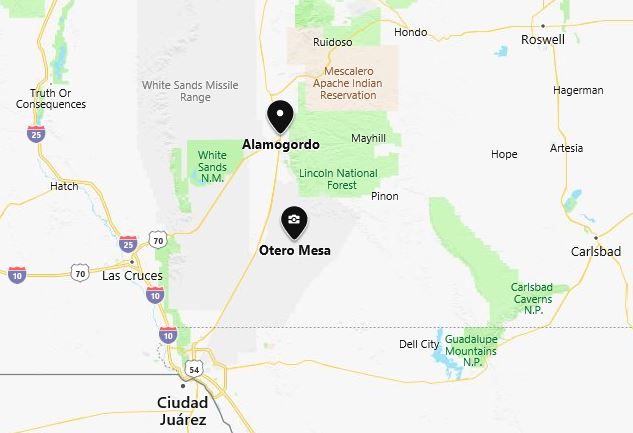
McGregor Range Map-1

Pick the mid point.  If $40 per AUM is the going rate for livestock grazing on public lands, why are the ranchers who graze HMAs and WHTs allowed to pay just $1.35?

Title I of FLPMA says the U.S. [shall] receive fair market value of the use of the public lands and their resources unless otherwise provided for by statute (item 9, page 8).

How does $1.35 meet that requirement?  It doesn’t.  How do those endeavors return the maximum benefit to the American people?  They don’t.  (Refer to Title IV on page 31 for remarks about grazing fees.  Page 34 has the infamous helicopter roundup provision that was added to the WHB Act.)

Public-lands ranching is a gravy train.  That’s what groups like Protect the Harvest and the National Cattlemen’s Beef Association are trying to defend—and expand.

It’s the driver of the despicable ‘Path Forward.’

Raising the grazing fee to $60 per AUM—in line with the cost of warehousing excess wild horses and burros in off-range pastures—would be a nice down payment on the goal of erasing public-lands ranching from the American landscape.

The U.S. would receive an additional $528 million annually, at least for a while, until the ranchers throw in the towel, because paying market rates just plain spoils the party.

‘Path Forward’ in the News

Refer to this report by the Washington Post, published yesterday.  Includes a link to the wild horse and burro management plan announced on 04-22-19.

The plan was negotiated by ranching interests and animal welfare groups.  Wild horse advocates were omitted from the process.

The story includes some photos and anecdotes from the Triple B roundup in July, and, as expected, gives the ranchers and their allies in government a pass.

RELATED: Liberals Will Never Condemn Public-Lands Ranching.

UPDATE: Added video.

How Wild Horses and Burros Should be Managed

The American Farm Bureau Federation issued this pronouncement today:

“Wild horses and burros are to be managed according to the Wild and Free-Roaming Horse & Burro Act of 1971, which not only specifies where wild horses and burros can occupy public lands but that they shall be managed in a manner that produces a thriving natural ecological balance.”

Couldn’t agree more.  Of course, the WHB Act of 1971 no longer exists—it was revamped by Congress at the behest of the public-lands ranchers.

So the first step would be to roll back the changes, restoring the Act to its original form.

Wild horses and burros are to occupy lands on which they were found when the bill was signed into law.  This will nearly double the amount of land they inhabit today.

As for the thriving ecological balance, Congress ordered the Secretaries of Interior and Agriculture to confer with state agencies to ensure that wildlife, especially endangered species, are not adversely affected by the horses and burros.

There was no provision for domestic livestock, which leads to the second step: Ending public-lands ranching and its 100-year reign of terror in the American west.

The third step is a thorough house cleaning of federal agencies involved with public lands: Anyone with a ranching background or ties to the ranching industry is gone.

RELATED: The Land Can Only Support 27,000 Wild Horses and Burros.

Park Service to Resume Fertility Control at TRNP

The Grand Forks Herald reported today that the wild horses of Theodore Roosevelt National Park will again be subject to a birth control program, meaning the mares will be shot in the butt with contraceptive darts.

The report did not indicate if the pesticide would be administered by park staff or volunteers from local ‘advocacy’ groups.

The full effect of this practice—tampering with breeding patterns and the reproductive systems of mares—will not be known for generations.

RELATED: TRNP ‘Culls’ Adopted.

Another Animal Welfare Group Pushes Contraceptives for Horses

Animal Wellness Action, a lobbying group in Washington, DC, said today in a news release that Congress should order the BLM (and presumably the Forest Service) to increase fertility control programs as a way to halt the growth of wild horse herds and reduce the need for roundups on public lands in the western U.S.

“It’s time to double down on contraception not roundups,” said the group’s director of federal affairs, in response to the wild horse management plan announced on 04-22-19.

Sadly, the problem is not wild horse overpopulation, it is public-lands ranching.

RELATED: Ten Years to AML: The Way Forward for America’s Horses and Burros.

Liberals Will Never Condemn Public-Lands Ranching

Because it’s an enterprise of the Left, a darling of the Democrat Party.  They love their little collective farms, with all the government control.  Cow farts and climate change be damned.

Private sector ranching is another story.

Be sure to read the commentary by Eleanor Schwartz, beginning on page 59 of the 25th anniversary edition of FLPMA, including the footnotes, to see who drafted the statute, which codified ‘multiple use’ and gave us helicopter roundups of wild horses.

What about the Burns AmendmentConrad Burns, senator from Montana, had little to gain from a change to the WHB Act that accelerated the disposal of wild horses removed from public lands in the western U.S.  But Harry Reid, senator from Nevada, sure did.

Of the states with federally managed herds of wild horses and burros, Montana is at the bottom of the list, while Nevada, with half of the nation’s wild horses, is at the top.

Reid convinced Burns to fall on his sword for the benefit of the public-lands ranchers.

IMG_8664

Ending Public-Lands Ranching

The first step is to build public support for the plan—just like Velma did—and to find individuals in Congress who believe in freedom/ruggedness/self-reliance and want to conserve something that’s right and good.

This automatically excludes liberals.

Individuals who signed on to the new wild horse management plan, the PZP zealots and others that have bought into the overpopulation narrative (indicated by their support of wild horse gathers, adoption incentives and expanded training programs) are of no use to the effort.

RELATED: Mass Training Is Not the Answer!

PSA_178-1

Mass Training Is Not the Answer!

Holding pens are flooded with wild horses and burros because the WHB Act no longer functions as Velma intended.  The safeguards that would keep these animals on public lands in the western U.S. are gone.

Meanwhile, back on the range, privately owned livestock graze peacefully on land that belongs to the horses and burros.

The alternative is not slaughter and euthanasia, it is to end public-lands ranching and roll back the changes to the statute.

RELATED: PZP Is Not the Answer!