The number of wild horses and burros in off-range corrals and long-term pastures can be explained by the misappropriation of forage on just a few dozen HMAs.
Half of those animals can be accounted for by the misuse of forage on 13 HMAs.
Western Horse Watchers Association
Exposing the Hypocrisy, Lies and Incompetence of the Wild Horse Advocates
Opinion
The number of wild horses and burros in off-range corrals and long-term pastures can be explained by the misappropriation of forage on just a few dozen HMAs.
Half of those animals can be accounted for by the misuse of forage on 13 HMAs.
The underlying premise of the ill-conceived WHB management plan is that public-lands ranching is a given, self-evident, unchanging.
It is not.
Who will prevail on western rangelands? Wild horses and burros or privately owned cattle and sheep?

The man-made power outages in California over the last few days have set a new low water mark for people living there.
Publicly, the governor opposes them. Privately, he and his Marxist travelers are fully on board with them.
If there are any regrets in his mind about the situation, it’s that the kill switch is still in PG&E’s hands, not his.
Refer to this AP report, posted today.
You don’t need that much money and that much time. You only need an executive order, effective Monday morning, ending public-lands ranching. The driver of the roundups, and the warehousing of captured animals, will be gone.
There is no ‘two-state solution’ on western rangelands. There is no ‘working together,’ not when the other party wants you wiped off the map.
It’s free-roaming horses or privately owned livestock. Take your pick.
In this video, Celeste Carlisle, RTF scientist and WHBAB member, speaks about wild horse fertility control at the Pathways 2019 Wildlife Conference in Estes Park, CO.
Discussion of the ‘Path Forward,’ to which RTF is a signatory, begins at 15:20.
Yes, they are getting hammered for it, and rightly so.
Wild horse preservationists were barred from the formulation, you see, because they are fringe groups—there would be no advancement in the discussion (16:32).
That’s what happens when you try to reconcile two incompatible views.
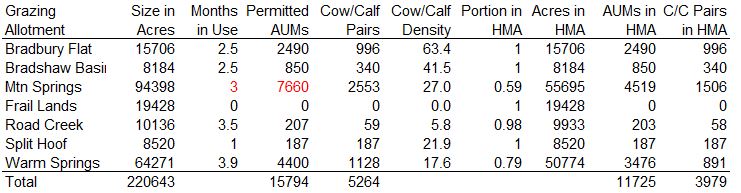
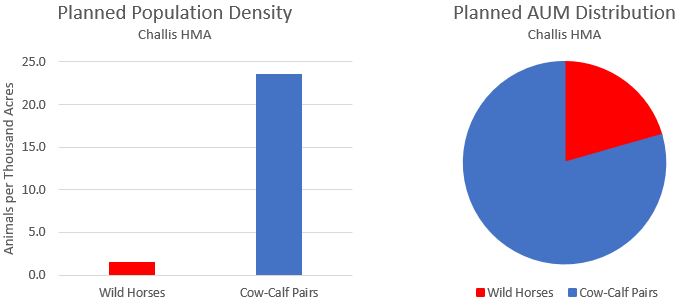
How can anyone look at the AUM distribution on lands set aside for the horses, such as in this post, and conclude that fertility control is the answer?
As reported yesterday, the forage allocated to domestic livestock in the Antelope Complex would support over 10,000 wild horses. The forage allocated to livestock on the Triple B Complex would support over 4,000 wild horses.
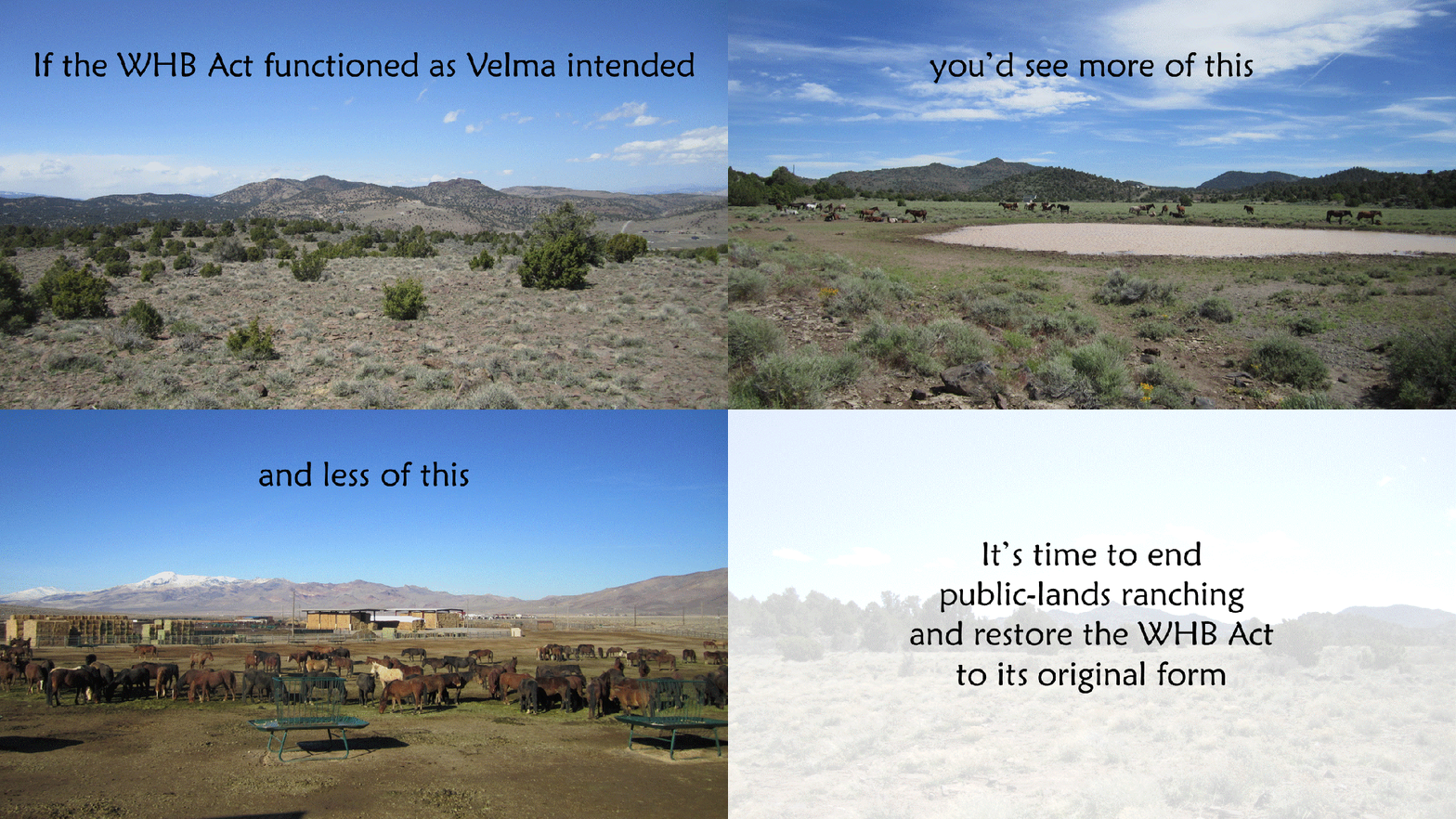
The problem is not uncontrolled reproduction, it is public-lands ranching.
RELATED: PZP Zealotry on a Global Scale.
Five areas were considered this week in a series of posts about the number of wild horses that have been displaced from public lands by privately owned livestock.
Yep, 8,127 wild horses have been denied a place on their home range by pro-ranching statutes and regulations of the federal government.
How many more HMAs would you have to look at to reach 50,000—the number of wild horses and burros languishing in off-range corrals and long-term pastures?
The government spends roughly $50 million every year to care for those animals, with the expectation of receiving just $12 million per year from the ranchers.
The ridiculous ‘Path Forward‘ will only make the situation worse.
There is no wild horse problem on western rangelands.
Public-lands ranching is rarely mentioned in news reports, such as this one, and most of allegations against the horses are aimed at getting them off the land—land that was set aside for them—so their food can be sold to the ranchers at fire-sale prices.
It’s a gravy train if ever there was one.
RELATED: Greatest Threat to Public Lands: Wild Horses and Burros.

A judge has ruled that the BLM cannot give itself power to decide which HMAs will be managed primarily for wild horses and burros, and that the ‘thriving ecological balance’ of the WHB Act refers to wildlife, not privately owned cattle and sheep. With livestock coming off the Twin Peaks HMA at the end of the grazing season, by how much can the AML be increased?
A. 2,265
B. 1,550
C. 925
D. 385
E. 95
Answer: A (27,178 ÷ 12).
That’s on top of the 758 wild horses currently allowed by plan.
Four years have passed since new rules went into effect regarding the labeling of range-fed beef. Consumers, angered by the way wild horses were being treated, refused to buy the product, putting the public-lands ranchers out of business, including those at Silver King HMA. With the livestock gone, by how much can the AML be increased?
A. 84
B. 313
C. 850
D. 1,645
E. 2,004
Answer: E (24,028 ÷ 12).
That would be in addition to the miniscule 128 wild horses already allowed by plan.
Suppose the Devil’s Garden ranchers gave up their permits because the grazing fee had been brought in line with the cost of warehousing wild horses in off-range pastures ($60 per AUM vs. the current $1.35). By how much could the AML be increased?
A. 1,309
B. 1,064
C. 897
D. 436
E. 149
Answer: A (15,711 ÷ 12).
On top of the 402 wild horses already allowed by plan.
The Warm Springs HMA can support 1,800 wild horses, but only 200 are allowed, because most of the forage has been sold to public-lands ranchers.
Many of the former inhabitants have been languishing in BLM corrals for a year, at a cost of $5 per day per head. That’s almost $1.5 million per year for 800 horses.
The HMA has enough capacity to empty those corrals twice.
The ranchers pay $26,000 per year to graze livestock on the same territory.
Yep, the government is spending $1.5 million per year to warehouse wild horses so they can collect $26,000 per year from the ranchers, on land set aside for the horses.
Eventually, most of the captives will be moved to long-term holding, at a cost of $2 per head per day.
Even then, the economics stink. Nobody in the private sector would do that.
The situation reeks of politics, favoritism and special interests, all at the expense of America’s wild horses.
RELATED: Warm Springs Quiz.
If the Warm Springs ranchers joined the productive side of the economy, working their own cattle on their own land, by how much could the AML be increased?
A. 99
B. 256
C. 614
D. 1,008
E. 1,616
Answer: E (19,392 ÷ 12).
In addition to the 202 wild horses already allowed by plan.
If the Saylor Creek ranchers had to get real jobs, instead of sponging off the taxpayers, by how much could the AML be increased?
Answer: 933 (11,193 ÷ 12).
On top of the 50 already allowed by plan, bringing the total to 983.
Refer to this story in AZ Central, published earlier today. Hopefully, personnel at the Salt River Wild Horse Management Group will be allowed to post a rebuttal.
RELATED: Strangles Hits Salt River Horses.
The legislation was drafted by the Subcommittee for Interior, Environment and Related Agencies and approved by the Senate Committee on Appropriations last week. It still has to be put to a vote of the full Senate and be reconciled with the bill in the House.
The House authorized $6 million for a ‘Path Forward’ pilot program earlier this year.
The Senate authorized $35 million for the ‘Path Forward’ in FY 2020.
Almost all of the senators on the Subcommittee are liberals. The two in the ‘minority’ are not paragons of conservatism (grades from Conservative Review).
Look at the first page of the ‘Path Forward.’ There are no endorsements from oil companies, mining companies, timber companies.
So who on the Subcommittee is in bed with the public-lands ranchers? Which senators would benefit from fewer wild horses in their state?
The BLM manages wild horses and burros in ten western states, while the Forest Service manages wild horses and burros in nine western states.
The demonic plan was not discussed in the Appropriations Committee meeting last week, even though the Bill for Interior contained a large expenditure for the new item.
You can listen to the audio here. Remarks about the bill run from 30:37 to 43:30.
Apparently, the guilty parties don’t want to be identified.
The Idaho Rangeland Resources Commission, the propaganda arm for public-lands ranching in the state, was recognized today by the BLM for involving students in rangeland education and policy formation. The award was presented at the annual meeting of the Public Lands Council (another propaganda organ).
Also commended was their promotion of recreational activities involving livestock grazing, according to the news release.
RELATED: IRRC Expands Propaganda.
Sixty percent of the Cedar Island herd is gone. You could argue that genetic diversity was lacking before the storm. If not, it is now. Can they recover?
The same thing could happen out west. A fast moving wildfire, a harsh winter or a fatal disease could ruin one or more HMAs.
Even in the face of these threats, the PZP zealots will not rethink their position, because they, like the public-lands ranchers, believe there are too many wild horses on western rangelands.
The glorious Path Forward, with its plan for massive roundups and widespread use of contraceptives, will make those rangelands look like they were hit by a natural disaster, at least from a wild horse viewpoint.
The fences will still be there. The forage will still be there. And the livestock will still be there, as they were before that pesky Wild Horse Annie got involved.
RELATED: Cedar Island Horses Swept Away by Dorian.
Not all the news is bad.
Yesterday the BLM announced that local ranchers bid $35 to $43 per AUM to graze eight parcels on withdrawn lands in southern New Mexico.
The McGregor Range covers 606,000 acres on the west side of Otero Mesa, between Alamogordo, NM and El Paso, TX, according to the news release. It was a part of Fort Bliss and supported live fire exercises with new missile systems.

Pick the mid point. If $40 per AUM is the going rate for livestock grazing on public lands, why are the ranchers who graze HMAs and WHTs allowed to pay just $1.35?
Title I of FLPMA says the U.S. [shall] receive fair market value of the use of the public lands and their resources unless otherwise provided for by statute (item 9, page 8).
How does $1.35 meet that requirement? It doesn’t. How do those endeavors return the maximum benefit to the American people? They don’t. (Refer to Title IV on page 31 for remarks about grazing fees. Page 34 has the infamous helicopter roundup provision that was added to the WHB Act.)
Public-lands ranching is a gravy train. That’s what groups like Protect the Harvest and the National Cattlemen’s Beef Association are trying to defend—and expand.
It’s the driver of the despicable ‘Path Forward.’
Raising the grazing fee to $60 per AUM—in line with the cost of warehousing excess wild horses and burros in off-range pastures—would be a nice down payment on the goal of erasing public-lands ranching from the American landscape.
The U.S. would receive an additional $528 million annually, at least for a while, until the ranchers throw in the towel, because paying market rates just plain spoils the party.
You’ll hear that frequently over the next few months as roundup season grinds its way across western rangelands.
They had good homes, before the helicopters came. Anything else is unacceptable.

Refer to this report by the Washington Post, published yesterday. Includes a link to the wild horse and burro management plan announced on 04-22-19.
The plan was negotiated by ranching interests and animal welfare groups. Wild horse advocates were omitted from the process.
The story includes some photos and anecdotes from the Triple B roundup in July, and, as expected, gives the ranchers and their allies in government a pass.
RELATED: Liberals Will Never Condemn Public-Lands Ranching.
UPDATE: Added video.