Grazing Program Receives Annual Endowment

The $10 million payment is acknowledged on page 14 of the Division G Explanatory Statement for the FY 2021 appropriations bill.

Those funds, derived from grazing fees, are plowed back into the program every year to make life better for the public-lands ranchers.  Refer to paragraph (b)(1) in Section 1751 of the Federal Land Policy and Management Act (the ‘No Rancher Left Behind Act’).

Money to remove animals that rob forage from the ranchers, such as wild horses and burros, is discussed on page 13 of the statement.  Taxpayers provide those funds.

The current fee is $1.35 per AUM, determined by a formula in Section 1905 of the Public Rangelands Improvement Act.  Note that the base fee, $1.23 per AUM, was set in 1966.

Section 3.2.8 in the Draft EA for resource enforcement actions in the Desatoya HMA notes that the value of grass hay in Nevada is $68 per AUM.

That means the ranchers are paying two cents on the dollar to feed their livestock, even on lands set aside for wild horses and burros.

Paragraph (a)(9) in Section 1701 of FLPMA says the United States shall receive fair market value for the use of the public lands and their resources, unless otherwise provided by statute, which in the case of livestock grazing is PRIA.

Now you know why there is so much interest in achieving and maintaining AMLs, the goal of the rancher-friendly ‘Path Forward.’

What would happen if grazing fees reflected market conditions?

Table 3-3 in the EA provides costs associated with roundups and off-range holding.

In the discussion that follows, the present value of gathering and holding an animal over a 25 year period was estimated to be $15,950.  The present value of the benefits arising therefrom—forage available to privately owned livestock over the same period—was estimated to be $14,209.

The present value of the costs exceeds the present value of the benefits, meaning it’s a bad investment.  Nobody in the private sector would do it.

But insulating the ranchers and their overlords from the realities of a free market is what the grazing program is all about.

If grazing receipts were used in the benefit calculation ($1.35 per AUM), instead of avoided costs ($68 per AUM), the present value would be nil and the proposal would never even see the light of day.

RELATED: Grazing Program Ancillaries.

Cattle and Horses

So Long, PZP Amendment?

The Division G Explanatory Statement in the FY 2021 appropriations bill does not direct the BLM to spend $11 million on wild horse contraceptives, although it does include an expectation that wild horse management actions will “include a robust expansion of fertility control utilizing methods that are proven, safe, effective, and humane.”

That may signify the end of the story, at least for now.  Roundups and off-range holding will likely consume most of the budget, as adoptions go down and surrenders go up.

It’s sad, really.  An idea so good that even the Rolling Stones would support it.

RELATED: PZP Amendment Omitted from Senate Spending Bill?

Pancake Gather Plan

Note to Visitors: Stay Away from Currituck Horses

You should never approach wild horses unless you’re a trained volunteer with CO2 pistol, CO2 rifle or blowgun in hand.

A report published yesterday by WAVY News shows several people getting too close to the horses, which is illegal.  The photo initially appeared on socialist media.

Cruelty, enticing, harboring, luring, seizing and failure to report injury are also unlawful, according to the story.

RELATED: Currituck Horses at Great Risk?

Ivermectin Cures Covid?

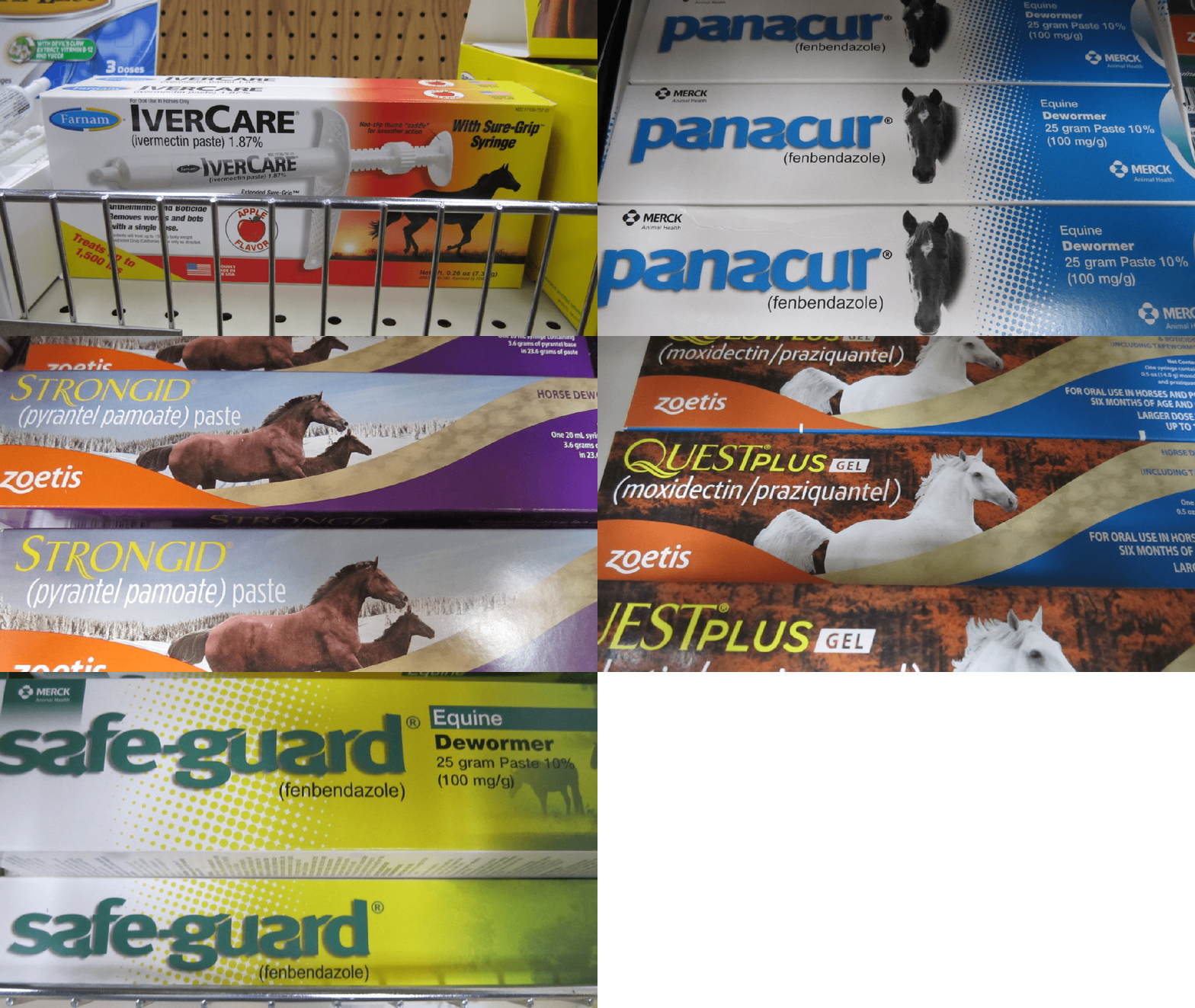
Many in the horse world know it as a dewormer.  But if you search for Ivermectin Covid-19, you’ll find reports on its use in treating the virus.

The local feed store had it in paste form on December 24.  But it also had several other types of dewormers.  There were no special warning signs in that area—Ivermectin not fit for human consumption—and there were no indications that it was being taken off the market or going out of stock.

My guys get Panacur on an as-needed basis.  It’s expensive but works well.

RELATED: Colt’s First Worm Treatment.

Dewormers

‘D’ Is for Demonic

If we have three co-equal branches of government, why is there so much interest in the presidency?

The political party trying to force its way into the White House hates Christmas as much as it hates the Constitution.

What exactly did they do yesterday?  Spend some time in front of their holiday trees, listening to holiday music, wishing each other happy holidays?

Most of its members already subscribe to the movement discussed in this video, they just haven’t come out of the closet yet.

The PZP Zealots Want Many One-Horse Ponies

Some want no-horse ponies, mares that have become sterile through extended use of contraceptives.

Do they agree with the idea of managing HMAs primarily for livestock and HAs almost exclusively for livestock?  Sure looks like it.

How do they differ from the public-lands ranchers?  The ranchers want AMLs achieved as quickly as possible, while the ‘advocates’ want herd sizes reduced gradually.

Unfortunately, darted mares consume resources assigned to ‘other mandated uses of public lands,’ and that’s at the center of the debate.

RELATED: What Is a One-Horse Pony?

What Is a Scandal?

When the words or deeds of one person cause others to lose the faith or act in ways that offend God, you have a scandal.

Here are a few facts about the material world, in case you didn’t get the memo:

  • It’s God’s creation
  • You don’t get to make the rules
  • All men will be held to the same standard

Keep these things in mind when you look at a nativity scene and see the Word made flesh, lying in a manger.

There are tens of thousands of churches but only one standard.  Which one has the fullness of the truth?

RELATED: What Triggered the ‘One-Horse Pony’ Remark?

Family, Freedom Overrated

Roundups are not necessarily a bad thing for wild horses, according to the writer of the Sac Bee article, because humans will “find them loving homes and a life of fresh hay, warm barns and veterinary care.”

No more hooves stuck in cattle guards.

Instead, they’ll be locked in stalls and fed a steady diet of bits, spurs, tiedowns, blankets, braided tails and maybe even shoes, everything they dreamed of while on the range.

And, of course, everybody has a heated barn with running water, except the host of Western Horse Watchers.

RELATED: Sac Bee Publishes Hit Piece On Wild Horses.

Corral 12-21-20-1

Economic Benefit of Public-Lands Ranching in Wild Horse Areas?

The federal government sells about 12 million AUMs per year to public-lands ranchers, across 155 million acres, mostly in the western U.S.

That transaction generates about $16 million per year in revenue for the government, which manages those lands—supposedly—for the benefit of the American people.

How much of that income is produced in areas identified for wild horses and burros?

One way to answer the question is to scale the revenue according to acreage.

The management plans assign 27 million acres to horses and burros, approximately 17% of the land authorized for grazing.  The estimated revenue would be .17 × 16 = $2.7 million per year.

Another approach would be to consider the resource allocations in areas designated for wild horses and burros, where the plans allow 27,000 of them.  Data reviewed on these pages suggest that livestock receive eighty to eighty five percent of the forage, excluding wildlife.  That means they receive four to five times as much as the horses and burros.

If that’s true in other areas, the forage assigned to livestock in areas identified for horses and burros would be 27,000 × 12 × 5 = 1.6 million AUMs per year, worth $2.2 million per year at current prices.

Not much of an offset for the tens of millions of dollars spent every year—confiscated from American wage earners—to remove and warehouse the horses and burros, so the ranchers can enjoy more of what their allotments have to offer.

The major economic benefit accrues at harvest time.  Of course, those revenues stay with the ranchers and their overlords, not the American people.

It’s redistribution of wealth, classic socialism.  That’s what the farm bureaus, stockgrower’s associations and cattlemen’s groups are trying to defend.

What the CAWP Can’t Do

The program can’t change the resource allocations that leave America’s wild horses and burros with crumbs, necessitating their removal from public lands in favor of privately owned livestock.

So as the roundups accelerate and the ‘Path Forward‘ is put into practice, know that the animals are being treated humanely—even the ones that don’t survive—while cattle and sheep graze peacefully on land that belongs to them.

RELATED: BLM Reaffirms Commitment to CAWP.

Pancake Gather Plan