Haaland Urged to Hit ‘Reset’ Button in WHB Program

A press release issued today by The Cloud Foundation recommends three actions for future management of wild horses and burros:

  • Protect their natural behaviors
  • Give them their fair share of forage on public lands
  • Fix inadequate standards during roundups, in holding facilities and at adoption

How about “managing principally for wild horses and burros” and “managing at the minimum feasible level,” per the original statute, while rolling back federal regulations aimed at “managing primarily for livestock?”

Piceance Appeal Deadline Nears

The appeal period closes on March 23, according to a report by Vail Daily.

The 337 wild horses found five years ago have blossomed into 1,200, for an average annual growth rate of 29% per year!

The story includes comments by one of the two sisters who recently received a Trailblazer award.  With 74% of the BLM grazing land in Colorado failing to meet standards for rangeland health, and most of the allotments not inhabited by free-roaming horses, she doesn’t have a leg to stand on.

RELATED: Piceance Decision Record Signed.

Focus on Beef This Weekend

Commissioners of Mesa County, CO designated March 20 “Meat-In Day,” according to a report posted today by KREX News of Grand Junction.

Western Horse Watchers encourages you to enjoy beef and beef products not produced on America’s public lands.  Sadly, you may have a hard time making the determination.

The Mesa County Republican Women will host a BBQ from 12 until 2 PM in Grand Junction.  The story did not say if they’ll be offering range-fed steaks.

Government dependency and redistribution of wealth are not hallmarks of conservatism, which has been traditionally associated with the Republican Party.

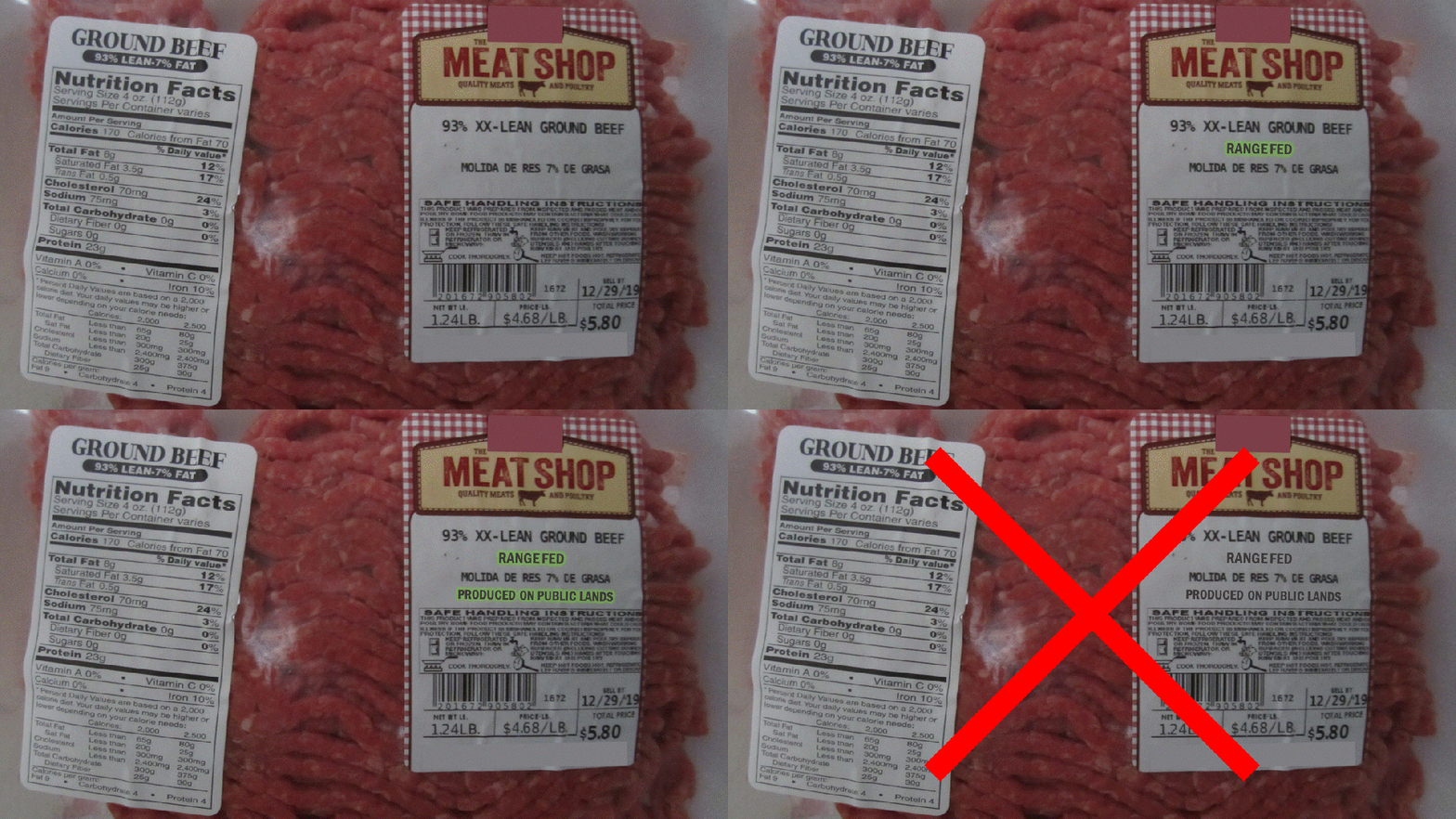
Range Fed Beef

Wild Horse Detractors Receive Trailblazer Awards

The awards were presented to two sisters, according to a story posted today by the Rio Blanco Herald Times.

One of them, executive director of the White River and Douglas Creek Conservation Districts, speaks about the impact of wild horses in this video by Protect the Harvest, a cheerleader group for the public-lands ranchers.

The other, a steward of the public lands and president of the Colorado Cattlemen’s Association, operates a cattle ranch near Fruita, CO.

The Operator Information and Allotment Information reports in RAS tie the ranch to the North Fork Kannah Creek and Whitewater Common allotments.

The Allotment Master report puts both of them in the Improve category.

RELATED: Allotment Categories Explained.

Three Allotment Categories Are Not Enough

Western Horse Watchers has already suggested Category D for allotments ruined by wild horses and burros, even in areas where the AML is zero.

But now there’s another issue: Man-made climate change.

For allotments threatened by global warming, which should be all of them, Western Horse Watchers proposes Category W—not for warming but for Woke—because only the enlightened can see what’s truly going on.

The rest of us dolts, including your host, only see sedentary animals congregating around water holes, polluting them with their droppings.

The new category would relieve the ranchers of any responsibility for rangeland health.

RELATED: Rewilding Western Rangelands?

Thriving Ecological Balance-3

The Multiple-Use Mission of ‘Perseverance’

A drawback of the automatic darting machine introduced last year is that the horses have to come to it, necessitating the continual restocking of bait.

But what if it was mobile and could go on the offensive?  Artificial intelligence would identify the target and steer the machine to the appropriate distance.

Multiple-Use Mission of Perseverance

Contraceptive darts, loaded into twelve-round cartridges that resemble baseball bats, would be fired automatically.  A ballistics computer would aim the device based on wind speed and direction.

Spent cartridges would be jettisoned.

The rover demonstrates the concept.  No more youngsters consuming critical resources in the Designated Area.

RELATED: ‘Perseverance’ Finds No Pinyon Pines or Juniper Trees.

Rewilding Western Rangelands?

The writer of a guest column appearing today in The Hill argues that deteriorating conditions on public lands in the western U.S. have more to do with climate change than wild horses, and that a massive conservation program is needed to stop it.

Given the political leanings of the publication, those could be code words for deindustrializing and depopulating western rangelands.

The piece could have been written at the behest of ranching interests.  Notably absent are terms such as ‘cattle,’ ‘livestock,’ and ‘grazing.’

Yet, approximately 250 million acres have been designated for public-lands ranching, with many of the BLM allotments in the Improve category.

The article includes the usual propaganda, such as “developing a humane contraceptive that will effectively slow the growth of wild horse populations” and incentivizing private landowners to “support the relocation of wild horses to suitable lands.”

How exactly does relocation of wild horses to private sanctuaries and remote wilderness areas achieve the original goals of the WHB Act?

What happens when you use phony problems as a basis for action?

The author is a legal advisor for The CANA Foundation, a non-profit group whose founder supports horse slaughter.

RELATED: CANA Foundation Throws in with Public-Lands Ranchers.

Your Cookie Dollars at Work

A story posted last night by The Fountain Hills Times said Brownie Troop #6445 donated $300 from this year’s cookie sales to the Salt River Wild Horse Management Group, a non-profit that humanely manages the Salt River wild horses.

The report did not mention that ‘humane management’ means stalking the mares and shooting them with contraceptive darts.

RELATED: Saving the Salt River Horses by Getting Rid of Them.

Arizona Forests Not Producing Enough Forage?

The Salt River horses live in the Tonto National Forest but are managed at the state level.  There is no Salt River WHT.

Human involvement, including darting and feeding, has, in effect, turned their range into a sanctuary.

Why can’t the horses fend for themselves?  If food is scarce, why don’t they move to greener pastures?  What’s on the other side of the fence?

A summary of grazing activity in Arizona forests during 2016, the most recent year for which the Forest Service has provided data, yields the following results:

  • Forage to cattle: 924,099 AUMs
  • Forage to sheep and goats: 25,129 AUMs
  • Forage to wild horses and burros: 10,427 AUMs

Horses and burros receive 1.1% of the total, which may not include the Salt River herd.

Are the horses constrained by other mandated uses of public lands?  If so, why isn’t the ‘advocacy’ group talking about it?

RELATED: Saving the Salt River Horses by Getting Rid of Them.

Saving the Salt River Horses by Getting Rid of Them

In 2019, more than 100 foals were born.  Last year, only 16 were born and this year the ‘advocates’ hope for even better results, according to a story posted yesterday by FOX10 News of Phoenix.

The multi-dimensional program includes darting and feeding.

As usual, the effort focuses on the horses, not on the causes of their removal from their home range.

Contraceptives have short-term and long-term effects.  Unlike the Covid vaccines, where some acute effects have been documented while the chronic effects are mostly unknown, the short-term and long-term effects of PZP are known but are usually glossed over or dismissed by the PZP zealots.

With this much human involvement, the Salt River horses are no longer wild, they are a carefully curated exhibit.

Go see them before they’re gone.

RELATED: Success on the Salt River.

UPDATE: Added video.

‘Perseverance’ Finds No Pinyon Pines or Juniper Trees

Clear-cutting will not be needed in the Designated Area, according to the Bureau of Livestock on Mars, allowing the project to move to the next step, which is seeding.

The rover has identified some water sources but more will be needed.  With most of the grazing fees plowed back into the program for range improvements, the goal should easy to achieve.

Perseverance Finds No Trees 03-03-21

“Although pinyons and junipers crowd out some forage,” said one rancher, “what we really want is access to areas previously off limits.”  He added that “Seeding boosts forage availability and stocking rates much more effectively than clear cutting.”

“Those fuels reduction programs are bogus,” said another.

As for the RMP, the ranchers want at least 95% of the resources assigned to livestock, with the balance reserved for wildlife, especially big game.

“The WHB Act should be restricted to Earth,” said one of the wranglers.  “Margins are paper thin up here and we can’t afford any losses to wild horses.”

RELATED: ‘Perseverance’ Tests Martian Soil.

Livestock Grazing on Forest Service Lands

The BLM sells about 12 million AUMs annually on 155 million acres.  At current prices, the government receives about $16 million per year, a small offset to the cost of the WHB program, which is operated mostly for the benefit of the public-lands ranchers.

A summary of grazing activity on Forest Service lands in 2016, the most recent year for which the agency has published data, shows sales of about seven million AUMs annually on 102 million acres, for an income of roughly $9 million per year at current prices.

In total, privately owned livestock receive 19 million AUMs per year on about 250 million acres of public lands, allowing for some overlap in jurisdictions.

The ranchers would have to place 3.2 million cow/calf pairs on those lands to consume 19 million AUMs in a six month grazing season, for a stocking rate of 12.8 cow/calf pairs per thousand acres.

At current herd sizes, wild horses and burros are consuming about one million AUMs per year on slightly more than ten percent of the land.

The current stocking rate is less than four animals per thousand acres.

The target rate is one animal per thousand acres, suggesting that resource availability and productivity improve dramatically when areas are designated for livestock.

Fixing the Ranching Problem in the Western U.S.

Many permittees own land and appurtenances known as a ‘base property.’  Grazing privileges on public lands are usually tied to base properties, which may include other assets such as water rights.

Where do livestock go during the off season?  Where would they go if AUMs on public lands had to be curtailed because of a fire or drought?  Back to the base property and/or rented pastures, where the ranchers would have to pay market rates to feed them.

The 4M Ranch, a sponsor of the Meeker Mustang Makeover and probable beneficiary of wild horses thus adopted, has almost 12,000 acres of deeded lands which, presumably, secure its grazing privileges on 125,000 acres of BLM and Forest Service lands.

Hay production on the ranch, about 1,200 tons annually, would support 240 cow/calf pairs, assuming they consume five tons per year per pair (25 to 30 pounds per day).

Forage on the deeded acres would support another 100 cow/calf pairs, assuming a stocking rate of eight pairs per thousand acres.

Additional food can be imported (at going rates) if a larger number of animals is desired.  No more dependence on government, no more slurping at the public trough.

Yes, it’s a radical idea—confining them to their own property.  Nobody has ever been expected to do that.

RELATED: Sponsor of Meeker Mustang Makeover or Beneficiary?.

Quick Note on Overpopulation

It does not mean the carrying capacity of the land has been exceeded, not even close.

It means more horses than allowed by plan, too many resources lost to animals that bring in no economic return.

The resources are there.  In most cases there are no ‘excess’ horses.  There is no basis for a roundup or fertility control program.  Most of the ‘advocacy’ groups are clueless.

The problem is resource management—the plans—which typically allocate four to five times as much food to privately owned livestock as they do to wild horses, on lands identified for the horses.

Thriving Ecological Balance-3

Sponsor of Meeker Mustang Makeover or Beneficiary?

One of the event’s sponsors is 4M Ranch.

The Operator Information report in RAS, for the State of Colorado, Northwest District, White River Field Office, gives an address in Meeker, along with authorization numbers 0505793 and 0505794.

The Allotment Information report ties the authorization numbers to the River and Little Toms Draw allotments.

The Allotment Master report puts Little Toms in the Improve category and River in the Custodial category (condition unknown).  Western Horse Watchers is unable to explain how it qualifies for Custodial.

The principal of 4M Ranch is Craig Macnab, according to a Bizapedia report.

A 1985 announcement in The New York Times suggests that he’s married to Deirdre Macnab, the woman who said that genetic viability of wild horses is threatened by increasing herd sizes.

A 2016 report by the Rio Blanco Herald Times says the ranch was purchased in 2015 for $9.5 million.  It covers 11,870 deeded acres and has grazing preference on more than 125,000 acres of BLM and Forest Service land.  The allotment master report accounts for only a small fraction of the total acreage.

The ranch has 800 acres of hay meadows and supports up to 1,000 cow/calf pairs, for a stocking rate of eight cow/calf pairs per thousand acres.  The aimed-at stocking rate across all HMAs is one wild horse per thousand acres.

To say that the Macnabs have only a passing interest in wild horses would be a gross understatement.

RELATED: Meeker Mustang Makeover Seeks Trainers and Adopters.

‘Perseverance’ Tests Martian Soil

Multiple samples failed to meet standards for rangeland health so the Designated Area was immediately placed into the Improve category.  No major problems are expected, however, as there are many such areas in the western U.S., even where horses have been zeroed out.

Peserverance Tests Soil 02-27-21

A spokesman for the Bureau of Livestock on Mars said an RMP and EIS are in the works but they will not be put out for public review because grazing is “too important” for the red planet’s fledgling economy.

He went on to say that retraining cattle ranchers for other roles, such as solar techs, would be “darn near impossible.”

The spacecraft carried the historic first doses of PZP to the surface, so the ranchers can get out in front of the horse problem before it even gets started.  Clipboards and darting rifles will be delivered in a subsequent mission.

RELATED: ‘Perseverance’ on Mars, Stakes Claim for Public-Lands Ranchers.