Refer to this letter to the editor of the Aspen Daily News, posted today.


Western Horse Watchers Association
Exposing the Hypocrisy, Lies and Incompetence of the Wild Horse Advocates
Opinion
Refer to this letter to the editor of the Aspen Daily News, posted today.
Q.
Are you an advocate for wild horses or not? I can not tell from your website and some of the commentary.
A.
Hi L., the advocates are wrong about almost everything in the wild horse world, so, no, I don’t count myself among them.
You can see it in the news release for horses returned to Sand Wash Basin: Government gets rid of most of them and the advocates make sure they never come back, leaving the ranchers as the primary—if not principal—consumer of resources in the HMA.
The rate at which the new way of thinking can spread to other wild horse areas will be limited only by the number of kool-aid drinkers that can be recruited and trained on the use of darting rifles.

RELATED: Sand Wash Basin Aftermath.
The change follows a hit-and-run collision in July that killed the mare and injured her foal according to a story posted yesterday by Delmarva Now, an online news service of the Salisbury Daily Times.
Until 2016, when the darting program was stopped, the PZP zealots were getting rid of many more horses than motorists. This is true today wherever they ply their trade.
The herd continued to decline until this year, when it produced a 7.8% birth rate, slightly larger than the death rate.
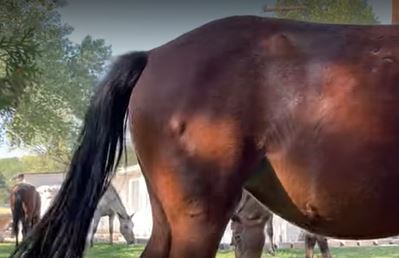
The advocates, undeterred by the facts, continue to push this snake oil on our wild horses, with benefits accruing to the public-lands ranchers.
It’s a classic example of wild horse mismanagement, with benefits accruing to the public-lands ranchers.
First, you assign four times more forage to livestock than the horses.
Next, you get rid of 80% of the horses.
Then, you return a few dozen, a token gesture, with mares inhibited by contraceptives.
The advocates, realizing that the best way to protect wild horses is to not have them, double down on their fertility control program.
If everything goes according to plan, there will be no more roundups—because there will be no new horses—and the ranchers will be the primary consumer of resources in the HMA for many years to come.
You might think from today’s episode of Mustang Monday that the horses found a place where they’re safe from the advocates, but stop the video at 4:27. What do you see?
There’s a war going on in those hills, led by the Campaign Against America’s Wild Horses and staffed by an army of kool-aid drinking volunteers.
All because some bureaucrat said there should be around 300 wild horses on the Virginia Range, ideally, and no more than 600.
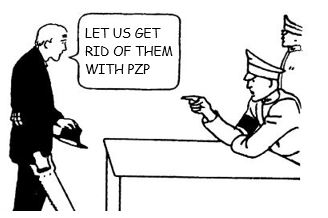
The lower end of that range corresponds to a stocking rate of one wild horse per thousand acres, identical to the target rate for horses on public lands. Imagine that.
She’s with the Sand Wash Darting Team, referred to in this audio segment by KDNK News as a wild horse protection group, along with the Campaign Against America’s Wild Horses and Return to Normal (Before WHB Act).
The BLM should have left more horses on the range, she argues, because this band of merry men can control their numbers with PZP.
Like the ranchers, the advocates want to get rid of the horses, but they want it done with safe and humane darting programs, not cruel and inhumane helicopter roundups.
These people are jumping through hoops to make sure the ranchers receive most of the resources in an area set aside for wild horses.
Why are you still giving them money?
RELATED: Sand Wash Basin Devoid of Life?
Three horses were taken to the Spring Creek HMA and released, while 49 horses were returned to the Sand Wash Basin HMA, according to the gather page.
Bringing in horses from other areas improves genetic diversity while keeping herd sizes small.
Unfortunately, it dilutes herd identity. Today you might be able to adopt a Spring Creek horse, but in the future you’ll be adopting a horse captured at Spring Creek, assuming they haven’t been wiped out by a safe and humane darting program.
UPDATE: Event acknowledged in BLM news release.
Government is full of psychopaths and other assorted kooks, all levels. They are not faithful public servants, they have an agenda.
They don’t get their thrills by announcing emergency roundups that don’t meet the criteria for emergencies, by telling you the horses are starving while livestock are not, or by removing more horses than necessary with no plans to return them.
They get their kicks by doing these things in your face and getting away with them.
It feeds and darts! What’s not to like? No more riding around in rough terrain, lugging heavy equipment and stalking wild horses.
Just keep it stocked.
The facial recognition upgrade was not mentioned, but soon these machines could be scattered across western rangelands, disrupting natural herd behaviors, driving birth rates to zero and letting the herds die off, ensuring that public-lands ranchers receive most of the resources in wild horse areas.
She does not distinguish between public lands and public lands set aside for wild horses in this opinion piece posted yesterday’s by the Reno Gazette Journal.
Why?
The woman testified in favor of the failed resolution and was instrumental in its development.
Does she have a real job? Or is she a rabble-rouser and malcontent, tying to establish credibility with hunters, ranchers, bureaucrats and the PZP zealots?

Nonsense! Grazing season is just getting started. Did you think the HMA was managed principally for wild horses?
Unfortunately, this boots-on-the-ground update by the Steamboat Pilot does not look upstream at the resource allocations and land-use plans that the helicopters are trying to enforce.
The roundup, sold as an emergency, is likely an attempt to shield the public-lands ranchers from the effects of a temporary change in the weather. The operation was scheduled and the conditions that preceded it accrued gradually.
Drought helps you accomplish what you wouldn’t be able to do otherwise.
Never let a crisis go to waste.
They have a list of 25 stallions and 25 mares to return to the HMA, and look through each day’s take to find them and prevent their shipment, according to a story posted yesterday by The Craig Press.
The mares will be treated with fertility control, not necessarily the same type as they’ve been receiving for the past few years?
The advocates want to replace cruel and inhumane roundups with cruel and inhumane darting programs, ensuring that most of the resources in wild horse areas go to the public-lands ranchers.
Good work, guys.
RELATED: Sand Wash Roundup Day 7.

Gonna get some heat for this one.
What else is she supposed to do when you put her in cross ties and stand in front of her?
When asked by WHW if she’ll do this in pasture, the owner said “Pretty much every time I’m around her.”
Life must be protected from the moment of conception to natural death.
This article about rescue and adoption in The Daily Sentinel of Grand Junction isn’t a human-interest story or a horse-interest story. It’s a setup.
When two mustangs reunite, would they remember
The story begins on Navajo land but shifts to “all the wild horses roaming millions of acres without enough food or water” and the need for their management.
It’s all downhill from there.
A competitive shooter and PZP darter trains other firearms aficionados to shoot mares with contraceptive darts to reduce the number of foals born every season.
Many still starve and die of thirst, according to the writer, but these heroes are doing their part to get rid of them, along with the helicopters, while shielding the public-lands ranchers from the effects of a temporary change in the weather.
Bring a photo of wild horses on public lands when you’re buying Ivermectin.
They belong to the American people, which includes you.
Take the vaccines or take the shots. It’s how communist countries get things done.
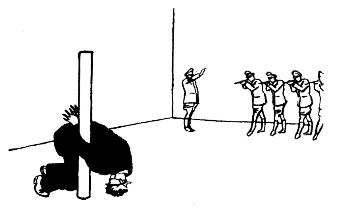 Dissenting voices and alternative treatments will not be tolerated.
Western Horse Watchers offers the following remarks in response to an op-ed appearing in today’s online edition of the Greeley Tribune.
The AML of 362 corresponds to a resource allocation in a land-use plan. It is not the number of wild horses the HMA can sustain. If the land can only support 362, how did the pre-gather population reach 896? Half of them should be dead by now.
Sometimes you limit your spending in one area because other things are more important.
Wild horses are not domesticated animals. If you think they are, adopt one and try throwing a saddle on him. He might spin his butt and put a hoof in your face.
Table 2.1 in the Final EA for resource enforcement actions in the HMA shows 499 AUMs per year assigned to cattle in one of the pastures of the Sheepherder Spring allotment, which is inside the HMA according to the paragraph above the table.
If sheep only traverse the HMA on their way to summer and winter feeding grounds, why does the plan authorize over 16,000 AUMs per year to livestock inside the HMA?
Amend the plan and shift the resources back to the horses! The roundup will no longer be necessary and the darting program can be stopped.
Horses appear in the North American fossil record, cattle and sheep do not. They are the predominant non-native species on America’s pubic lands.
There are few if any predators in wild horse areas because those animals would also be interested in the offspring of the non-native species.
The Federal Land Policy and Management Act, 43 USC 35, puts domestic livestock grazing at the top of the list of principal uses of public lands, not fish and wildlife development, mineral extraction, recreation or timber production. Refer to §1702(l).
The use of helicopters and motor vehicles in wild horse roundups, §1338a in 16 USC 30, was authorized by FLPMA, the first formal attack on the WHB Act by the public-lands ranchers, their overlords, cheerleaders and political allies.
RELATED: Sand Wash Horses Consume 95% of Resources?

The statement occurs at 1:36 in the following video by KUSA News of Denver.
Could it be true? Yes, during the off season.
Table 2.1 in the Final EA for resource enforcement actions shows grazing seasons for allotments that overlap the HMA. The pastures in rows 1, 2, 4, 6 and 7 are inside the HMA and represent a shifting of resources from wild horses to public-lands ranchers.
Grazing does not occur in June, July and August, so during the summer, the horses are the majority consumer of food and water.
Gates and fences might impede their movement within their home range and some areas may be off limits to help them recover for the next grazing season. Most of the land does not meet standards for rangeland health.
The management plan assigns 79% of the authorized forage to privately owned livestock over a twelve month period, as explained in this report. The horses are the minority consumer of resources overall, next to wildlife.
The pre-gather population of 896 is unacceptable—the horses are robbing too much forage, sometimes referred to as ‘their food,’ from the ranchers.
That’s why they have to go. Resource enforcement.
Livestock AUMs may have been cut due to a temporary change in the weather but the horses are being permanently removed. When conditions improve, it’ll be business as usual, with the ranchers receiving the lion’s share of the resources.
The BLM rep in the video is not telling the whole story.
Would that be true for your favorite advocacy group?
They couldn’t convert an AML to AUMs if their lives depended on it, but they can tell you exactly how many cc’s of adjuvant to add to the PZP and how long to mix them.
They’re working with government to achieve and maintain AMLs by attrition, which means they’re trying to protect and preserve the lopsided resource allocations that strongly favor the public-lands ranchers—in areas set aside for wild horses.
Charlatans, every one of them.
 Western Horse Watchers Association