Somewhere on the Navajo Nation. Although tribal leaders have given orders to thin the herd, there are some who disagree and want these animals preserved.
H/T Ron Toahani Jackson.

Western Horse Watchers Association
Exposing the Hypocrisy, Lies and Incompetence of the Wild Horse Advocates
Somewhere on the Navajo Nation. Although tribal leaders have given orders to thin the herd, there are some who disagree and want these animals preserved.
H/T Ron Toahani Jackson.
Western Horse Watchers forgot to cover the demonic event, sponsored by the kooks at Protect the Harvest. Darn it! Will try to do better next year.
The helicopter roundup at Muddy Creek HMA ended 09/13/18, with 153 wild horses removed from the range due to dry conditions and overpopulation. No horses were returned to the range and one died in the process. Details of the loss were not provided.
Wild horse populations have been declining in Utah this year, with the Range Creek, Cedar Mountain, Four Mile, Bible Spring, Tilly Creek and Sulphur HMAs—along with Muddy Creek—targeted for removals. Onaqui Mountain, popular with visitors and residents, has been spared so far.
The drought that has affected several western states in 2018 only seems to affect wild horses and burros. Impacts to livestock have not been reported.
If winter brings sufficient precipitation will the horses be returned to the range?
Animals not placed into private care will be moved to segregated long-term holding in off-range pastures. No foals, no family, no legacy.
RELATED: Muddy Creek Gather Starts Next Week.
BLM said yesterday that it will remove more wild horses from the Antelope Valley and Goshute HMAs, starting on or about September 18. The stated reason for the gather is lack of water and forage on the range. Refer to this news release.
Bait traps will be used for the removals. The announcement did not indicate if the operations would be open to public inspection (probably not).
The HMAs are south of Wells, NV, near the Utah border.
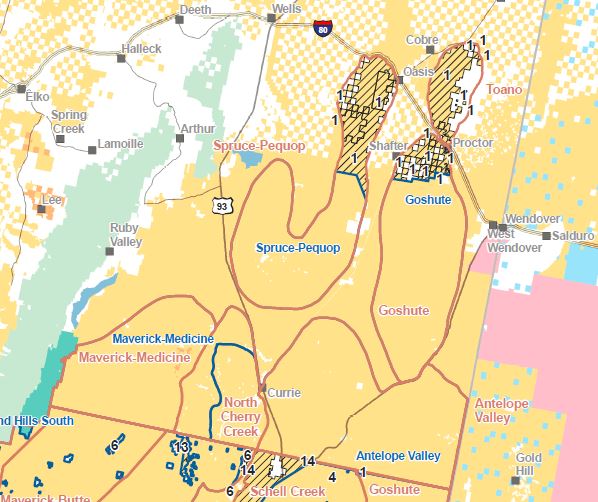
The wild horse population at Antelope Valley is estimated to be 1,755 and that for Goshute is 1,429. These figures correspond to lands covered by the HMAs and those surrounding them where the horses have been observed.
The AML for Antelope Valley is 259 wild horses, while that for Goshute is 123. These figures pertain to lands within the HMAs only and therefore cannot be compared to the population estimates because they don’t have the same land-basis. They do not provide a rational basis for statements regarding overpopulation.
Captured animals will be taken to the Indian Lakes Off-Range Wild Horse and Burro Corrals in Fallon, NV, where they will be checked by a veterinarian and prepared for adoption. Almost certainly the system is flooded with all the horses removed from western rangelands in 2018. Who benefits from this?
Gather stats and daily reports can be found at this page.
The announcement stated that the horses were consuming water from a spring on private land. If this is a problem, why hasn’t the owner installed a fence? Or would a fence preclude access to the spring by other species (such as, ahem, cough-cough, livestock)?
Note that the BLM can bring water to the traps but not to the range. If an advocacy group stepped forward with a desire to haul water, would the horses be allowed to stay on the range?
Approximately 900 wild horses will lose their freedom forever as a result of these gathers, on top of those removed just a few weeks ago. Some may be adopted, most will either be sold (into questionable hands) or moved to off-range pastures.
RELATED: Antelope Valley Gather Complete, BLM Ends Goshute Roundup.
Two men have been taken into custody after firing shots into the corral facility operated by the Salt River Wild Horse Management Group in Arizona. No volunteers and none of the horses were injured in the incident.
Not a word on the immigration status of the perps!
UPDATE: The shooting happened on 09/16/18 around 5:00 PM. See this report by FOX-10 in Phoenix.
The BLM will gather 1,175 wild horses from HMAs affected by the Martin Fire in July of this year, starting on or about September 21, according to a news release issued today.
Of this amount, 875 horses, classified as ‘excess,’ will be permanently removed from the area. Some mares, no more than 150, will be treated with contraceptives and returned to the range, along with an equal number of stallions.
Helicopters will be used to push the horses into the traps and the operation will be open to public observation.
The fire started near Paradise Valley, NV on 07/04/18 and spread eastward, consuming over 435,000 acres (BLM announcement says 07/09/18).

The Owyhee Complex includes the Little Owyhee, Owyhee, Snowstorm Mountains, Little Humboldt and Rock Creek HMAs. The complex covers about 1.06 million acres and has a combined AML of 999, for an aimed-at population density of 0.94 animals per thousand acres.
The average population density across all HMAs is one animal per thousand acres.
The announcement did not acknowledge the presence of livestock on these HMAs, nor did it indicate if AUMs would be curtailed as a result of the fire. Don’t worry though, it’s the oil and mining companies behind this madness. Those industries require thousands of tons of forage every year to keep their machinery running, and they’re not going to let some stupid horses steal it from them.
Captured animals will be taken the Palomino Valley Corrals north of Reno, NV (already flooded with horses from other roundups), where they will be checked by a veterinarian and prepared for adoption (already saturated with horses from other roundups).
Gather stats and daily reports can be found on this page.
RELATED: BLM Seeks Information on Martin Fire.
About 200 acres have burned, according to a story posted today by The Denver Post, but it has not harmed any horses and they are still able to access water normally. However, volunteers are concerned that the fire has consumed forage in an area already suffering from drought.
Personnel from Wild Horse Warriors have been hauling water to the Sand Wash horses since July, avoiding an emergency gather. The HMA covers 157,730 acres in northwest Colorado.
The Tahoe Reno Industrial Center is home to some well known companies, such as Tesla and Walmart. It’s also home to some Virginia Range mustangs, and TRIC wants to keep it that way. Refer to this article posted today by The Nevada Independent to see what these and other companies are doing to keep the horses on the range.
Unlike most of the wild horses in Nevada, the Virginia Range mustangs are managed at the state level by the Department of Agriculture. Like most of the wild horses in the western U.S., they are despised by certain individuals and agencies who believe their numbers should be permanently reduced.
Refer also to the Youtube audio of the Board of Agriculture meeting on 09/05/18 for a discussion of their status and future.
On Theodore Roosevelt National Park. H/T Karen King.
Turbidity and pH on target, fit for equine consumption. They don’t call it Clean Water Way for nothing! H/T Dr. Jennifer Jewell PhD.
Somewhere along Geiger Grade (road to Virginia City, NV). H/T April Thompson.
See this story in The Coastland Times, posted today. Volunteers have not been able to reach the horses at Cape Lookout due to hazardous conditions.
RELATED: Corolla Horses Survive Florence.
At Hidden Valley Regional Park, east of Reno, NV. H/T Dr. Jennifer Jewell PhD.
Go to jail, get a horse. H/T Good Day Sacramento.
RELATED: Saddle-Started Horses Available at R3C Next Weekend.
Personnel with the Cajun Navy help flood victims in New Bern. No, they’re not administering birth control to all the women.
Shouldn’t the government be rescuing those people?
What an individual can do, society should not take over, and what small societies can do, larger societies should not take over. That is the principle of subsidiarity.
Nowadays too many people have given up control of their lives, instead, receiving their sustenance from government. Can you think of an example on western rangelands?
See this story in The News & Observer, posted 09/14/18. No word yet on the condition of herds farther south, such as Rachel Carson Reserve and Shackleford Banks.
RELATED: Banker Horses Shelter in Place.
Experts cannot explain the deaths of thirteen wild horses on the Big Island of Hawaii in June and July of this year, according to a news release posted today by the Department of Agriculture.
All of the sick horses were from one band on the west side of the Waipio Valley. None of the other bands in the area or any of the trail riding horses were affected.
See also this story in West Hawaii Today.
RELATED: Illness Affecting Waipio Valley Horses Still Not Identified.
BLM announced yesterday that it will remove 652 excess wild horses from the Warm Springs HMA in southeastern Oregon, beginning in early October, to thin the herd and collect test subjects for sterilization research. Refer to the news release issued by the Burns office.
Helicopters will be used to drive the horses into the traps and the operation will be open to public observation.
The HMA covers 475,460 acres and has an AML of 202, for an aimed-at population density of 0.42 animals per thousand acres. The average density across all HMAs is one animal per thousand acres. (The lower the density the higher the wild horse dispersion, which pleases the public-lands ranchers, their cheerleaders, and overlords in the livestock industry.)

The news release stated that the AML was 178, which differs from the figure at the HMA description.

The new AML means even greater wild horse dispersion (0.37 animals per thousand acres, almost nothing). The announcement did not indicate if livestock were present on the HMA or surrounding lands but a reduction in AML, if true, would further pacify the government dependents and will probably be overlooked by the public.
Captured animals will be taken to the Wild Horse Corral Facility in Hines, OR, where they will be prepared for adoption, or in the case of some of the mares, placed into the hands of the on-site Mengeles, who have been tasked with removal of their ovaries.
Gather stats and daily reports can be found on this page.
This so-called research sets a low-water mark for the BLM, an unelected bureaucracy acting against the wishes of the American people. They have their fanboys however, who see this effort as another step in the process of nullifying the WHB Act.
Dry conditions persist in some parts of the western U.S. This is an example of wild horse advocacy, folks. Shooting mares in the ass with PZP is capitulation.
H/T HighStakesRanch.
RELATED: Water for Sand Wash Horses.
A story posted today in the Craig Press shows how the horses of Sand Wash Basin HMA benefit the local economy. In a nutshell, people spend money to watch horses: food, fuel, lodging and supplies. If they have a good experience, they come back and tell a friend. The informal study was conducted in August.

