
Wild horses pick up the local scent at Theodore Roosevelt National Park. Mud helps to repel the flies as well. Filmed July, 2015 by Dakota Grown Photos.
Author: Western Horse Watchers
Forest Service Moving Ahead with Devil’s Garden Sale
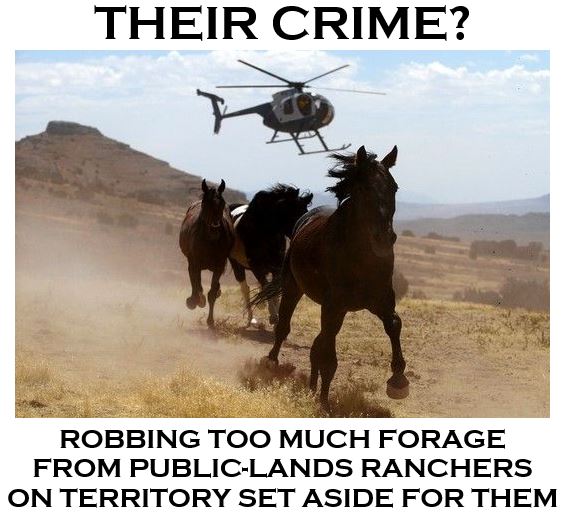
The legal battle continues over wild horses removed from the Modoc National Forest in October and November, 2018, according to a syndicated report that appeared today in the Atlanta Journal-Constitution. Animals aged ten years or more, currently held in a Forest Service corral, are subject to ‘sale without limitation’ next month, which means they could be shipped to slaughter.
The report stated that “Ranchers generally support these sales because of the horses’ economic impact on leased grazing land.” It didn’t mention that the land was set aside for the horses.
RELATED: Group Attempts to Block Sale of Devil’s Garden Horses, Devil’s Garden Horses Get Short End of Stick, Livestock Grazing in California.
Gillette Bows to the Marxists
Second Day of Winter on the Virginia Range
Five wild horses gather at the watering station on an overcast day. Elevation 6,500 feet.

Mustang Monday
On the Virginia Range. Temperature 25 ºF, elevation 6,500 feet.
Fences on Western Rangelands
Opponents of free-roaming horses like to point at photos of muddy ground on one side of a fence and lush green pasture on the other. They say the horses harm the ecology and therefore have to go.
Do you think the barren area would exist if these horses could come and go as they pleased? Of course not. The fence caused it.
The Wild Horse Debate
You can’t discuss wild horses and burros without discussing livestock and public-lands ranching. That did not happen in an opinion piece posted yesterday by Carson Now.
Omission of the topic, common in articles about wild horses, is a sure sign of bias. This one by Northern Ag of Billings, MT is typical. No ties to the ranching industry there.

Back to the original piece in Carson Now.
1. They’re a non-native species. The fossil record shows that horses existed in North America until they, and other large mammals, were wiped out 10,000 years ago. They were reintroduced by Spanish explorers 500 years ago, as stated in the article.
2. Humans were here a lot longer before any horses. The fossil record shows that horses pre-date the appearance of humans by tens of millions of years.
3. Free-roaming horses are feral, not wild. Horses that have been gelded or wear shoes are occasionally noted in BLM gather reports. They are the exceptions. Most of the domesticated horses died off decades ago. Their offspring have never known anything other than wild. The anti-horse crowd will often apply the feral and estray labels to diminish the importance of these animals and cast doubt on their protected status.
4. Don’t feed them. Carrots, apples and bits of hay may seem like innocent treats, but giving them to wild horses can make them pushy and disrespectful, jeopardizing their free-roaming status. Besides, it’s illegal in Nevada. Providing water is not illegal, but should be done away from populated areas, a practice known as diversionary watering.
5. Horses rob forage from deer, elk, antelope and bighorn sheep. You forgot livestock.
6. Horses reduce the risk of wildfires by consuming excess vegetation. Good point.
7. There are not enough predators to keep the horses numbers in check. That’s because of the livestock grazing in the next valley.
8. Fertility control has not been very effective, allow hunting of wild horses. The idea is sickening. And you can’t eat meat that’s been tainted with contraceptives (and dewormers in the case of freed or escaped ranch horses).
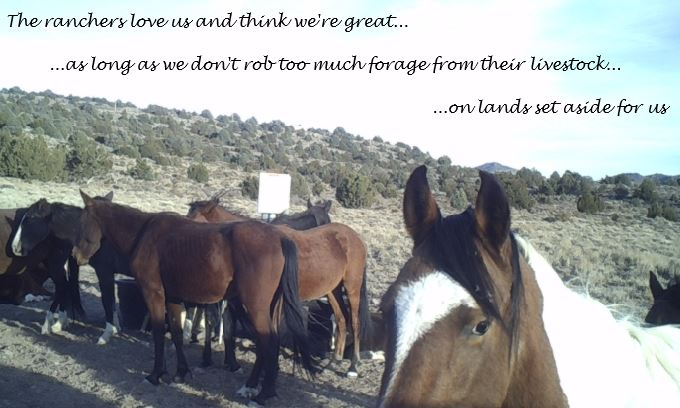
Why not start by retiring the grazing permits and giving back the territory that’s been allocated primarily to the public-lands ranchers?
RELATED: Livestock Grazing in Nevada.
Do We Really Need $5 Billion for a Wall?
Getting rid of wild horses and burros apparently is a top priority of our precious government, but rounding up the criminal invaders—and keeping them out—is not.
Are there other options for protecting the American people? Consider these data:
- 2,000 miles of border to defend
- $10,000 for a gas operated, belt fed, automatic rifle
Five billion dollars would buy 500,000 rifles (5,000,000,000 divided by 10,000), enough to put one every 21 feet on the border (2,000 times 5,280 divided by 500,000).
That’s way too many. One every 300 feet would be adequate, which means 35,200 rifles should be ordered immediately (2,000 times 5,280 divided by 300). Cost would be $352 million (35,200 times 10,000).
Liberals have offered $1.3 billion for border security so this is well within their budget.
Roughly one billion dollars would remain after they cut the PO.
The fence would be six to eight feet high, just enough to slow down the undocumented Democrats and increase the hit probability of the flying lead. Chain link would be ideal.
Assuming a cost of $50 per foot, the price for the ‘wall’ would be $528 million (2,000 times 5,280 times 50). Approximately $500 million remaining in the leftist budget.
Ammo consumption would be minimal, a few hundred rounds, enough to convince the murderers, rapists, drug runners, terrorists and socialist voters they’re not welcome here. Cost impact would be insignificant, not even the magnitude of a rounding error.
The final $500 million could be allocated to technology, just as the Progressives have insisted (for automation and surveillance). If a soldier sitting in a bunker on U.S. soil can take out an enemy in a foreign nation, these rifles can operated by remote control.
The inflow of Marxist supporters, some unwitting, some not, has to be stopped. Pay no attention to the national news coverage and imagery of poor, oppressed women and children confronted by racists at the border. It’s all theater.
Don’t worry, though, these measures will never be put into practice. The individuals charged with the safety of America are in favor of its fundamental transformation.
They become bolder as more illegals enter the country, and the veil is slowly coming off their plan.
The task for normal, God-fearing Americans is not to save the planet, but to save the republic, and its constitutionally limited government.
To learn more about the instruments of self defense referenced above, which are illegal in many states, watch this video by Iraqveteran8888.
ZPG On the Salt River
The Population Bombers of the wild horse world have targeted the Salt River mares, with the goal of reducing wild horse population growth to zero, according to a story posted today by AZ Family, the CBS affiliate in Phoenix. Includes video of mares being shot with contraceptives.
Yep, the Salt River horses have been protected from everything…except the PZP zealots.
Programs like this reflect the moral depravity of their adherents.
WHB Outplacement Continues Despite Government Shutdown
KVEO-TV, the NBC affiliate in Brownsville, covers the wild horse and burro sale event in Mercedes, TX. See also this report.
The woman at 0:23 does not appear to be much of a horseman. No problems though, her job is to lie about what’s happening on western rangelands.
RELATED: BLM Cash-and-Carry Event Next Month in Mercedes, TX.
Silver City Horses Ignore Driver
Barry Smith encounters some Virginia Range mustangs near Silver City, NV, on Hwy 342 at the Donovan Mill. Yes, they’re in the road, but it’s their road!
Waipio Horses Carry On
Stephen Dennish provides a boots-on-the-ground view of these animals in their subtropical habitat. No more deaths reported since the summer of 2018.
Winter Break
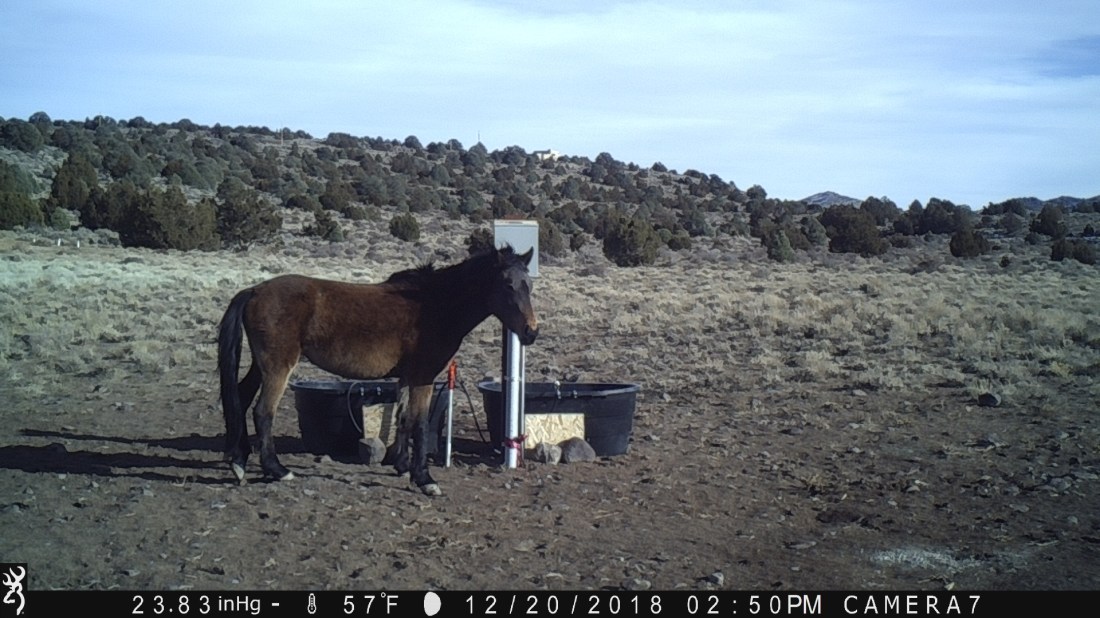
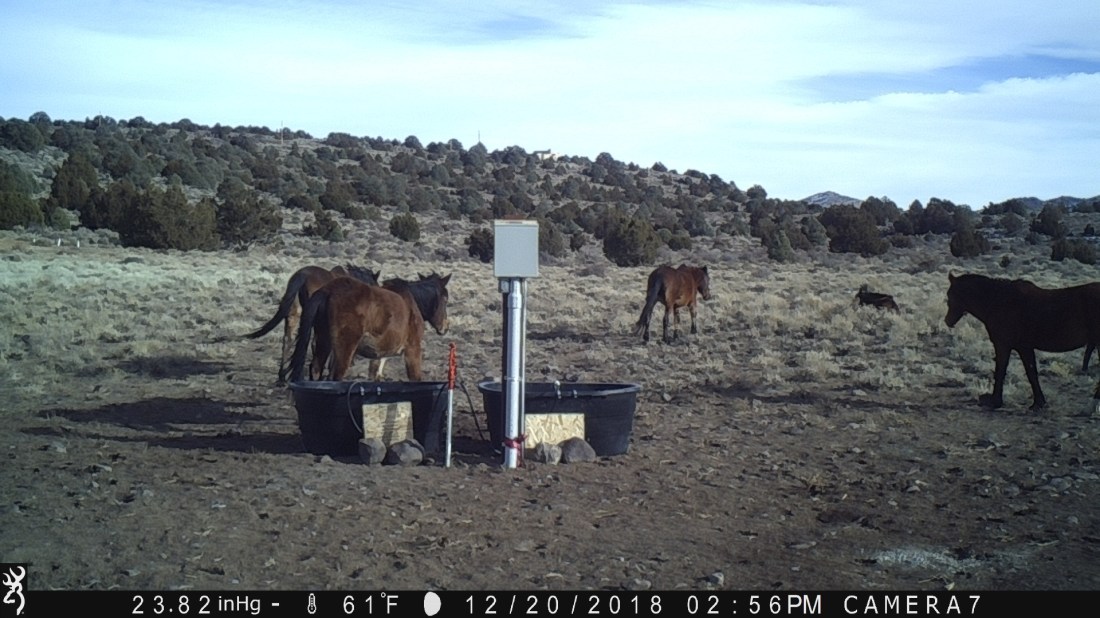
Virginia Range mustangs get a little relief from the cold just before Christmas.

Volunteers Monitor Corolla Wild Horses for ‘Swamp Cancer’
*** LANGUAGE WARNING ***
The disease, which took the lives of several wild horses on Chincoteague Island, has not infected any of the horses that inhabit the Currituck Outer Banks, and volunteers who care for them are trying to prevent an outbreak.
Residents of the island will be asked to clean up debris that could cause cuts and scrapes on the horses, according to a report filed today by The Outer Banks Voice.
A person interviewed for a similar article by Coastal Review Online blamed the spread of the disease on climate change.
Folks, this will be hard to understand, but we’re going to have to throw in with the godless, butt fucking, baby murdering liberals to save our wild horses.
Look at the bright side.
With open borders, we’ll have access to ponies that do the jobs our mustangs typically refuse. Clearly, they are way more virtuous and deserving than American horses.
And by treating the natural-born horses with contraceptives, they can eventually be replaced with these imports.
Charming the Salt River Horses with Slime!
The Most Pressing Medical Issue of Our Time
What goes wrong with a person’s brain to turn him into a liberal?
Group Attempts to Block Sale of Devil’s Garden Horses
The Animal Legal Defense Fund has asked a federal judge in San Francisco to stop the sale without limitation of wild horses gathered from the Devil’s Garden Plateau WHT in October and November, according to a report filed today by Reuters.
The Forest Service announced last month that it would delay the process until February.
RELATED: Forest Service Delays Sale of Devil’s Garden Horses.
Former Wild Horses in Oklahoma
Sherryl Hannah photographed them near the town of Copan, north of Tulsa, on pastures that were probably contracted by the BLM for long-term holding. She said “They aren’t free range, even though they have plenty of land to roam on, those fences keep them safe from the crazy Okie drivers.”
RELATED: Wild Horses in Oklahoma?
Wild Horses Are Safe Tonight
Because of the federal government shutdown.
How the Mustang Ranch Got Its Name
Original location was on Peri Ranch Road, about a mile east of Lockwood, NV, along the Truckee River. The abandoned structure appears at 0:35 and 0:58 in this video by roobyroo2000. Even today, the place is vistited by the Virginia Range mustangs.
Current location of the brothel is a few miles to the east, at the Tahoe Reno Industrial Center, also inhabited by the Virginia Range mustangs.
Interesting bit of history but the activities that occur there are damnable.

