Paiute Lawsuit Fizzles

A story posted today by the Reno Gazette Journal says a privately owned horse caught in the Pyramid Lake tribal roundup last month is still missing and the number of defendants in the case has become smaller.

Claims against the Paiute Tribe were dropped last week, and now the Nevada Department of Agriculture and Cattoor Livestock Roundup, Inc. have been absolved.

Claims against two Department of Agriculture employees are still pending.

RELATED: Paiute Lawsuit Dismissed.

Zinke Orders Reinstatement of Hammond Grazing Permit

It’s tough being a government dependent.

You’re convicted of arson in 2012 (to hide the deer you killed, probably because they were robbing forage from your livestock), and when you tried to renew your grazing permit in 2014, the government said no.

In 2016, you returned to prison (because the original sentence was too light), sparking the Malheur Incident that ended with the death of another public-lands rancher.

In 2018, your hero (and wild horse hater) pulled some strings in the Trump Administration to get your sentence commuted.

Then, in early 2019, your grazing permit is restored, at the direction of outgoing DOI Secretary Ryan Zinke, according to a report that appeared Friday in Tri-State Livestock News.

Your cattle can once again enjoy the hills near South Steens HMA.  The next wild horse roundup can’t come soon enough.

“The people that are losing their permits from the wild horses, I feel terrible about that.  We’ve regained our ground.  I don’t see that they are going to get the horse deal understood before those people are totally out of business.  What in the world is America thinking about?”

There is nothing admirable in the story.  It’s not about rugged individualism and self reliance, it’s about victimhood and dependency.  Long-term access to cheap feed and periodic removal of other animals that get in your way.  Courtesy of the federal government and the American taxpayer.

The occupation of Malheur was in protest to the Obama administration, nothing more.

The ringleaders were public-lands ranchers from Bunkerville, NV.

Meanwhile, a few miles to the north in Elko County, NV, Madeleine Pickens waits patiently for the BLM to fulfill its end of the deal reached ten years ago to graze former wild horses on 600,000 acres of public land, access to which she obtained legally and with their blessing.

Moreover, the individual(s) who shot several wild horses there last August still haven’t been brought to justice.

SAFE Act Reintroduced in House

A story that appeared yesterday in the Bradenton Herald said that U.S. Representatives Vern Buchanan and Jan Schakowsky have submitted a bipartisan bill, known as SAFE Act, that would prohibit the export of American horses for slaughter.

A similar bill will be announced in the U.S. Senate, according to the report.

Figures from the USDA indicate that more than 100,000 horses are shipped to Canadian and Mexican slaughterhouses each year from the U.S.

What does that tell you about the breeders, the barn witches, the horse racing industry and the Indian tribes?

In 2018, a banner year for the wild horse haters, roughly 12,000 animals were removed from western rangelands by the BLM and USFS, and none of these (supposedly) went to slaughter.

How will the SAFE Act stop the roundups and keep wild horses on the range?  It won’t.

It can’t, because it’s focused on the outcomes…too late, too far downstream in the process to be of any help to the horses.

You can sit up and take notice when Congress acknowledges the problem of public-lands ranching and tries to do something about it.

PSA_178-1

That will probably happen right after they stop the slaughter of pre-born kids in the U.S.

Pine Nut Roundup Set for Next Week

BLM announced today that 575 ‘excess’ wild horses would be removed by helicopter from the Pine Nut Mountains HMA beginning on or about February 6.  The gather will be open to public observation and captured animals will be taken to the Palomino Valley Off-Range Corrals north of Sparks, NV, where they will be prepared for adoption.

Gather stats and daily reports will be posted to this page.

The HMA covers 104,316 acres in western Nevada and has an AML of 179, for an aimed-at population density of 1.7 animals per thousand acres.  Forage consumption would amount to 2,200 AUMs annually.

Pine_Nut_Mountains_Map-2

The estimated population in early 2018 was 775 horses.  A 20% growth rate would put the herd at roughly 900 horses today, for a population density of 8.6 animals per thousand acres.

Forage consumption would be 10,800 AUMs per year.  Resource loading attributable to horses would be 0.1 AUM per acre per year.

Wild horses that interfere with ‘other mandated uses’ of the land are said to be ‘excess.’

Would those uses be recreation, mineral extraction and timber harvesting?  No, they don’t require forage.  What could the other uses be?

Livestock grazing.  The Pine Nut HMA is subject to multiple grazing allotments.

Pine_Nut_Grazing_Allotments_Map-1

To decide which species is consuming more than its fair share of the available resources, you’d need to know

  • How many cattle and sheep are allowed on the HMA, or
  • How many AUMs are allocated to livestock, and
  • How many AUMs are set aside for wildlife

These figures never appear in the news releases.

Therefore, it must be the horses.  Livestock are blameless, always.

RELATED: Livestock Grazing in Nevada.

Comments Sought on Proposed Gather of Fifteenmile Horses

BLM announced today a plan to bring the wild horse population of Fifteenmile HMA in line with the capacity of the land to support them and ‘other mandated uses.’  The news release did not indicate what those other uses might be.

The HMA covers 81,000 acres in northern Wyoming and has an AML of 160, for an aimed-at population density of two animals per thousand acres.  The current population, said to be approaching 500 horses, yields a density of six animals per thousand acres and puts the herd at 3X AML.

mccullough_peaks_hma_map-1

The horses would consume about 1,900 AUMs annually at AML and nearly 6,000 AUMs annually at current population levels.

The announcement did not mention that livestock grazing occurs on the HMA.

mccullough_peaks_grazing_map-1

The number of livestock allowed on the HMA was not given in the announcement.

The aimed-at population density for livestock was not given in the announcement.

The forage allocated to livestock in the HMA was not given in the announcement.

Until these values are known there is no way of deciding which species needs to go.

But in a state where the BLM allocates 1.9 million AUMs to livestock every year, compared to 45,000 AUMs for horses, you can rest assured it ain’t the horses.

RELATED: Livestock Grazing in Wyoming.

Shannon County Horses Subject of Photo Exhibit

Photographs of wild horses that live in and around Echo Bluff State Park in southern Missouri will be on display at Social on Patton in Springfield starting February 1, as reported yesterday by the Springfield News-Leader.

Dean Curtis, who visits the area five or six times a year, will be present to answer questions and talk about his experiences photographing the horses.

These animals have roamed freely in Shannon County for more than a century and have organized into four herds: Round Spring, Shawnee Creek, Broadfoot and Rocky Creek.

The Broadfoot and Rocky Creek horses are said to be the most elusive.

RELATED: Wild Horses in Missouri?

Bill Aims to ‘Protect’ Corolla Wild Horses

Draft legislation, introduced in the U.S. Senate, would require the Fish and Wildlife Service, along with other stakeholders, to create a new plan for ‘managing’ the Corolla wild horses, according to a report posted yesterday in Coastal Review Online.

The move was endorsed by the Humane Society and ASPCA, groups that favor the use of contraceptives on wild horses.

You only have to look at western rangelands to see how this will turn out.

There will be claims of overpopulation, lack of predators and destruction of habitat.

Managers will be forced to achieve a ‘thriving ecological balance’ with ‘other mandated uses’ of the land.  This will come through amendments to the original statute, at the behest of one or more special interests.

Finally, actions will be taken to reduce the number horses, or better yet, replace them with other ‘ventures’ that are more ‘productive.’

Keep the feds out of it.

Return to Palomino Valley Wild Horse Corrals

Last day of government shutdown, at least for a while.  Two BLM workers were on site.

Service gate was open but visitor gate was closed.

Some of the corrals that were empty on 12/31/18 had horses, some of the corrals that had horses back then were empty.  Youngsters seen on 12/31 were not there.

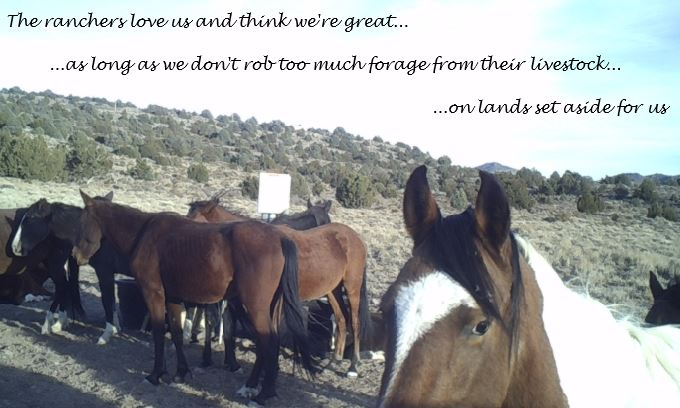
Ranchers like these wild horses best—the ones that are off the range—permanently.

No freedom, no family, no foals, no legacy.

RELATED: Palomino Valley Corrals, Day Ten of Government Shutdown.

Heber Death Toll Now at Seven

That’s since January 12.  Refer to this story by FOX-10 News in Phoenix.  Also killed were several coyotes (not mentioned in the report).

The WHT is like an Israeli settlement on Arab lands.  See the map on page seven of this document.  The Arabs view the occupiers with dripping contempt.

Do they have a motive for killing the settlers?  Absolutely.

Did they do the deed?  We’ll probably never know.  You see, they have friends at the U.N., the occupiers don’t.

RELATED: More Horses Found Dead at Heber WHT.

Alto Colts Subject of Court Battle

Two colts that have been held in a Santa Fe pen since June are wild and not under the jurisdiction of the New Mexico Livestock Board, according to volunteers with the Wild Horse Observers Association.  They should be returned to the range, just like the horses released by the court in September of 2018.

A hearing, originally set for January 21, has been rescheduled for next month.  Refer to this report, posted today by Ruidoso News.

RELATED: Judge Rules in Favor of Alto Wild Horses.