Nominations Sought for WHBAB

BLM requested applications today for three positions on the nine-member Wild Horse and Burro Advisory Board, in the areas of humane advocacy, livestock management and wildlife management.

The Board advises the BLM and USFS on matters pertaining to free-roaming horses and burros on public lands administered by those agencies.

Board members serve three-year terms without pay, meeting twice a year, but travel and per diem expenses related to their service are reimbursed.

Nominations are due 45 days after the notice appears in the Federal Register, which should happen tomorrow.  Refer to this news release for application details.

The last WHBAB meeting occurred in Salt Lake City, UT, October 9 – 11, 2018.

Investigation of Heber Wild Horse Deaths Continues

A news release posted yesterday by the Forest Service said most of the dead animals were found outside the WHT, which is subject to multiple grazing allotments (see map on page seven of this document).

Ten of the horses have evidence of gunshots, which is unchanged from last week.

Anyone with information about the case is asked to contact the Navajo County Sheriff’s Office at 1-800-78CRIME.

RELATED: More Wild Horses Found Dead at Heber WHT.

WHB Adoption This Weekend In Wickenburg, AZ

A BLM news release posted yesterday said wild horses and burros would be offered for adoption and sale February 15 – 17 at the Everett Bowman Rodeo Grounds.

The announcement did not indicate how many animals would be available.

Inmates from the Arizona Department of Corrections will demonstrate the gentling and training process on Friday and Saturday.

If you can’t adopt, tell your U.S. representative that you’d rather see these guys wild and free on western rangelands, not privately owned cattle and sheep.

IMG_5882

Placitas Wild Horse Preserve Needs New Home

An organization known as Placitas Wild has been asked to vacate a preserve on which they’ve kept about 70 wild horses for almost four years, according to a story by KRQE News in Albuquerque, NM.

The report did not indicate why the horses were there or what would be done with the land after they are gone.

One of the volunteers told this writer that the preserve has been “operated by several old ladies working only from donations who have been caring for these horses for 15 years or more.  We cannot find the land, the funds, or the younger volunteers needed to continue to operate a free roaming preserve.”

Grazing Fee for 2019 Pending

The government shutdown filled the public-lands ranchers with anxiety, according to a report by Tri-State Livestock News, causing undue stress about turnout dates and grazing fees.  One thing they won’t have to worry about is the price escalating into a range that brings it in line with the cost of private-sector ranching.

The current fee, which expires at the end of the month, is 4.7¢ per cow/calf pair per day, or $1.41 per AUM.

Try feeding your horse for that.  Or your parakeet.

Wild horse critics like to point at the expense of animals in long-term holding, for which the government spends around $50 million per year.  The cost of feed is about $2 per day, or $60 per AUM.

Given nine million AUMs allocated to livestock annually, with room for three million more, the government receives about $13 million each year from the ranchers.

Add the costs of roundups, adoptions, transport and the like and you have the government spending around $60 million each year so it can collect $13 million from the ranchers.

If you restrict the revenue to lands subject to the roundups, you’d have the government spending at least ten times as much as it hopes to collect in grazing fees.

Those nine million AUMs would support 750,000 wild horses and burros, enough to empty all the off-range corrals and long-term pastures fifteen times over.

Their position is untenable and they know it.  That’s why they spew all the BS about wild horse overpopulation and damage to western rangelands.

If it was really about the money, the government would leave the horses on the range and tell the ranchers to go pound sand.

RELATED: Dire Condition of Wild Horses and Burros in Western U.S.

IMG_8139

Colville Gather Underway

The helicopter-assisted process started this week, according to an announcement in the Tribal Tribune of Nespelem, WA, long on headcount but short on details.

Tribal leaders changed the rules to allow the use of motorized vehicles in wild horse capture and increased the payoff to tribal members to $383 per horse removed.

Captured animals will likely be shipped to slaughter.

Any time you see actions like these justified by a need for ‘healthy rangelands’ or ‘healthy animals,’ you’re probably being lied to.

Perhaps tribal leaders were propositioned by ranchers to allow cattle on the affected lands, or livestock were already there but were losing too much forage to the horses.

Regardless, it’s a fine example of cultural annihilation on BIA lands.

RELATED: Colville Roundup Moving Ahead.

Dire Condition of Wild Horses and Burros in Western U.S.

True or false?

___ a. Wild horses and burros are starving to death.

___ b. The land can no longer sustain the basic needs of these animals.

___ c. They are displacing cattle, sheep, elk, mule deer and sage grouse.

___ d. They graze vegetation close to the surface, stunting regrowth.

___ e. If livestock were removed, they would still die.

All are true, according to this opinion piece posted today in HJ News of Logan, UT.

No evidence, no citations, no supporting documentation.  Never let the facts get in the way of a good story.

Given that roughly nine million AUMs are allocated to livestock each year on public lands in the western U.S., 750,000 wild horses and burros could be returned to the range if the cattle and sheep were removed.

That’s fifteen times the number of animals currently in long-term holding!

RELATED: Infamous Fence Experiment, Vegetation Control on the Virginia Range, Wild Horses on the Edge (of the Road), Population Densities on Western Rangelands.

Colville Roundup Moving Ahead

A report posted today by The Star of Grand Coulee, WA says the Colville Business Council has awarded a $500,000 contract to Sun J Livestock of Vernal, UT to remove 1,250 horses from tribal lands in northeastern Washington.

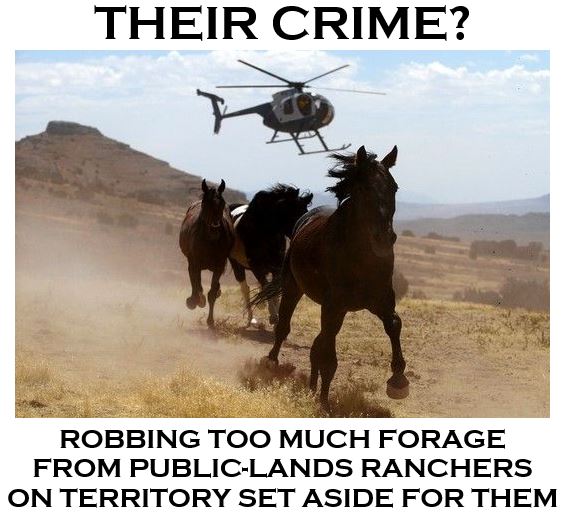
Charges against the horses sound like they were drafted by public-lands ranchers.

Captured animals will likely be shipped to slaughter in Canada, a practice that’s opposed by some members of the tribe.

RELATED: DVM Pushes Back Against Colville Gather.

Devil’s Garden Adoption Starts Next Week

The Forest Service will be holding an online adoption for wild horses removed from the Devil’s Garden Plateau WHT in October and November of 2018, starting 02/11/19, according to a report posted today by the Herald and News of Klamath Falls, OR.

Animals aged ten years and over will be available for sale with limitations.

RELATED: Additional Remarks About the Devil’s Garden Wild Horse Sale.

Salt River Rescue Attacked Again

Shots were fired Sunday into a rescue operated by the Salt River Wild Horse Management Group, according to a report posted yesterday by FOX-10 in Phoenix.

Personnel with the Maricopa County Sheriff’s Office are investigating the incident.

The facility, and the Salt River horses, are west of the Heber WHT, where ten wild horses have been shot in the past three weeks.  No arrests have been made in the case.

My friends, you’re not in California.  Set the dart guns aside and get reacquainted with gas operated, magazine fed, semiautomatic rifles, such as this one.  Note the images at 0:22 and 2:42.  In the forest.  Hint, hint.

RELATED: Shots Fired at Salt River Wild Horse Rescue Facility.

UPDATE: Added video by ABC-15 in Phoenix.

BLM Cash-and-Carry Event Set for Uvalde, TX

Fifty wild horses and burros will be available for direct sale February 22 – 23 at the Uvalde County Fairplex.  These animals once roamed freely on western rangelands but interfered with ‘other mandated uses’ of those lands, necessitating their removal.

The ‘other rangeland resources’ protected thereby now graze peacefully on land that belongs to the horses, while their owners sip whiskey and dance the night away.

Refer to this shameless news release for details.