Same band as in this post, different camera.

Western Horse Watchers Association
Exposing the Hypocrisy, Lies and Incompetence of the Wild Horse Advocates
Same band as in this post, different camera.

A fine example of what not to do. What are his prospects for adoption? How many times will he be handed off from owner to owner? How long before he’s put down or taken to auction because he’s ‘dangerous?’
Refer to this opinion piece in The Hill by a representative of the ASPCA, one of the signatories to the ill-conceived management plan for wild horses.
Forcing wild horses off their home range will ensure they’re not killed and sold for their meat—allowing ranchers to replace them with other animals that will be killed and sold for their meat. Brilliant.
RELATED: The ‘Path Forward’ is Wrong.
BLM announced today that a Decision Record and Finding of No Significant Impact have been issued for the Twin Peaks HMA on the CA/NV border near Susanville.
The move clears the way for a wild horse roundup, but a date for that has not been set, according to the news release.
As of today, the gather does not appear on the preliminary schedule for FY 2020.
A report by Northern Wyoming News says the mares returned to the Fifteenmile HMA after the roundup were not treated with contraceptives. The sex ratio of the herd was altered, however, by selective return of captured horses.
How many cow/calf pairs are needed to graze off 3,226 AUMs in 4.5 months? Easy, just divide the available forage (AUMs) by the grazing season (months):
Cow/calf pairs = AUMs ÷ Grazing season
If you don’t know the grazing season, assume it’s six months.
To compute the annual forage requirement for a given number of cow/calf pairs, just reverse the math:
AUMs = Cow/calf pairs × Grazing season
Although wild horses and cow/calf pairs are said to be equivalent in terms of their forage consumption, their AUM budgets differ because of their grazing seasons.
Listen to this 44 second radio segment by KOH News of Reno. The woman interviewed for the story is with Pine Nut Wild Horse Advocates.
Section 4.2.2 in the environmental assessment for the roundup states that 15,794 AUMs per year have been allocated to thirteen livestock operators on seven allotments within the HMA. The EA also states in section 1.1 that the AML is 185 – 253 wild horses.
The roundup, which starts next week, will bring the HMA to the low end of the AML, meaning that:
There’s not enough forage to sustain the pre-gather population of 429 wild horses (5,148 AUMs per year), but there’s three times that amount for domestic livestock.
RELATED: Challis Herd to Be Thinned Next Month.
The operation no longer appears on the list of ongoing gathers. The daily reports stopped on 10-25-19, with 607 horses gathered from the HMA. Eleven deaths occurred and 95 animals were returned to their home range.
All but twelve horses were gathered, according to a footnote, suggesting that returned mares were to be treated with contraceptives, but that was not indicated in the reports.
RELATED: Fifteenmile Roundup Begins Mid Month.
Much of the conversation recently about wild horses revolves around the ‘Path Forward’ and the $35 million down payment on the plan approved by the Senate Appropriations Committee in September.
But a report posted yesterday by Horse Network offers a new approach (new if you haven’t been reading these pages): Get some of the livestock off the range.
Yep, somebody tried to distinguish between cause and effect. Somebody asked why the problem occurs.
There are real reasons and stated reasons. You have cut through the obfuscation and propaganda.
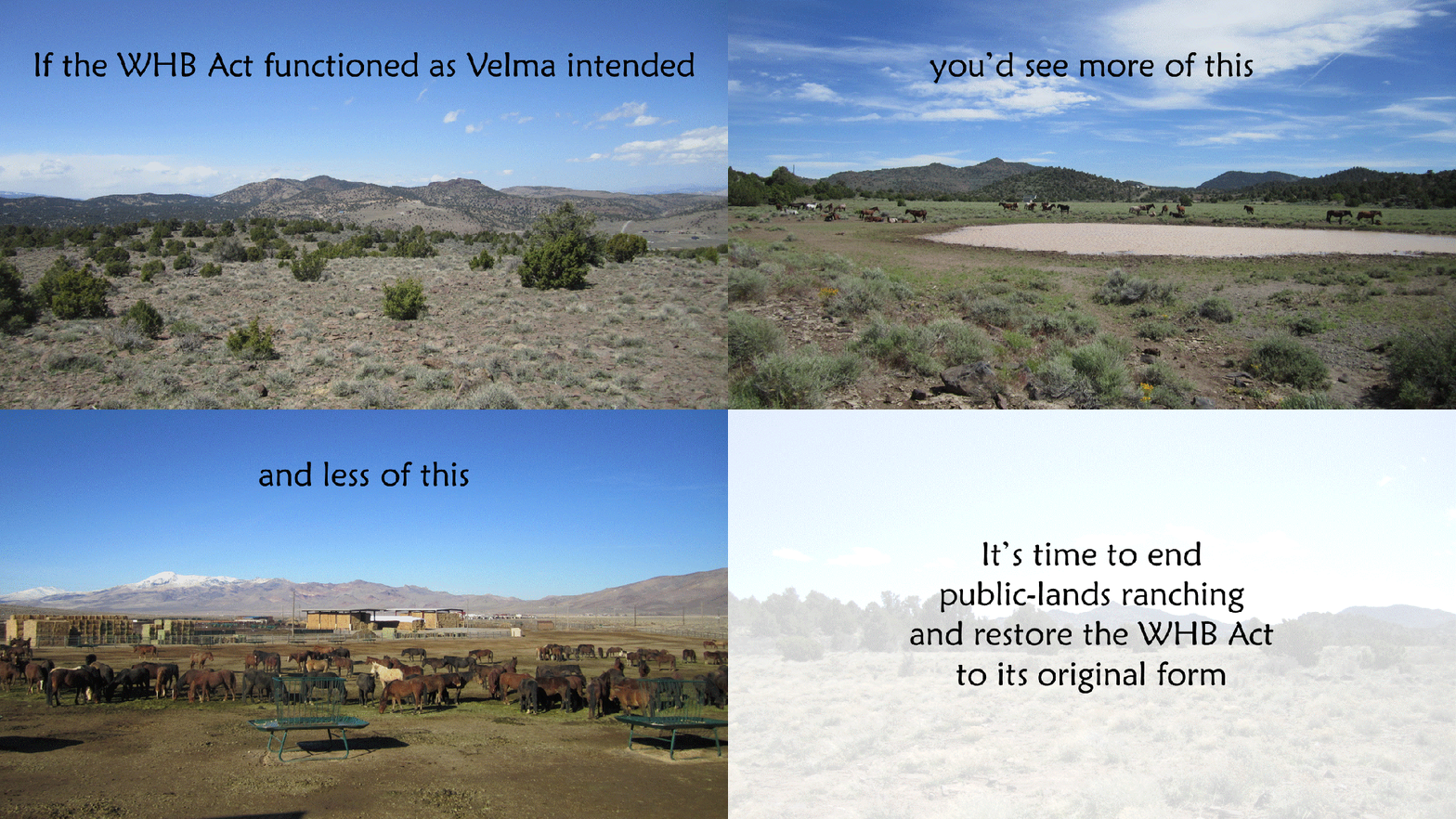
Public-lands ranching drives the roundups and warehousing of wild horses.
You can’t have two competing interests trying to occupy the same territory, especially when the other side wants you wiped off the map.
What do you want to see on western rangelands? Privately owned cattle and sheep or free-roaming horses and burros?
RELATED: The ‘Path Forward’ is Wrong.

Animal Wellness Action, a lobbying group based in Washington, D.C., said today in a news release that nearly three in four Americans reject the removal of wild horses and burros from western rangelands as proposed in the ‘Path Forward.’
According to the announcement, 686 registered voters were polled October 25 – 27, but the inference was drawn to Americans.
Might as well look at some apples and draw conclusions about oranges.
The margin of error was not reported and techniques for avoiding bias were not given, so the results are probably not valid.
RELATED: Invalid Conclusion from Recent Sterilization Survey?
Trailcam photos from the Virginia Range on 10-05-19. Water system will be shut off for the winter around 12-01-19. Elevation 6,200 feet.

The first day of the meeting usually involves a field trip to a nearby HMA to see how the horses are destroying their habitat and the livelihoods of the poor ranchers.
But that’s not going to happen in Washington, D.C.
Refer to the meeting agenda for a list of today’s events. You can watch Days 2 and 3 of the meeting here.
RELATED: WHBAB Meeting Next Month.
You have horses on your property in a rural area.
Do you have a second source of power? Another supply of water?
Some day, one of them will fail. Not for a few hours, for a few days.
How many will be left? One or none?
RELATED: Rural Water Systems – Power, Rural Water Systems – Tanks.
The man-made power outages in California over the last few days have set a new low water mark for people living there.
Publicly, the governor opposes them. Privately, he and his Marxist travelers are fully on board with them.
If there are any regrets in his mind about the situation, it’s that the kill switch is still in PG&E’s hands, not his.
A letter signed by dozens of veterinarians, opposing BLM’s sterilization research on wild horses, was delivered to Secretary of the Interior David Bernhardt today, according to a news release by the Animal Welfare Institute.
The letter arrived a day before the start of the Wild Horse and Burro Advisory Board meeting in Washington, DC, where the topic may be considered.
The research is directed at a herd in Oregon that receives just 11% of the available forage on its HMA, with the balance going to privately owned livestock.
RELATED: WHBAB Meeting Next Month.
Refer to this story by This is Reno, posted yesterday. Organizers of the event refused to show a video by AWHC unless it was edited to suit their agenda!
RELATED: Protests at ‘Horse Rich’ Forum.
On Sand Wash Basin HMA with Mike Mack.