Photo showing the ‘as left’ condition of the corral, after cleaning. Note the underside of the oak tree on the left, pruned straight across. Wonder who did that?

Western Horse Watchers Association
Exposing the Hypocrisy, Lies and Incompetence of the Wild Horse Advocates
Photo showing the ‘as left’ condition of the corral, after cleaning. Note the underside of the oak tree on the left, pruned straight across. Wonder who did that?

Photo showing the ‘as found’ condition of his corral, with water buckets flipped over and everybody looking the other way.
RELATED: Tiny Footprints.

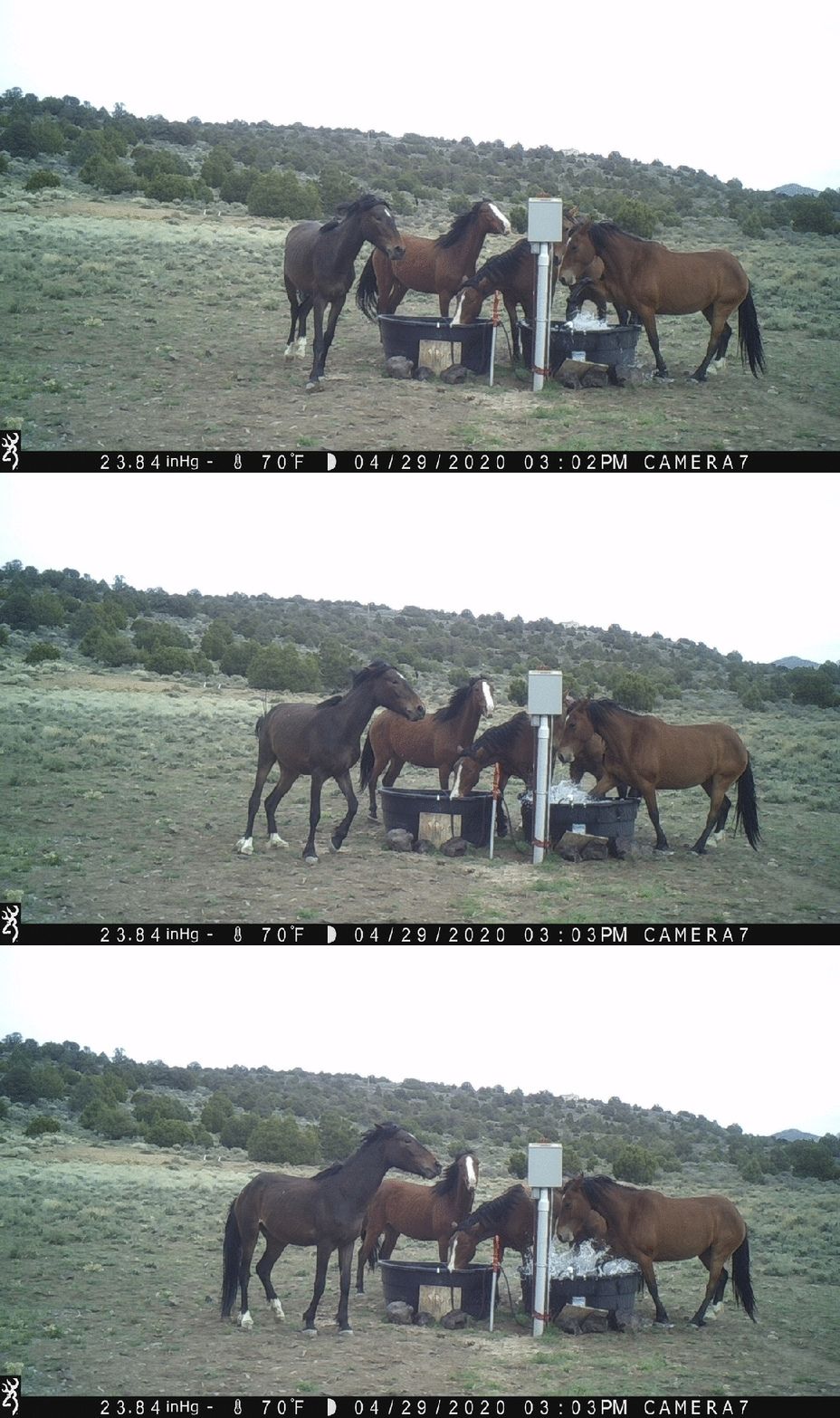
Everybody knows those galvanized tubs are for keeping your feet clean while you eat.

On the Salt River with Deni Seymour.
Two of the five HMAs located within the county are below their AMLs, according to an opinion piece posted yesterday by the Elko Daily Free Press, but three are way above their government-mandated limits.
The overpopulated HMAs belong to the Antelope Complex, reviewed on these pages back in August, where the management plan assigns 89% of the forage to livestock.
That tells you that the available resources are far greater than those required by the AMLs. In other words, AMLs represent the number of wild horses the land can support after most of the resources have been diverted to privately owned cattle and sheep.
That’s what makes the writer grumpy: He can’t stand the thought of horses roaming freely on lands designated for them, enjoying resources that were set aside for them.
Such a waste!
The Spruce-Pequop HMA, one of the offending areas, was the scene of a wild horse shooting at the beginning of a gather in 2018. Multiple rounds to the abdomens.
BLM knows who did it but to my knowledge there have been no arrests in the case.
The HMA intersects the massive Spruce Allotment, to which Madeleine Pickens has grazing preference. Not for cattle but for wild horses. Initially the BLM agreed with the plan but has since blocked every attempt to effect it. Because of the crybaby ranchers.
The AML for Spruce-Pequop yields a stocking rate of 0.3 wild horses per thousand acres, almost nothing, which is what you’d expect for an area where most of the food has been allocated to public-lands ranchers.
Horses on the Goshute HMA, which is 1,184% over AML (not 1,284% as stated in the article) must be skin and bone.
Same for the Antelope Valley horses, which are 272% over the limit (not 372%).
Except they’re not. Resources are more than adequate. They’re just not being distributed in a manner that satisfies the ranchers.
An editorial posted this morning by the Rocket Miner of Rock Springs, WY says “It’s time for a roundup.” Wild horses are robbing the poor ranchers of their birthright.
These animals have been set up to fail, by the government agencies entrusted with their care. Yes, Virginia, it’s sabotage.
The management plan for the affected HMAs allocates 86% of the forage to privately owned livestock—on lands set aside for the horses. This is now—before the plan is amended to satisfy a rancher-friendly court order!
Would that explain the movement of horses off their HMAs? Would it account for complaints about wild horses on private property and safety issues attributed to the animals near roads and highways?
The ranchers, who believe they have a right to place their property on land they don’t own, cluttering it with various ‘improvements’ that allow them to strip away a sizeable portion of the resources, are the problem. Never mind that the fees they pay have been stuck in time capsule since the 1960s.
Nobody’s trying to force them off their own land. But they do need to be confined to it.
Many of the wild horse ‘advocates’ buckle at the idea, because they have ranching backgrounds or ties to the ranching industry. They’d rather give aid and comfort to the government serfs through application of contraceptives.
The 50,000 wild horses in long-term holding can be explained by the misappropriation of forage on just a few dozen HMAs.
Payments by the ranchers ($1.35 per AUM) don’t even come close to the cost of feeding those animals ($60 per AUM). There is no payout and no rate of return for removing wild horses from their home range. Like other government programs, it’s negative cash flow all the way, with the shortfall covered by taxpayers.
Meanwhile, the ranchers and contractors get rich.
The wild horse outplacement program, with its adoption events, financial incentives and training programs is necessary because the WHB Act—altered at the behest of ranching interests—no longer functions as Velma intended.
It’s not time for a roundup. It’s time to end public-lands ranching and restore the Act to its original form.
RELATED: Rock Springs AML Amendments, Defending the Ranchers.

BLM announced today the opening of a comment period for proposed management actions on the Pryor Mountains WHR.
With goals involving horse color, age, bloodlines, size, growth rates, dispersion and sex ratios, the proposed plan is anything but management at the minimum feasible level, per Section 1333(a) of the statute.
The area would be closed from April 15 to June 15, according to the proposal, to protect the horses and their young during foaling season.
Comments can be submitted at this page.
Seven more are on the way, according to a report posted this morning by the Maryland Coast Dispatch.
The fertility control program was suspended in 2016, according to the story, as park managers realized the herd was too small.
The report did not mention the high mortality rate of the stallions, the highly skewed sex ratio of the herd, and the possible lack of genetic diversity—hallmarks of a successful management program, according to the PZP zealots.
Eight foals would put the growth rate at just 11% this year, four years into the ‘adaptive phase,’ making slow recovery another hallmark of the program.
RELATED: Assateague Herd Declines in Latest Census, New Assateague Foal.
So says the writer of an opinion piece appearing today in the Reno Gazette-Journal.
He’s talking about a Virginia Range darting program that started a year ago. To date, his ‘volunteers’ have ‘treated’ over 950 mares with PZP.
At least he didn’t refer to them as ‘advocates,’ because they aren’t, and neither is he.
The Virginia Range, with a stocking rate of approximately ten wild horses per thousand acres, refutes the claim by the BLM that western rangelands can only support one wild horse per thousand acres.
And these idiots are destroying it. Whose side are they on?
The author says “PZP doesn’t hurt horses.” Apparently, he hasn’t looked at the data for the Assateague herd, where it has been applied for many years.
The EPA was recently ordered to review new evidence of the detrimental effects of the pesticide, that may lead to the withdrawal of its registration.
But he describes the affair as a model for humane management of wild horse herds.
The organization backing the venture is the American Wild Horse Campaign.
BLM announced again today the availability of two allotments for cattle grazing near Sturgis, SD. The previous announcement was on February 6.
The minimum bid is $29.50 per AUM, considerably higher than the $1.35 per AUM paid by public-lands ranchers in the western U.S.
Does that mean that forage in South Dakota is overpriced?
Or could it be that the grazing fee is stuck in a time capsule and that the United States is not receiving fair market value for the use of those lands, as required by FLPMA?
The maximum stocking rate on the Fort Meade allotment is 49 head per thousand acres and 76 head per thousand acres on the Bear Butte allotment, a bit higher than the rates seen in and around the Great Basin.
RELATED: Grazing Fee Defies FLPMA.
They’re only about two inches across! Video of new colt on WHW YouTube channel.

County Commissioners will meet tomorrow but the rule change that would bring a high-density horse feeding operation to Burns, WY is not on the agenda. That does not mean the topic won’t be discussed, as was the case on March 3.
On the Onaqui Mountain HMA with Emily Carter Mitchell.
“They have a right to be here,” according to the narrator of a video about Sand Wash Basin HMA, an area set aside for wild horses but shared with privately owned sheep.
Seriously? You have a right to place your property on land you don’t own?
Since when do you need a permit to enjoy your rights?
My truck has been out in the rain for years but it didn’t have to be that way. All I needed to do was to go next door and demand my rights.
Livestock grazing on public lands is a privilege, not a right. What the government gives, the government can take away. Please read The Bill of No Rights.
The remarks run from 09:16 to 12:11 in the video. Would sympathies for the ranchers correlate with participation in fertility control programs?
You bet it would.
RELATED: Ties Between PZP Zealots and Public-Lands Ranchers Revealed.
So says the writer of an opinion piece that appeared last week in the East Oregonian.
The solution “will require the removal of at least 60,000 horses, most of them through killing, and a commitment to remove by one means or another 5,000 per year to maintain an appropriate level.”
That’s about 70% of the horses currently on public lands in the western U.S., in line with the rancher-friendly ‘Path Forward.’
After all, the government just killed hundreds of bison in Yellowstone National Park to protect cattle, so why not horses?
The population limit set by the government, approximately 27,000 wild horses and burros on 27 million acres (which works out to one animal per thousand acres), is not a function of available resources. Rather, it is the number of animals the land can support after diverting most of the food and water to privately owned cattle and sheep—on lands set aside for the horses and burros.
If you don’t think that’s true, just look at this example. If you do believe it, you’re just seeing a “nefarious motive,” according to the author. Leave the poor ranchers alone.
The fences that hold livestock in also keep horses out. That may not be a problem on allotments with grazing seasons of two or three months per year, but what about areas that are in use for eight to twelve months per year, with stocking rates five to ten times higher than the horses?
Would that explain the movement of horses off their HMAs?
Would it account for conditions that don’t meet standards for rangeland health?
Have the most productive areas been given to the public-lands ranchers?
Stop imagining things!!! There is no nefarious motive (even though it looks like sabotage). If anything, it’s just an ‘unintended consequence’ of the grazing program.
On the Little Bookcliffs WHR in western Colorado, one of four areas set aside for wild horses and burros (out of roughly 200) that’s managed principally for wild horses and burros, per the statute.
The denominator doesn’t include areas where WHB were found in 1971 that have been commandeered for other mandated uses of public lands.
What about the other 196 areas set aside for WHB? Most of the resources have been diverted to the other mandated users, a truly sad state of affairs for these animals.
The roundups, adoption incentives, training programs, off-range warehousing, darting programs, sterilization research, sanctuaries and preserves reflect that reality.
RELATED: Suggestion for the Big-Name Advocacy Groups, Hypothesis Revisited.
BLM announced today the completion of an Environmental Assessment (EA) and Finding of No Significant Impact (FONSI) for management actions involving wild horses and burros in the Southern Nevada District.
The decision authorizes the removal of those animals on public and private lands to (1) mitigate safety concerns near roads, (2) reduce landowner complaints, and (3) respond to emergencies.
The scope does not include the removal of horses and burros to achieve AML, but does include the removal of excess horses and burros outside of HMAs and HAs.
Section 1.4 in the final EA says that wild horses and burros will be removed from private property after “reasonable efforts to restrict the animals…have failed,” suggesting that state fence-out rules are a factor in responding to landowner complaints.
RELATED: Comments Invited on Southern Nevada Nuisance Gather Plan.
The Virginian-Pilot reported the arrival of new foal, spotted this morning in a wooded area of the Currituck Outer Banks. Observers were unable to determine the sex of the youngster, according to the story.
Probably less than a half hour old in first photo. Mom is very protective!

A U.S. District Court Judge ruled yesterday in favor of Friends of Animals regarding the detrimental effects of PZP, a pesticide applied to wild horses and burros to reduce herd sizes. Long-term use can result in sterilization.
Many of the so-called advocacy groups accept and promote wild horse fertility control, with some of them actually providing it, to the delight of the public-lands ranchers.
A news release by FOA said that the EPA will now be required to review the “evidence of unintended—and previously undisclosed—side effects on both targeted mares and wild horses in general.”
Stallions on the Maryland side of Assateague Island. where contraceptives have been applied for many years, have a high mortality rate, the sex ratio of the herd is far from normal and genetic diversity may be compromised. But the PZP zealots point to it as a model of wild horse management.
RELATED: Assateague Herd Declines in Latest Census.