House Passes PZP Amendment to FY 2021 Spending Bill

Refer to this news release issued today by Animal Wellness Action.  The full bill will be considered by the House tomorrow.

The amendment requires the BLM to use $11 million from the FY 2021 WHB budget to apply PZP to wild horse herds.  It does nothing to stop the misappropriation of resources that’s forcing them off western rangelands.

The Senate will take up its own spending bill in the coming weeks or months.

RELATED: Swasey Wild Horse Fatality Justifies Contraceptives?

Swasey Progress Report Day 8

The daily reports show 567 wild horses captured through July 22, with none returned to their home range.  One was put down on July 21 but no details were given.  Two deaths have occurred since the operation began.

Body condition scores over the last two days ranged from one to five.

There is an error in the daily reports, probably on July 15.  Sixty stallions were gathered that day along with twenty four mares and no foals, but the total is 150.  The breakdown has 66 missing horses.

If you add all the stallions, mares and foals from the daily reports you get 501 horses captured through July 22.

RELATED: Swasey Progress Report Day 6.

Ranchers Challenged by Water Shortages and Wild Horses

It may cost less to bring the animals to the feed than the feed to the animals, but that’s not always the case for water.  Sometimes public lands have enough forage to support livestock but not enough water, according to a report posted today by AgAlert, a trade publication based in Sacramento, CA.

One of the ranchers interviewed for the story noted that grazing by the AUM makes more sense than grazing by the acre [especially when the fee is five percent, give or take, of the going rate on private lands].  Pay only for what you use.

As for the horses, they’re going after the same water, so in some cases the ranchers have to haul it in for their animals.

RELATED: Montana Grazing Fees.

Triple B Emergency Wild Horse Roundup Begins This Week

BLM announced today that approximately 360 wild horses will be removed from the Triple B and Maverick-Medicine HMAs starting July 24, due to lack of water.

The HMAs belong to the Triple B Complex, which was gathered about a year ago.

The operation will be carried out with bait traps, according to the news release, and will not be open to public observation.

Triple B covers 1,232,494 acres in eastern Nevada.  Maverick-Medicine, to the north, contains 323,562 acres.  The AML at Triple B is 518, for a target stocking rate of 0.4 wild horses per thousand acres.  At Maverick-Medicine, the AML is 276, for a target stocking rate of 0.9 wild horses per thousand acres.

Triple B HMA Map-1

Recall from the discussion in April that fractional stocking rates may indicate large amounts of forage diverted to privately owned livestock.

The estimated population at Triple B is 1,618 wild horses, with an estimated 1,944 wild horses at Maverick-Medicine.

Captured animals will be taken to the off-range corrals at Palomino Valley, about 20 miles north of Reno.

Gather stats and daily reports will appear on this page.

RELATED: Triple B Horses Get Short End of Stick.

Comments on Saylor Creek Wild Horse Roundup

The stocking rate allowed by plan is 0.5 wild horses per thousand acres.  That should raise an eyebrow.  The plan assigns 95% of the authorized forage on the HMA, omitting wildlife, to livestock, with the balance to horses.

It’s one of the best examples of mismanagement in the WHB program.

The pre-gather population of 131 horses is 2.6 times above AML, yet it represents just 13% of the carrying capacity of the land.

Unlike Swasey, which reached its capacity, the HMA is not overpopulated, at least not with horses, so what’s driving the roundup?  What’s the rationale for contraceptives?

Could it be that the herd was approaching the minimum recommended size for genetic viability?  Or might it be the attitudes, loyalties and beliefs of those who wrote and approved the management plan?

RELATED: Saylor Creek Roundup Pending.

Thriving Ecological Balance-3

Saylor Creek Roundup Pending

BLM said today that all wild horses on the Saylor Creek HMA will be gathered, with 50 to be returned, beginning later this month.  Mares selected for return will be treated with contraceptives.

The operation will be carried out with bait traps, according to the news release, and will not be open to public observation.

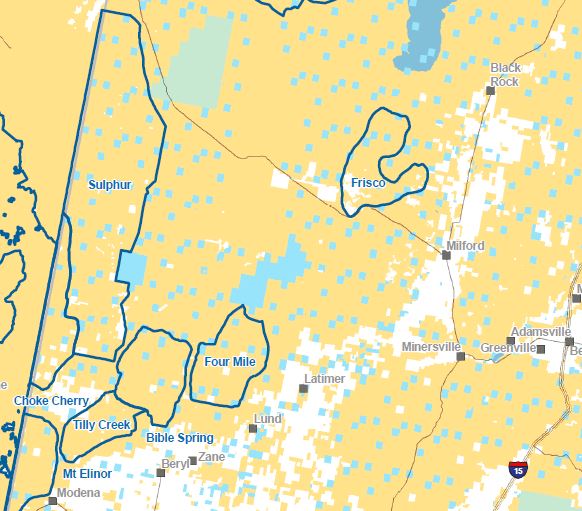
The HMA covers approximately 101,900 acres in southern Idaho.  The AML is 50, for an aimed-at stocking rate of 0.5 wild horses per thousand acres.  The current population is 131, including 81 ‘excess’ animals.

Saylor Creek HMA Map-1

The HMA intersects eight grazing allotments.  There are no naturally occurring water sources in the area and the horses survive on water provided by ranchers.

The management plan for the HMA assigns 18 times more forage to livestock than the horses.  That resource would support an additional 932 wild horses, over ten times the number of animals claimed to be ‘excess.’

Captured animals will be taken to the off-range corrals in Boise.  Gather stats and daily reports will be posted at this page.

RELATED: Saylor Creek Horses Get Short End of Stick.

Swasey Progress Report Day 6

The daily reports show 506 wild horses captured through July 20, with none returned to their home range.  The contractor has been removing an average of 84 horses per day.

Most body condition scores over the last two days ranged from three to five, although a few of the horses were rated two.

Foals accounted for 14% of the animals gathered since July 15.

RELATED: Swasey Progress Report Day 4.

Swasey Wild Horse Fatality Justifies Contraceptives?

A press release issued today by AWA and AWHC, in the wake of a death yesterday during the Swasey wild horse roundup, calls for an $11 million expenditure in 2021 to dart wild horses with PZP.

They need better protection, according to the writers.

Contraceptives mean they won’t even be born—never to be harmed by roundups—a strategy that dovetails perfectly with approved plans to divert most of their food to privately owned livestock.

The announcement suggests that AWHC was the client behind the opinion piece that appeared in several publications on Friday.  Whose side are they on?

RELATED: Swasey Progress Report Day 4.

BLM Opinion Piece Acclaims ‘Path Forward,’ Ignores Livestock

“Now is the time to chart a bold new course for the management and protection of the horses and burros and prevent unnecessary degradation to their habitat,” according to the writer of a guest column appearing this evening in the Las Vegas Review Journal.

The current population of 95,000 wild horses and burros on BLM-managed public lands is more than three and a half times what the land can support [given the amount of resources we’ve diverted to privately owned livestock].

He forgot that part.

AWA Urges Lawmakers to Accept PZP for Wild Horses

Animal Wellness Action, a lobbying group in Washington D.C., said yesterday in an opinion piece published by the Pagosa Daily Post that “lawmakers have the opportunity to land on the right side of history – and the American taxpayer – by requiring BLM to implement PZP contraceptive in 2021.”

Never mind that the EPA was ordered to reconsider the registration of the pesticide earlier this year.

And you should ignore the Assateague census results that show its long-term effects on wild horse herds.

Lobbyists do as their clients require.  In this case, a photo of a wild horse roundup, provided by AWHC, was included.  Might they be the client?

That group has thrown in with the public-lands ranchers.  They’re using your hard earned donations to do the rancher’s dirty work, which is to ensure that seventy, eighty, ninety percent or more of authorized forage on lands set aside for wild horses goes to privately owned livestock.

Don’t pay attention to their words, pay attention to their deeds.

Thriving Ecological Balance-3