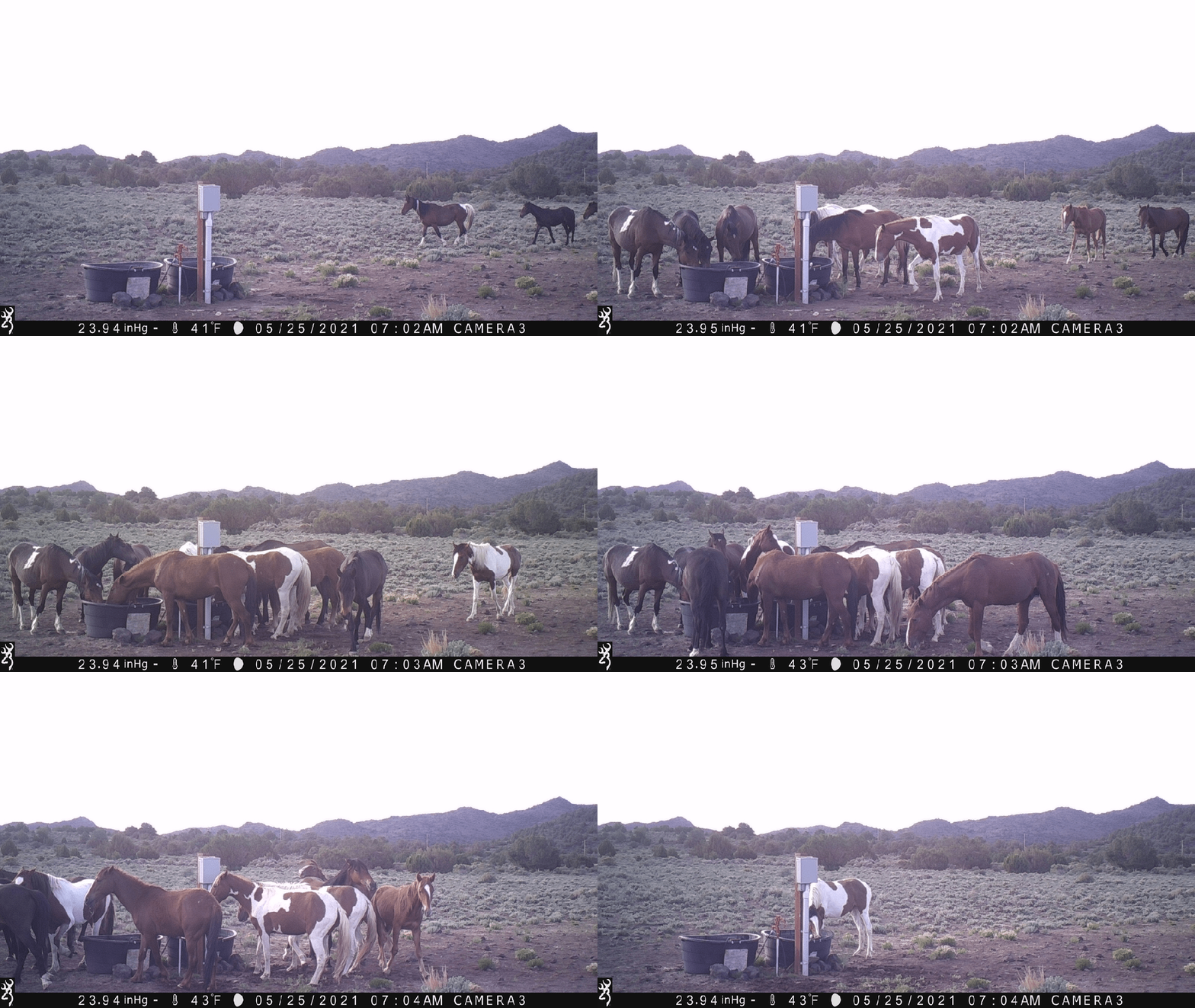
A band of six left the 4WD area north of town to visit the local grocery, only to be escorted back to their habitat, according to a story by OBX Today.
The herd manager for the local advocacy group said you should never chase the horses or try to move them yourself. Let the advocates do that or they may be killed.
Western Horse Watchers estimates that the group got rid of ten to fifteen wild horses this year with their fertility control program.
Who’s the greater threat to these animals? You or the advocates?
An advisory council, consisting of four individuals with expertise in business, law, conservation and Native American traditions, has been established for the project, according to a news release dated May 20.
Additional members will be announced in the next few weeks.
The proposed facility would be located in South Dakota.
The announcement concludes with a note about the organization’s research that led to a model for managing wild horses based on the idea of stable family bands.
Western Horse Watchers agrees with the concept and believes it warrants further study.
However, an email sent to ISPMB on March 6, asking for a link to the reports, which were to be published by the end of 2018 according to the second paragraph in a rebuttal of criticisms regarding conditions at the ranch in 2016, was never answered.
Legislation to stop horse slaughter in the U.S., known as the Save America’s Forgotten Equines (SAFE) Act, was introduced in the House today, according to a news release by Animal Wellness Action.
Previously, the measure was called the Safeguard American Food Exports (SAFE) Act.
The schedule was updated May 7 for the remainder of FY 2021. Most of the activity will occur in Utah, Oregon and Nevada.
Emergency roundups are also possible.
The chart shows 35 wild horses removed from private lands at the Chloride Canyon HMA in April, but Western Horse Watchers was unable to find any announcements at the BLM news site or Utah gather page.
The writer of a guest column appearing today in the Sierra Nevada Ally looks back at some of the issues that never came up in the hearings.
Although not stated explicitly, one of the most remarkable statistics in the debate is the amount of money the government spends on the WHB program and other grazing program ancillaries to prop up just 3.5% of the nation’s cattle output.
A district court’s ruling in favor of the U.S. Fish and Wildlife Service has been reversed by the Ninth Circuit Court of Appeals, according to an opinion filed May 17.
The district court was ordered to enter judgment in favor of Friends of Animals in an action challenging a FWS rule, 50 C.F.R. § 424.14(b), that requires affected states to receive a 30-day notice of intent to file a petition to list an endangered species.
Western Horse Watchers was unable to find an announcement explaining the ruling at the FOA home page.
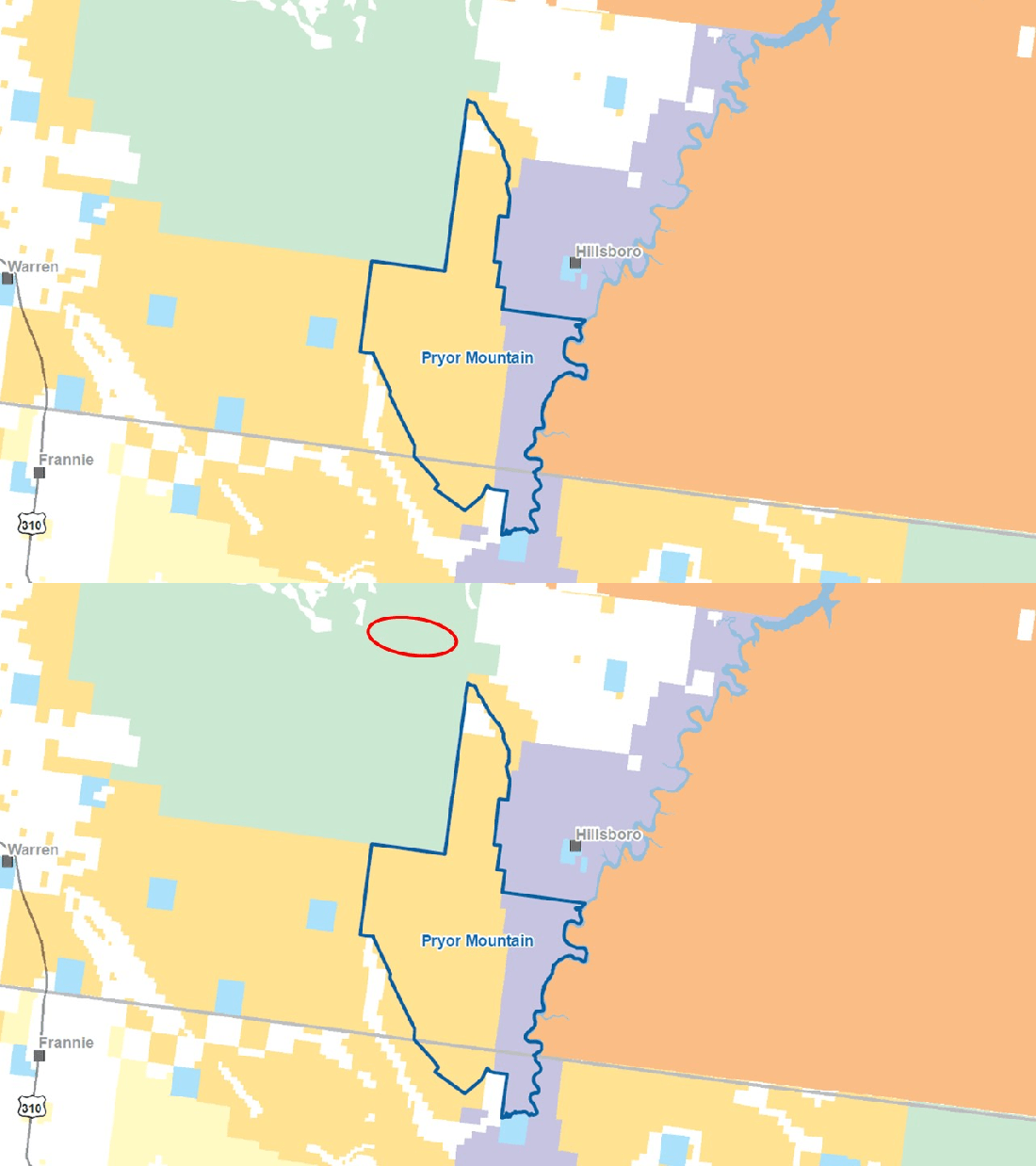
The 38,000 acre Pryor Mountain WHR, an area managed principally for wild horses, is on the Wyoming-Montana border.
Yesterday’s article by The New York Times noted that the BLM spends $60 million per year to keep 51,000 wild horses and burros in off-range holding. The story did not indicate what the agency receives from the ranchers to whom their food is sold.
A report from August 2020 shows that approximately 98% of the animals in off-range holding are horses so let’s assume it’s 100% for simplicity.
The forage sold to the ranchers would be 51,000 × 12 = 612,000 AUMs per year.
Grazing fees would provide 612,000 × $1.35 = $826,200 per year, at current prices.
The government spends $60 million per year on the horses so it can collect less than $1 million per year from the ranchers. Nobody in the private sector would do that.
Wild horses and burros are removed from their home range to make sure the ranchers receive their allocated share of the resources, not because they’re overpopulated.
Opposition to the practice has been minimal, although the method of removal has been the subject of recent debate: The advocates want to get rid of them with contraceptives, while the government and the ranchers prefer helicopters.
The last two animals were put down by their caretakers last month after the state’s warming climate became too much for them, according to a report by KMSP News, the FOX affiliate in Eden Prairie, MN.
About ten years ago, zookeepers noticed that the heat and humidity were affecting the herd, so they decided not to breed them any more and not acquire any new members.
Does the climate change? Yes. Is it caused by man? No. So why did they do it?
One possibility is that the state is not suited for that type of animal and they never should have been moved there in the first place.
Another possibility, given the political leanings of the state, is that the animals were sacrificed to help you believe a lie.
A third possibility is that it was an act of terror, designed to scare you into submitting to their wicked agenda.
Have you been wearing a mask lately? Are you terrified by an overblown virus? Have you taken the death jabs? If one is good, why not go for the triple crown?
Could the same thing be happening on America’s public lands?
Have the roundups, not necessary from a resource viewpoint, convinced you that wild horses are overpopulated? How about the videos of foals being thrown to the ground by wranglers and dragged back to the traps?
What about horses stockpiled in off-range corrals (all of whom could be returned to the range if livestock grazing was discontinued on just a few dozen HMAs)? Are you ready to support fertility control, sex-ratio skewing and sterilization?
And now, with stories emerging about the slaughter of wild horses, are you willing to accept the government’s pro-ranching agenda?
Wild horses adopted with the $1,000 payout are ending up at kill pens, according to a story in today’s online edition of The New York Times.
Statements condemning the practice, by farm bureaus, stock grower’s associations and cattlemen’s groups, were not mentioned in the article.
The advocates point to it as justification for fertility control programs.
Nobody’s thinking in terms of cause and effect. Slaughter, a result of the wild horse management process, cannot fix the problem, it can only prolong it.
You have to look upstream.
Public lands in the western U.S. can support many more horses than the government admits, but those resources have been assigned to privately owned livestock.
The American people may not realize the extent to which their government caters to ranching interests on public lands in the western U.S., as noted in a commentary posted yesterday by The Record-Courier of Gardnerville, NV.
Areas set aside for wild horses and burros have been zeroed out, AMLs have been reduced and habitats have been altered to suit those interests.
As land, food and water shift to privately owned livestock, the number of wild horses and burros in those areas must go down. Resource enforcement plans, which read like pest control programs, maintain the status quo. The Proposed Action for the Calico Complex is just one example.
Would horses and burros be better off if the statute was restored to its original form?
Probably. Are additional protections needed?
Velma knew that they’d need protection from the ranchers but she did not realize—and could not realize—that they’d also need protection from the advocates.
Areas where wildness is at greatest risk are those where the advocates are most actively involved.
The list is too long to enumerate and one organization in particular seems to be a common cause among them, evident in yesterday’s story about the Onaqui herd.
That’s the theme of an article about wild horses in Oregon by Eugene Weekly.
Imagine a Venn Diagram for two mutually exclusive events A and B, where A is public-lands ranching and B is wild horse preservation. Where’s the common ground?
There isn’t any. Expressed mathematically, A ∩ B = ∅.
Where’s the common ground in the Arab-Israeli conflict, given that one side wants the other side wiped off the map? Same for the communists and the capitalists.
And so it is in the wild horse world.
As for the truth, it’s in the data, despised by the advocates but served up regularly on Western Horse Watchers.
The area was set aside for wild horses. Yet, every Wednesday, according to a story by KSL-TV of Salt Lake City, the advocates show up with their darting rifles to make sure most of the resources go to privately owned livestock.
If the ranchers understood this, they’d shut up, be patient, and let these idiots have their way.