Beatys Butte Roundup Ends

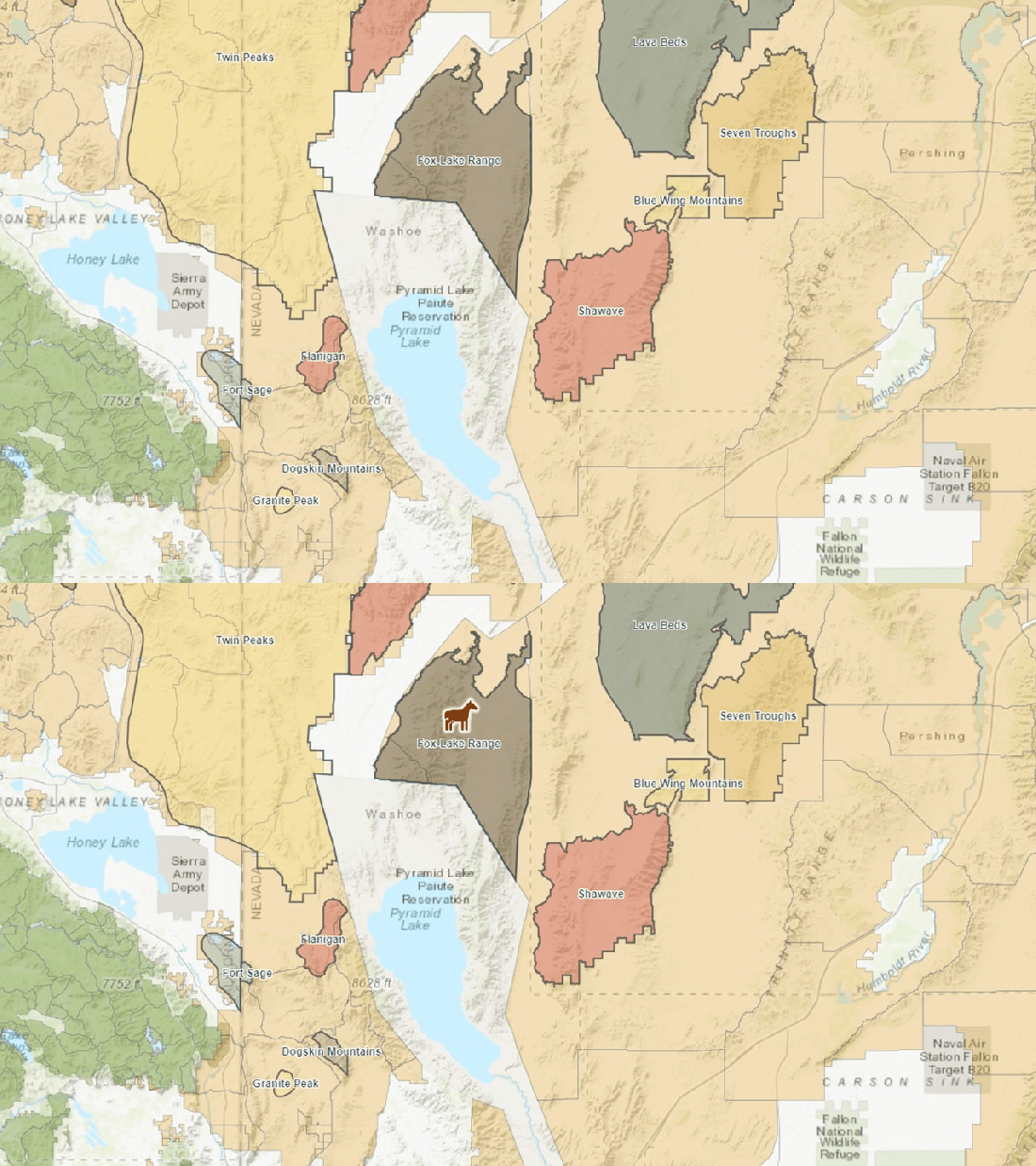
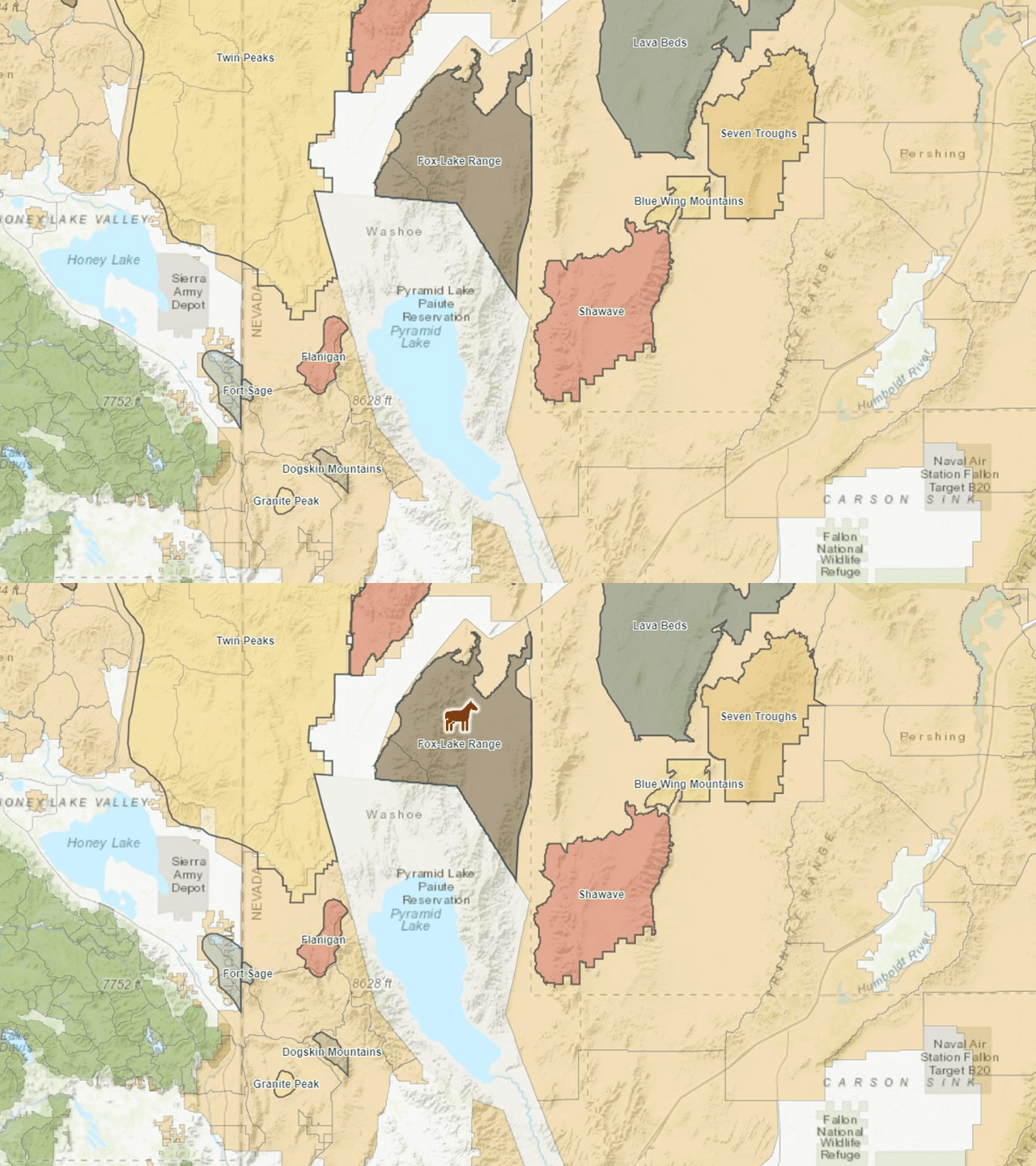
The operation has concluded, according to a statement at the gather page, with 46 horses captured, 45 shipped and one dead.  No horses were returned.  The totals at the gather page are 37, 36 and 1.

The capture goal was 100 and the removal goal was 50.

There were no unaccounted-for animals.

The death rate was 2.2%.

The percentages of stallions, mares and foals is unknown.

The HMA lies within the Beaty Butte Allotment.

RELATED: Beatys Butte Roundup Starts This Week?

Barren Valley Roundup Day 54

The incident began on September 8.  Gather stats through October 31:

  • Type: Emergency
  • Method: Helicopter
  • Horses captured: 1,593, up from 1,538 on Day 50
  • Average daily take: 29.5
  • Capture goal: 1,900
  • Removal goal: 1,900
  • Returned: 0
  • Deaths: 23, up from 22 on Day 50
  • Shipped: 1,498, up from 1,461 on Day 50

The cumulative totals at the gather page are 1,604 horses captured, 1,530 shipped and 22 dead.  The figures above are based on the daily reports.

A mare ran into a panel and broke her neck on Day 52.  The death rate is 1.4%.

Foals represented 20.7% of the horses gathered.  Of the adults, 45.8% were male and 54.2% were female.

The percentage of foals is consistent with a herd growth rate of 20% per year.

Body condition scores on Days 51 to 54 ranged from 2.5 to 4.

Gather ops may be occurring at Coyote Lake.  Three HMAs are involved in the roundup.

Barren Valley Map 10-28-21

Day 54 ended with 72 unaccounted-for animals.

Other statistics:

  • AML: 892 (total for three HMAs)
  • Forage assigned to horses: 10,704 AUMs per year
  • Pre-gather population: 2,500
  • Forage liberated to date: 19,116 AUMs per year
  • Water liberated to date: 15,930 gallons per day
  • Forage assigned to livestock: 27,011 AUMs per year (estimated)
  • Horses displaced from Complex by livestock: 2,258 (4.5% of off-range holding)
  • True AML: 3,150

RELATED: Barren Valley Roundup Day 50.

Owyhee Roundup Day 21

The incident began on October 11.  Gather stats through October 31:

  • Type: Planned
  • Method: Helicopter
  • Horses captured: 682, up from 552 on Day 19
  • Average daily take: 32.5
  • Capture goal: 947
  • Removal goal: 615
  • Returned: 260, up from 166 on Day 19
  • Deaths: 19, up from 12 on Day 19
  • Shipped: 371, no change from Day 19

One horse was put down on Day 20, followed by four more on Day 21, all due to pre-existing conditions.  The Day 18 report now shows two deaths, not included in the last update.  The death rate is 2.8%.

Foals represented 17.6% of the horses captured.  Of the adults, 53.2% were male and 46.8% were female.

Body condition scores were not reported.

Of the horses returned on Day 19, approximately 55% were stallions and all of the mares were treated with PZP.  These pest control actions reduce growth rates and keep the resource scales tipped in favor of the public-lands ranchers for longer periods of time, which is what the advocates are trying to accomplish.

The location of gather activity was not given.  Five HMAs are involved in the roundup.

Owyhee Complex Map 10-04-21

Day 21 ended with 32 unaccounted-for animals.

Other statistics:

  • AML: 999 (across five HMAs)
  • Forage assigned to horses: 11,988 AUMs per year
  • Pre-gather population: 1,188
  • Forage liberated to date: 5,064 AUMs per year
  • Water liberated to date: 4,220 gallons per day
  • Forage assigned to livestock: Unknown
  • Horses displaced from Complex by livestock: Unknown
  • True AML: Unknown

RELATED: Owyhee Roundup Day 19, Status of Owyhee Allotments.

Rock Springs Roundup Day 25

The incident began on October 7.  Gather stats through October 31:

  • Type: Planned
  • Method: Helicopter
  • Horses captured: 880, up from 743 on Day 19
  • Average daily take: 35.2
  • Capture goal: 4,400
  • Removal goal: 3,500
  • Returned: 1, no change from Day 19
  • Deaths: 6, no change from Day 19
  • Shipped: 810, up from 690 on Day 19

The cumulative total at the gather page is 882.  The figures above are based on the daily reports.

The breakdowns for Days 1 to 16 were reported as mares/stallions/foals instead of the usual stallions/mares/foals and this was not picked up by Western Horse Watchers until today.  The percentages of males and females in previous reports are backwards.

Helicopters did not fly on Days 20, 21 and 22 due to poor weather.

The death rate declined to 0.7%.

Foals represented 20.7% of the horses captured.  Of the adults, 45.3% were male and 54.7% were female.

Body condition scores were not reported.

Gather activity may still be occurring at Divide Basin.  Five HMAs are involved in the roundup.

Rock Springs HMAs 10-13-21

Day 25 ended with 63 unaccounted-for animals.

Other statistics:

  • AML: 2,165 (across five HMAs)
  • Forage assigned to horses: 25,980 AUMs per year
  • Pre-gather population: 5,105
  • Forage liberated to date: 10,548 AUMs per year
  • Water liberated to date: 8,790 gallons per day
  • Forage assigned to livestock: 191,791 AUMs per year (estimated)
  • Horses displaced from HMAs by livestock: 15,982 (32% of off-range holding)
  • True AML: 18,147

RELATED: Rock Springs Roundup Day 19.

The Myth of Multiple Use

The original WHB Act refers to the term in the definitions:

(c) “range” means the amount of land necessary to sustain an existing herd or herds of wild free-roaming horses and burros, which does not exceed their known territorial limits, and which is devoted principally but not necessarily exclusively to their welfare in keeping with the multiple-use management concept for the public lands;

It’s not the multiple use you know today.  The term was defined in the Multiple-Use Sustained-Yield Act of 1960.

(a) “Multiple use” means: The management of all the various renewable surface resources of the national forests so that they are utilized in the combination that will best meet the needs of the American people; making the most judicious use of the land for some or all of these resources or related services over areas large enough to provide sufficient latitude for periodic adjustments in use to conform to changing needs and conditions; that some land will be used for less than all of the resources; and harmonious and coordinated management of the various resources, each with the other, without impairment of the productivity of the land, with consideration being given to the relative values of the various resources, and not necessarily the combination of uses that will give the greatest dollar return or the greatest unit output.

The MUSY Act is now 16 USC 528-531.  The definitions are in 16 USC 531.  The terms ‘livestock’ and ‘grazing’ do not appear in any of the sections.

The multiple use you know today was defined in the Federal Land Policy and Management Act, 43 USC 35, five years after the WHB Act was signed into law.

The definition, which may have been lifted from MUSY, is in §1702 of Subchapter 1.

(c) The term “multiple use” means the management of the public lands and their various resource values so that they are utilized in the combination that will best meet the present and future needs of the American people; making the most judicious use of the land for some or all of these resources or related services over areas large enough to provide sufficient latitude for periodic adjustments in use to conform to changing needs and conditions; the use of some land for less than all of the resources; a combination of balanced and diverse resource uses that takes into account the long-term needs of future generations for renewable and nonrenewable resources, including, but not limited to, recreation, range, timber, minerals, watershed, wildlife and fish, and natural scenic, scientific and historical values; and harmonious and coordinated management of the various resources without permanent impairment of the productivity of the land and the quality of the environment with consideration being given to the relative values of the resources and not necessarily to the combination of uses that will give the greatest economic return or the greatest unit output.

Wild horses and burros fall into the ‘historical values’ category.  They are not wildlife.

Unlike MUSY, FLPMA went on to define the principal uses of public lands managed by the BLM, putting livestock grazing at the top of the list.

(l) The term “principal or major uses” includes, and is limited to, domestic livestock grazing, fish and wildlife development and utilization, mineral exploration and production, rights-of-way, outdoor recreation, and timber production

Further, public involvement was associated with affected citizens.

(d) The term “public involvement” means the opportunity for participation by affected citizens in rulemaking, decisionmaking, and planning with respect to the public lands, including public meetings or hearings held at locations near the affected lands, or advisory mechanisms, or such other procedures as may be necessary to provide public comment in a particular instance.

That term wasn’t defined.

RELATED: Origin of AMLs?

Tale of Two Interests-1

Owyhee Roundup Day 19

The incident began on October 11.  Gather stats through October 29:

  • Type: Planned
  • Method: Helicopter
  • Horses captured: 552, up from 531 on Day 16
  • Average daily take: 29.1
  • Capture goal: 947
  • Removal goal: 615
  • Returned: 166, up from 55 on Day 16
  • Deaths: 12, up from 8 on Day 16
  • Shipped: 371, up from 331 on Day 16

Helicopters did not fly on Days 18 and 19.

Four animals were put down on Day 17 due to pre-existing conditions, including a 3MO foal, lifting the death rate to 2.2%.

Foals represented 17.8% of the horses captured.  Of the adults, 51.8% were male and 48.2% were female.

Body condition scores were not reported.

The number of horses removed to date is 383.

Of the horses returned on Days 17 and 18, approximately 56% were stallions and all of the mares were treated with PZP.  These pest control actions reduce growth rates and keep the resource scales tipped in favor of the public-lands ranchers for longer periods of time, which is what the advocates are trying to accomplish.

The location of gather activity was not given.  Five HMAs are involved in the roundup.

Owyhee Complex Map 10-04-21

Day 19 ended with three unaccounted-for animals.

Other statistics:

  • AML: 999 (across five HMAs)
  • Forage assigned to horses: 11,988 AUMs per year
  • Pre-gather population: 1,188
  • Forage liberated to date: 4,632 AUMs per year
  • Water liberated to date: 3,860 gallons per day
  • Forage assigned to livestock: Unknown
  • Horses displaced from Complex by livestock: Unknown
  • True AML: Unknown

RELATED: Owyhee Roundup Day 16, Status of Owyhee Allotments.

Origin of AMLs?

The term does not appear in the original statute.

It can be found in the current statute, 16 USC 30, not in the definitions, but beginning in §1333(b)(1).

Footnotes to that section refer to amendments by Public Law 95–514, the Public Rangelands Improvement Act of 1978, a product of the 95th Congress.

The alteration, found in Section 14 of the original Act, authorized the government to get rid of excess animals on an arbitrary and capricious basis.

Appropriate Management Levels, the number of horses or burros allowed by plan, would be achieved by removing or destroying excess animals (bottom of page 6 in the pdf), not by allowing them to fill their niche.  They were to be small, relative to the available resources.

Who benefits from that?

Thriving Ecological Balance-3

Barren Valley Roundup Day 50

The incident began on September 8.  Gather stats through October 27:

  • Type: Emergency
  • Method: Helicopter
  • Horses captured: 1,538, up from 1,496 on Day 47
  • Average daily take: 30.8
  • Capture goal: 1,900
  • Removal goal: 1,900
  • Returned: 0
  • Deaths: 22, no change from Day 47
  • Shipped: 1,461, up from 1,392 on Day 47

The cumulative total at the gather page is 1,525, with 1,493 shipped.  The figures above are based on the daily reports.

The death rate declined slightly to 1.4%.

Foals represented 21.1% of the horses gathered.  Of the adults, 45.3% were male and 54.7% were female.

The observed percentage of foals is consistent with a herd growth rate of 20% per year.

Body condition scores on Days 48 to 50 ranged from 2 to 4.

The location of gather ops is not known.  Three HMAs are involved in the roundup.

Barren Valley Map 10-28-21

Day 50 ended with 55 unaccounted-for animals.

Other statistics:

  • AML: 892 (total for three HMAs)
  • Forage assigned to horses: 10,704 AUMs per year
  • Pre-gather population: 2,500
  • Forage liberated to date: 18,456 AUMs per year
  • Water liberated to date: 15,380 gallons per day
  • Forage assigned to livestock: 27,011 AUMs per year (estimated)
  • Horses displaced from Complex by livestock: 2,258 (4.5% of off-range holding)
  • True AML: 3,150

RELATED: Barren Valley Roundup Day 47.

RMPs Put Ranching Interests Far Above Those of Wild Horses

You can’t criticize public-lands ranchers about livestock grazing while you’re trying to get rid of wild horses with PZP—the latter helps the former—but the writer of a guest column in today’s online edition of the Wyoming Tribune Eagle does exactly that.

Miniscule AMLs, large amounts of forage assigned to livestock and enforcement actions such as helicopter roundups, fertility control, sex ratio skewing and sterilization have a common origin: Resource Management Plans, sometimes referred to as land-use plans.

If you want to help America’s wild horses, put your darting rifles down and change the plans so HMAs are managed principally for wild horses, not privately owned livestock.

RELATED: Rock Springs Roundup Just Getting Started.

Owyhee Roundup Day 16

The incident began on October 11.  Gather stats through October 26:

  • Type: Planned
  • Method: Helicopter
  • Horses captured: 531, up from 488 on Day 13
  • Average daily take: 33.2
  • Capture goal: 947
  • Removal goal: 615
  • Returned: 55, no change from Day 13
  • Deaths: 8, up from 7 on Day 13
  • Shipped: 331, up from 294 on Day 13

Helicopters were grounded on Days 14 and 15 due to rain and low visibility.

A stallion was put down on Day 16 due to pre-existing conditions, bringing the death rate to 1.5%.

Foals represented 17.9% of the horses captured.  Of the adults, 51.1% were male and 48.9% were female.

Body condition scores were not reported.

The location of gather ops was not given.  Five HMAs are involved in the roundup.

Owyhee Complex Map 10-04-21

Day 16 ended with 137 unaccounted-for animals.

Other statistics:

  • AML: 999 (across five HMAs)
  • Forage assigned to horses: 11,988 AUMs per year
  • Pre-gather population: 1,188
  • Forage liberated to date: 5,712 AUMs per year
  • Water liberated to date: 4,760 gallons per day
  • Forage assigned to livestock: Unknown
  • Horses displaced from Complex by livestock: Unknown
  • True AML: Unknown

RELATED: Owyhee Roundup Day 13, Status of Owyhee Allotments.

Stone Cabin Roundup Ends

The incident concluded on October 26, according to a statement at the gather page, with 322 horses captured, 314 shipped and eight dead.

The removal goal was 450.

The daily reports show 296 horses shipped, with 18 unaccounted-for animals.

The death rate was 2.5%.

Foals represented 14.6% of the horses captured.  Of the adults, 47.6% were male and 52.4% were female.

The low percentage of foals suggests the population is not growing at a rate of 20% per year, a benchmark used by land managers to predict herd sizes.

The roundup, which began on September 1, was billed as an emergency.

RELATED: Stone Cabin Emergency Roundup Starts This Week.

UPDATE: BLM news release issued today.

Rock Springs Roundup Just Getting Started

A keyword search of a story posted today by Cowboy State Daily yielded these results:

  • Forage – 0
  • Allocation – 0
  • Livestock – 0
  • AUM – 0
  • Allotment – 0
  • Grazing – 0
  • Permit – 0
  • Consent decree – 0
  • Horses – 23
  • PZP – 7
  • Darting – 2
  • Overpopulation – 2
  • Fertility control – 2

The author didn’t mention the forage assigned to livestock and the number of wild horses displaced thereby.

Are you sure you still want to read it?

RELATED: Rock Springs Roundup Day 19.