A Day on the Range with the Piceance Advocates

An article posted yesterday by The Colorado Sun tells the story of two volunteers with Piceance Mustangs, a group known for its pro-ranching/anti-horse sentiment.

How much of this is covered on their web site?  None.

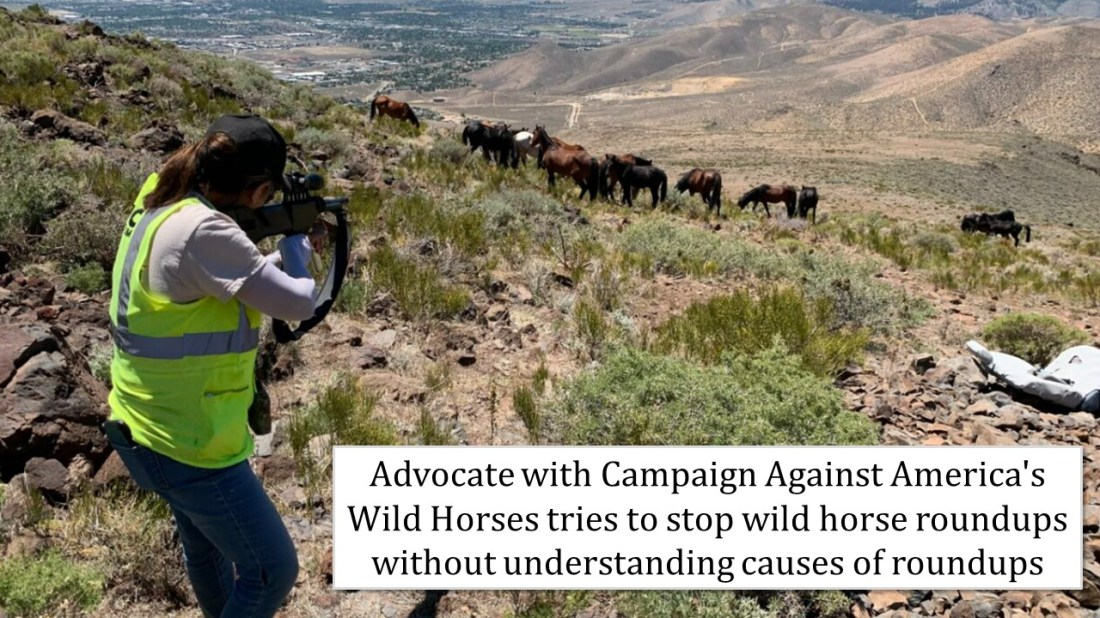
They’ve accidentally darted stallions, who become infertile, lose their mares and end up living alone.

They receive their supplies from the BLM, including the projector, RDDs, rangefinder and pesticide of choice, GonaCon Equine.

The agency will pay them 14 cents per mile if they file travel reports.

The report provides evidence of unlawful use, such as handling the product without the required PPE.

GonaCon PPE Requirements 07-09-23

Advocate Handles Gonacon without Proper PPE 07-09-23

GonaCon Warning Label 07-09-23

On the bright side, it’s no longer classified as a restricted-use pesticide, so it can be used to control pests that interfere with animal agriculture, even in their lawful homes.

Curiously, the women describe themselves as horse lovers, typical of the advocates.

And, like most advocates, their words never match their deeds.

RELATED: How the Advocates Violate Federal Law.

Calling it a Vaccine 05-01-23

Antelope Roundups in Progress

Trapping began yesterday, with two operations running concurrently.

Antelope North

  • Scope – Spruce-Pequop, Goshute, Antelope Valley HMAs
  • Target – Wild horses
  • Purpose – Pest control
  • Type – Cruel and costly
  • Captured – 22
  • Shipped – 0
  • Deaths – 0

The capture and removal goals are identical, 2,000 each.

Antelope South

  • Scope – Antelope, Antelope Valley HMAs
  • Target – Wild horses
  • Purpose – Pest control
  • Type – Cruel and costly
  • Captured – 128
  • Shipped – 0
  • Deaths – 1

The capture and removal goals are identical, 1,107 each.

A mare was lost on Day 1 due to a fractured neck, probably sustained in a collision with a pipe panel.

A better approach, according to the wild horse advocates, is to poison the mares with ovary-killing pesticides.

The Complex is managed primarily for animal agriculture.

RELATED: Antelope Roundups Announced.

Antelope Complex with Allotments 07-06-23

Western Horse Watchers Banned from Socialist Media?

One data point does not establish a trend but it can certainly indicate an unusual event in the process.

Traffic from Facebook and Twitter averaged 13.6% of the total during the 18-month period from Jan-22 through Jun-23, but dropped sharply last month, accounting for just 1.9% of the total.

A basic statistical calculation of the following form put the June data point outside the limits of random variation.

How to Compute p-chart Limits 02-10-22

As of today, traffic in July amounts to 1.4% of the total.

The fact-checkers in socialist media, sometimes referred to as censors, know a lot about climate change, sodomy, abortion, pedophilia and transvestism, but not much about wild horses, so who put them up to it?

Maybe some of the butthurt advocates who don’t like being called pesticide pushers and don’t want you knowing the truth about their ruinous darting programs?

Perhaps their financial support is drying up as it should.

Or maybe the bureaucrats don’t want their followers learning about mismanagement of resources in the lawful homes of wild horses or the unlawful use of pesticides therein.

Time will tell if the pattern continues.  But this is the type of affirmation you want when you’re going up against the old guard, who in the case of wild horses are mostly frauds.

Traffic from Solialist Media 07-09-23

Antelope Pesticide Test Shows How GonaCon Works

According to the 2015 Final EA for the Water Canyon Wild Horse Growth Suppression Pilot Program, mentioned in the July 5 roundup announcement,

When injected, the GonaCon vaccine targets the reproductive hormone gonadotropin releasing hormone (GnRH) secreted by the hypothalamus of the brain.  Antibodies produced in response to the vaccine inactivate endogenous GnRH, which in turn eliminates stimulation of the pituitary gland and gonads in males or females.  The resulting “immunocastration” renders animals unable to produce reproductive steroids or gametes.

The EA was copied to the project folder in ePlanning with other related documents.

The Proposed Action, Alternative A, called for the use of PZP-22, but the Decision Record authorized Alternative B, similar to Alternative A except the mares would be treated with GonaCon-B instead of PZP-22.

A keyword search of the EPA web site yielded no results for GonaCon-B.

The description of Alternative B (bottom of page 34 in the pdf) refers to the registration of GonaCon-Equine, suggesting a rebranding or reformulation of the product.

A 2017 labeling amendment dropped the restricted-use designation and increased the interval between primer and booster from 30 days to 90 days.

RELATED: Antelope Roundups Announced.

Foal-Free Friday, Battle of the Pesticides Edition

Of the two leading fertility control pesticides for wild horses, Zonastat-H and GonaCon Equine, which product

  • Is classified as restricted use?
  • Is commonly referred to as a vaccine?
  • Must be administered by certified applicators?
  • Can be applied to horses that interfere with animal agriculture?
  • Must be fired from Dan-Inject or Pneu-Dart rifles?
  • Must be delivered in neon orange or green darts?
  • May cause sterility with one or two doses?
  • Cannot be mixed or applied without chemical-resistant gloves?
  • Requires a minimum 90-day interval between doses?

Which one, in view of the pros and cons above, will surpass the other in terms of use?

RELATED: Foal-Free Friday, Managing for Genetic Diversity Edition.

Antelope Roundups Announced

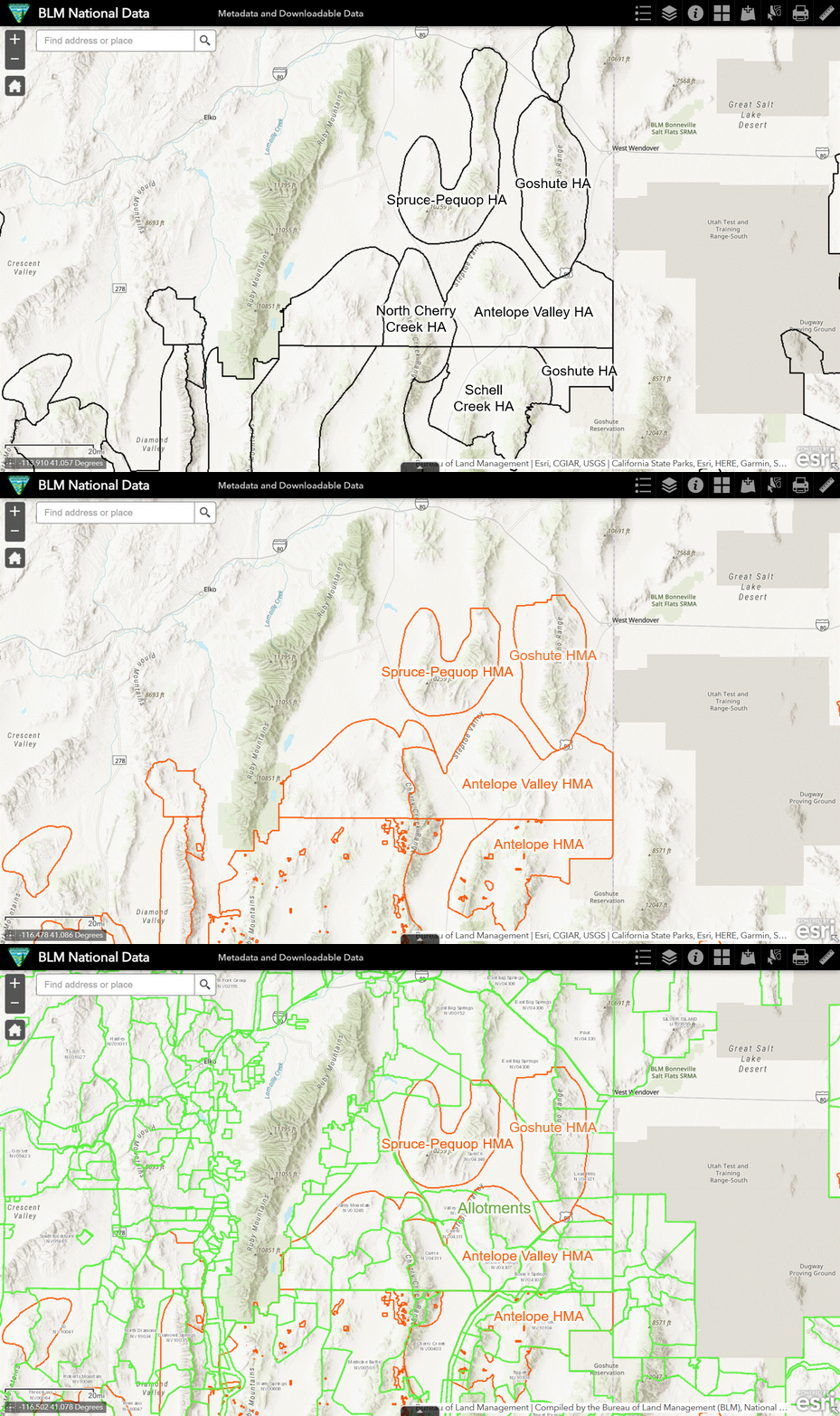
Two news releases appeared yesterday, one covering pest control actions in and around the Spruce-Pequop and Goshute HMAs, as well as a portion of the Antelope Valley HMA, and the other for pest control actions in and around the Antelope HMA and remaining portion of Antelope Valley.

Highway 93 Alt, which runs northeast to West Wendover, serves as the split line for Antelope Valley.

The National Data Viewer shows the arrangement.  Click on image to open in new tab.

Antelope Complex with Allotments 07-06-23

The June 14 roundup schedule suggests they will run concurrently, with start dates of July 9.

Call them resource enforcement actions or rancher protection actions if you’d like.

The HMAs are subject to, and managed primarily for, permitted grazing.

The combined capture and removal goals are 3,107 and 3,107, respectively, with no animals to be returned to their lawful homes.

One of the announcements said 15 mares in the Water Canyon area previously treated with GonaCon Equine will receive another dose of the pesticide before being released back to the range.

Captured animals will be taken to the off-range corrals at Indian Lakes and Palomino Valley.

Gather stats and daily reports for the northern portion will be posted to this page.

Data for the southern portion will be posted here.

The Spruce-Pequop HMA lies mostly within the massive Spruce Allotment, one of the parcels to which Madeleine Pickens obtained grazing preference through the purchase of the associated base property.

The Allotment Master Report indicates most of the active AUMs are held by the Spruce Grazing Association, which Bizapedia ties to a law firm in Elko.  One of the company contacts is Saving America’s Mustangs, a 501(c)(3) nonprofit started by Pickens.

A 2018 roundup in the HMA started with the massacre of eight wild horses.

RELATED: Horses in Antelope Complex Get Short End of Stick.

Another Group Tries to Stop Rock Springs RMP Amendments

Friends of Animals announced on Monday that it has filed suit in U.S. District Court against the BLM for its plan to eliminate wild horses from more than one million acres of public lands in the southwestern Wyoming.

The complaint alleges that nothing in the WHB Act allows the BLM to respond to requests from private landowners to remove wild horses from public lands.

Nevertheless, such requests are common in the scoping and document review phases of wild horse gather projects in ePlanning, with ranchers and ranching advocacy groups among the most vocal.

Section 1334 in the statute authorizes the agency to remove free-roaming horses that stray from public lands onto privately owned land.

RELATED: Another Coalition Tries to Stop Rock Springs RMP Amendments.

EPA Updating Certification Standards for RUP Applicators

According to the FAQs at the standards update page, the EPA classifies the most acutely toxic pesticides or those needing to be applied with special care as RUPs, which means they may be bought and applied only by a certified applicator or someone working under his or her direct supervision.

RUPs are not available for purchase or use by the general public.

Zonastat-H, also known as PZP and the Montana Solution, is a restricted-use pesticide, on the same EPA list as toxic chemicals.

It’s much better than cruel and costly helicopter roundups according to the Campaign Against America’s Wild Horses.

Let Us Fix Your Wild Horse Problem 02-18-23

Although the advocates apply pesticides for the production of agricultural commodities, they’re not working on land they own or rent.  Therefore, they’re considered to be commercial applicators.

RUP Applicator Types 07-04-23

Will a diploma from the Billings School of PZP Darting and Public Deception meet the new standards?

There are ten federal categories of certification.

The advocates probably fall under agricultural pest control with one distinction: Horses are the pests!

Agricultural Certification Category 07-04-23

We’re not talking about the use of fly spray or dewormers to help the horses, we’re talking about reproductive barriers that help the ranchers.

Unfortunately, Zonastat-H was not approved for such purposes, making the glorious darting programs illegal.

RELATED: Multiple Use Applies to Public Lands, Not Registered Pesticides.

Reveille Roundup Over

The Day 3 report indicated 134 horses captured, 76 shipped, 30 released and one dead.

With 27 mares held for treatment with GonaCon Equine, there were no unaccounted-for animals.

Youngsters represented 11.2% of the horses captured.

Of the adults, 52.9% were male and 47.1% were female.

The report said the GonaCon mares will receive a second dose of the pesticide in 30 days, a violation of federal law.

Gonacon 90-Day Requirement 07-01-23

The 2017 labeling amendment that dropped the RUP designation increased the time interval between doses from 30 days to 90 days.

The BLM probably won’t mobilize law enforcement resources against itself.

RELATED: Reveille Gather Ops Conclude.

Fish Springs Advocates Double Down on Pest Control Program

In an attempt to prove they can be as ruthless as the helicopter pilots and wranglers, mares in the Pine Nut HA have been reprimed “to be sure they don’t get in foal,” according to the real estate agent and PZP darter in the Minden/Gardnerville area.

Go to the column titled “Wild Horse Tales” in the June edition of Horse Tales.

Protect Wild Horses from Advocates 08-29-21

Instead of pushing back against ranching overreach and the continual loss of resources, the advocates solve the problem by pounding the mares with ovary-killing pesticides.

As explained last year by Tracy Wilson, defeatist for the Campaign Against America’s Wild Horses, “As you start reducing the amount of available space and forage, then you need to manage the numbers to fit what’s available for the horses.”

RELATED: Protecting Them from Removal by Getting Rid of Them with PZP.

Pine Nut HMA with Allotments 07-03-23

Reveille Gather Ops Conclude

Helicopters were grounded this afternoon, with 133 horses captured, 39 shipped and one dead.

The colt lost yesterday died from a spinal cord injury caused by blunt trauma to the lower neck, according to today’s report.

One more update will be posted tomorrow.

Mares treated with Gonacon Equine could be returned to the HMA this week, but they won’t go home until October if two doses are given.

Gonacon 90-Day Requirement 07-01-23

Stallions identified for return could be released before the contractor demobilizes.

RELATED: Where Are the Reveille Foals?

Chaos at Wheatland Corrals?

Last year the facility was closed due to a strangle outbreak.  Nineteen horses were lost.

In March, on-site adoptions resumed.

In June, in-person adoptions were suspended in favor of the online system.

On Friday, a BLM news release said wild horse and burro adoptions will resume as scheduled throughout the summer.

The Wheatland population consisted of 2,511 wild horses and 23 wild burros, according to the May 21 Facility Report.

PSA 12-12-19

Where Are the Reveille Foals?

Yesterday’s action netted 37 stallions, 40 mares and 6 foals.

Almost certainly the helicopter pilots are targeting family bands, as the advocates do, but why the low percentage of foals?

The sample size was not large but at the rate the incident is going, the chase may end tonight.

A 7.2% birth rate implies a herd growth rate of two percent per year.

Can the results be attributed to population suppression efforts?  Harsh winter?

Mares captured in the 2020 roundup were treated with fertility control of unspecified type according the gather page.

RELATED: Reveille Roundup in Progress

Bold Prediction for Fertility Control Pesticides

Of the two leading products, Zonastat-H and GonaCon Equine, Gonacon will outpace Zonastat in use, for the following reasons:

  • May sterilize treated mares
  • Applicators need not be certified
  • Can be misused with no consequences
  • Few if any limitations on where it can be used

In the first part of the June 14 roundup schedule, for nonmotorized removals, the two products are more-or-less evenly split.

Given that GonaCon Equine can be used to control or eradicate pests (wild horses and burros) that interfere or could interfere with animal agriculture (permitted grazing), which is not true for Zonastat-H, it will become the pesticide of record until something better comes along.

RELATED: An Incomplete History of GonaCon Equine.